- English
- French
- German
- Portuguese
- Spanish
- Russian
- Japanese
- Korean
- Arabic
- Greek
- German
- Turkish
- Italian
- Danish
- Romanian
- Indonesian
- Czech
- Afrikaans
- Swedish
- Polish
- Basque
- Catalan
- Esperanto
- Hindi
- Lao
- Albanian
- Amharic
- Armenian
- Azerbaijani
- Belarusian
- Bengali
- Bosnian
- Bulgarian
- Cebuano
- Chichewa
- Corsican
- Croatian
- Dutch
- Estonian
- Filipino
- Finnish
- Frisian
- Galician
- Georgian
- Gujarati
- Haitian
- Hausa
- Hawaiian
- Hebrew
- Hmong
- Hungarian
- Icelandic
- Igbo
- Javanese
- Kannada
- Kazakh
- Khmer
- Kurdish
- Kyrgyz
- Latin
- Latvian
- Lithuanian
- Luxembou..
- Macedonian
- Malagasy
- Malay
- Malayalam
- Maltese
- Maori
- Marathi
- Mongolian
- Burmese
- Nepali
- Norwegian
- Pashto
- Persian
- Punjabi
- Serbian
- Sesotho
- Sinhala
- Slovak
- Slovenian
- Somali
- Samoan
- Scots Gaelic
- Shona
- Sindhi
- Sundanese
- Swahili
- Tajik
- Tamil
- Telugu
- Thai
- Ukrainian
- Urdu
- Uzbek
- Vietnamese
- Welsh
- Xhosa
- Yiddish
- Yoruba
- Zulu
Do Full Mask Respirator Standards Really Matter?
Of course. Standards for breathing protection tools are not just paperwork; they protect workers from getting hurt on the job and keep them safe. It doesn't matter what the ads say; a Full Mask Respirator that isn't certified by a recognised organization like NIOSH, EN, or AS/NZS doesn't really protect you. These standards describe how well a respirator filters air, how well the seal works, how durable the material is, and how clear the vision is. These are the main factors that show whether or not a respirator will protect workers from chemical vapours, harmful particles, or volatile organic compounds. When purchasing in bulk, procurement teams have a lot of responsibility. Choosing non-compliant equipment puts workers at risk of health problems and companies at risk of legal trouble. On the other hand, certified devices offer measured, repeatable security that has been proven through strict testing methods.
What Are Full Mask Respirator Standards and Why Do They Matter?
The Foundation of Respiratory Protection
Respiratory protection guidelines lay out the technical details for making tools that can protect against dangers in the air. The National Institute for Occupational Safety and Health (NIOSH) in the US, the European Committee for Standardisation (EN), and the International Organization for Standardisation (ISO) all put out rules that companies must follow before they can sell their goods. These models look at things like how well filters work and how permeable the material on the facepiece is when it's exposed to chemicals.
If you don't follow these standards, it will have effects beyond worker health. Regulatory bodies like OSHA make sure people follow the rules by inspecting workplaces. People who don't follow the rules are fined a lot. During a regular site check, inspectors found non-certified Full Mask Respirators at a mining operation. This led to the shutdown of operations and fines of more than $250,000. The accident makes a basic point clear: using approved breathing equipment is not a choice; it's the law and the right thing to do in the workplace.
Legal Imperatives and Operational Risk
Organisations can avoid lawsuits and insurance problems by following set standards. When accidents happen at work, inspectors check to see if managers gave workers the right safety gear. No matter what other safety steps are in place, non-certified respirators put people in situations that can't be defended in court. Insurance companies are requiring more and more proof of standard compliance when they write policies, because they know that approved equipment lowers the number and intensity of claims.
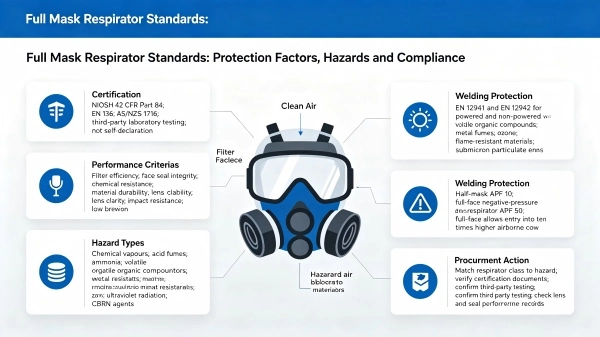
Since 1956, Xi'An PPE MAX Co., Ltd. has been providing respiratory protection. During that time, we've seen standards change along with workplace dangers. Our full-face respirators meet the standards set by NIOSH 42 CFR Part 84, EN 136, and AS/NZS 1716. These standards were achieved through independent laboratory testing, not by self-declaration. This multi-standard compliance makes sure that our tools can serve customers in 134 countries, each with its own set of rules.
Types of Full Mask Respirators and Their Relevant Safety Standards
Chemical Protection Respirators
A Full Mask Respirator that meets certain requirements is needed in places with acid fumes, chemical vapours, or ammonia. Based on how durable they are, EN 136 divides full-face masks into three classes: Class 1 is for light-duty tasks, Class 2 is for general industry use, and Class 3 is for harsh settings. The NIOSH CBRN (Chemical, Biological, Radiological, and Nuclear) license covers the most dangerous situations and needs tools that can handle chemical weapons and industrial accidents.
Chemical safety isn't always the same. A medicine company that works with formaldehyde needs different filters than a petrochemical company that works with hydrogen sulphide. Standards take these differences into account by testing respirators against specific contamination profiles. This makes sure that the device works in real-life exposure situations, not just in a lab.
Industrial and Welding Applications
Welding releases metal fumes, ozone, and ultraviolet rays, all of which are dangerous and need to be protected from both the eyes and the lungs. Standards EN 12941 and EN 12942 set rules for powered and non-powered breathing apparatus used in welding. They say how well the filters work against submicron metal particles and require materials that are resistant to flames. It's important to make this difference because welding respirators have to be able to handle extreme heat and sparks without affecting the seal or lens clarity.
Our manufacturing facility produces respirators with wide-view, anti-fog polycarbonate lenses meeting ANSI Z87.1 impact resistance standards. The material selection isn't accidental—polycarbonate maintains optical clarity while resisting thermal shock, critical when workers transition between welding stations and ambient environments. Dual inhalation valves reduce breathing resistance during prolonged operations, addressing wearer fatigue that leads to improper usage or removal in hazardous zones.
Comparing Full-Face and Half-Mask Protection
Protection factors are directly affected by the difference in coverage between full-face and half-mask respirators. NIOSH gives Assigned Protection Factors (APF) to masks based on how they are made. For example, half-masks get APF 10, and full-face negative-pressure respirators get APF 50. Because of this tenfold difference, full-face masks let you enter ten times more focused air than half-masks can safely handle.
Ocular contact is a major weakness that half-masks don't cover. Chemicals like chlorine and sulphur dioxide hurt the eyes before they affect the lungs. This means that workers take off their protective gear just as the danger is at its highest. This failure mode is eliminated by a full-face covering, which keeps a shield across the whole face. Our devices have soft rubber seals that can fit a wide range of face shapes. This makes sure that everyone in the workforce is properly protected.
How Full Mask Respirator Standards Impact Procurement Decisions
Verifying Certification Authenticity
Certification logos are often used in marketing materials, but procurement workers need to make sure the logos are real by getting independent proof. NIOSH keeps a public database of approved Full Mask Respirators that can be searched by model number and maker. European Notified Bodies give out Declarations of Conformity, which are real EN-certified goods. When these papers are asked for during the buying process, they help separate honest sellers from dishonest ones.
We've seen complex counterfeiting operations copying paperwork and packages. Cross-referencing source claims with approving body records is a safety measure. PPE MAX makes it possible to fully track every respirator: NIOSH TC numbers, EN Notified Body certificates, and test results can all be requested, giving procurement teams the chance to do their research before committing to big orders.
Evaluating Performance Indicators
Filtration efficiency is not the only thing that determines how well a mask works. Fit testing checks how well the device fits against a person's face, which is where most breathing protection fails. Standards call for objective comfort ratings to be replaced by quantitative fit tests that measure real leaks. Even if a respirator has a filter that works 99.97% of the time, it doesn't mean anything if the fit is bad and contaminants can get past the filter through seal holes.
Our respirators have a 5-point adjustable harness system that spreads stress equally across the head. This keeps pressure spots from forming that would cause people to loosen the straps. This technical detail takes into account a fact about human factors: being uncomfortable makes people not follow the rules. When making decisions about what to buy, you should think about situations where workers will be wearing something for a long time and how the practical design will keep them safe.
Balancing Cost, Compliance, and Comfort
When buying, teams are on a tight budget, they tend to go with the lowest price, but this doesn't take into account the total cost of ownership. A mask that is 30% less expensive than similar ones but doesn't pass fit tests is a waste of the whole purchase. When it comes to value, reusable designs with changeable filters are better than disposable ones, especially in fields where dangers are present all the time instead of just sometimes.
Our bayonet filter link method makes it easy to change the cartridge in seconds. With proper care, the respirator can last longer than ten years. The initial cost of purchase is spread out over thousands of work shifts, which lowers the cost per use below throwaway options while keeping security levels the same. For wholesalers and big industrial operators, bulk procurement prices for orders over 500 units make costs even more efficient.
Maintenance, Cleaning, and Lifetime: Standardized Best Practices
Filter Replacement Schedules
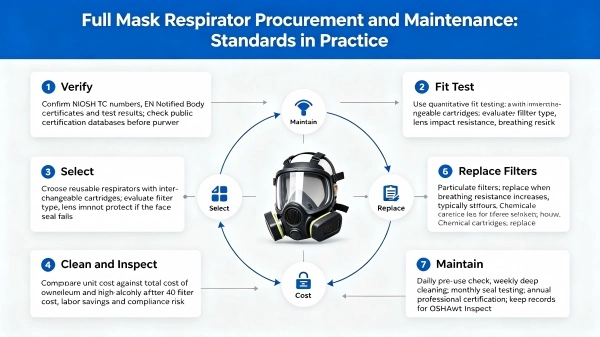
Standards say how often filters need to be replaced based on the type of filter and the conditions of contact. Particulate screens need to be changed when breathing becomes more difficult, which usually happens after 40 hours in places with a lot of dust. Chemical capsules have breakthrough times that are set by the maker. This is the time when the concentration of contaminants inside the mask is high enough to be seen. Standardised plans are not possible because breakthrough relies on the type of contaminant, its quantity, the humidity, and the rate of breathing.
Change-out plans set up through tracking of exposure at work are the answer. Industrial hygienists check the amount of contaminants in the air and then use built-in safety factors to figure out how long a cartridge can be used safely. Our technical support team helps clients make these plans, taking into account things like temperature swings that cause filters in chemical processing plants to become saturated more quickly.
Cleaning Protocols and Seal Integrity
A Full Mask Respirator breaks down faster than work clothes when not cleaned properly. Petroleum-based liquids that break down elastomers are not allowed by standards. Instead, light detergent solutions and hot water must be used. Handling the speech diaphragm and valve sections with care is important because rough scrubbing can damage delicate parts that control airflow. We put our silicone facepieces through 500 cleaning cycles using the allowed ways and found that they kept their seal performance at the same level as brand-new devices.
A big building company used strong disinfectants to clean their respirators every day, which caused the seals on all of their respirators to fail early. An investigation showed that the cleaning product had high levels of alcohol, which stiffened the silicone and made tiny cracks in it. The problem was fixed by using cleaning products that were allowed by the maker. This shows that the way you do maintenance has a direct effect on how well your protection works.
Maintenance Checklist Essentials
Regular checks find problems as they start to happen before they put people's safety at risk. Cover the filter connection and try to breathe to see if the valve works. Valves that are working properly will cause visible resistance. Check the rubber on the facepiece for changes in colour, cracks, or stiffness that could mean the material is breaking down. Check the quality of the lens and look for scratches that could make it hard to see, which could pose safety risks beyond breathing issues.
Here are critical maintenance intervals that preserve respirator performance:
- Daily Pre-Use Inspection: Before each work shift, straps, valves, and seals are looked at visually. This takes about two minutes per device. Users should look for damage that can be seen and make sure that all the parts are put together correctly.
- Weekly Deep Cleaning: All parts must be taken apart and cleaned thoroughly with approved solutions. Then, the item must be left to dry in the air, out of direct sunlight, and away from heat sources that speed up the ageing process.
- Monthly Seal Testing: Either a quantitative fit test for important jobs or a qualitative test using irritating smoke or saccharin solution to make sure the face seal is right in real work situations.
- Annual Certification: A professional review by trained staff who check for leaks in the seals, look at how parts wear, and either say the machine can keep working or suggest it be retired.
These practices make sure that the property lasts longer and is always protected. Maintaining records of repair tasks helps with regulatory compliance checks and creates safety programs that can be defended and meet OSHA record-keeping requirements.
Conclusion
Respiratory protection standards are the result of many years of study, accident investigations, and engineering improvements. They take all of this knowledge and turn it into measured requirements that tell the difference between real protection and fake security. When buying things, putting an approved Full Mask Respirator ahead of saving money shows that you understand how important worker health is and how much it will save you in the long run. Standards make people responsible: companies can't sell equipment without showing that it works, and bosses can't say they did their research but give out items that haven't been tested. When you compare the small price increase for approved respirators to the costs of medical bills, legal fees, and lost work time due to avoidable exposure events, the small price increase becomes meaningless. Companies that do well in dangerous fields know that breathing protection is an investment, not a cost. It protects the human capital that makes the business successful.
FAQ
1. Are NIOSH and EN standards recognized internationally?
In North and South America, NIOSH licenses are widely accepted, while EN standards are the most common in Europe, the Middle East, and Africa. Either certification is accepted in a lot of Asian and Pacific countries, but some keep their own standards, like Australia and New Zealand, with AS/NZS. The challenge of a Full Mask Respirator emerges in countries where new rules are being put in place but aren't always being followed. Reputable international companies usually need NIOSH or EN approval, even if it's against the law in the country, because these standards provide proven levels of safety. When sellers offer multi-standard certification, procurement teams that serve a wide range of regional markets don't have to keep separate stocks of equipment for each operating area.
2. Can uncertified respirators be used in industrial settings?
Using breathing masks that aren't approved in the workplace puts people's safety and the law at risk. In the US, OSHA rules make it clear that respirators approved by NIOSH must be used in the workplace, with a few exceptions for certain study uses. European Directive 89/686/EEC says that CE marking must be backed up by approval from a Notified Body. In addition to following the rules, devices that aren't approved don't have any outside checks to make sure they really protect, so makers can say whatever level of performance they want without being held accountable. The dangers go beyond insurance coverage; accidents at work involving non-compliant tools could make employer liability policies null and void, leaving companies open to court fees and medical bills.
3. How frequently should respirators undergo inspection?
How often you inspect depends on how much you use it and how exposed you are to it. The bare minimum is to visually check each device every day before each use. This shouldn't take more than two minutes per device. In situations with modest use, detailed inspections should happen once a week. In situations with high activity, like chemical processing or hazardous waste cleanup, detailed inspections should happen every day. Professional inspections by experienced technicians once a year make sure that parts stay in good shape over long work lives. By keeping track of these checks, compliance records are made that meet legal requirements and show what equipment needs to be fixed or replaced before protection fails during real exposure events.
Partner With PPE MAX for Certified Respiratory Protection
Xi'An PPE MAX Co., Ltd has been making high-quality safety gear for 65 years, and every approved Full Mask Respirator we make shows that. We have a wide range of products, such as respirators that are approved by NIOSH and EN 136. These have soft silicone seals, anti-fog polycarbonate glasses, and bayonet filter fittings that work with particulate, gas, and vapour cartridges. We understand the balance between meeting compliance standards and running a business because we work with building companies, industrial safety distributors, and government procurement offices in 134 countries. Email our team at marketing@ppemax.com to talk about large sales, OEM agreements, or technical details. We give your team specific certification paperwork, set up factory tours of our Xi'an facilities, and offer product samples so they can check the quality before committing to large-scale purchases.
References
1. National Institute for Occupational Safety and Health. "Respiratory Protection Program Standards and Guidelines." NIOSH Publication Series on Occupational Safety, 2019.
2. European Committee for Standardisation. "EN 136:1998 Respiratory Protective Devices - Full Face Masks - Requirements, Testing, Marking." CEN Technical Standards Documentation, 1998.
3. Occupational Safety and Health Administration. "Respiratory Protection Standard 29 CFR 1910.134 Compliance Guide for General Industry." U.S. Department of Labor OSHA Publications, 2021.
4. International Organisation for Standardisation. "ISO 16900-1:2014 Respiratory Protective Devices - Methods of Test and Test Equipment." ISO Technical Committee Standards, 2014.
5. American National Standards Institute. "ANSI Z88.2-2015 American National Standard for Respiratory Protection - Respirator Program Administration." ANSI Safety Equipment Standards, 2015.
6. Standards Australia/Standards New Zealand. "AS/NZS 1716:2012 Respiratory Protective Devices." Joint Australian-New Zealand Standards Committee Industrial Safety Publications, 2012.
Learn about our latest products and discounts through SMS or email