- English
- French
- German
- Portuguese
- Spanish
- Russian
- Japanese
- Korean
- Arabic
- Greek
- German
- Turkish
- Italian
- Danish
- Romanian
- Indonesian
- Czech
- Afrikaans
- Swedish
- Polish
- Basque
- Catalan
- Esperanto
- Hindi
- Lao
- Albanian
- Amharic
- Armenian
- Azerbaijani
- Belarusian
- Bengali
- Bosnian
- Bulgarian
- Cebuano
- Chichewa
- Corsican
- Croatian
- Dutch
- Estonian
- Filipino
- Finnish
- Frisian
- Galician
- Georgian
- Gujarati
- Haitian
- Hausa
- Hawaiian
- Hebrew
- Hmong
- Hungarian
- Icelandic
- Igbo
- Javanese
- Kannada
- Kazakh
- Khmer
- Kurdish
- Kyrgyz
- Latin
- Latvian
- Lithuanian
- Luxembou..
- Macedonian
- Malagasy
- Malay
- Malayalam
- Maltese
- Maori
- Marathi
- Mongolian
- Burmese
- Nepali
- Norwegian
- Pashto
- Persian
- Punjabi
- Serbian
- Sesotho
- Sinhala
- Slovak
- Slovenian
- Somali
- Samoan
- Scots Gaelic
- Shona
- Sindhi
- Sundanese
- Swahili
- Tajik
- Tamil
- Telugu
- Thai
- Ukrainian
- Urdu
- Uzbek
- Vietnamese
- Welsh
- Xhosa
- Yiddish
- Yoruba
- Zulu
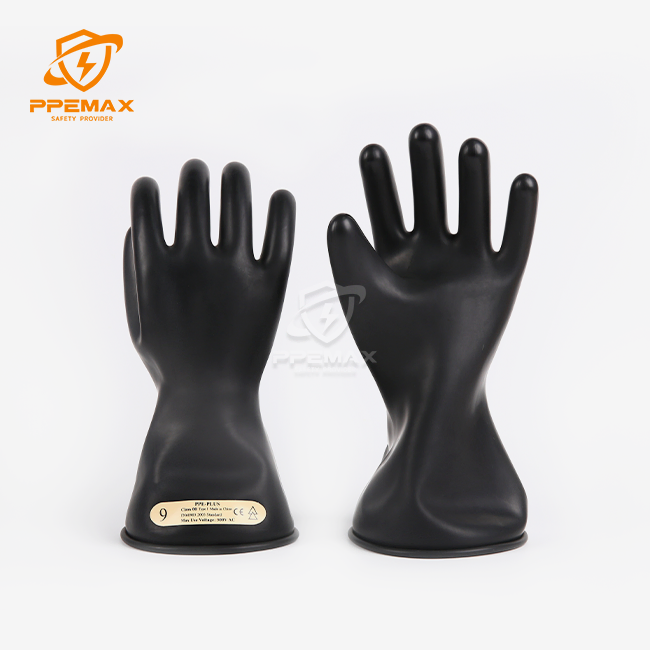
Class 1 Electrical Insulating Rubber Gloves
AC Proof Test: 10000V
Length: 16 inch
Product Size: 8/9/10/11/12
Product Color: Bicolor(black and red)
Reference Weight:420g
Implementation standard: IEC60903,ASTM-D120
Packing: 1pair/box, 6pair/carton
CTN size: 48X31X41cm
carton weight: 7kg
Class 1 Electrical Insulating Rubber Gloves – 7,500V AC Protection for Electrical Workers
Class 1 Electrical Insulating Rubber Gloves come from Xi'An PPE MAX Co., Ltd. They handle up to 7,500V AC. Proof testing happens at 10,000V AC. The gloves meet both IEC 60903 and ASTM D120. You can get sizes 8 through 12. Every pair ships with a two-tone black and red finish. Length is 16 inches. Weight sits at about 420g. PPE MAX has built electrical protective equipment since 1956. Decades of manufacturing experience go into each pair.

What Are This Product?
This product are a type of PPE made for electrical workers. They guard against shock and electrocution on systems that run up to 7,500V AC or 11,250V DC.
Your hands and energized conductors stay apart because of a dielectric barrier. The material is rubber. Natural rubber makes up Type I, and it bends easily. Type II uses EPDM/synthetic, which fights off ozone and UV. Safe contact with live equipment depends on that rubber insulation.
Class 1 gloves get a white label. That is what ASTM D120 and IEC 60903 call for. A white label lets a crew spot the right voltage class fast, right there on site. It also keeps someone from grabbing an under-rated glove for a higher-voltage system.

Standard Specifications
| Parameter | Details |
|---|---|
| AC Maximum Use Voltage | 7,500V |
| AC Proof Test Voltage | 10,000V |
| DC Maximum Use Voltage | 11,250V |
| Length | 16 inches |
| Available Sizes | 8 / 9 / 10 / 11 / 12 |
| Color | Bicolor (Black & Red) |
| Reference Weight | 420g / pair |
| Rubber Thickness | ~1.02 mm – 1.52 mm |
| Label Color | White (Class 1 standard) |
| Implementation Standards | IEC 60903, ASTM D120 |
| Packing | 1 pair/box, 6 pairs/carton |
| Carton Dimensions | 48 × 31 × 41 cm |
| Carton Weight | 7 kg |

Key Features
Dual Material Options
Type I natural rubber gives you the most dexterity. Pick it for controlled environments. Type II EPDM is the one for outdoor work. Ozone cracking and UV exposure are real concerns out there.
Bicolor Design for Quick Identification
One look at the black-and-red finish tells you it is a Class 1 glove and not another voltage class. That cuts the chance of misuse on site.
Consistent Rubber Thickness
Thickness falls between 1.02 mm and 1.52 mm. Systems running at 7,500V AC get the dielectric strength they need from that range. The glove still stays flexible enough for detailed hands-on work.
White Label Marking
A Class 1 rating is printed in plain view on the white label. This follows the ASTM D120 color-coding system. Supervisors can then check fast that the right PPE was picked.
Compatible with Leather Protectors
The rubber cuff dimensions follow guidelines that allow leather protectors (per ASTM F696) to be worn over the gloves without reducing flashover distance — an important fit consideration for field use.

Compliance
Class 1 Electrical Insulating Rubber Gloves from PPE MAX are manufactured in compliance with:
- IEC 60903: The international standard covering insulating gloves for electrical work
- ASTM D120: the American standard that covers rubber insulating gloves
Proof test voltages are set by these standards. So are material integrity and labeling. Dimensional requirements are covered too. That gives you a documented basis for bringing these gloves into your safety program.

Applications for Class 1 Electrical Insulating Rubber Gloves
These gloves show up in a number of trades. In each one, the job brings people near or onto live systems rated up to 7,500V AC:
- Electric utilities: running switchgear, working overhead lines, and looking after substations
- Industrial manufacturing: control panels and transformers get serviced, and high-voltage motors get fixed too
- Construction: electrical installation work on commercial and industrial projects
- Telecommunications: when the job is done near live infrastructure, workers face exposure to elevated voltage
- EV and renewable energy: solar inverters and high-voltage battery systems are part of the work

Why Choose PPE MAX?
PPE MAX has made electrical protective equipment since 1956. Production never leaves the company. Materials, production steps, and testing stay under direct control.
B2B buyers often arrive with questions about how an order gets set up. Size mix and labeling needs come up as well. Placing a catalog order, or talking through a custom bulk supply deal, our sales team works directly with procurement and safety teams to meet your specifications.
Factory visits are welcome. We encourage procurement managers and safety officers to tour our facility and review our production and testing processes in person.


Packing & Storage
- 1 pair per box
- 6 pairs per carton
- Carton dimensions: 48 × 31 × 41 cm
- Carton weight: 7 kg
Keep gloves clear of chemicals, UV light, and heat sources. For long storage, put the rubber gloves in a separate spot from the leather protectors. That stops them from losing their shape. Do not fold or crease the rubber.
After-Sales Support
Questions about Class 1 Electrical Insulating Rubber Gloves re-testing schedules, storage needs, or reordering? Our team can help. Once rubber insulating gloves go into service, they need an electrical re-test every 6 months. Need paperwork for your compliance records? We can support that too.
If a product quality problem comes up, get in touch with us right away. We will work with you to sort it out.
FAQ
Q: How frequently must this product go through electrical testing?
A: Once in service, electrical re-testing is required every 6 months. If stored unused, re-testing is required after 12 months on the shelf.
Q: Is a leather protector required, or can the rubber glove be used on its own?
A: No. Without a leather protector, the rubber is exposed to cuts and punctures that compromise its dielectric rating. ASTM D120 gloves are designed to be worn with protectors.
Q: How does Type I rubber differ from Type II rubber?
A: Natural rubber is what Type I means. It flexes more, and that suits indoor jobs where conditions stay under control. Type II is EPDM. Ozone and UV light leave it intact, so outdoor work is where it does better.
Q: What can you learn from the white label on the glove?
A: It marks the glove as Class 1 rated. That means a maximum use voltage of 7,500V AC. This matches the color-coding system laid out in ASTM D120 and IEC 60903.
Q: How should these gloves be stored?
A: Store the gloves in a canvas glove bag made to protect them. Keep heat, UV light, and chemicals far away from it. Do not fold or crease the gloves. Rubber can lose its shape, so take them out of the leather protectors before you store them for a long time.
Q: What sizes are available, and is custom ordering possible?
A: You can get the gloves in sizes 8, 9, 10, 11, and 12. Bulk B2B orders? Our sales team can talk through size mix ratios and labeling choices with you.
Contact Us
Reach our Class 1 Electrical Insulating Rubber Gloves team at bettybing@ppemax.com: we aim to respond to all inquiries within one business day.
Learn about our latest products and discounts through SMS or email