- English
- French
- German
- Portuguese
- Spanish
- Russian
- Japanese
- Korean
- Arabic
- Greek
- German
- Turkish
- Italian
- Danish
- Romanian
- Indonesian
- Czech
- Afrikaans
- Swedish
- Polish
- Basque
- Catalan
- Esperanto
- Hindi
- Lao
- Albanian
- Amharic
- Armenian
- Azerbaijani
- Belarusian
- Bengali
- Bosnian
- Bulgarian
- Cebuano
- Chichewa
- Corsican
- Croatian
- Dutch
- Estonian
- Filipino
- Finnish
- Frisian
- Galician
- Georgian
- Gujarati
- Haitian
- Hausa
- Hawaiian
- Hebrew
- Hmong
- Hungarian
- Icelandic
- Igbo
- Javanese
- Kannada
- Kazakh
- Khmer
- Kurdish
- Kyrgyz
- Latin
- Latvian
- Lithuanian
- Luxembou..
- Macedonian
- Malagasy
- Malay
- Malayalam
- Maltese
- Maori
- Marathi
- Mongolian
- Burmese
- Nepali
- Norwegian
- Pashto
- Persian
- Punjabi
- Serbian
- Sesotho
- Sinhala
- Slovak
- Slovenian
- Somali
- Samoan
- Scots Gaelic
- Shona
- Sindhi
- Sundanese
- Swahili
- Tajik
- Tamil
- Telugu
- Thai
- Ukrainian
- Urdu
- Uzbek
- Vietnamese
- Welsh
- Xhosa
- Yiddish
- Yoruba
- Zulu
How Do Electrical Rubber Gloves Protect Against Electric Shock?
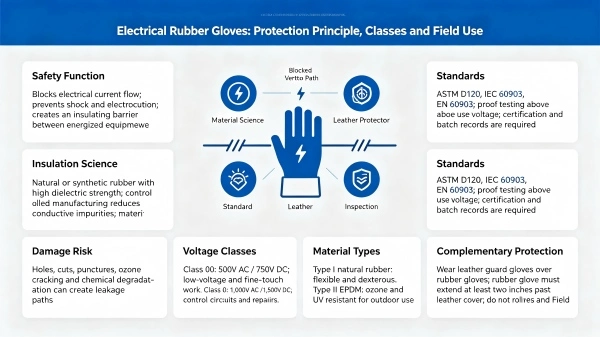
By using carefully made rubber materials with exceptional dielectric strength, electrical rubber gloves act as insulating barriers that stop electrical current from moving through the human body. When a worker with the right-rated insulating gloves touches a live wire, the chemical structure of the rubber keeps the electricity in the live source instead of trying to find a way through the technician to ground. This safety feature depends on exact voltage-class grades and pure materials that are made to last through certain amounts of electrical stress without breaking. Knowing this safety principle helps procurement professionals choose the right PPE to protect workers in a range of voltage settings.
Understanding Electrical Rubber Gloves and Their Role in Electric Shock Protection
The Science Behind Electrical Insulation
Is rubber immune to electricity? Rubber gloves for electrical safety are made of natural or man-made rubber that has been carefully designed to stop the flow of electricity. Unlike regular work gloves, these are made with strict steps that get rid of any conductive impurities and make the material's insulating properties the same all over. When rubber is properly made, its chemical structure makes it impossible for electrons to move within certain voltage limits.
The electrical current can't reach the worker's skin and body when it hits this shield. When a charged wire touches ground through the body, the insulation breaks the circuit that would otherwise happen. This safety only works as long as the electrical rubber gloves' structure stays intact. Any hole, cut, or wear and tear makes a possible weak spot where current could enter.
Voltage Ratings and International Standards
Specific voltage classes set by manufacturing standards tell us where and how to safely use protective gloves. In North America, the rules are set by ASTM D120. For foreign markets, IEC 60903 is used, and EN 60903 is used for European markets. In these systems, testing procedures are set up to check the dielectric strength, physical qualities, and resistance to environmental factors.
Proof tests are done on each voltage group at levels that are much higher than the maximum use voltage. This makes safety gaps that take into account stress conditions that happen in real life. When working on foreign projects, procurement teams have to make sure that the goods they choose meet the regional standards that apply to their work areas. This proof of compliance saves both workers and businesses from being sued for not having the right safety gear.
Key Types and Classifications of Electrical Rubber Gloves for Industrial Use
Voltage Class Selection for Different Applications
There are four levels of classification, from Class 00 to Class 4. Each level corresponds to a higher voltage number. Class 00 electrical rubber gloves are the most basic level. They can handle up to 500 Volts AC and 750 Volts DC. These gloves are used in low-voltage situations where dielectric protection must be balanced with high tactile sensitivity. This lets technicians work on small parts while installing smart meters or servicing batteries for electric vehicles. The white sticker makes it easy to tell which glove type someone is wearing on job sites where there may be more than one type.
Class 0 electrical rubber gloves guard against 1,000 Volts AC and 1,500 Volts DC. They are usually marked with red stickers that follow ASTM D120 standards. Utility workers and industrial electricians who work on charged panels need these gloves because they protect their hands while they work on control circuits and do repairs on distribution systems. The design puts both physical strength and dielectric strength at the top of the list, because it is known that safety cannot be sacrificed for usefulness in complex tasks.
With a maximum use voltage of 26,500 Volts AC, Class 3 electrical rubber gloves provide heavy-duty safety for high-voltage areas. These strong goods are used for repair on transmission lines and substations, as well as other tasks where extreme electrical dangers require superior insulation performance. Class 3 gloves must come with leather covers that keep the rubber from getting damaged mechanically, which would compromise its dielectric stability.
Complementary Protection Systems
Insulating gloves protect you from electric shock, but leather guard gloves are just as important for protecting your hands from mechanical harm. It is protected by these upper layers from cuts, scrapes, and holes that could go through the rubber shield. The combined system needs the right fit. The electrical rubber gloves need to be at least two inches longer than the leather cover so that electricity doesn't track across the glove's surface.
Specialty versions deal with certain problems in the world. Type I gloves are made of natural rubber, which is very flexible and easy to work with when the temperature is mild. EPDM synthetic rubber is used in Type II builds because it is more resistant to ozone degradation and can be used outside, where ultraviolet light and weather conditions speed up material breakdown. Chemical-resistant products keep surfaces clean from oils, solvents, and industrial fluids that are used in a variety of work environments.
How to Ensure the Reliability and Safety of Electrical Rubber Gloves
Mandatory Testing Protocols
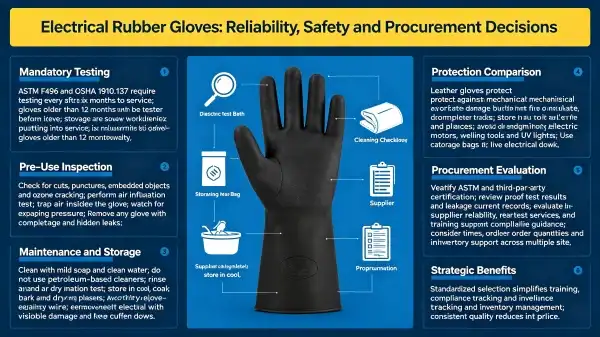
Dielectric testing is the most important part of making sure that gloves are reliable. ASTM F496 and OSHA 1910.137 say that electrical systems must be tested every six months after they are put into service. If testing took place more than twelve months ago, gloves that have been stored cannot be given out, even if they have not been used. This strict deadline takes into account the fact that rubber products break down over time, even when they are not being used. This happens because they are exposed to the environment, temperatures change, and the materials themselves age.
As part of the testing process, the object is submerged in a conductive solution while voltage levels that are higher than the working values are applied. Technicians measure leaking current to find places where shielding has broken down. Gloves that don't stay intact during proof tests need to be taken out of service right away. We've seen companies have trouble with testing compliance, but sites that follow the right procedures have much lower incident rates than those that skip or put off needed evaluations.
Proper Maintenance and Storage Practices
The first step in maintenance is a careful check-up before each use. Workers should look at their electrical rubber gloves for damage that can be seen, like cuts, punctures, foreign objects stuck inside, or signs of ozone cracking, which is a pattern of wear and tear that shows up as surface crazing, especially near stress spots. As a field-verification method, the air expansion test has techs trap air inside the glove and watch for pressure that escapes, which means there are leaks.
Service life and dependability are directly affected by how the goods are stored. Electrical rubber gloves should be kept in cool, dark, dry places that are out of direct sunlight and away from things that produce ozone, like electric motors, welding tools, and UV lights. When gloves are kept with the cuffs down to avoid compression or folding that causes stress buildup, canvas storage bags are the best way to keep them safe. We never store gloves with the insides facing out or in damp places that speed up wear and tear.
When you clean, you get rid of things that could damage insulation or cause allergic responses. Don't use cleaners or solvents that are based on petroleum because they break down rubber materials. Instead, use light soap and clean water. Rinse and let dry completely in the air before putting away to make sure no water gets stuck in the structure of the material.
Comparing Electrical Rubber Gloves: Making the Right Procurement Decisions
Evaluating Protection Against Alternatives
Before making a purchase choice, it's important to know exactly what each type of PPE protects against. Leather gloves protect against mechanical damage but don't insulate against electricity. This is an important difference that keeps dangerous misuse from happening. Arc-rated gloves protect against the thermal risks of arc flashes, but they might not have enough dielectric qualities to be worn directly on live wires. Electrical rubber gloves with the right rating are the only ones that offer the right level of safety for working with live electricity.
Companies like Honeywell, Ansell, Salisbury, Klein Tools, 3M, and MSA have been in the market for a long time and make quality goods that have been improved over many years. Instead of just looking at name recognition, procurement should look at certification paperwork, proof test results, and third-party validation. Support services after the sale, like retesting, new programs, and expert advice, add a lot of value above and beyond the initial purchase price.
Strategic Procurement Considerations
When you buy in bulk, you save a lot of money and make sure that a lot of people always have what they need. Standardized product selection makes training, tracking compliance, and handling inventory easier for companies that run multiple sites in different parts of the world. Customization choices, such as longer cuffs, ergonomic shapes, and unique color coding, help meet particular operating needs.
When it comes to safety-critical PPE, supplier dependability is very important. It's been a pleasure working with procurement teams that value steady quality, open communication, and quick expert help. In addition to unit price, lead times, minimum order amounts, and inventory support during project spikes all affect the total cost of ownership. Partnership-oriented sellers offer training materials, help with compliance, and early warnings about changes to standards or better products.
The Future of Electrical Rubber Gloves in Workplace Safety
Material and Design Innovations
Newer rubber mixes for electrical rubber gloves are more flexible without lowering their dielectric strength. This fixes the problem where protection level and physical skill used to be two sides of the same coin. Anatomical shape and ergonomic design make it easier on the hands to work for long periods of time, which has a direct effect on both safety and efficiency. Some companies are thinking about making smart gloves with sensors that check the insulation's quality in real time and let users know if there are any problems before they happen.
Better ways of making things get rid of the tiny flaws that used to cause walls to fail before they should have and make the wall thickness more regular. Automated visual checking and computerized electrical testing are two types of quality control technologies that make sure that all production runs are the same. These improvements mean that safety equipment will last longer, need to be replaced less often, and give people more faith in its performance.
Evolving Regulatory Landscape
The goal of global harmonization is to make testing standards and classification systems more consistent across all foreign markets. This will make it easier for overseas businesses to follow the rules. New rules put more and more emphasis on electrical safety programs that go beyond just providing tools. Employers are now responsible for training, repair, and inspection routines. If procurement managers know about these changes, they can change buying standards and relationships with suppliers ahead of time to meet future needs.
Risk management plans now include choosing the right electrical rubber gloves as part of designing a larger safety system. Analysis of arc flash hazards, working with live electricity, and putting in place hierarchical control systems all affect the choice of gloves and how they should be used. Knowing how these things are connected helps procurement pros add strategic value beyond just buying things.
Conclusion
Electrical rubber gloves protect workers from getting shocked by electricity by stopping current from flowing through their bodies when they touch live systems. How well something works rests on choosing the right voltage class, following strict testing procedures, and doing thorough upkeep. If procurement professionals know about these safety measures, classification systems, and reliability standards, they can make choices that really protect workers while also meeting compliance standards and running the business efficiently. Buying good insulated gloves and programs to support them pays off in a way that can be measured: fewer accidents, lower insurance costs, and higher worker output.
FAQ
How often should dielectric gloves undergo testing?
ASTM F496 and OSHA 1910.137 say that gloves must be electrically checked every six months after they are put to use. If testing took place more than twelve months ago, gloves that have been stored cannot be given to workers, even if they have been used. This required plan takes into account how materials break down over time and makes sure that the gloves always provide the same level of safety.
What distinguishes electrical rubber gloves from leather protectors?
Electrical rubber gloves are made from carefully formulated compounds that have been tested for particular voltage rates. They act as insulation to stop the flow of current. It is possible to cut, abrasion, or damage a leather guard glove, but it does not insulate against electricity. Both are very important and work together; the rubber glove protects against electrical damage and the leather cover keeps it safe from physical damage. To stop electronic tracking, the rubber glove must go beyond the leather protection by a certain amount.
Can Class 00 gloves be used for 480-volt applications?
Not at all. Class 00 gloves can handle up to 500 Volts AC, which means they can be used for service work in homes and on some industrial control circuits. When 480 volts are used, the upper limit is reached, and proper safety gaps become very important. For normal 480-volt work, Class 0 gloves rated for 1,000 Volts AC are a better choice because they provide the minimum voltage safety gap according to best practices in the industry.
Partner with PPE MAX for Certified Electrical Rubber Gloves
Since 1956, we've been protecting workers in 134 countries. Our image is based on goods that really do keep workers safe and have been tested very carefully. PPE MAX sells a wide range of electrical rubber gloves, from Class 00 to Class 4. These gloves are made to meet ASTM, IEC, and EN standards and come with all the necessary licensing paperwork. As a top maker of personal protective equipment (PPE), we can offer you reasonable bulk prices, a lot of customization options, and expert technical advice that helps you find products that are perfect for your needs.
When procurement teams choose PPE MAX, they get more than just goods. They also get decades of experience with applications, quick support that sticks to project deadlines, and consistent quality that makes managing compliance easier. The tools our company makes are tested because we know it will help real people in dangerous situations. Email Betty Bing at marketing@ppemax.com to talk about your electrical rubber gloves needs, get full specs, or set up a trial sample. We can help you reach your safety goals with our proven knowledge and dependable relationship, whether you need a reliable provider of electrical rubber gloves for ongoing programs or custom solutions for one-of-a-kind uses.
References
1. American Society for Testing and Materials. "ASTM D120 - Standard Specification for Rubber Insulating Gloves." Annual Book of ASTM Standards, Vol. 10.03, 2022.
2. Occupational Safety and Health Administration. "1910.137 - Electrical Protective Equipment." Code of Federal Regulations, Title 29, Part 1910.
3. International Electrotechnical Commission. "IEC 60903: Live Working - Gloves of Insulating Material." Edition 3.0, 2019.
4. Cadick, J., Capelli-Schellpfeffer, M., and Neitzel, D. "Electrical Safety Handbook." 4th Edition, McGraw-Hill Education, 2012.
5. National Fire Protection Association. "NFPA 70E: Standard for Electrical Safety in the Workplace." 2021 Edition.
6. Jamil, M., Khan, S.A., and Ahmad, A. "Performance Evaluation of Insulating Materials for High Voltage Applications." IEEE Transactions on Dielectrics and Electrical Insulation, Vol. 28, No. 2, 2021, pp. 645-652.
Learn about our latest products and discounts through SMS or email