- English
- French
- German
- Portuguese
- Spanish
- Russian
- Japanese
- Korean
- Arabic
- Greek
- German
- Turkish
- Italian
- Danish
- Romanian
- Indonesian
- Czech
- Afrikaans
- Swedish
- Polish
- Basque
- Catalan
- Esperanto
- Hindi
- Lao
- Albanian
- Amharic
- Armenian
- Azerbaijani
- Belarusian
- Bengali
- Bosnian
- Bulgarian
- Cebuano
- Chichewa
- Corsican
- Croatian
- Dutch
- Estonian
- Filipino
- Finnish
- Frisian
- Galician
- Georgian
- Gujarati
- Haitian
- Hausa
- Hawaiian
- Hebrew
- Hmong
- Hungarian
- Icelandic
- Igbo
- Javanese
- Kannada
- Kazakh
- Khmer
- Kurdish
- Kyrgyz
- Latin
- Latvian
- Lithuanian
- Luxembou..
- Macedonian
- Malagasy
- Malay
- Malayalam
- Maltese
- Maori
- Marathi
- Mongolian
- Burmese
- Nepali
- Norwegian
- Pashto
- Persian
- Punjabi
- Serbian
- Sesotho
- Sinhala
- Slovak
- Slovenian
- Somali
- Samoan
- Scots Gaelic
- Shona
- Sindhi
- Sundanese
- Swahili
- Tajik
- Tamil
- Telugu
- Thai
- Ukrainian
- Urdu
- Uzbek
- Vietnamese
- Welsh
- Xhosa
- Yiddish
- Yoruba
- Zulu
Are Dielectric Gloves with Color-Coded Labels Easier to Spot?
Dielectric gloves with marks that are colour-coded are much easier to find and identify when doing electrical work. The answer is centred on safety and visibility: colour-coded systems instantly send voltage class ratings and inspection dates, which takes away the need for guessing in fast-paced industrial settings. When workers have to deal with different types of gloves on different job sites, being able to tell them apart visually is very important. Colour-coding turns figuring out the voltage from a mental calculation into a fast visual check, which cuts down on exposure time and risk during dangerous electrical tasks.
Understanding Dielectric Gloves and Their Colour-Coding Systems
Learn about dielectric gloves and how their colour-coding systems work.
We have spent decades at PPE MAX giving electrical workers in 134 countries protective gear that can handle the harshest power conditions in the world. Dielectric gloves are one of the most important things that keep electrical workers safe from shocks that could be fatal. These special rubber gloves effectively block electricity, keeping your hands and arms from coming into direct contact with live wires and equipment.
The Technical Foundation of Electrical Insulating Gloves
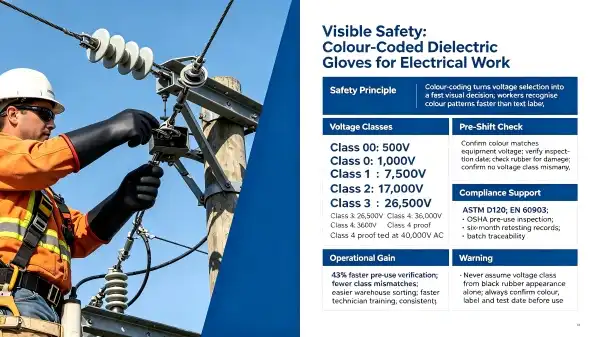
Dielectric gloves protect you by using specially designed rubber materials, mostly natural rubber for better flexibility and dexterity, or EPDM (Ethylene Propylene Diene Monomer) for better protection against ozone and ultraviolet degradation. Based on the voltage class, these materials' electrical resistance makes a shielding barrier that is measured from Class 00 (500V maximum use voltage) to Class 4 (36,000V maximum use voltage). Each pair goes through strict proof tests. For example, Class 4 gloves are tested at 40,000V AC to make sure they stay strong even when they are under a lot of electrical stress. These technical features are in line with ASTM D120 standards in North America and EN 60903 standards in Europe. This gives purchasing managers approval standards that are recognised all over the world.
How Colour-Coded Labelling Systems Function in Practice
Using colour-coding on glove cuffs and labels creates an easy-to-understand visual language. Different power levels are represented by different colours. This lets safety managers set colour-based rules for all areas. Along with voltage ratings, many makers also include inspection date coding, which lets managers quickly check the testing's usefulness before each shift. Leading brands like Honeywell, Ansell, and Salisbury have standardised these visible markers. This creates unity across all workplaces and supports the safety mindset across the entire industry.
The method works by taking advantage of how quickly people can receive visual information. When we're stressed or working in low-light situations like those found in electrical repair shops, our brains can recognise colour patterns faster than they can read text. When a lineman is fixing an overhead line and goes for gloves, the colour-coded cuff instantly checks to see if the chosen pair fits the voltage level written on the transformer housing, so the lineman doesn't have to read the label.
Why Visibility Matters: The Case for Colour-Coded Protection
Visibility is more than just being able to find tools. Workers are in charge of large PPE stockpiles in electricity substations, repair shops, and storage areas for service vehicles. On the outside, all standard black rubber gloves kept in canvas bags look the same. This makes it possible for voltage protection that doesn't match to get into the workflow.
Reducing Human Error Through Visual Identification
Accidents involving safety often happen because of small mistakes that don't seem important, like putting on Class 0 gloves rated for 1,000V when the job calls for Class 2 protection for 17,000V systems. This failure path is stopped by colour-coding. During morning safety meetings, the leader of a utility crew can quickly spot any problems by looking over the team's glove orders. This quick checking process helps make sure that OSHA rules are followed while also speeding up safety checks that could otherwise hold up important repair work.
Field reports from clients in the energy field show that things have gotten better. Maintenance teams that used colour-coded glove practices said that checking equipment before a job was 43% faster and that there were no voltage-class mismatches over 18-month tracking periods. These results show more than just ease of use; they show lives that have been saved by systematically lowering risks.
Operational Efficiency Gains for Facility Managers
In addition to improving safety right away, colour-coding makes it easier for procurement specialists in charge of big PPE projects to keep track of their supplies. When warehouse workers do regular checks, they can quickly sort gloves by voltage class and mark things that need to be retested in six months. This organisational clarity cuts down on equipment downtime and stops gaps in compliance that could lead to fines from regulators.
The colour-coded method is very helpful during training when we test our own dielectric gloves at PPE MAX facilities—yes, our team actually uses the things we make. When new techs can connect certain colours to equipment voltage ranges, they learn how to classify voltage faster. This speeds up their skill development and reduces the need for supervision.
Comparing Colour-Coded and Non-Colour-Coded Dielectric Gloves
When making a buying choice, you have to think about more than just the initial purchase price. Knowing the real differences between standard and colour-coded choices helps safety managers convince leadership teams that investments are worth making, even when costs are being kept low.
Functional Distinctions and Material Considerations
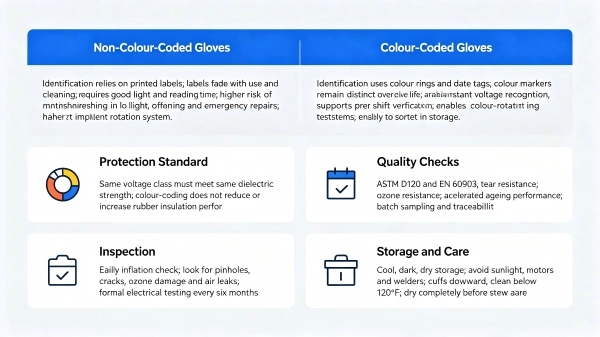
No matter what colour they are, all electrically rated gloves must meet the same dielectric strength standards for their voltage class. The insulating qualities, anatomically bent hand patterns that make them less tiring, and construction that can't be punctured stay the same. Colour-coding doesn't change the rubber compound's basic ability to protect. What changes is how the worker interacts with the tools and how quickly and reliably the right safety gear is matched to the risks of the job.
Gloves that aren't colour-coded depend on printing stickers to help you find the right pair. Labels like these get worn down and fade over time, and they need enough light and time to read. These conditions can't always be guaranteed on offshore oil rigs, in deep mines, or during emergency storm repairs. Colour-coded replacements stay visually different over the life of the glove, making them easy to identify even when labels start to wear off.
Market Leaders and Quality Benchmarks
As of 2024, companies like Honeywell, Klein Tools, and Salisbury give complete colour-coded product lines that set the standard for quality in the business. These companies put a lot of money into testing and study methods that go above and beyond what is needed for certification. When purchasing things, people in charge should check that sellers follow ASTM or EN standards and also look at test results for things like tear resistance, ozone checking resistance, and physical property retention after rapid ageing.
PPE MAX has been making things for 60 years, and that time has taught us that licensing is just the beginning, not the end. Our factories in Northwest China use testing procedures that take samples from every production batch. This makes sure that the products are always the same and meet the reliability standards needed by utility companies and businesses with big teams working in different countries.
Maintenance, Testing, and Usage Guidelines for Colour-Coded Equipment
The length of time that dielectric gloves protect you is directly related to how well you take care of them. Following these important steps is easier when they are colour-coded, which makes it easier for safety officers to set up full management systems.
Inspection and Testing Requirements
Electrical testing of gloves in use is required by OSHA and ASTM guidelines every six months. In between official tests, workers must check the gloves for pinholes, cracks, or foreign items by inflating them every day before each use. According to the rules for visual inspection, you must also look for ozone cracks, chemical breakdown, and holes that let air through and weaken the insulation layer.
By using colour-coded signs with dates, these requirements are turned from general rules into workable processes. Supervisors can set up colour-rotation systems so that gloves of different colours are tested at different times. For example, gloves with red labels are tested in January and July, and gloves with blue labels are tested in February and August. This systematisation keeps gloves from missing retesting dates and makes audit trails that show inspectors that regulations were followed.
Proper Storage and Care Practices
The way rubber compounds are stored has a big effect on their stability. Dielectric gloves need to be kept somewhere cool, dark, and dry, out of direct sunlight and away from things that make ozone, like motors or welders. When putting gloves in a canvas storage bag, the cuffs should be facing downward so that no folds or tightness could cause stress spots. Colour-coded labels can also be used in storage systems. For example, coloured shelf tags or bin marks can be used to match glove classes, keeping them from getting mixed up and making it easier to rotate inventory.
Mild soap and water below 120°F (49°C) are needed to clean, and then the item needs to be dried completely before being put away. At PPE MAX, we suggest setting up cleaning stations with colour-coded signs that tell workers the right way to handle each type of glove. This reinforces the link between visual cues and the right way to handle things.
Procurement Considerations for Sourcing Colour-Coded Insulating Gloves
Finding PPE for foreign operations or big building projects is hard for B2B buying workers in their own way. To choose the right provider, you need to look at more than just unit price.
Supplier Credibility and Manufacturing Capabilities
Suppliers you can trust show consistent quality by having clear testing records, certified production facilities, and a history of working with big industry clients. When PPE MAX works with government agencies, mining operations, or factories that make electric vehicles, we make sure that all of the materials can be tracked and that the test results are specific to each batch. This meets the needs of internal audits and third-party verification processes.
It's important to be able to make things, especially for OEM and ODM partnerships where safety programs require custom logos, special sizes, or different colour schemes of dielectric gloves. Suppliers who have their own facilities for mixing, moulding, and testing can meet these needs and keep wait times shorter than businesses that rely on outside production steps.
Logistics and Cost Optimisation Strategies
Buying in bulk from well-known makers can save you a lot of money and make sure that your company always has the supplies it needs for stable, ongoing demand. To get the best total landed costs, buying teams need to know about minimum order amounts, volume discount limits, and the economics of shipping containers.
When you send goods internationally, customs classifications, duty rates, and compliance paperwork become more complicated. Suppliers who have worked with more than 134 countries bring transportation knowledge that makes doing business across borders easier. PPE MAX has created shipping relationships and paperwork processes that speed up deliveries in Asia, Europe, the Middle East, Africa, and the Americas. This makes it easier for buying teams to do their jobs and ensures that deliveries happen on time.
Quality assurance rules should cover things like the number of defects, how to fix them, and how to get expert help. Support that lasts long after the sale is made is very valuable, especially when adding new tools to safety programs that are already in place or teaching workers how to follow new rules.
Conclusion
Colour-coded dielectric gloves make electrical work settings safer and more efficient, which is why they should be used everywhere. The visual identification method cuts down on mistakes made by people, speeds up compliance checks, and makes it easier for companies that run complicated PPE programs to keep track of their goods. When looking at your purchasing choices, give more weight to suppliers who can offer proven quality, full testing paperwork, and logistics services that are compatible with where your business is located.
FAQ
1. What Voltage Classes Require Different Colour Coding?
In colour-coding systems, Classes 00 through 4 are usually given their own colours, which match their highest use voltages, which range from 500V to 36,000V. Managers in charge of buying things should make sure that the colour schemes used by suppliers are in line with their own safety rules. They should also find out if the way colours are assigned follows industry standards or standards set by the maker.
2. How Does Colour-Coding Enhance Safety Compliance?
Visual identification speeds up safety checks before a job and lets managers check from a distance that the right equipment was chosen. This makes it less important to read text labels in tricky situations and gives instant visual cues during safety checks or training sessions, which strengthens the culture of compliance as a whole.
3. Do Colour-Coded Gloves Cost More Than Standard Options?
Prices depend on the maker and the size of the order. Colour-coded choices may cost a little more, but the difference is usually less than 5 to 8 per cent of the unit price. When figuring out value, businesses should look at the total cost of ownership, which includes things like lower risk of misuse, easier product management, and faster compliance checks.
Partner with PPE MAX for Superior Dielectric Gloves Solutions
Adding colour-coded dielectric gloves from a reputable provider to your electrical safety program will protect your workers and gain the trust of regulators. PPE MAX has been making high-quality safety gear for more than 60 years and is the biggest seller of PPE in Northwest China. They have a track record of success in 134 countries. Our wide range of products includes products for all power classes, and we can make them fit your exact operating needs. Our expert team offers complete solutions backed by years of experience in the field, whether you need huge orders for big building projects or OEM production partnerships to build your own brand. Get in touch with marketing@ppemax.com right away to talk about your needs with our technical experts and ask for a full catalogue from the dielectric gloves provider of your choice.
References
1. American Society for Testing and Materials. (2022). ASTM D120-20 Standard Specification for Rubber Insulating Gloves. West Conshohocken: ASTM International.
2. Occupational Safety and Health Administration. (2021). Electrical Protective Equipment Standards and Compliance Guide. Washington: U.S. Department of Labour.
3. International Electrotechnical Commission. (2023). IEC 60903: Live Working—Gloves of Insulating Material. Geneva: IEC Publications.
4. National Institute for Occupational Safety and Health. (2020). Electrical Safety in the Workplace: PPE Selection and Maintenance Protocols. Cincinnati: NIOSH Publication Series.
5. Institute of Electrical and Electronics Engineers. (2022). IEEE Guide for In-Service Maintenance and Electrical Testing of Live-Line Tools. New York: IEEE Press.
6. Canadian Standards Association. (2021). CSA Z462: Workplace Electrical Safety Standard—Personal Protective Equipment Requirements. Toronto: CSA Group.
Learn about our latest products and discounts through SMS or email