- English
- French
- German
- Portuguese
- Spanish
- Russian
- Japanese
- Korean
- Arabic
- Greek
- German
- Turkish
- Italian
- Danish
- Romanian
- Indonesian
- Czech
- Afrikaans
- Swedish
- Polish
- Basque
- Catalan
- Esperanto
- Hindi
- Lao
- Albanian
- Amharic
- Armenian
- Azerbaijani
- Belarusian
- Bengali
- Bosnian
- Bulgarian
- Cebuano
- Chichewa
- Corsican
- Croatian
- Dutch
- Estonian
- Filipino
- Finnish
- Frisian
- Galician
- Georgian
- Gujarati
- Haitian
- Hausa
- Hawaiian
- Hebrew
- Hmong
- Hungarian
- Icelandic
- Igbo
- Javanese
- Kannada
- Kazakh
- Khmer
- Kurdish
- Kyrgyz
- Latin
- Latvian
- Lithuanian
- Luxembou..
- Macedonian
- Malagasy
- Malay
- Malayalam
- Maltese
- Maori
- Marathi
- Mongolian
- Burmese
- Nepali
- Norwegian
- Pashto
- Persian
- Punjabi
- Serbian
- Sesotho
- Sinhala
- Slovak
- Slovenian
- Somali
- Samoan
- Scots Gaelic
- Shona
- Sindhi
- Sundanese
- Swahili
- Tajik
- Tamil
- Telugu
- Thai
- Ukrainian
- Urdu
- Uzbek
- Vietnamese
- Welsh
- Xhosa
- Yiddish
- Yoruba
- Zulu
Safety Respirator Full Masks
Safety Respirator Full Masks for Industrial & Chemical Protection
Xi'An PPE MAX Co., Ltd has made breathing protection gear for working professionals since 1956. Soft silicone goes into every Safety Respirator Full Masks, and that silicone is gentle on skin. It shapes itself around different faces. Air cannot slip past the edges. Very little pressure lands on the face. Clear sight comes from a panoramic polycarbonate visor, and distortion stays away even on tough job sites. Filters from suppliers all over the world fit the standard 40mm NATO thread (RD40) interface. One supplier is never your only option.

What Are This Product?
This product sit inside the full-face Personal Protective Equipment (PPE) group. Dangerous air is what these masks guard the wearer against. Dust, mist, and fumes count as particulate matter, and this group covers them. Airborne biological agents belong here too. Chemical gases or vapors do as well.
A different setup is used by surgical masks and half-face respirators. On a full-face respirator, the seal stays tight. Each breath you pull in must pass through a filter cartridge. Negative-pressure filtration is the name for this. Before anything reaches your airways, harmful particles get trapped. At the same time, your eyes are covered too. Where chemical spray or vapor is present, that counts for a lot.
Job sites with silicosis and asbestosis hazards are one place you will see these masks. Chemical toxicity, acute cases, and biological exposure happen there as well. Healthcare and industrial workplaces are the usual settings.
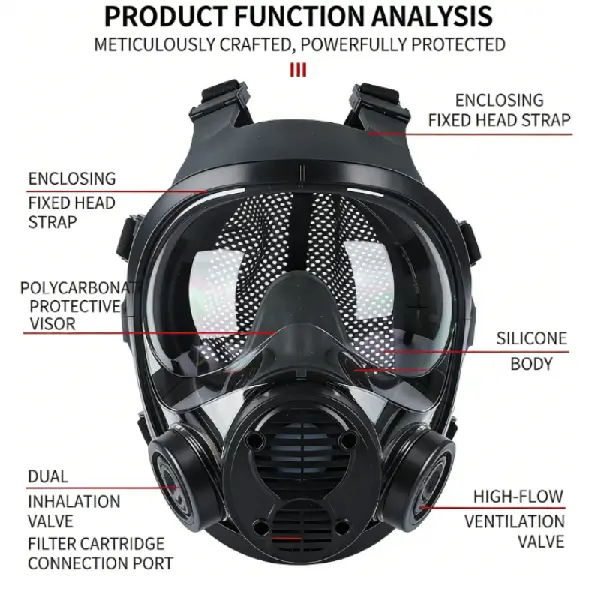
Standard Specifications
| Parameter | Details |
|---|---|
| Facepiece Material | High-grade skin-friendly silicone |
| Visor Material | Panoramic polycarbonate (anti-impact, anti-scratch) |
| Filter Interface | Standard 40mm NATO thread (RD40) |
| Filtration Efficiency (filter-dependent) | Up to 99.97% with P100/HEPA-rated compatible cartridges |
| Inhalation Resistance | <35 mm H₂O (343 Pa) at 85 LPM |
| Total Inward Leakage (TIL) | <8% at FFP2 / <2% at FFP3 filter level |
| Particle Size Targeted | 0.3 microns MMAD |
| Filter Standards Referenced | NIOSH 42 CFR Part 84 (US), EN 149:2001+A1:2009 (EU) |
The filtration efficiency and TIL numbers come from tests run with compatible-rated filter cartridges. You will not get those figures from the facepiece alone. Need certification paperwork for your market? Get in touch.
Key Features
Panoramic Polycarbonate Visor
This wide-angle visor stands up to impact and scratches. Neither one damages it. In dusty air or areas with active chemicals, the view stays clear. Distortion is not an issue.
Skin-Friendly Silicone Facepiece
The silicone here is a high grade one. It flexes to match different face shapes. That keeps the seal tight. No one spot ends up carrying all the pressure. Ask wearers what bothers them most on a long shift, and fit usually comes up first. This design goes after that problem.
Universal RD40 Filter Interface
The thread is the standard 40mm NATO (RD40). You can buy compatible filter cartridges from several suppliers around the world. No proprietary adapter is needed.
Multi-Layer Filtration Compatibility
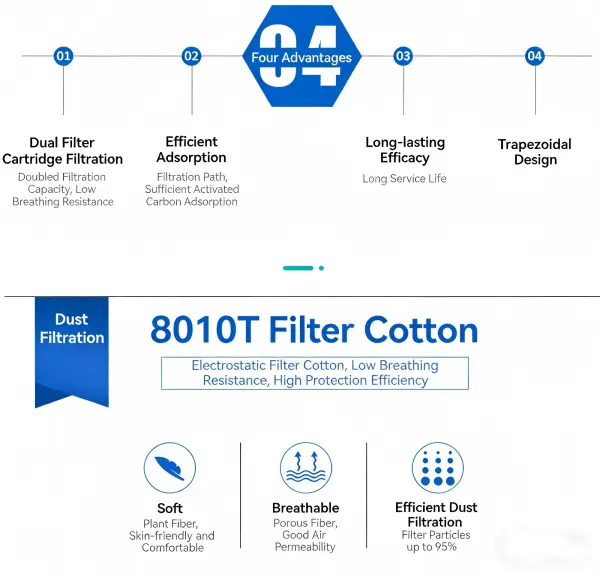
This mask takes cartridges made with electret non-woven media. A few mechanisms hold particles back. Inertial impaction grabs them. Interception and diffusion play their part. Electrostatic attraction pulls them in too. Your cartridge choice sets the filter rating. Ratings start at N95/FFP2 and go up to P100/HEPA levels.
Our product
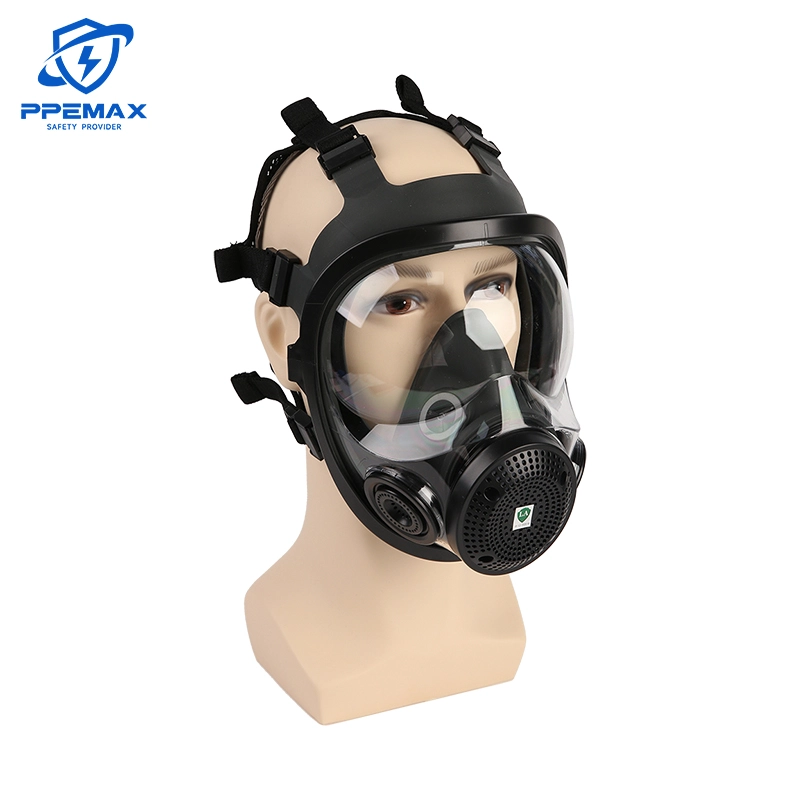
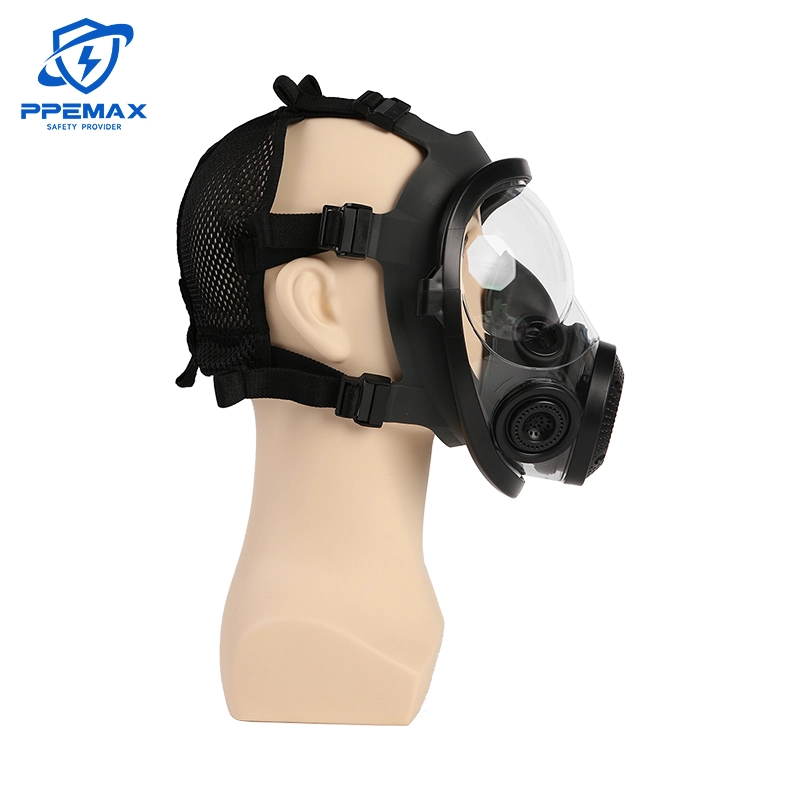
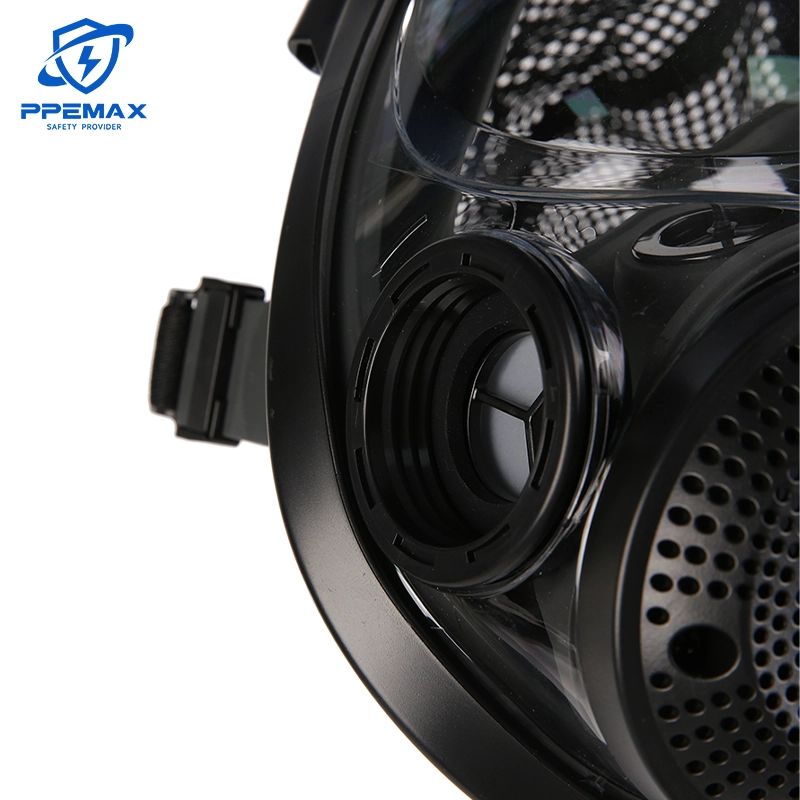
Protection Benefits
- Airtight face seal: stops leaks around the face gap. Left unchecked, those leaks can pull effective protection down a lot
- Full-face coverage: eyes and airways get covered by a single unit, all at once
- Low inhalation resistance (<35 mm H₂O). Over a long shift, that means the wearer tires out less
- Cartridge system you can replace: throwaway respirators cost more over time. This setup does not.
- Silicone build that is gentle on skin: even during long shifts, skin stays calm. It doesn't get irritated.
Applications
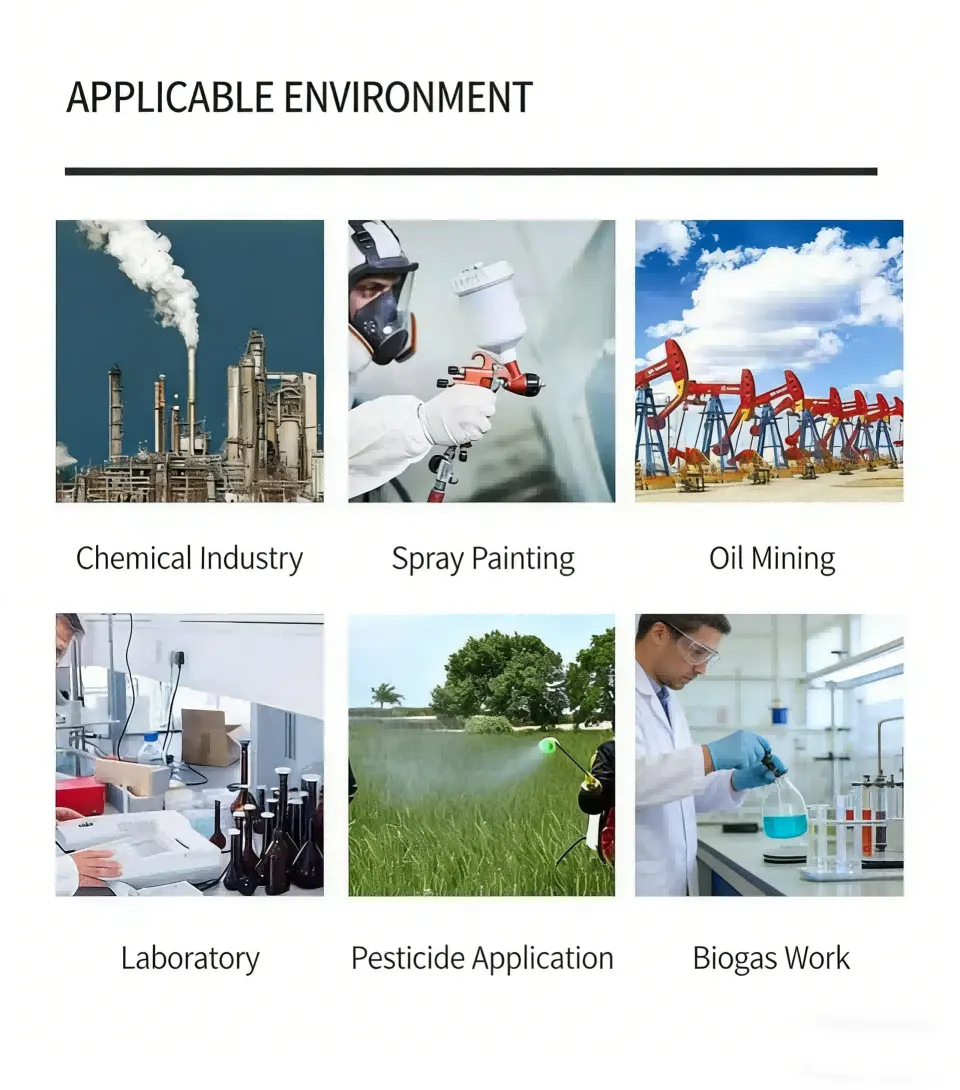
Heavy Industry & Safety Respirator Full Masks Construction
Respirable Crystalline Silica (RCS) gets thrown off by grinding and sanding. Demolition work does the same. Put P100-rated filter cartridges on these masks and the dust stays out. So do other fine particulates of a similar kind.
Pharmaceutical & Petrochemical Manufacturing
Some workplace air calls for an elastomeric full-face respirator. That covers volatile organic compounds (VOCs), acid gases, and pharmaceutical powder. Activated carbon cartridges do the job. So does a combination cartridge matched to the task. Where aerosolized oils are present, use oil-resistant R-series or P-series filters. They stop the media from breaking down.
Industrial Painting & Surface Coating
Full coverage of the face means solvent vapor and paint mist never reach the worker. Fine finishing work also needs a clear view. A panoramic visor gives that. Sightlines stay open the whole time.
Chemical Handling & Laboratory Use
Eyes and airways can both take a hit at once in a lab or a chemical processing plant. One full-face respirator covers the two. Half-face options fall short in these settings, so this type wins.
Why Choose PPE MAX
PPE MAX has manufactured occupational safety equipment since 1956. Our Safety Respirator Full Masks were designed to address two specific issues that distributors and end-users frequently report: unreliable face seal and dependency on proprietary filter systems. The RD40 interface and silicone facepiece construction directly respond to both.
- Over 65 years of manufacturing experience in occupational safety equipment
- Stable stock with global shipping capability
- Pricing comes in tiers, so a small distributor and a bulk buyer each get a rate that works
- Help is on hand when you pick a filter. We also check cartridge compatibility and sort out the import paperwork
Come and see the factory for yourself. Testing our products is no problem either. Tell us what you are after, or ask for samples first and send the full order through later.


Certifications for Safety Respirator Full Masks
Our products reference compliance with:
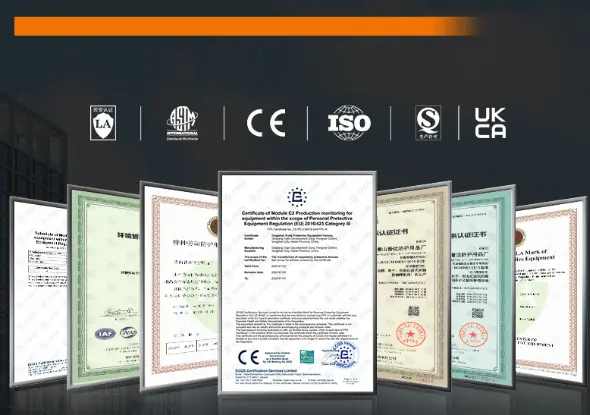
- US filter compatibility standards under NIOSH 42 CFR Part 84
- Filter compatibility standards for the EU, per EN 149:2001+A1:2009
Need certification documents for your market or the place the product gets used? Get in touch with us and ask.
Packaging
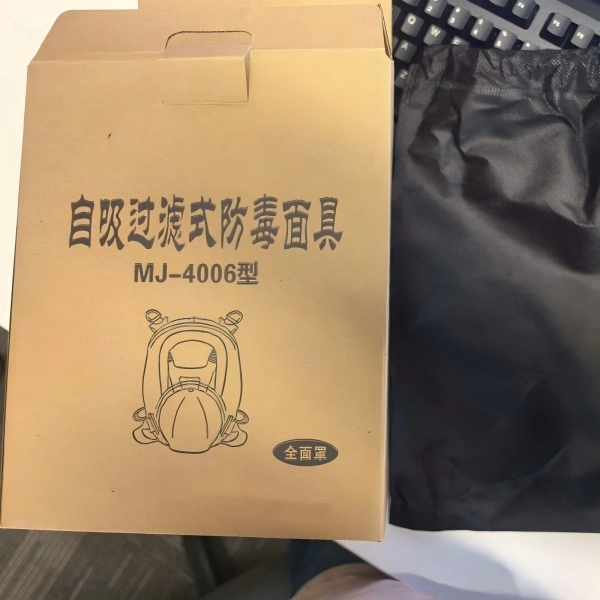
- Standard export carton with individual unit protection to prevent visor scratching during transit
- Custom labeling and packaging available for OEM and private label orders
After-Sales Support
- Technical consultation on filter selection and cartridge compatibility
- Paperwork help for customs clearance and import rules
- Spare parts on hand for straps and visors, plus filter adapters
FAQ
Q: How do N95, KN95, and FFP2 differ when you look at the technical details?
A: All three set limits for particle filters. Test methods differ, though. N95 (NIOSH, US) pushes NaCl aerosol through at 85 LPM airflow. FFP2 (EN 149, EU) gets checked with NaCl and Paraffin Oil, and the airflow runs at 95 LPM. KN95 (GB 2626, China) follows N95 closely. On top of that it adds a fit-factor requirement. Most buyers treat FFP2 as the tougher standard. The extra oil-resistance test is why.
Q: Can this product be used in oxygen-deficient environments?
A: No. These masks only filter the air around you. That is all they do. Oxygen is never added. If the oxygen level falls below 19.5%, a Self-Contained Breathing Apparatus (SCBA) or supplied-air systems are required.
Q: How long can a user keep one replaceable filter cartridge in service?
A: Dust loading capacity sets how long a cartridge lasts. So does contaminant concentration. Working conditions matter too. Replace cartridges when breathing resistance rises noticeably. Visible physical damage means swap them out. The cartridge maker's recommended service life is another trigger.
Q: Why is fit testing important?
A: The face seal is what decides how well a respirator works. OSHA 1910.134 calls for fit testing. Run that test quantitative (PortaCount) or qualitative (Bitrex/Saccharin). Facial hair can leave a gap. A wrong size will do it too. So will wearing the mask the wrong way. A gap like that can cut real protection a lot.
Q: In P100 filter ratings, what is the "P" short for?
A: NIOSH puts them in three groups. N means the filter is not resistant to oil. R means it is resistant, though use is capped at 8 hours. P stands for Oil Proof. You find oil-based mists wherever lubricants or metalworking fluids are used. Those sites need P-series filters. At such places, oil contact would break down the electrostatic charge in standard filter media.
Q: Can I request samples before placing a full order?
A: Yes. We do take sample orders. Get in touch with our team and tell us about your application and the volume you need.
Contact Us
Have a question or ready to order? Reach our team at bettybing@ppemax.com: we are glad to help with Safety Respirator Full Masks product selection, samples, and documentation.
Learn about our latest products and discounts through SMS or email