- English
- French
- German
- Portuguese
- Spanish
- Russian
- Japanese
- Korean
- Arabic
- Greek
- German
- Turkish
- Italian
- Danish
- Romanian
- Indonesian
- Czech
- Afrikaans
- Swedish
- Polish
- Basque
- Catalan
- Esperanto
- Hindi
- Lao
- Albanian
- Amharic
- Armenian
- Azerbaijani
- Belarusian
- Bengali
- Bosnian
- Bulgarian
- Cebuano
- Chichewa
- Corsican
- Croatian
- Dutch
- Estonian
- Filipino
- Finnish
- Frisian
- Galician
- Georgian
- Gujarati
- Haitian
- Hausa
- Hawaiian
- Hebrew
- Hmong
- Hungarian
- Icelandic
- Igbo
- Javanese
- Kannada
- Kazakh
- Khmer
- Kurdish
- Kyrgyz
- Latin
- Latvian
- Lithuanian
- Luxembou..
- Macedonian
- Malagasy
- Malay
- Malayalam
- Maltese
- Maori
- Marathi
- Mongolian
- Burmese
- Nepali
- Norwegian
- Pashto
- Persian
- Punjabi
- Serbian
- Sesotho
- Sinhala
- Slovak
- Slovenian
- Somali
- Samoan
- Scots Gaelic
- Shona
- Sindhi
- Sundanese
- Swahili
- Tajik
- Tamil
- Telugu
- Thai
- Ukrainian
- Urdu
- Uzbek
- Vietnamese
- Welsh
- Xhosa
- Yiddish
- Yoruba
- Zulu
Can a Full Mask Respirator Stop Toxic Gases?
When used with the right chemical cartridge filters or canisters made for the contaminants in your workplace, a Full Mask Respirator can successfully stop harmful gases. Unlike regular particulate respirators, these ones cover the whole face and use advanced filter technologies, like activated carbon layers and specialised absorbents, to get rid of harmful gases, organic vapours, and other substances. How well it works rests on choosing the right filters, testing the fit, and knowing what concentration amounts you're dealing with.
Understanding Full Mask Respirators and Their Role Against Toxic Gases
Gas protection is always brought up when safety managers look at risks to people's lungs. Here at PPE MAX, we've spent decades coming up with solutions to this very problem. The key is to know what these gadgets really do.
What Defines a Full Face Respirator
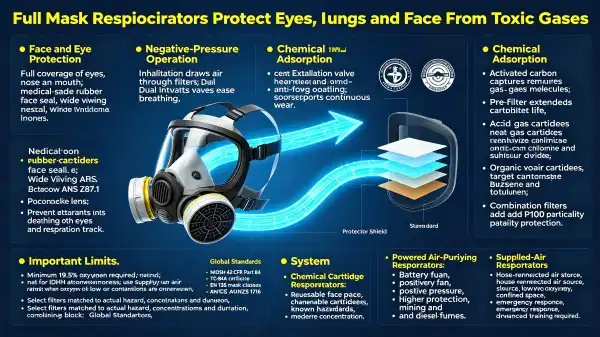
A Full Mask Respirator protects the eyes, nose, and mouth, as well as the rest of the face. It shuts out airborne contaminants and keeps them out. At PPE MAX, our designs include medical-grade rubber face seals that can mould to different face shapes and sizes, preventing leaks as much as possible. The wide-view polycarbonate glass meets ANSI Z87.1 standards for impact protection and lets you see clearly. This full covering fills in a very important safety gap: protection for both the eyes and the lungs at the same time. Many workplace settings have irritants that hurt eyes just as easily as lungs, so half-mask options aren't always enough.
The tech behind these respirators is based on making negative air when you breathe in. Air moves through filter cartridges connected by bayonets or threaded connectors that meet EN 148-1 standards as you take in. Our dual intake valves make it easier to breathe, which keeps you from getting tired during long shifts. The centre-mounted breathing valve effectively gets rid of breathed air and heat, which keeps the lenses from fogging up. This is a common problem that we've tried to solve by changing the placement of the valve and applying anti-fog treatments to the lenses.
How Filtration Technologies Neutralise Toxic Gases
To stop harmful gases, you need more than just mechanical filters. Chemical adsorption is used in gas and vapour cartridges. As polluted air flows through activated carbon that has been treated to make millions of tiny holes, it catches gas molecules. Different methods are used to deal with different dangers. For example, acid gas cartridges use materials that react with and neutralise chlorine and sulphur dioxide, while organic vapour cartridges use carbons that are specifically made for benzene and toluene.
We make canisters that have multiple layers of safety. A pre-filter gets rid of particles that would otherwise clog the carbon layer, which makes it last longer. The activated carbon bed then takes care of the gases and vapours. The capacity is directly related to the depth of the bed and the quality of the carbon. For some uses, you need combination tubes that have P100 particulate filters and gas absorption media built in. These protect against a variety of dangers that can happen in painting or making drugs.
The main problem is that air-purifying respirators, like our Full Mask Respirator types, can only work when there is enough oxygen (at least 19.5%) and not enough contaminants to be Immediately Dangerous to Life or Health (IDLH). When these levels are reached, supplied-air respirators must be used.
International Standards Governing Respiratory Protection
Procurement decisions should be based on well-known approval systems. In North America, NIOSH approval under 42 CFR Part 84 is still the gold standard, and our devices' TC-84A start numbers show that they have been through thorough testing. European buyers look at EN 136, which sorts masks into three levels of toughness (Class 1 through 3) and lists performance standards for lens visual quality, breathing resistance, and seal integrity.
Our manufacturing methods make sure that they are compliant with a number of different standards at the same time. Products going to Australia have to be certified to AS/NZS 1716, but Gulf Cooperation Council countries usually need extra paperwork. We keep test results from licensed labs that show how well the filters work, how much they leak, and how well the materials work with common industrial poisons. This method of multiple standards makes purchasing easier for global companies that have sites in places with different rules.
Types of Full Face Respiratory Systems
The type of contamination, its quantity, and the length of the work determine the best arrangement. Most of our customers buy chemical cartridge respirators, which have changeable filter cylinders attached to a facepiece that can be used again and again. These work best in places where dangers are known, and numbers are modest. This setup is often used by people who work in the chemical industry and deal with organic solvents. They switch out capsules based on contact time or breakthrough signs.
Powered air-purifying respirators (PAPR) have battery-powered fans that push air through filters before sending it to the facepiece. This makes positive pressure, which stops leakage from the inside and greatly raises the Assigned Protection Factor, which is the amount of security the device regularly offers. We've seen mining companies use PAPR systems for workers who are exposed to diesel particles and residual blasting fumes. These workers like how easy it is to breathe while doing physically hard jobs.
Supplied-air respirators (SAR) use hoses attached to compressors or tanks to give breathing air. They can be used in places with low oxygen levels or unknown contaminants. This top-level of protection is often needed when entering a confined area or responding to an emergency. We do have facepieces that work with SAR systems, but they need more complicated training and equipment than air-purifying models.
Full Mask Respirator vs Other Respirators: Which Is Best for Toxic Gases?
People are tempted to choose simpler options because they are cheaper and easier to use, but knowing about security gaps keeps people from making terrible mistakes. Safety heads we talked to told us about these differences after hearing about close calls.
Comparing Full Mask and Half Mask Respirators
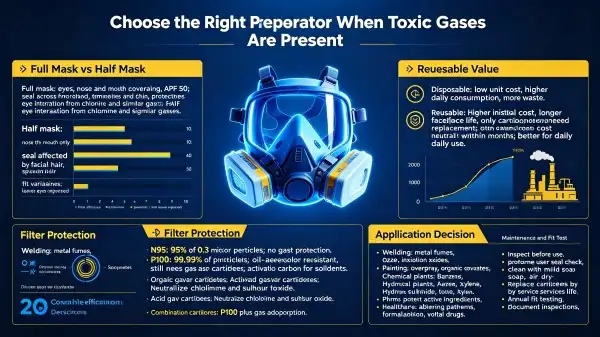
Half mask respirators only cover the nose and mouth. The eyes are left open. This makes two major holes in the defence. Many harmful gases upset nasal membranes and hurt the eyes, even when breathing protection is used correctly. This is shown by chlorine exposure: even a short touch damages the eye very badly. The second problem is about the security of the seal. Half masks seal against the upper lip and chin, which can be affected by facial hair, face movements during speech, and differences in how well the mask fits. Our Full Mask Respirator designs spread the sealing pressure across the forehead, temples, and chin, making extra layers that make leaking much less likely.
This difference can be measured by Assigned Protection Factors. A half mask that fits properly usually gets an APF of 10, which means it lowers exposure to a tenth of the level of the air around you. Our negative-pressure Full Mask Respirators have an APF rating of 50, which means they protect five times better. Often, regulations set minimum APFs for different types of situations. Going above these minimums gives you extra protection in case concentrations suddenly rise.
Full Face Respirators Versus Gas Masks
The words are often used interchangeably, but it's important to know the difference. The main purpose of military gas masks is to protect against war agents. They are made of materials that are resistant to certain chemical weapons and often come with ways to drink and talk. To keep costs down, industrial Full Mask Respirators make sure that workers are comfortable during long shifts and that their glasses can be worn with them.
Our business designs strike a mix between safety and usefulness. The speech diaphragm we use lets you talk clearly without taking the device off, which is very important for group projects that need to coordinate your voice. The 5-point harness system evenly spreads weight so that there are no pressure spots, even during 8-hour shifts. When workers have to decide whether to always wear safety gear or take steps that put safety at risk, these physical factors often make the difference.
P100 vs N95: Filter Efficiency for Different Hazards
Ratings for particulate filters show how well they catch particles, but they don't talk about gases. At least 95% of airborne particles 0.3 microns in diameter are caught by N95 filters. These are the smallest particles that can get through filters, but they don't protect against gases or vapours. Even though P100 filters are 99.97% effective and can block oil-based aerosols, they still need different cartridges to protect against gases.
There is confusion because many dangerous processes make both air and particles. Metal fumes (particulates) and ozone (gas) are made when you weld. Overspray (particulate matter) and solvent vapours (gas) are made when you paint. Our combination cartridges handle these different kinds of situations by combining P100 pre-filters with organic vapour carbon beds. Specifications for purchases must list all contaminants that are present. If they don't, workers wearing respirators that seem to be appropriate could be exposed to dangers that they can't see.
Reusable vs Disposable: Long-Term Value Analysis
Low unit costs make disposable filtering facepiece respirators appealing, but lifetime analysis usually shows that reuse systems are better. With proper care, a good Full Mask Respirator facepiece will last for many years, and all that is needed is to change the cartridges every so often. We found that reused systems equalise in cost within months in places where daily respiratory protection is needed. They also produce less trash, which is becoming an increasingly important factor as sustainability metrics affect purchasing decisions.
The caveat is about how to handle pollution. When there are chemicals in the environment that break down materials or enter elastomers, disposable methods may be needed. Material suitability data for our thermoplastic rubber and silicone parts against thousands of chemicals helps safety managers make smart choices. Our training classes go over the right way to clean reusable items so that they stay clean for multiple people when assigning one to each person isn't possible.
Practical Applications and Benefits of Full Mask Respirators in Industrial Settings
Theory doesn't mean much without proof in the real world. Because we work with businesses all over the world, we can see where these gadgets really make a difference in safety.
Protection During Welding and Surface Coating Operations
Metal fumes with manganese, chromium, and nickel, ozone made by UV light, and nitrogen oxides from high-temperature processes are all dangerous airborne substances that come from welding. Painters are exposed to volatile organic chemicals and isocyanates, which can make the lungs more sensitive and cause workplace asthma. In both cases, poisonous gases need to be filtered in a certain way.
A shipbuilding contractor we work with shows how the real application works. They used to use local air ventilation for their tight space welding jobs, but workers still had problems with respiratory irritation. After taking samples of the air and finding that ozone levels were getting close to the standards for safe exposure, they made us wear Full Mask Respirators with P100 and ozone filters. Respiratory problems got a lot better, and eye pain, which hadn't been noticed before, got better too, because the whole face was covered.
Surface finishing processes present similar challenges. Paint shops that fix up cars use two-part polyurethane paints that have isocyanate hardeners in them. Even a short exposure can make someone highly sensitive, and any further contact will cause serious reactions. Our organic vapour packs with P100 pre-filters protect you, and the wide-view lens lets painters keep an eye on quality without putting safety at risk.
Chemical Handling and Manufacturing Environments
Chemical plants handle chemicals all the time that are bad for your health in both the short and long term. Acid gases cause lung oedema, and hydrogen sulphide quickly knocks out the nervous system. Organic solvents like toluene and xylene hurt the liver and kidneys. To set up effective lung protection, you need to evaluate the risks, keep an eye on the exposure, and choose the right gear.
A petroleum plant that handles benzene, which is known to cause cancer, came to us looking for ways to help maintenance workers who enter process areas during turnarounds protect their lungs. Benzene levels changed unexpectedly depending on the amount of leftover vapours and how well the airflow worked. We suggested Full Mask Respirators with benzene-rated high-capacity organic vapour cartridges, along with quantitative fit testing to make sure each person got a good seal. The facility set up routines for changing cartridges based on maker data on service life that was adjusted for the unique conditions of exposure. This stopped breakthroughs that could have compromised protection.
The pharmaceutical industry has to deal with special problems because the active ingredients they use are very strong and can hurt workers at microgram exposure levels. Our clients in this field use Full Mask Respirators for compounding and cleaning tasks. They like the positive-pressure PAPR choice because it keeps contaminants out even if the face seal breaks briefly. These systems are flexible for a wide range of production efforts because they let you choose the right cartridges for different compounds. They also come with combination units that protect against multiple dangers at the same time.
Healthcare and Laboratory Respiratory Protection
More and more healthcare situations are realising that airborne infections can be caused by more than just bacteria. Laboratories that work with chemical materials, biological samples, and volatile drugs need to have security that meets industry standards. Our Full Mask Respirators are used by research centres doing aerobiology studies, pathology departments working with formaldehyde-fixed cases, and pharmaceutical research labs making new chemicals.
In order to follow institutional biosafety practices and OSHA bloodborne pathogen guidelines, people are often required to wear eye protection and filter their airways. Full Mask Respirators stylishly meet both needs. As a result of the recent focus on being ready for dangerous diseases, many hospitals added our PAPR systems to their emergency supplies. They know that powered systems provide better protection than throwaway respirators during prolonged patient care activities.
Maintenance Protocols and User Training Requirements
Equipment is only safe when it is used and kept in good shape. We've made thorough training lessons that go over things like how to inspect, how to put on, how to check the seal, how to choose a cartridge, and how to clean. Users learn to spot damage that makes safety less effective, such as broken lenses or worn-out face seals. They work on getting the right fit because they know that rushing this step will make them more visible.
Maintenance makes sure that devices work reliably and extends their life. Workers take respirators apart after each use and wash the facepieces with warm water and light soap. They then let the facepieces dry naturally before putting them away. Inhalation and exhale valves need to be checked and replaced on a regular basis, as specified by the manufacturer. We keep spare parts in stock all over the world, so when parts need to be refreshed, there is less downtime.
It is still necessary to do fit tests. Basic proof can be done with qualitative methods that use irritant smoke or saccharin aerosols, while quantitative testing uses special tools to measure real leakage. OSHA requires fit tests once a year and whenever a person's body changes in a way that could affect the seal, like losing a lot of weight, getting dental work, or getting scars on their face. Our technical support team helps clients set up fit-testing programs that are legal and appropriate for their workforce size.
How to Choose the Right Full Mask Respirator for Toxic Gas Protection — A Buyer's Guide
The health of workers is a good way to measure the effects of procurement choices. We help our clients choose tools that fit their needs and the dangers they face on the job.
Assessing Workplace Exposure Risks and Environmental Factors
A thorough risk estimate is the first step in choosing the right Full Mask Respirator. Industrial hygienists take samples of the air to find contaminants and measure concentrations. They then compare the results to the standards for occupational exposure set by OSHA, ACGIH, or similar regulatory groups. This information figures out the amount of safety that is needed and gets rid of the need to guess, which could leave workers not well protected.
The environment affects how well technology works. When temperatures are high, breathing rates go up, which uses up cartridge space faster and makes it harder for users to be comfortable. Some filter media can be damaged by high humidity. We've given mining companies in tropical areas respirators that are better at managing moisture, and users say they stay comfortable even in tough situations. On the other hand, places that are cold might need to think about lens mist and the temperature of the air entering the facepiece.
Work length is important. Tasks that need to be protected continuously during full shifts need comfortable designs that keep workers from getting too tired. Our soft silicone face seals and customisable harness systems keep pressure spots from forming, even when you wear them for a long time. People who are exposed to things on and off might be able to handle less comfy but cheaper choices.
Evaluating Filtration Efficiency and Certification Standards
The choice of cartridge directly affects how well security works. Each type of cartridge is designed to kill a certain type of contamination. Knowing about the risks in the job lets you make the right matches. Organic vapour cartridges are good for compounds like fuels and solvents. Acid gas cartridges are good for neutralising chlorine, hydrogen sulphide, and sulphur dioxide. Multi-gas cartridges combine media to protect against a wide range of hazards. Ammonia-specific cartridges are good for this specific threat that doesn't respond well to standard organic vapour media.
Service life estimates stop dangerous breakthroughs that happen when contaminants get through media that is already full. Manufacturers give capacity information based on the type of contaminant, its quantity, the rate of breathing, and the factors in the surroundings. Conservative change-out plans increase safety margins, especially when working with gases that don't smell or have weak warning properties that don't let users know when a cartridge is empty.
Certification makes sure that gadgets do what they say they will do. Our goods have been approved by NIOSH and have specific TC numbers that can be checked in public sources. The European CE mark shows that a product meets EN 136 standards, and the informed body identification numbers show that the testing was done by a third party. We offer documentation packages that include test results, statements of conformity, and material safety data to help with the buying process in government contracts and regulated businesses.
Considering Ergonomics and User Compatibility
If workers don't wear gadgets regularly, even the best technical specs don't matter. Compliance is driven by comfort. Our design theory is based on user feedback we've gathered over many years working with a wide range of businesses. We now know that acceptance rates are directly related to things like even weight distribution, enough air flow to keep heat from building up, and a clear field of view.
Concerns about compatibility include the ability to accommodate eyeglasses (our facepieces can hold sunglass kits with correction lenses without breaking the face seal) and the need to communicate. Speech diaphragms that keep you clear are helpful for jobs that require you to coordinate your words. In some settings, workers must wear hard hats, hearing protection, or chemical protective suits. Our products work well with these extra PPE items.
The size available makes sure that everyone in the workforce can find the right fit. We make different sizes of facepieces and include measuring guides to help people choose the right one. Fit is affected by gender differences in facial measurements, racial differences in facial features, and the fact that each person is unique. Wide size ranges are better for accommodating this variety than one-size-fits-all solutions, which don't really work best for anyone.
Single vs Dual Filter Configurations and Bulk Procurement Strategies
The balance, breathing resistance, and pollution ability are all affected by how the filters are set up. Single-cartridge versions put the filter in the middle, but they may cause a small imbalance in the weight. Dual-cartridge types put filters on the side, which spreads the weight evenly and makes breathing easier by giving the media more surface area. Dual configurations are better for hard work, while compact single setups may be better for tight areas with little room to move.
When you buy in bulk, you get more benefits than just lower unit costs. We offer private labelling for wholesalers, custom packaging, and training programs that are made just for them when their orders hit certain levels. Our global delivery network sends packages to 134 countries. Regional stores cut down on lead times and freight costs. Setting up supply deals makes sure that products are always available. This is especially important in industries with strict safety rules, where a lack of equipment could stop activities.
People should pay attention to managing spare parts and consumables. Long-term running costs are lower when you buy cartridges, new valves, and lens covers in bulk and get discounts. We help our clients figure out how much to use based on the size of their workforce, how often they are exposed to germs, and how long each cartridge lasts. Then, we set up delivery plans that keep the right amount of goods on hand without keeping too much cash on hand.
Verifying Performance and Future Trends in Full Mask Respirator Technology
As new tools come out and dangers appear, workplace safety changes. Protection methods will continue to work if they are kept up to date.
Testing Methodologies and Compliance Verification
Lab tests in controlled environments set a standard for performance, but field proof proves how well it works in the real world. We test for inward leakage to see how much contamination gets into the breathing zone. This shows that devices that are properly fitting meet the stated safety factors. By measuring breathing resistance at different flow rates, you can be sure that workers can keep breathing normally without having to work too hard, which could make them tired or cause the equipment to break down.
Chemical protection is checked by checking the material. Chemical tests on elastomers and plastics show that they won't break down when they're supposed to. Permeation testing shows if chemicals seep into fabrics over time, which is important information to know when choosing respirators for different chemical exposures. On our technical data sheets, we list the absorption rates and breakthrough times for popular industrial chemicals. This helps you decide which chemicals to use.
Regulatory compliance is more than just getting certified at the start. Quality management systems that are regularly checked against ISO 9001 standards make sure that the products always meet the requirements. Regulatory audits look closely at the design paperwork, output records, and complaint investigation systems that we keep. This infrastructure lets buyers know that the shipment they are getting today fits the approved design they asked for.
Advances in Filtration Media and Smart Technologies
New technologies have made both safety and the user experience better. Better methods for activated carbon improve its ability to absorb, which makes cartridges last longer and need to be replaced less often. Catalytic media don't just absorb harmful gases; they actively change some of them into safe substances. This protects against gases like carbon monoxide that regular carbon doesn't really get rid of.
Material science makes parts that are lighter and stronger. Modern thermoplastic elastomers offer better chemical protection and skin-friendly closing. Different types of polycarbonate lenses make them lighter and more scratch-resistant. These changes are important for long shifts, where every gram counts when it comes to getting tired.
Emerging smart technologies include sensors that check the quality of the fit, the amount of contamination in the surroundings, and the load on the filters. As prototypes are being made, they will let users know when they need to change the cartridge based on real exposure rather than conservative schedules. This will improve both safety and cost-effectiveness. Heads-up screens that are cast onto respirator lenses could show real-time safety information without getting in the way of work. The direction of the industry can be seen in these new ideas, even though they aren't widely available yet.
Sustainability and the Shift Toward Reusable Systems
Environmental awareness is becoming more and more important in purchasing choices. Single-use, throwaway respirators create large amounts of waste, and businesses that use thousands of them every year are aware of the environmental issues they raise. Reusable Full Mask Respirators help companies meet their environmental goals by cutting down on the amount of trash that needs to be thrown away.
Product lifecycles that last longer help the environment. Our facepieces work reliably for years, and the only thing they need to be replaced are the cartridges. Even these have parts that can be recycled, and we're looking into programs that will let used cartridges be handled instead of being dumped in a landfill. Designing for repairability instead of replacement makes things last longer and uses fewer resources.
Trends in regulations support this direction. Reusable PPE is encouraged by European Union rules that stress the ideals of a circular economy. More and more, corporate sustainable reports keep track of how much waste a company makes, which makes people more likely to buy durable equipment. These factors, along with the lower costs over the course of its lifetime, make reusable lung protection a good choice for future purchasing plans.
Conclusion
To protect people from toxic gases, you need to do more than just wish them well or follow the rules. It involves matching high-tech gear to exactly identified dangers, making sure the gear fits right and that workers are trained properly, and staying alert by constantly watching and maintaining the gear. When chosen and used correctly, Full Mask Respirators offer good safety that lets workers do dangerous jobs without harm. We've learned a lot over the past 65 years about what really keeps people safe, which is reflected in the full facial seal, multiple cartridge options, and strong structure of our goods. As safety rules change and new dangers appear, lung protection technology keeps getting better. But some things stay the same: know the danger, choose the right protection, make sure it fits right, train fully, and keep it in good shape.
FAQ
1. How long do gas cartridges last on a full face respirator?
How long a cartridge lasts depends on the type of contamination, its quantity, the temperature, the humidity, and how fast it breathes. In moderate-concentration settings, organic vapour packs can last between 8 and 40 hours. In high-concentration environments, the media is used up in hours. Manufacturers offer end-of-service-life indicators (ESLIs) or ways to figure out how long something will last. Change-out plans that are too conservative stop progress. Don't depend on smells to warn you; many poisonous gases don't smell bad enough.
2. Can you wear a full face respirator with glasses?
Yes, our Full Mask Respirators can fit corrective glasses because they have built-in spectacle kits that keep the glasses inside the facepiece without breaking the seal. When normal glasses are worn under the mask, they make it harder for the facepiece to make contact with the face, which leads to leaks. The answer to the spectacle kit keeps the visual correction while keeping the safety.
3. What is the difference between an air-purifying respirator and a supplied-air respirator?
Air-purifying respirators clean the air around you by removing contaminants. However, they need enough oxygen (at least 19.5%) and pollution levels below the IDLH level. Supplied-air respirators get clean air from outside sources through lines. They can be used in places with low oxygen, unknown contaminants, or amounts that are too high for air-purifying respirators to handle. Which method to use depends on the needs of the application.
Partner with PPE MAX for Reliable Full Face Respiratory Protection
Our dedication to safety at work goes beyond just making gadgets. We've been a reliable Full Mask Respirator seller since 1956, so we know how to keep workers safe in the harshest workplace settings in 134 countries. Our tech team knows how hard it is for procurement workers to find a balance between user acceptance, effective safety, following the rules, and staying within budget. We make approved respiratory protection that meets NIOSH, EN 136, and AS/NZS standards. Our products come with full expert support to help with selection, application, and training. Our methods can be changed to fit the needs of any facility, whether it's a chemical plant, a mine, or an emergency response team. Email our team at marketing@ppemax.comto talk about your needs for breathing safety. Let us use our decades of experience to make sure that every day, your workers get home safely.
References
1. National Institute for Occupational Safety and Health (NIOSH). "NIOSH Guide to the Selection and Use of Particulate Respirators." Publication No. 96-101, U.S. Department of Health and Human Services, Centres for Disease Control and Prevention, 1996.
2. Occupational Safety and Health Administration (OSHA). "Respiratory Protection Standard, 29 CFR 1910.134." U.S. Department of Labour, Federal Register, Volume 63, 1998.
3. European Committee for Standardisation. "EN 136:1998 - Respiratory Protective Devices - Full Face Masks - Requirements, Testing, Marking." CEN-CENELEC Management Centre, Brussels, Belgium, 1998.
4. American National Standards Institute. "ANSI Z88.2-1992 - American National Standard for Respiratory Protection." American Industrial Hygiene Association, Fairfax, Virginia, 1992.
5. Cohen, H.J. and Birkner, L.R. "Respiratory Protection: A Manual and Guideline, Third Edition." American Industrial Hygiene Association Press, Fairfax, Virginia, 2004.
6. Bollinger, N.J. and Schutz, R.H. "NIOSH Guide to Industrial Respiratory Protection." U.S. Department of Health and Human Services, Public Health Service, Centres for Disease Control, National Institute for Occupational Safety and Health, Division of Safety Research, DHHS Publication No. 87-116, 1987.
Learn about our latest products and discounts through SMS or email