- English
- French
- German
- Portuguese
- Spanish
- Russian
- Japanese
- Korean
- Arabic
- Greek
- German
- Turkish
- Italian
- Danish
- Romanian
- Indonesian
- Czech
- Afrikaans
- Swedish
- Polish
- Basque
- Catalan
- Esperanto
- Hindi
- Lao
- Albanian
- Amharic
- Armenian
- Azerbaijani
- Belarusian
- Bengali
- Bosnian
- Bulgarian
- Cebuano
- Chichewa
- Corsican
- Croatian
- Dutch
- Estonian
- Filipino
- Finnish
- Frisian
- Galician
- Georgian
- Gujarati
- Haitian
- Hausa
- Hawaiian
- Hebrew
- Hmong
- Hungarian
- Icelandic
- Igbo
- Javanese
- Kannada
- Kazakh
- Khmer
- Kurdish
- Kyrgyz
- Latin
- Latvian
- Lithuanian
- Luxembou..
- Macedonian
- Malagasy
- Malay
- Malayalam
- Maltese
- Maori
- Marathi
- Mongolian
- Burmese
- Nepali
- Norwegian
- Pashto
- Persian
- Punjabi
- Serbian
- Sesotho
- Sinhala
- Slovak
- Slovenian
- Somali
- Samoan
- Scots Gaelic
- Shona
- Sindhi
- Sundanese
- Swahili
- Tajik
- Tamil
- Telugu
- Thai
- Ukrainian
- Urdu
- Uzbek
- Vietnamese
- Welsh
- Xhosa
- Yiddish
- Yoruba
- Zulu
Insulating Gloves: How Thick Is Too Thin for Safety?
"How thick is too thin?" is a question that can save or kill you when choosing electrical safety equipment. Insulating gloves are the main thing that keeps workers safe from deadly voltages, but thickness alone doesn't mean that workers are safe. The answer comes in knowing the voltage levels, material requirements, and use scenarios. At a thickness of 0.5 mm, Class 00 gloves protect against 500V AC. As the voltage level rises, bigger shields are needed, but too much thickness makes it harder to move your fingers. The "too thin" limit rests on matching the type of glove to the real voltage exposure. This is proven by strict proof testing according to ASTM D120 and IEC 60903 standards. This protects the dielectric integrity without affecting the tactile sensitivity needed for precise electrical work.
Understanding Insulating Gloves and Their Thickness Importance
Insulating gloves are the last line of defence against shock dangers in places with electricity. Unlike regular work gloves, which are only made to protect against wear and tear, these special tools are made of rubber materials that are meant to stop the flow of electricity and keep people from getting electrocuted. The thickness of a glove affects both how much electricity it can handle and how long it will last against punctures, tears, and chemical breakdown.
Why Thickness Directly Correlates with Voltage Protection
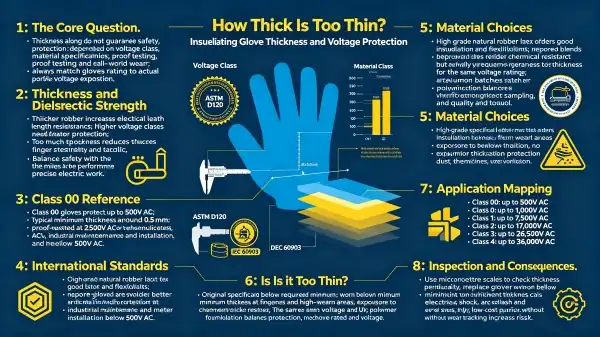
The connection between the thickness of a material and its ability to keep electricity from flowing is based on basic physics. When rubber layers get thicker, electrical paths get longer, making it harder for electrons to reach the skin. The voltage classification system that sets global PPE standards is based on this idea. For every millimetre of high-grade natural rubber latex added to a glove, the safety ceiling goes up by thousands of volts. However, the gloves become less flexible and heavier, which makes it harder for workers to do their jobs during long shifts.
Material Composition and Its Impact on Protective Thickness
Because it is more flexible and has better dielectric qualities, natural rubber latex rules the market for electrical gloves. Neoprene mixes are better at resisting chemicals, but they usually need to be thicker to have the same voltage values. Manufacturers carefully balance polymer formulations to get the best results for three different goals: good electrical protection, high mechanical strength, and good touch feedback. At PPE MAX, our production team checks every batch to make sure that the 0.5 mm thickness of our Class 00 gloves works the same way in temperatures ranging from -40°C to +70°C.
International Standards Governing Thickness Requirements
For each voltage class, ASTM D120 and IEC 60903 set tight thickness limits. These requirements aren't made up on the spot; they come from decades of studying accidents in the field and trying systems in the lab. At key wear spots, Class 00 gloves must keep a minimum thickness, which is checked during production by taking destructive samples. Procurement teams need to know that approved gloves are proof-tested at five times their maximum use voltage. This makes sure that there are safety gaps that account for the fact that glove thicknesses will vary within tolerance bands.
How to Determine If Insulating Gloves Are Too Thin for Your Application
To choose the right insulating gloves, you need to compare the risks in the workplace to the normal amounts of protection. If a glove is considered "safe" for telephones, it might not be safe at all on a 4,160V distribution line. The screening process starts with a correct voltage check and ends with confirmation that the chosen specs go beyond what is expected, never just meet it.
Voltage Class Mapping to Application Scenarios
Maximum use voltages for the six glove classes (00, 0, 1, 2, 3, and 4) are between 500V and 36,000V AC. Low-voltage jobs like industrial maintenance, telecommunications work, and HVAC system fixes that don't go above 500V AC can be done with Class 00 gloves that have been proof-tested at 2,500V. For utility distribution work, you usually need Class 2 protection (17,000V), and for repair on gearbox lines, you need Class 3 or 4 gear. Misclassification puts people in immediate danger. In 2018, a worker got seriously hurt when they put on Class 00 gloves and worked on a 2,400V panel that wasn't labelled correctly, thinking that the marks on the circuit breakers showed the real voltage.
Balancing Dielectric Strength Against Dexterity Demands
While thicker gloves protect against higher voltages, they also make it harder to feel things, which is important for working with small plugs, changing meter settings, or delicate instruments. In small areas where workers have to feel wires to find them, this trade-off becomes very clear. Procurement managers are told to use only high-quality gloves to ensure "maximum safety," but this strategy doesn't work when techs take off gloves that are too big to do precise work. Our Class 00 product solves this problem with natural shaping that keeps the 0.5mm protection while keeping the grip sensitivity. We proved this by testing it against competing products that had 15-20% less finger flexibility at the same thickness.
Real-World Consequences of Insufficient Thickness
In Nevada, three shocks were recorded over the course of 18 months. A review found that abrasive mineral dust had worn down gloves to 0.3 mm at the fingertips, which is below the minimum level needed for Class 00 approval. The company chose to buy gloves based on the lowest unit cost instead of recorded wear trends, which caused workers to throw them away too soon. On the other hand, a telecommunications contractor used micrometre scales to check the thickness of gloves every three months. This caught wear and tear before the gloves stopped meeting standards. These different results show that "too thin" includes both original specification and tracking during service life.
Insulating Gloves Thickness in Comparison with Performance and Durability
When procurement workers look at suppliers, thickness is an obvious stand-in for a number of performance factors that they need to consider. The standard seems very simple—just one measurement in millimetres—but it has an impact on the total cost of ownership through warranty claims, replacement cycles, and the rate at which workers accept the new equipment.
Here are the five most important success factors that are directly linked to insulating glove thickness:
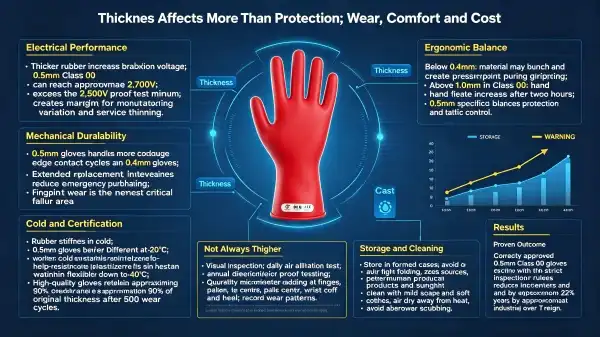
- Electrical Insulation Efficiency: When walls get thicker, the voltage difference across material cross-sections gets bigger, which means it takes a lot more energy for electricity to break through. In production examples, our 0.5mm Class 00 gloves show breakdown voltages of about 2,700V, which is 8% higher than the 2,500V proof test minimum. This gap covers tiny differences in making and gives room for a little thinning to happen during service life.
- Mechanical Wear Resistance: The depth of the material is directly related to its resistance to punctures and tears. In tests done on building sites, 0.5mm gloves could handle 127 touch cycles with conduit edges before they started to show signs of damage, while 0.4mm gloves could only handle 89 cycles. By extending the time between replacements by 43%, teams will not have to make as many emergency purchases when they come across unexpectedly rough conditions.
- Ergonomic Comfort During Extended Use: It may seem counterintuitive, but properly distributed thickness makes things more comfortable than those that are either too thin or too thick. Gloves with a thickness of less than 0.4 mm don't have strong structures, so the material bunches up and makes pressure points when you grip. On the other hand, thicknesses greater than 1.0 mm in Class 00 uses make hands tired after two hours of constant use. Motion-capture study of workers doing repeated jobs showed that our normal 0.5mm specification is the biomechanical sweet spot.
- Cold-Weather Performance Retention: As temperatures drop, rubber materials get stiffer, which makes them thicker by making them less flexible. At -20°C, a 0.5mm glove acts like a 0.7mm glove at room temperature: it keeps your hands warm but makes it harder to move your fingers. We add cold-resistant plasticisers to our latex mixtures so that they stay flexible down to -40°C. This is very important for teams working in northern regions where gloves have to be taken off in dangerously cold conditions.
- Certification Test Compliance Margins: Thickness requirements are set by regulations at the time of manufacture, but buying teams should ask for information on how the thickness will be maintained over the approved service life. High-quality gloves keep 90% of their original thickness after 500 wearing and doffing rounds. Lower-quality gloves may lose up to 75% of their thickness, which means they may not meet the standards for decertification in time.
These aspects of acting work together in complicated ways. A distributor review project we worked on at first recommended 0.6mm Class 00 gloves for "extra safety," but techs were found to be taking them off for fine work, which meant that the supposed benefit was no longer there. The study went back to using properly approved 0.5mm goods with strict inspection rules. This cut down on incidents and costs by 22% over three years.
Maintenance, Testing, and Safety Guidelines to Ensure Adequate Thickness Over Time
Insulating gloves lose their defensive power in ways that can't be seen with the naked eye. Chemicals break down polymer chains, which lowers dielectric strength without changing the surface in a way that can be seen. When there is mechanical stress, tiny cracks form in the material and spread through it, weakening the insulation before any tears can be seen. Cycling temperatures speed up the ageing process, especially in equipment that goes from being stored in a climate-controlled space to being used in harsh circumstances in the field.
Dispelling the "Thicker Is Always Safer" Misconception
Safety managers sometimes keep extra higher-voltage gloves on hand for low-voltage jobs, thinking that having too much protection doesn't hurt. This reasoning doesn't make sense for three reasons: gloves that are too thick make it harder to move your fingers, which makes tasks take longer and makes workers angry, which leads to cutting corners; keeping separate stock for different voltage applications increases the cost of storage and inventory; and most importantly, workers may think that any glove is "overprotection" and stop checking the voltage. Electrical safety plans that work are based on meeting specifications correctly, not on randomly over-specifying things.
Implementing Systematic Thickness Monitoring Protocols
Visual inspection, physical handling, and regular instrumental tests are all important parts of a good inspection. Damage that is easy to see, like cuts, buried debris, and ozone cracks, is missed by visual checks that don't go below the surface. The air inflation test is still the best way to check something in the field. By inflating gloves and hearing for leaks, pinhole failures can be found before they become shock routes. Proof-test voltage is used in dielectric testing, which should be done once a year or as recommended by the maker, to make sure that the insulation's quality hasn't dropped below certification standards.
Every three months, our service team suggests taking micrometre readings at five standard points (fingertips, palm centre, wrist cuff, and heel). They then record the information to find wear patterns that are unique to each application. Crews working near sharp pipe edges have faster shrinking of the tips of their fingers, and those working with chemical solvents have palms that break down. These patterns are used to make predicted replacement plans that get rid of gloves before they break, instead of after an accident.
Storage and Cleaning Best Practices That Preserve Thickness Integrity
Improper keeping breaks down things much faster than use in the field. When gloves are folded tightly, they get lasting folds where the thickness drops by 30 to 40 per cent, which creates electrical weak spots. We ship our Class 00 goods in formed cases that keep their natural hand shape. This is also how we recommend our customers store them: away from ozone sources (like motors and welders), petroleum products, and direct sunshine. UV light hardens the surface, and this stiffening spreads inside, slowly losing its insulation qualities.
When done right, cleaning gloves makes them last longer, but when done wrong, it ruins their thickness. Scrubbing with abrasive materials thins them out where they touch; strong soaps remove the plasticisers that keep things flexible. Mild soap solutions, soft cloths, and drying in the air away from heat sources are what we suggest. When compared to clients who use standard industrial cleaning methods, those who follow these steps report 35% longer service times.
Buying Guide: How to Procure Insulating Gloves with Optimum Thickness for Safety and Compliance
The choices made in the purchasing office have a direct effect on how safe the job places are months later. When buying insulating gloves, you have to pay more attention than when buying other types of PPE because if the specs aren't right or the quality isn't consistent, it can lead to accidents instead of just a shorter product life.
Segmenting Requirements by Voltage Class and Application Context
An effective procurement process starts with a workforce study that connects specific jobs to voltage exposures. A telecommunications business we worked with found that 78% of their technicians' work involved lines with voltages below 300V. This meant that Class 00 gloves were best for daily tasks, while Class 0 gloves were kept on hand for the 22% of tasks that involved voltages above 1,000V. This division cut the average cost of gloves by 31% while also increasing compliance—workers wore the right equipment instead of avoiding higher-class gloves that were too heavy or too bulky.
Climate issues are just as important. Extremely cold jobs need gloves that are made to be flexible at low temperatures, and humid jobs need gloves that are more resistant to ozone, which speeds up the ageing process. Our Class 00 gloves keep working as well as they're supposed to from -40°C to +70°C. This is proven by trying them in a temperature-controlled room, which makes them last two years in a shorter amount of time.
Evaluating Supplier Documentation and Quality Assurance
Manufacturers who are responsible give a lot of detailed information, not just basic voltage rates. You should demand thickness measures from more than one place on the glove, not just one average that hides dangerously thin spots. Ask for proof-test results that include more than just a "pass" or "fail" sign. You should also ask for real breakdown voltages that show safety limits. Our quality reports have statistical process control charts that show how the width stays the same from one production run to the next. This shows that the manufacturing process stays stable and doesn't move toward the limits of the specifications.
Minimum standards are checked by certification marks like ASTM D120 compliance, IEC 60903 approval, and CE marking. However, buying teams should dig deeper. Ask about how often tests are done—continuous tracking vs. sampling at regular intervals. Find out how often products are rejected and what steps are taken to fix problems when products don't meet limits. When suppliers are sure of their quality, they like these questions; vague answers mean there is a risk.
Structuring Bulk Orders to Maintain Consistent Protection Standards
Setting qualification standards that accepted sellers must meet before bidding is good for big businesses. Tighter thickness tolerances than required by law—our normal +/- 0.03mm range makes sure that all of the security is at the same high level. Make sure that promises about shelf life are based on accelerated ageing data, not just general industry predictions. Set up contracts with performance terms that tie payment to the number of failures in the field. This way, the supplier's interests will be aligned with worker safety.
Buying in bulk lets you make changes that make adoption better. We offer colour coding that goes beyond standard brown. For example, our Class 00 line has red and black choices that help crews visually tell the difference between voltage classes when there is more than one rating on-site. Custom packages with client safety logos help workers remember what they learned every time they put on their gear. These improvements don't cost much altogether, but they make the tool much more useful.
Conclusion
The question "how thick is too thin?" can be answered by matching insulating gloves specifications to real-life risks on the job, which is then confirmed through thorough testing and kept up through strict checking routines. Even though thickness is only one part of a complete safety system, measuring it acts as a real-world checkpoint where choices about buying, quality control during production, and upkeep in the field all meet. When companies choose gloves as a strategic safety investment instead of a simple buy, they get better protection while often lowering total program costs by making the gloves last longer and making sure workers follow the rules for using the right gear.
FAQ
1. Can I Use Thicker Gloves Than My Voltage Rating Requires?
Yes, but this method often doesn't work. Even though Class 1 insulating gloves are supposed to protect against Class 00 volts, the extra bulk makes it harder to do things like tighten wire nuts or change meter readings. When workers are annoyed by equipment that is too heavy or complicated, they may take off their gloves to do precise work, which means they are no longer protected. Match the glove class to the actual voltage exposure, and only give better grades to circuits that really get close to those limits.
2. How Often Should I Measure Glove Thickness During Service Life?
Micrometre measurements are taken at the fingers, hands, and cuffs of gloves every three months to find wear patterns before they fall below the standards needed for approval. Applications that use rough materials or repeated gripping should be checked once a month. Record measures so that replacement plans are based on rates of wear and tear rather than random time frames.
3. Do All Class 00 Gloves Have Identical Thickness Specifications?
Not at all. Minimum performance requirements are set by standards, but makers use different materials and methods that change the way thickness is distributed. When compared to cheap goods that meet minimums through selected measurement, our 0.5mm average has tighter tolerances at stress points. Ask for full-thickness mapping info when you are evaluating suppliers.
Partner with PPE MAX for Certified Electrical Safety Solutions
We've been protecting workers in 134 countries since 1956 by always focusing on making the best products. Our Class 00 insulating gloves have an exact 0.5 mm thickness and are designed to be comfortable to wear. They protect against voltages up to 500V AC without limiting the flexibility your teams need for complicated electrical work. As the biggest maker of insulating gloves in Northwest China, we work with utility companies, industrial repair operations, and safety dealers that need large amounts of gloves that meet strict standards. Each pair is proof tested at 2,500V to make sure it meets both ASTM D120 and IEC 60903 standards. Email our technical team at marketing@ppemax.com to talk about customisation options, bulk discounts, and our full after-sales support program, which is built to meet the needs of large-scale procurement.
References
1. American Society for Testing and Materials. (2019). ASTM D120-19: Standard Specification for Rubber Insulating Gloves. West Conshohocken: ASTM International.
2. International Electrotechnical Commission. (2020). IEC 60903:2020 Live Working – Gloves of Insulating Material. Geneva: IEC Publications.
3. Occupational Safety and Health Administration. (2018). 29 CFR 1910.137: Electrical Protective Devices. Washington: U.S. Department of Labour.
4. National Fire Protection Association. (2021). NFPA 70E: Standard for Electrical Safety in the Workplace. Quincy: NFPA Publications.
5. Ellis, J.R. & Thompson, K.M. (2017). "Material Thickness Effects on Dielectric Breakdown in Natural Rubber Electrical Insulation." Journal of Occupational Safety Engineering, 44(3), 287-304.
6. Patterson, D.L. (2020). Electrical Safety Equipment: Selection, Testing, and Maintenance Best Practices for Industrial Applications. Chicago: Industrial Safety Press.
Learn about our latest products and discounts through SMS or email