- English
- French
- German
- Portuguese
- Spanish
- Russian
- Japanese
- Korean
- Arabic
- Greek
- German
- Turkish
- Italian
- Danish
- Romanian
- Indonesian
- Czech
- Afrikaans
- Swedish
- Polish
- Basque
- Catalan
- Esperanto
- Hindi
- Lao
- Albanian
- Amharic
- Armenian
- Azerbaijani
- Belarusian
- Bengali
- Bosnian
- Bulgarian
- Cebuano
- Chichewa
- Corsican
- Croatian
- Dutch
- Estonian
- Filipino
- Finnish
- Frisian
- Galician
- Georgian
- Gujarati
- Haitian
- Hausa
- Hawaiian
- Hebrew
- Hmong
- Hungarian
- Icelandic
- Igbo
- Javanese
- Kannada
- Kazakh
- Khmer
- Kurdish
- Kyrgyz
- Latin
- Latvian
- Lithuanian
- Luxembou..
- Macedonian
- Malagasy
- Malay
- Malayalam
- Maltese
- Maori
- Marathi
- Mongolian
- Burmese
- Nepali
- Norwegian
- Pashto
- Persian
- Punjabi
- Serbian
- Sesotho
- Sinhala
- Slovak
- Slovenian
- Somali
- Samoan
- Scots Gaelic
- Shona
- Sindhi
- Sundanese
- Swahili
- Tajik
- Tamil
- Telugu
- Thai
- Ukrainian
- Urdu
- Uzbek
- Vietnamese
- Welsh
- Xhosa
- Yiddish
- Yoruba
- Zulu
Dielectric Gloves for Substations: What Class Is Mandatory?
It's not just a suggestion that people who work in substations choose the right class of dielectric gloves; it's the law, and it can save lives. Class 2 dielectric gloves with a maximum use voltage of 17,000V are usually required for substations that work with voltages between 11kV and 33kV. But transmission substations that work with higher voltages, like 66kV or more, need Class 3 gloves (rated for 26,500V) or even Class 4 gloves (rated for 36,000V). The exact class is based on the highest voltage that workers may be exposed to while doing repairs, tests, or emergency work. Knowing these rules helps procurement managers make sure they follow OSHA and IEC rules completely and keep their workers safe from electricity dangers that could kill them.
Understanding Dielectric Gloves and Their Role in Substation Safety
Learn about dielectric gloves and how they help keep substations safe. Some of the most dangerous jobs in the business world are those that involve electricity and substations. Accidental touch with energized wires, arc flashes, and exposure to high voltage all require special safety gear that goes far beyond regular work gloves.
What Makes Dielectric Gloves Different from Standard Protective Gloves?
Dielectric gloves are made from special rubbers, like natural rubber or EPDM (Ethylene Propylene Diene Monomer), that don't just protect against mechanical damage but also from electricity. Different types of natural rubber are more flexible and dexterous, which allows techs to use tools and controls precisely. EPDM formulations don't crack when exposed to ozone or UV light, which extends their useful life in outdoor settings where substations are usually found. The multi-layer construction and color-coded innards of these gloves make it easy to check for holes before starting to use them.
The Science Behind Electrical Insulation
These gloves protect your hands because they have a high dielectric strength, which stops electricity from flowing through the material and touching your hands. When a worker with the right gloves touches an electrically charged surface, the rubber material makes the electrical current go in a different direction than through the body. Proof test voltages that can hit 40,000V AC for higher classes are used to measure this insulating feature. As we all know, worker comfort has a direct effect on safety compliance. The natural "curved-hand" design keeps muscles from getting tired after long periods of use. Instead of leather or cloth gloves that protect against mechanical damage, these special gloves have been tried and approved for use with electricity according to ASTM D120 in North America and EN 60903 in Europe.
Critical Applications in High-Voltage Environments
When working with switchgear, checking circuit breakers, maintaining transformers, or doing any other job that could put you in contact with live equipment, substations require workers to wear dielectric gloves. Engineers who work in maintenance wear these gloves with leather covers to keep the thin rubber layer from getting damaged by sharp edges or rough surfaces. Arc flash is a rapid release of energy that can happen when there are electrical problems. This is why it is important to have good shielding. If you don't have the right safety gear, even a short touch with high-voltage busbars or wires can cause serious burns, cardiac arrest, or even death.

Dielectric Glove Classes Explained: Which Class Is Mandatory for Substations?
To pick the right glove class, you need to know about both the voltage classification system and the electrical setting where the workers will be working.
The Six-Class Voltage Rating System
Dielectric gloves are grouped into four classes, from Class 00 to Class 4. Each class is made for a higher voltage exposure: Class 00 gloves protect you up to 500V AC, which makes them good for low-voltage electrical work and battery systems for electric vehicles, where you need to be very careful when moving around in small areas. Class 0 gloves cover up to 1,000V AC and are often found in low-voltage distribution systems and industrial control screens. Class 1 gloves, which can handle 7,500V AC, are used in factories for medium-voltage tasks. Class 2 gloves are the most common choice for distribution substations that work at 11kV to 33kV because they protect against up to 17,000V AC. Class 3 gloves, which can handle 26,500V AC, keep workers safe in gearbox substations up to 66kV. Class 4 gloves offer the most safety at a maximum voltage of 36,000V AC, which is needed for work with extra-high voltage transmissions above 110kV. The proof test voltage is much higher than the highest use voltage, which is what is used to test the gloves electrically. Proof tests are done at 20,000V AC on Class 2 gloves and 40,000V AC on Class 4 gloves.
Regulatory Frameworks Governing Glove Selection
According to 29 CFR 1910.137 of the Occupational Safety and Health Act, companies must give their workers electrical safety gear that is rated for the voltages they may be subjected to. As part of ASTM D120, the technical requirements, testing methods, and classification system for rubber-insulated gloves in North America are set. The IEC 60903 standard from the International Electrotechnical Commission sets the same standards for foreign markets. This makes sure that all businesses around the world are protected the same way.
Matching Glove Class to Substation Voltage Levels
Distribution substations that work at 11kV, 22kV, or 33kV usually need Class 2 gloves as the bare minimum for safety. Transmission substations with a voltage of 66kV need Class 3 gloves, while sites with a voltage of 132kV or higher need Class 4 gloves. As an extra safety step against short-term overvoltages and measurement errors, safety rules often say to wear gloves rated one class higher than the average system voltage. Before finalizing glove specs, procurement managers should talk to electrical engineers and safety officers to write down the worst-case situations for maximum voltage exposure.
Inspection, Testing, and Maintenance of Dielectric Gloves for Long-Term Safety
When it gets broken or isn't kept properly, even the best electrical safety equipment stops working as well as it should. Setting up strict rules for tests and inspections saves both workers and companies from being sued.
Pre-Use Visual and Physical Inspection
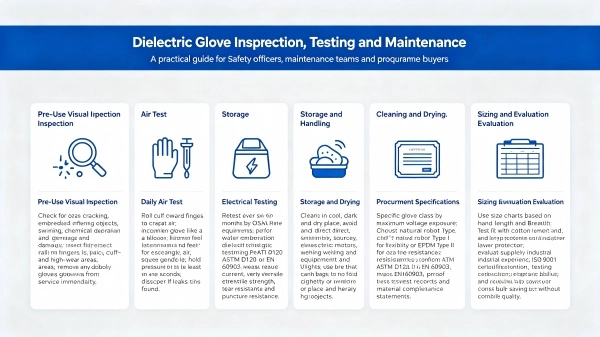
Before each use, workers must carefully look over the whole surface of the glove, looking for ozone checking (fine cracks), foreign objects buried in the rubber, swelling, or chemical breakdown. The daily air test is still the best way to check gloves in the field. Workers fill the glove by squeezing air into it and rolling it toward the fingers. They then listen and feel for air exiting, which means there are holes or punctures. Any glove that looks damaged or fails the air test must be taken out of service right away.
Electrical Testing Requirements and Frequencies
Electrical testing must be done again on dielectric gloves that are in use every six months by OSHA, or sooner if the safety is thought to have been weakened. For this dielectric test, the glove is submerged in water, and a high-voltage AC or DC is applied while the leaking current is measured according to ASTM D120 rules. If the leakage current is higher than the highest allowed value, the gloves fail the test and cannot be used again. Manufacturers also test the rubber's physical properties, such as its tensile strength, tear resistance, and puncture resistance, to make sure that it keeps its protective properties over time.
Storage and Handling Best Practices
When gloves are stored properly, they last a lot longer and keep their protective qualities between uses. Gloves should be kept in cool, dark, dry places that are out of direct sunshine, which breaks down rubber materials. Electric motors, welding tools, and UV lights are all sources of ozone that should not be in storage areas because they speed up the breakdown of materials. When you put the ends of a canvas bag down, they keep dust from collecting and let air flow. Gloves should never be folded very tightly or squished under big things, because the folds can become weak spots. Cleaning with light soap and water that isn't hotter than 120°F will get rid of germs without damaging the gloves, and they need to be completely dry before being stored to stop microbes from growing.
Procuring Dielectric Gloves for Substations: What Buyers Need to Know
A good buying process strikes a balance between technical compliance, accurate sizing, and cost-effectiveness, all while making sure that suppliers can be relied on for ongoing safety operations.
Technical Specifications and Certification Compliance
The requirements for buying dielectric gloves must make it clear what class of gloves is needed based on the highest voltage that can be reached, the type of material (natural rubber vs. EPDM), and the standards that apply (ASTM D120 or EN 60903). Buyers should make sure that providers give them all the certification paperwork they need, like proof test records and material compliance statements. Type I gloves made from natural rubber are very flexible but don't protect against ozone. Type II gloves made from manmade materials protect against environmental damage in open substations.
Sizing Accuracy and Fit Considerations
Gloves that don't fit right put both safety and efficiency at risk. Too-tight gloves cut off blood flow and make your hands tired, while too-big gloves make it harder to move your fingers and raise the risk of snagging on something. Accurate buying is made possible by detailed size charts that take into account measurements of hand length and breadth. Sample kits from many sellers let workers see how well they fit before they order in bulk. Sizes must take this layering system into account because gloves are worn over cotton or synthetic layers and under leather protection.
Supplier Selection and Vendor Evaluation
Procurement managers should look at a possible supplier's industrial experience, quality certifications (ISO 9001), testing skills, and ability to reach customers in different areas to save time on logistics. Suppliers who have been in business for decades have shown that they can be stable and reliable in meeting ongoing demand. Total cost of ownership goes down when you order in bulk and get savings for doing so without affecting delivery times. When companies need custom solutions, like longer cuff lengths or special color coding, they can get them because custom-made is possible. Since 1956, PPE MAX has been making things. This history helps us make electrical safety gear that people in 134 countries trust. We do this by mixing old-fashioned quality standards with new ways of making things.
Best Practices for Using Dielectric Gloves in Substations
When used correctly, approved equipment can protect you, but when used incorrectly, even the best equipment can't do its job.
Proper Donning and Doffing Procedures
Clean cotton or synthetic covers should always be worn under dielectric gloves to soak up sweat and make long hours of use more comfortable. Before putting on the glove, the liner is carefully put on, then the dielectric glove is carefully pulled on while being careful not to damage it with sharp nails or jewelry, and finally, the leather protection is put on over the rubber glove. This three-layer method keeps out noise and electricity, protects against damage, and makes you feel good. When doffing, the steps are done backwards, carefully taking off each layer to avoid damage or contamination. Pulling on the fingers to take off the gloves can tear them. Instead, workers should turn the gloves inside out from the cuff and peel them off that way.
Integration with Complementary Personal Protective Equipment
For electrical safety in substations, you need more than just gloves when it comes to PPE. Arc flash thermal energy and moving objects can hurt you, but face guards protect you from them. When working on tools, insulating mats offer extra safety against grounding. Wearing clothes that don't catch fire keeps you from getting burnt by arc flashes. Dielectric gloves are one part of a multilayered defense plan, and procurement managers should make sure that the whole PPE system works with each other.
Real-World Case Studies Demonstrating Proper Selection
A global energy business that runs 132kV transmission substations first asked for Class 2 gloves to save money on the cost of buying them. After a close call where a worker touched an energized busbar while doing maintenance, safety checks showed that the glove class wasn't protecting against the real voltage exposure. The company bought Class 4 gloves and gave its employees more training on how to check the power. The event shows that choosing required glove classes based on real working conditions, not just cost, is the best way to avoid possibly fatal outcomes. In a different case, the government's purchasing office bought gloves that weren't approved from a seller that hadn't been checked out. They didn't find out until after the gloves were delivered that they didn't have the right testing paperwork and failed electrical proof tests. The company had to pay more for replacements that were safe, and regulators were looking closely at them because of the safety breach.
Conclusion
To choose the right dielectric gloves for working in substations, you need to carefully look at the highest voltage levels, follow all OSHA and ASTM rules, and be dedicated to regular maintenance. Most distribution substations that work between 11kV and 33kV use Class 2 gloves. Transmission facilities, on the other hand, need Class 3 or Class 4 protection, based on the voltage levels. Detailed buying instructions, regular inspections, and combining with full PPE systems provide the multiple layers of safety needed in high-voltage areas. Companies that put an emphasis on electrical safety gear that is legal protect their employees and show they are committed to following the rules and doing a great job.
FAQ
1. What class of dielectric gloves do I need for a 33kV substation?
Class 2 dielectric gloves, which can handle up to 17,000V of power, are usually good enough for 33kV distribution substations. However, many safety rules say that Class 3 gloves (rated for 26,500V) are a better way to protect against short-term overvoltages. Before finalizing the specs, talk to electrical experts to figure out the worst cases for maximum voltage exposure.
2. How often must dielectric gloves be electrically tested?
According to OSHA and ASTM guidelines, gloves that are being used must be electrically tested every six months again. Also, gloves need to be checked right away if damage is thought to have happened or if they have been in an environment that could have damaged them, like being exposed to chemicals or mechanical stress.
3. Can dielectric gloves be reused after passing electrical certification testing?
If gloves pass both an electrical proof test and an eye check, they can be used again. The six-month testing period assumes that the item is stored and handled properly between uses. If you take care of gloves the way the maker tells you to, they should last for several years. This makes them a good investment, even though they cost a lot to buy at first.
Partner with PPE MAX for Certified Electrical Protection Solutions
At PPE MAX, we know that substation safety requires more than just normal safety gear. It also needs electrical protection technology that has been tested extensively and is backed by decades of manufacturing experience. We have been a top provider of dielectric gloves since 1956. Our goods meet both ASTM D120 and EN 60903 standards and are used by energy companies, government procurement offices, and industrial safety distributors in 134 countries. Our team doesn't just make PPE; we also wear it. We test each item to make sure it gives your workers the safety they need. Email us at marketing@ppemax.com for expert advice on choosing the right glove class, buying in bulk, and making products that are specifically made for your substation's voltage needs.
References
1. American Society for Testing and Materials. (2021). ASTM D120-20: Standard Specification for Rubber Insulating Gloves. West Conshohocken, PA: ASTM International.
2. Occupational Safety and Health Administration. (2020). 29 CFR 1910.137: Electrical Protective Devices - Regulations and Compliance Standards. Washington, DC: U.S. Department of Labor.
3. International Electrotechnical Commission. (2019). IEC 60903: Live Working - Gloves of Insulating Material. Geneva, Switzerland: IEC Publications.
4. National Fire Protection Association. (2018). NFPA 70E: Standard for Electrical Safety in the Workplace. Quincy, MA: NFPA Press.
5. Institute of Electrical and Electronics Engineers. (2020). IEEE Guide for Maintenance Methods on Energized Power Lines. Piscataway, NJ: IEEE Standards Association.
6. Canadian Standards Association. (2019). CSA Z462: Workplace Electrical Safety Standard. Toronto, ON: CSA Group.
Learn about our latest products and discounts through SMS or email