- English
- French
- German
- Portuguese
- Spanish
- Russian
- Japanese
- Korean
- Arabic
- Greek
- German
- Turkish
- Italian
- Danish
- Romanian
- Indonesian
- Czech
- Afrikaans
- Swedish
- Polish
- Basque
- Catalan
- Esperanto
- Hindi
- Lao
- Albanian
- Amharic
- Armenian
- Azerbaijani
- Belarusian
- Bengali
- Bosnian
- Bulgarian
- Cebuano
- Chichewa
- Corsican
- Croatian
- Dutch
- Estonian
- Filipino
- Finnish
- Frisian
- Galician
- Georgian
- Gujarati
- Haitian
- Hausa
- Hawaiian
- Hebrew
- Hmong
- Hungarian
- Icelandic
- Igbo
- Javanese
- Kannada
- Kazakh
- Khmer
- Kurdish
- Kyrgyz
- Latin
- Latvian
- Lithuanian
- Luxembou..
- Macedonian
- Malagasy
- Malay
- Malayalam
- Maltese
- Maori
- Marathi
- Mongolian
- Burmese
- Nepali
- Norwegian
- Pashto
- Persian
- Punjabi
- Serbian
- Sesotho
- Sinhala
- Slovak
- Slovenian
- Somali
- Samoan
- Scots Gaelic
- Shona
- Sindhi
- Sundanese
- Swahili
- Tajik
- Tamil
- Telugu
- Thai
- Ukrainian
- Urdu
- Uzbek
- Vietnamese
- Welsh
- Xhosa
- Yiddish
- Yoruba
- Zulu
Why Use a Welding Face Shield for Grinding and Cutting Tasks?
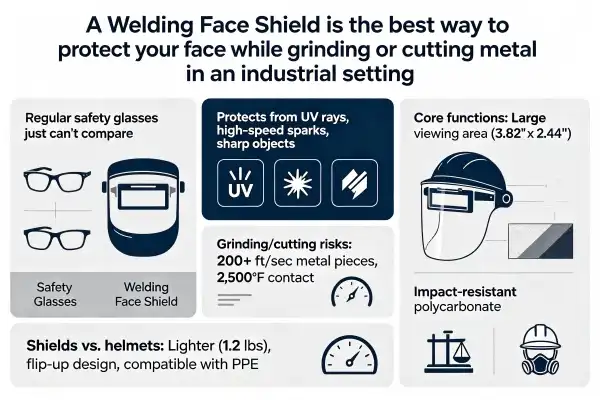
A Welding Face Shield is the best way to protect your face while grinding or cutting metal in an industrial setting. Regular safety glasses just can't compare. These covers protect your whole face and neck from dangerous UV rays, high-speed sparks, and sharp objects. Many workers think that face covers are only needed when welding, but the truth is that grinding and cutting also pose similar risks, with metal pieces moving at speeds of over 200 feet per second and temperatures hitting 2,500°F at the point of contact. Getting the right face protection isn't just about following the rules; it's also about keeping your employees safe and letting them do their best work without fear.
Understanding Welding Face Shields: Essential Protective Gear
Basic eye protection has come a long way since face covers made for welding, grinding, and cutting. Industrial accidents that could have been avoided with the right face shields have happened a lot to us at PPE MAX. That's why we're committed to making shields that really work in the real world.
What Makes Face Shields Different from Safety Glasses
Even though safety glasses protect your eyes, they leave your face, forehead, and neck open to hot objects and moving objects. An effective face shield protects a larger area, putting up a physical wall between your skin and the things you're working with. Our tests show that when grinding, particles can bounce off of workpieces at strange angles, sometimes going up and out of sight of normal glasses. With a face mask, these blind spots are gone for good.
Our shields are made of high-impact plastic, which means they won't break or crack when hit by metal pieces. This choice of material is very important in tough industrial settings where broken equipment is not only annoying but also risky. Acrylic alternatives break down over time, but polycarbonate keeps its defensive qualities even after being exposed to changes in temperature and rough handling for a long time.
Core Functions During Grinding and Cutting
Sparks and sharp particles that come from grinding are always flying around and can seriously burn your face and hurt your eyes. Modern face shields, like our 3.82" x 2.44" design, have a large viewing area that lets users stay safe and aware of their surroundings at the same time. This vision is especially important when using angle grinders or cutting tools, which need clear lines of sight for precise control.
In addition to protecting against impacts, these screens stop dangerous infrared and ultraviolet rays. Cutting with plasma or oxy-fuel tools sends out dangerous light bands even when the job isn't welding. Even when they're not moving, our screens block all UV and IR rays, which stops conditions like photokeratitis (also known as "welder's flash") from happening hours after exposure.
When to Choose Shields Over Helmets
Heavy welding caps are useful for long arc welding sessions, but they make you tired when you're grinding and cutting all the time. Welding Face Shield weighs about 1.2 pounds, which is a lot lighter than most welding helmets. This makes them easier on the neck during jobs that last eight hours or more. When operators want to check on work or switch between jobs, they like that they can quickly flip up screens, which is much harder to do with a full helmet.
We've also seen that face shields work well with hard hats and respirators. This makes them perfect for building sites and other places where a lot of PPE needs to work together. Our shields have flexible protection that fits heads of all sizes and lets workers wear them over other safety gear without affecting the fit or comfort.
Key Considerations When Selecting Welding Face Shields for Industrial Use
Procurement decisions for industrial face protection require careful evaluation of several technical and practical factors. The wrong choice doesn't just waste budget—it puts your workforce at risk and can lead to costly downtime from injuries.
Evaluating Shield Types and Construction
Lightweight shields are good for places where workers switch between tasks that need protection and tasks that don't need protection throughout the day. big-duty types with stronger frames and thicker Plexiglas belong in places where the level of danger is always high, like ships and big manufacturing shops. We make both types because different operating situations need different amounts of safety.
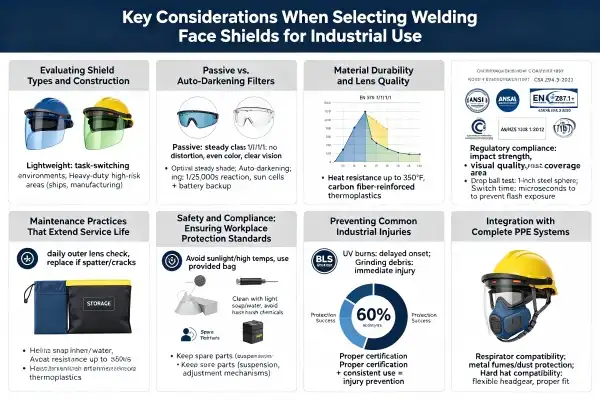
Another important choice point is the difference between inactive and auto-darkening filters. When you grind or cut something, and there is no arc light around, passive lenses keep the shade level steady. With reaction times of up to 1/25,000 seconds, auto-darkening technology is useful when workers need to switch between welding and cutting without having to change tools. Our auto-darkening types have sun cells that work with a battery backup to make sure they work reliably even in dimly lit areas.
Material Durability and Lens Quality
The quality of the lens has a direct effect on both safety and efficiency. According to EN 379 guidelines, an optical -+- class grade of 1/1/1/1 means that there is no distortion, the colour is even, and the vision is clear. These are all things that help keep the eyes from getting tired and help workers do better work. Bad glasses give people headaches, blur small details, and slow down work because they have to try to see clearly.
The protection shell has to be able to handle both force and heat. Our shields don't bend at temperatures up to 350°F, which is very important when working near heat sources or when hot sparks land on the surface. Carbon fibre-reinforced thermoplastics are stronger and lighter than regular plastics, which means they last longer in tough situations.
Maintenance Practices That Extend Service Life
Even the most durable face shield needs to be serviced regularly to keep working well. We suggest checking the outer cover lens every day and replacing it if spatter buildup or cracking makes it hard to see. Damaged cover lenses can spread light in unpredictable ways and may block sensors on auto-darkening models, which can delay the operation of the shade dangerously.
A lot of buyers don't realise how important storage is. Shields that are left out in direct sunlight or high temperatures break down faster. The plastics inside become brittle, and the electronics inside fail before they should. Giving each piece of equipment its own protected bag, which we do with every cover, makes sure it works between uses. Instead of strong chemicals that can damage the protective layers, clean the lenses with light soap and water.
Most of the time, parts of the helmet wear out before the shield itself. Suspension systems break down when they get wet or greasy, and dust and dirt build up in adjustment mechanisms, making them less effective. Having spare parts on hand cuts down on downtime when parts need to be serviced. The reason we keep such large stockpiles is to meet this need.
Safety and Compliance: Ensuring Workplace Protection Standards
Regulatory compliance isn't just paperwork—it represents decades of research into what actually prevents injuries. Procurement teams must verify that any face shield under consideration meets or exceeds applicable standards for their jurisdiction and industry.
Essential Certifications and Standards
According to the ANSI Z87.1+ standard in the US, workplace welding face shields must meet certain requirements for impact strength, visual quality, and covering area. This approval, along with EN 175:1997 (European standard), CSA Z94.3-2020 (Canadian standard), and AS/NZS 1338.1:2012 (Australian/New Zealand standard), means that our shields can be used in actions that take place in more than one country.
To get these licenses, you have to pass strict testing procedures. The drop ball impact test, in which a 1-inch steel sphere hits the lens at certain speeds, ensures that shields won't break when hit by a projectile. Switching time confirmation for auto-darkening filters makes sure that the lens goes from light to dark in microseconds. This stops flash exposure, which can damage the eye and cause brief blindness or damage that lasts for a long time.
Preventing Common Industrial Injuries
According to the Bureau of Labour Statistics, about 25,000 accidents happen at work every year in the industry and building sectors that result in injuries to the eyes or face. Most of these accidents happen because workers weren't wearing the right gear or their gear wasn't protecting them well enough.
UV burns happen slowly; workers often don't notice any signs for hours after being exposed. This is when the damage to the eye shows up as pain, tears, and sensitivity to light. When grinding debris hits someone, small metal pieces can get stuck in soft tissue or even go through the eye and hurt the person right away. Both types of injuries can be completely avoided if workers wear properly certified face shields all the time.
We've worked with building companies that are putting in place new safety rules and have seen that accident rates drop by more than 60% when proper face protection is required for grinding and cutting. It's not enough to just give workers the right gear; they also need to be able to wear shields comfortably for the whole shift.
Integration with Complete PPE Systems
Protective gear that goes with face shields works best when used together. Our shields can fit respirators, which protect workers from metal fumes and dust that are created when cutting. Grinding stainless steel releases hexavalent chromium, which is very bad for your health. In many situations, you have to wear respirators to protect your lungs.
Compatibility with hard hats is important for both building and infrastructure tasks. Our shields have flexible headgear that fits over regular hard hats without making either part less stable. With this combination, workers don't have to choose between protecting their heads and their faces in case of an accident; they get both at the same time.
To get the right fit, you have to take the time to change the suspension systems for each person. Too low a shield makes it impossible to see, and too high a shield leaves holes where debris can get in. We give buying teams thorough fitting instructions and training materials to make sure that the equipment they give to their employees is used properly.
Market Overview and Comparative Analysis of Welding Face Shields
Understanding the competitive landscape helps procurement professionals make informed decisions that balance cost, performance, and supplier reliability. The face shield market has evolved considerably, with manufacturers differentiating themselves through technological features and service offerings.
Leading Manufacturers and Product Positioning
Big brands in North America, like 3M, Lincoln Electric, and Honeywell, control the market thanks to their large delivery networks and well-known names. These companies put a lot of emphasis on advanced auto-darkening technology and high-quality visual clarity. They price their goods higher to represent the money they spend on research and development.
As a producer with more than 60 years of experience working with customers in 134 countries around the world, PPE MAX is in a unique situation. Since 1956, our main goal has been to combine strict quality control with reasonable prices that make sense for businesses with large staffs. Our shields meet the same ANSI, EN, and CSA standards as high-end brands, and when you buy a lot of them, the price per unit goes down a lot.
Pricing Tiers and Value Considerations
Basic face masks with passive glasses and basic equipment that are good for light-duty cutting usually cost between $15 and $35 per unit. Between $75 and $150 are mid-range choices with auto-darkening screens and extra comfort features. More expensive types with advanced sensors, breathing systems, and zoom choices can cost more than $300 each.
When you buy in bulk, the math changes in a big way. When you buy more than 100 units, you can often get savings ranging from 20 to 40 per cent. This means that you can get better tools at the same price as cheaper options bought one at a time. We set our prices so that relationships with companies that are committed to full safety plans are rewarded more than one-time orders.
The real cost of ownership is higher than the price of the car itself. Shields that need lens replacements often, because they are easily scratched or headgear that breaks after a few months, add secret costs that eat away at any savings that might have been made. Our long-lasting build, along with our full insurance coverage, means that you'll pay less over the usual 3–5 year service life.
Procurement Channels and Supplier Selection
Industrial supply specialists offer personalised service and product expertise that online marketplaces cannot match. These distributors understand specific industry requirements and can recommend shields optimised for particular applications, whether that's pipeline welding in outdoor environments or precision grinding in automotive manufacturing.
Direct manufacturer relationships, like those we cultivate at PPE MAX, provide additional advantages. Bulk ordering capabilities accommodate large-scale rollouts across multiple facilities. Custom branding options reinforce corporate safety culture by making equipment instantly recognisable as company-issued gear. Technical support hotlines staffed by people who actually understand the products they're supporting solve problems faster than generic customer service.
Delivery reliability and after-sales support distinguish exceptional suppliers from merely adequate ones. We maintain inventory depth that ensures orders ship within 48 hours, preventing project delays. Our replacement parts availability means damaged shields can be repaired rather than discarded, extending useful life and reducing waste.
How to Make the Right Decision When Buying Welding Face Shields
The final purchasing decision should align with your specific operational requirements, workforce characteristics, and safety objectives. Generic recommendations rarely account for the nuances that make particular shields ideal for your environment.
Matching Protection to Work Environments
Heavy fabrication shops and shipyards demand a Welding Face Shield capable of withstanding extreme conditions—high heat from flux-cored arc welding, integration with respiratory protection to filter welding fumes, and rugged construction that survives being knocked off benches or dropped on concrete floors. The reinforced frames and heavy-duty headgear in our industrial models address exactly these scenarios.
Automotive and precision manufacturing environments prioritise different characteristics. Here, operators need high-sensitivity sensors that detect low-amperage TIG welding arcs without flickering, along with true colour lens technology that helps distinguish colour-coded components and heat zones. The optical clarity becomes paramount when work quality depends on seeing fine details clearly.
Pipeline and outdoor construction present unique challenges related to temperature extremes and rough handling. Passive lenses or battery-assisted auto-darkening filters that function reliably in bright sunlight without false triggering suit these applications better than purely solar-powered models. The ability to withstand being tossed in tool boxes and transported across job sites matters more here than in controlled factory settings.
Balancing Comfort with Protection
The most protective shield in your inventory provides zero value if workers refuse to wear it consistently. Comfort drives compliance, which is why we obsess over details like weight distribution, padding quality, and adjustment range. Shields that cause pressure points or sit awkwardly get removed the moment supervisors aren't watching.
Extended wear comfort becomes critical during long shifts where grinding and cutting operations continue for hours. The 1.2 lb weight of our shields, combined with well-designed suspension systems, reduces neck strain that accumulates over eight-hour days. Breathability matters too—shields that trap heat against the face become unbearable in hot environments, creating a strong incentive to remove them prematurely.
Strategic Procurement Recommendations
We recommend starting with sample units to verify compatibility with your specific work processes before committing to large orders. What works brilliantly for one operation may prove inadequate for another due to subtle differences in equipment, techniques, or environmental factors. Testing eliminates expensive mistakes and builds workforce buy-in when employees participate in equipment selection.
Consider the total cost of ownership rather than just the purchase price. Shields requiring replacement every six months cost more long-term than durable models lasting three years, even when initial pricing appears higher. Factor in the productivity losses from injuries prevented—a single serious eye injury can cost tens of thousands in medical expenses, workers' compensation claims, and lost productivity from trained personnel being off work.
Vendor relationships matter tremendously for organisations managing complex safety requirements. Suppliers who provide training resources, maintain technical support capabilities, and stock replacement components add value far beyond the physical products they sell. We've built our business model around being that kind of partner rather than just another transaction-focused vendor.
Conclusion
Protecting your workforce during grinding and cutting operations requires more than basic safety glasses—it demands comprehensive facial protection that workers will actually wear consistently. Face shields designed specifically for industrial applications provide that protection through impact-resistant materials, broad coverage areas, and features addressing the real hazards present in metalworking environments. Compliance with established safety standards ensures equipment performs as promised, while proper selection based on your specific operational context maximises both protection and comfort. The investment in quality face protection pays returns through reduced injury rates, improved productivity, and the peace of mind that comes from knowing your safety program meets the highest standards.
FAQ
Can I use the same face shield for welding, grinding, and cutting?
Shields with auto-darkening filters featuring dedicated "Grind Mode" (DIN 4 or lower) or flip-up fronts work across multiple applications. Using a fixed welding shade for grinding impairs vision and creates hazards by limiting what operators can see. PPE MAX shields with mode switching accommodate various tasks without requiring equipment changes, improving workflow efficiency while maintaining appropriate protection levels for each operation type.
How often should I replace face shield components?
The outer cover lens requires replacement daily in heavy industrial settings or whenever spatter and pitting reduce visibility—damaged lenses can obstruct sensors and cause auto-darkening failures. Headgear and suspension components typically need replacement annually due to sweat and oil degradation. The main shield body lasts 5-7 years with proper care, though auto-darkening cartridges have 3-5 year lifespans as liquid crystals and electronics degrade over time.
Do your shields work with other personal protective equipment?
Our shields integrate seamlessly with hard hats, respirators, and safety glasses, making them suitable for complex industrial environments requiring multiple protection layers. The adjustable headgear accommodates various PPE combinations without compromising fit or stability. This compatibility matters tremendously in construction, mining, and manufacturing settings where workers need comprehensive protection from multiple simultaneous hazards.
Partner With PPE MAX: Your Trusted Welding Face Shield Manufacturer
PPE MAX delivers industrial-grade facial protection backed by 67 years of manufacturing excellence. As Northwest China's largest PPE supplier serving 134 countries, we understand what procurement professionals need: certified equipment that meets ANSI Z87.1-2020, EN 175:1997, and CSA Z94.3-2020 standards, competitive bulk pricing that respects your budget constraints, and responsive support that keeps your operations running smoothly. Our welding face shield supplier capabilities include OEM customisation for corporate branding, comprehensive warranties, and replacement parts availability that minimises equipment downtime. Contact our team at marketing@ppemax.com to discuss your specific requirements and discover how our face shields protect workforces across automotive manufacturing, shipbuilding, metal fabrication, and construction industries. We don't just sell equipment—we partner with you to build safety programs that actually work.
References
1. National Institute for Occupational Safety and Health. "Eye Safety in the Workplace: Preventing Occupational Eye Injuries Through Proper Personal Protective Equipment Selection." NIOSH Publication Series, 2023.
2. American Welding Society. "Safety and Health Fact Sheets: Personal Protective Equipment for Welding, Cutting, and Allied Processes." AWS Safety Standards Committee, 2024.
3. Bureau of Labour Statistics, U.S. Department of Labour. "Nonfatal Occupational Injuries and Illnesses Requiring Days Away from Work in Manufacturing and Construction Sectors." Annual Statistical Report, 2023.
4. International Safety Equipment Association. "Face and Eye Protection Standards: A Comprehensive Guide to ANSI Z87.1, EN 166, and Global Compliance Requirements." ISEA Technical Publications, 2024.
5. Canadian Centre for Occupational Health and Safety. "Welding, Cutting and Brazing: Health and Safety Guidelines for Personal Protective Equipment Selection." CCOHS Safety Publications, 2023.
6. Occupational Safety and Health Administration. "Eye and Face Protection Standards: Guidance for Employers on Compliance with 29 CFR 1910.133." OSHA Technical Manual, 2024.
Learn about our latest products and discounts through SMS or email