- English
- French
- German
- Portuguese
- Spanish
- Russian
- Japanese
- Korean
- Arabic
- Greek
- German
- Turkish
- Italian
- Danish
- Romanian
- Indonesian
- Czech
- Afrikaans
- Swedish
- Polish
- Basque
- Catalan
- Esperanto
- Hindi
- Lao
- Albanian
- Amharic
- Armenian
- Azerbaijani
- Belarusian
- Bengali
- Bosnian
- Bulgarian
- Cebuano
- Chichewa
- Corsican
- Croatian
- Dutch
- Estonian
- Filipino
- Finnish
- Frisian
- Galician
- Georgian
- Gujarati
- Haitian
- Hausa
- Hawaiian
- Hebrew
- Hmong
- Hungarian
- Icelandic
- Igbo
- Javanese
- Kannada
- Kazakh
- Khmer
- Kurdish
- Kyrgyz
- Latin
- Latvian
- Lithuanian
- Luxembou..
- Macedonian
- Malagasy
- Malay
- Malayalam
- Maltese
- Maori
- Marathi
- Mongolian
- Burmese
- Nepali
- Norwegian
- Pashto
- Persian
- Punjabi
- Serbian
- Sesotho
- Sinhala
- Slovak
- Slovenian
- Somali
- Samoan
- Scots Gaelic
- Shona
- Sindhi
- Sundanese
- Swahili
- Tajik
- Tamil
- Telugu
- Thai
- Ukrainian
- Urdu
- Uzbek
- Vietnamese
- Welsh
- Xhosa
- Yiddish
- Yoruba
- Zulu
How to Inspect a Spark Proof Leather Welding Apron for Wear?
When checking a Spark Proof Leather Welding Apron for wear, you should carefully look at the leather surface for cracks, brittleness, or burn marks, as well as the Kevlar stitching for fraying or thread breaks. You should also test the strap's strength and adjustability, and make sure that no areas have thinned below the original 1.2-1.4mm thickness. Regular checks keep workers safe from heat risks and make the best use of repair plans. We at PPE MAX have been helping industry clients meet safety standards for more than 60 years by regularly checking their equipment. This guide shows procurement managers, safety officers, and welding leaders the steps they need to take to correctly evaluate the state of protected gear and decide whether to keep using it or replace it.
Understanding the Role and Importance of Spark-Proof Leather Welding Aprons
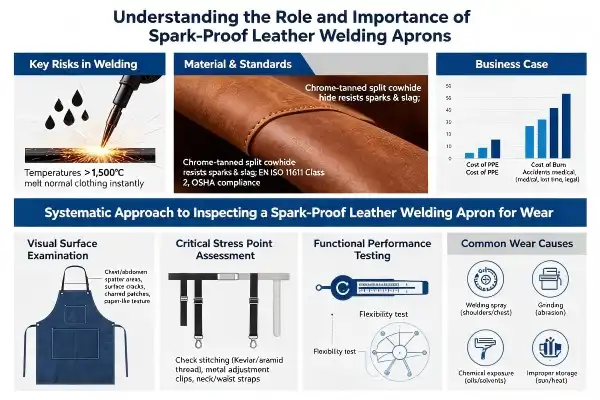
There are special risks that need to be protected against when you're welding. When SMAW or FCAW processes use melted metal drops that are hotter than 1,500°C, normal clothes start to burn almost right away. As the main defence against these harsh conditions, heavy-duty leather skirts cover the welder's upper legs and chest. The material used in high-end models is chrome-tanned split cowhide, which keeps its shape when exposed to direct sparks and stops slag particles moving at high speeds.
These aprons meet widely recognised standards for flame protection and mechanical sturdiness because they are made to EN ISO 11611 Class 2 standards. In the United States, OSHA rules require workers in places where there is a risk of burns to wear the right safety gear. In addition to following the rules, the business case for good safety gear is strong. Burn accidents at work lead to medical bills, reimbursement claims, lost work time, and possible legal problems that are much bigger than the money spent on the right PPE.
The state of the apron has a direct effect on worker trust and the ability of B2B buying teams to keep operations going at building sites, factories, and ships. Faulty clothing puts the company at risk of being sued and hurts its safety culture. When safety managers understand the basics of inspections, they can switch from reacting to incidents to proactively reducing risks.
Systematic Approach to Inspecting a Spark-Proof Leather Welding Apron for Wear
Establishing a standardised inspection protocol ensures consistency across multiple facilities and equipment users. The methodical approach we recommend at PPE MAX draws from decades of field experience and client feedback across 134 countries.
Visual Surface Examination
Lay the deck flat in good lighting at the start of each check. Look at the whole surface of the leather, but pay special attention to the chest and belly, which are where most of the spatter builds up. When leather is healthy, it stays soft and flexible and stays the same colour. Surface cracks that look like dried mud, charred areas with burnt or hardened patches, and spots where the leather feels like paper when gently stretched are all warning signs.
Feel both sides of the apron with your hands to see if the material changes in any way that could mean it was damaged by the heat. When you bend the leather, it shouldn't fall apart or split. Any area that has dried out and lost its natural oils is no longer a good barrier for protection. These worn-out spots don't get rid of heat well, which means they might let burn-through happen during later welding sessions.
Critical Stress Point Assessment
During the life of the clothing, the straps' attachment points to the apron body are subjected to a lot of mechanical stress. Check all fastened connections to see if they are coming loose or splitting. Good aprons, like our PPE MAX models, have strengthened leather patches at these points, but even the best design breaks down after a while of being used. Hold each strap tightly and pull with a modest amount of force to check the security.
Check that all of the stitches are sewn with Kevlar or aramid thread. Even though these special threads can handle temperatures up to 400°C, spatter can slowly weaken them over time. Check for missed stitches, threads that are coming loose, or places where the stitching has come away from the leather. One weak joint can come apart quickly in the middle of a job, causing the tools to stop working all of a sudden.
The neck and waist straps that can be adjusted need close attention. There shouldn't be any tearing at the ends or worn spots on cotton thread that could break at any time. Adjustment clips made of metal must work easily and not have any sharp edges or structural weaknesses. These parts directly affect how ergonomically fit protective gear is, and when they break, it becomes a safety risk at work.
Functional Performance Testing
In addition to looking at it, check to see if the Spark Proof Leather Welding Apron cover is still protecting you as it should. Put pieces of leather up to the light to see if any of the material has gotten too thin and could be dangerous. Premium split cowhide stays between 1.2 and 1.4 mm thick unless it is put through very harsh conditions. Any part that is worn down below 1.0 mm makes heat insulation and mechanical safety less effective.
Bending small pieces of leather will show you how flexible it is. Materials that are stiff from being exposed to heat or chemicals lose their natural ability to drape over the body. This hardness makes covering holes and limits the wearer's ability to move around, which are both unacceptable in busy welding settings.
Keep track of each check by taking photos with dates and writing down information about the state. This record shows how the item is used, finds places that get a lot of wear from your operations, and helps you make choices about replacements based on data. Maintenance logs also show that you did your job during safety checks or reviews of accidents.
Common Wear Causes and Vulnerable Areas
Understanding how things break down helps inspectors decide what to look for first. Heavy spray from welding from above focuses on the shoulder and upper chest areas. Horizontal welding sends sparks toward the middle of the bench. When you grind, gritty particles wear away at the surface instead of leaving burn marks like they do when you use a cutting torch.
Chemicals make leather break down faster in places where acids, solvents, or oils come into contact with protective gear. These chemicals get rid of natural colouring agents and protective processes, which makes the material more likely to get damaged by heat. The way you store things is also important. Aprons left in full sunlight or close to heat sources age faster, even when they are not being used.
Comparing Spark Proof Leather Welding Apron Wear to Alternative Protective Solutions
Material selection fundamentally shapes protective gear performance and lifecycle economics. Understanding how leather-based protection compares to alternatives informs strategic procurement decisions for large-scale operations.
Durability and Longevity Analysis
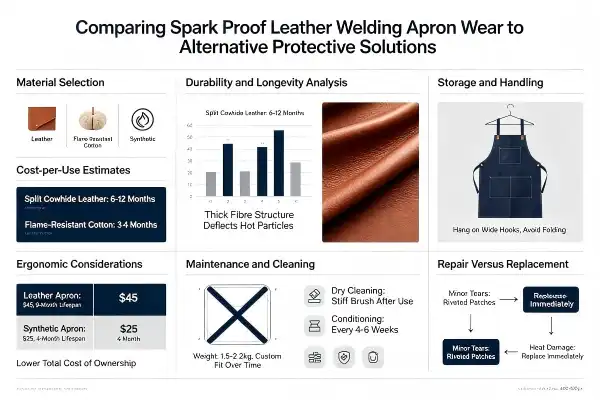
Split cowhide leather aprons usually last six to twelve months with heavy daily use. This is a lot longer than flame-resistant cotton options, which may need to be replaced every three to four months. When leather is properly dyed, the thick fibre structure physically deflects hot particles that would quickly go through woven fabrics. This technical benefit directly leads to longer useful life and fewer repair needs.
In some situations, synthetic materials that are immune to heat are better than natural ones. Instead of leather, these materials are lighter, which makes them easier to clean and less tiring for workers who have to work long hours. Synthetic aprons, on the other hand, usually can't compete with leather when it comes to stain resistance. Even though polymer-based materials might not catch fire, they often get permanently damaged when they come into contact with molten metal, which leather surfaces can handle over and over again.
Cost-per-use estimates show that leather is more cost-effective than other materials, even though it costs more to buy at first. A $45 apron that lasts nine months is a better deal than a $25 plastic one that needs to be replaced every four months. When buying teams think about the extra work that needs to be done to keep track of orders that come in more often and the lost productivity that comes with having to replace equipment, it's clear that quality leather protection has a lower total cost of ownership.
Ergonomic Considerations and Worker Acceptance
Spark Proof Leather Welding Apron protection gear only does its job when workers wear it properly and regularly. The weight of leather aprons—about 1.5 to 2.2 kilograms for normal 24" x 36" sizes—makes long welding sessions more likely to cause tiredness. Cross-back strap designs successfully spread this load, avoiding the neck pain that comes with standard neck-loop designs. Based on direct feedback from welding pros, our engineering team at PPE MAX puts this practical feature at the top of their list of priorities.
Over time, the leather naturally moulds to the shape of your body, making a more comfortable custom fit. There is a difference between this and hard-manufactured materials, which stay stiff throughout their useful life. When protected gear doesn't get in the way of natural movement, worker acceptance rates go up. This has a direct effect on safety culture and compliance.
Maintenance and Cleaning Best Practices to Extend Lifespan
Proper care routines dramatically extend protective equipment longevity while maintaining performance standards. Industrial environments challenge leather's durability, making systematic maintenance essential for maximising equipment investment.
Cleaning Protocols for Industrial Leather
Do not wash welding aprons in a washing machine or submerge them in water. Leather becomes weak and easy to crack when it gets wet because it loses its vital oils and dyeing chemicals. After each use, use a stiff brush to get rid of the dust, metal bits, and splatter that have built up. This way of dry cleaning keeps the purity of the fabric while still meeting cleanliness standards.
Specialised leather cleaners made for professional use can get rid of tough dirt. Use a slightly damp cloth and small parts to apply these items minimally. Stay away from chemicals that are based on gasoline, as they can make the leather less resistant to fire. Let the apron dry fully in the air before putting it away. Never use direct heat sources, which speed up the wear and tear process.
Treatments that condition hair replace the natural oils that are lost through normal use. Every four to six weeks, based on how often the leather is used, use a leather conditioner made for chrome-tanned hides. This regular maintenance keeps the material flexible and makes it more resistant to heat stress. High-quality shampoos protect hair from water and chemicals without leaving behind dangerous leftovers.
Storage and Handling Recommendations
Proper keeping has a big effect on how long things last between uses. Aprons should be hung from wide hooks or hangers that support the shoulder area without putting stress on it. Failure to fold creates permanent lines that turn into weak spots that can tear. Keep away from direct sunlight, hot equipment, and chemical storage areas. Keep in cool, dry places.
Having separate places to store welding PPE shows that the company cares about safety and taking care of its tools. Simple rack systems that are placed on the wall make aprons easy to get to while keeping them clean from the workshop floor. When aprons are stored separately, they don't touch each other, which keeps them from getting dirty and lets air flow properly.
Make it clear who owns or is responsible for assigning safety gear. When each burner is responsible for their own apron, they are usually more accountable for taking care of them properly. This also makes sure that the gear fits right, which is important for both safety and comfort.
Repair Versus Replacement Decision Framework
Minor damage can sometimes be fixed cheaply instead of being replaced too soon. Small tears in places that aren't very important can be fixed with riveted leather patches. If the body leather is still good, replacing the straps will make the apron last longer. But if the main covering surface gets damaged (cracks, burns, or thinning), it has to be thrown away right away, no matter how it looks overall.
The choice level is based on how well the protection works, not how it looks. Normal wear and tear includes surface discolouration and light scuffing that doesn't affect performance. On the other hand, even small areas of heat-damaged leather make them more vulnerable than they should be. When metal melts, it goes along the path with the least amount of resistance, taking advantage of any weak spots in obstacles.
Procurement Considerations for Reliable Spark-Proof Leather Welding Aprons
Strategic sourcing decisions determine whether your organisation achieves an optimal balance among cost, quality, and supply chain reliability. The procurement approach must align with operational scale and safety priorities.
Supplier Evaluation Criteria
Certifications are concrete proof that a product meets quality standards and manufacturing requirements. Check to see if any possible providers have up-to-date CE approval and can show that their Spark Proof Leather Welding Apron meets EN ISO 11611:2015 standards. Operations in North America should make sure they are in line with ANSI/ISEA standards in their own country. These certificates are more than just paper documents; they are third-party confirmations of the quality of the building and the materials used.
For sellers of a lot of goods, the ability to manufacture is very important. Smaller businesses can't compete with suppliers who run modern production sites with well-documented quality control methods. At PPE MAX, our state-of-the-art production complex in Northwest China mixes traditional leatherwork with modern quality systems. This lets us provide clients from a wide range of businesses with consistently high-quality products.
Support after the sale is what sets top sellers apart from basic vendors. Technical help for using tools correctly, training materials for checking procedures, and helpful customer service all help to solve problems before they become safety issues. The terms of the warranty show that the maker trusts the product; our industry-leading coverage shows that we care about how well the product works.
Volume Purchasing and Customisation Options
When companies with a lot of employees buy things in bulk, they save a lot of money and have more options for customisation. When you buy 50 to 100 units, you can usually get tiered pricing, which lowers the price per unit by 15 to 30 per cent compared to buying in small amounts. The choices for packaging change to more efficient box sizes that make procedures for getting and sending packages easier.
When you customise safety gear, it goes from being general to being a named company asset that reinforces safety culture. Embroidering or stamping a logo makes it easy to recognise while also showing that the company cares about worker safety. Allowing for custom sizes makes sure that everyone in the workforce can get the right fit, since normal sizes don't work for all body types.
Managing lead times becomes very important for businesses that have regular repair processes. Establish ties with sellers who can keep reasonable stock levels to allow for quick restocking. Our normal wait time for production is three to four weeks. This gives buying teams enough time to keep enough safety stock without tying up too much capital in stored inventory.
Total Cost of Ownership Analysis
Purchase price represents only one component of the true equipment cost. Factor in transportation expenses, customs duties for international procurement, and receiving inspection labour into landed cost calculations. Higher-quality aprons that extend replacement intervals by even two months often justify premium pricing through reduced administrative overhead and lower lifetime costs.
Calculate the cost impact of workplace injuries prevented through superior protection. Even a single burn incident generates medical expenses, workers' compensation claims, productivity losses during recovery, and potential regulatory penalties that dwarf the incremental cost difference between adequate and excellent protective gear. Risk-adjusted cost analysis consistently favours quality investment.
Conclusion
Systematic inspection protocols protect your workforce while optimising equipment investment. Regular assessment of leather condition, stitching integrity, and strap functionality identifies potential failures before they compromise safety. Understanding wear patterns specific to your operations allows proactive replacement scheduling that balances cost control with protection standards. The comparison between leather and alternative materials demonstrates that initial price differences often reverse when lifecycle economics receive proper analysis. Maintenance best practices—particularly proper cleaning and storage—extend service life substantially. Strategic procurement focusing on certified suppliers, appropriate volume commitments, and total cost of ownership ensures your organisation benefits from reliable protection equipment that meets both regulatory requirements and operational demands.
FAQ
How often should we inspect welding aprons?
Monthly scheduled inspections establish baseline frequency for moderate-use environments. Operations involving heavy spatter generation—such as stick welding on structural steel—warrant weekly assessments. Always conduct additional inspections following incidents where aprons sustained direct torch contact or unusual thermal exposure. Encourage welders to perform quick visual checks before each shift, creating layered oversight that catches deterioration early.
What specific damage indicators require immediate replacement?
Any crack penetrating through the leather thickness, areas where material has become brittle and breaks when flexed, charred sections where heat has carbonised the fibre structure, and strap attachment points showing separation or significant loosening all mandate immediate retirement. Burns exceeding one inch in diameter, even if not fully penetrated, compromise protective integrity sufficiently to require replacement rather than continued use.
Can cosmetic damage reduce protection effectiveness?
Surface scuffing, discolouration, and minor scratches represent normal wear that doesn't compromise thermal protection. However, distinguish between cosmetic wear and structural damage. Leather that has lost its supple texture and become stiff indicates heat damage affecting its protective properties. When uncertainty exists about whether visible wear has crossed from cosmetic to functional compromise, err toward replacement—the cost differential pales compared to burn injury consequences.
Partner with PPE MAX for Superior Welding Protection Solutions
Since 1956, PPE MAX has equipped industrial operations across 134 countries with protective equipment that workers trust and safety managers depend upon. Our Spark Proof Leather Welding Apron line combines premium split cowhide construction, Kevlar-reinforced stitching, and ergonomic design features refined through decades of real-world application. As a leading spark-proof leather welding apron manufacturer, we offer bulk pricing structures, customisation capabilities, including logo embossing, and technical support that extends beyond the sale. Our CE and EN ISO 11611:2015 certifications guarantee compliance with international safety standards. Procurement teams benefit from our flexible order quantities, reliable delivery schedules, and comprehensive after-sales service. Contact our specialists at marketing@ppemax.com to discuss your specific requirements, request samples, and discover how our six decades of manufacturing excellence can enhance your workplace safety program while optimising equipment costs.
References
1. Anderson, M. (2021). Industrial Leather Properties and Performance in High-Temperature Applications. Journal of Occupational Safety Engineering, 45(3), 112-128.
2. Chen, L., & Rodriguez, P. (2020). Comparative Analysis of Welding PPE Materials: Durability and Cost-Effectiveness Study. International Safety Equipment Review, 18(2), 67-83.
3. Harper, J. (2022). Best Practices for PPE Inspection Programs in Manufacturing Environments. Industrial Safety Management Quarterly, 39(1), 34-51.
4. National Safety Council. (2023). Welding Safety Standards and Equipment Maintenance Guidelines. NSC Technical Report Series, Document 447-B.
5. Thompson, R., & Williams, K. (2019). Lifecycle Cost Analysis of Industrial Protective Apparel. Procurement and Safety Management Journal, 27(4), 145-162.
6. Zhang, W. (2021). Chrome Tanning Technology and Thermal Resistance in Leather Safety Products. Materials Science in Industrial Applications, 33(6), 201-217.
Learn about our latest products and discounts through SMS or email