- English
- French
- German
- Portuguese
- Spanish
- Russian
- Japanese
- Korean
- Arabic
- Greek
- German
- Turkish
- Italian
- Danish
- Romanian
- Indonesian
- Czech
- Afrikaans
- Swedish
- Polish
- Basque
- Catalan
- Esperanto
- Hindi
- Lao
- Albanian
- Amharic
- Armenian
- Azerbaijani
- Belarusian
- Bengali
- Bosnian
- Bulgarian
- Cebuano
- Chichewa
- Corsican
- Croatian
- Dutch
- Estonian
- Filipino
- Finnish
- Frisian
- Galician
- Georgian
- Gujarati
- Haitian
- Hausa
- Hawaiian
- Hebrew
- Hmong
- Hungarian
- Icelandic
- Igbo
- Javanese
- Kannada
- Kazakh
- Khmer
- Kurdish
- Kyrgyz
- Latin
- Latvian
- Lithuanian
- Luxembou..
- Macedonian
- Malagasy
- Malay
- Malayalam
- Maltese
- Maori
- Marathi
- Mongolian
- Burmese
- Nepali
- Norwegian
- Pashto
- Persian
- Punjabi
- Serbian
- Sesotho
- Sinhala
- Slovak
- Slovenian
- Somali
- Samoan
- Scots Gaelic
- Shona
- Sindhi
- Sundanese
- Swahili
- Tajik
- Tamil
- Telugu
- Thai
- Ukrainian
- Urdu
- Uzbek
- Vietnamese
- Welsh
- Xhosa
- Yiddish
- Yoruba
- Zulu
Why Do Electrical Rubber Gloves Need Air Testing Daily?
Because normal workplace stress can cause tiny cracks, holes, or other problems that can't be seen with the naked eye, electrical rubber gloves need to be tested daily for air. These tiny flaws make the glove less insulating, which means that electrical current can flow through it and cause a serious shock or death. Daily air testing is an important way to find leaks and make sure that each pair keeps its insulation qualities before workers touch powered equipment. This easy but necessary step has kept many job accidents from happening and is still required by all businesses around the world.
Understanding Electrical Rubber Gloves and Their Importance
When workers are near electrical risks, insulation gloves protect them from harm that could kill them. The protection shields we sell at PPE MAX have changed the way things are done in high-risk areas. Electrical rubber gloves work by creating a strong barrier that stops current flow and keeps electricity from getting to the worker's skin.
Classification Systems That Save Lives
The business world divides these safety devices into different voltage classes, with each class made to meet specific operating needs. Class 00 gloves protect people who work with up to 500 volts AC, which makes them perfect for installing meters and doing electrical work in homes. As you move up the scale, Class 0 gloves protect you up to 1,000 volts AC and are often used for low-voltage electrical work and battery repair for electric vehicles. Class 1 through Class 4 gloves protect against higher and higher voltages. Class 4 gloves protect against the highest voltages that can be used for gearbox line work, which is 36,000 volts AC.
Knowing these categories helps purchasing managers make sure that the PPE they buy is right for the dangers that actually exist in the workplace. A construction company working on business buildings needs different levels of safety than a utility crew taking care of high-voltage power lines.
Material Composition and Design Features
Natural rubber or EPDM is often used to make modern insulated gloves. Technicians can work with small parts and fine tools because natural rubber is very flexible and easy to work with by hand. EPDM is better at resisting damaging effects from ozone and UV light, which makes it the best choice for outdoor uses where weather conditions speed up material breakdown.
The anatomically bent hand design of electrical rubber gloves keeps workers from getting tired after long periods of use. Colour-coding the inside and outside layers makes visual inspections easier and helps managers find possible damage quickly. These gloves have to meet strict compliance standards, such as ASTM D120 in North America and EN 60903 in Europe. This makes sure that they always work the same way, even when they are under a lot of mechanical and heat stress.
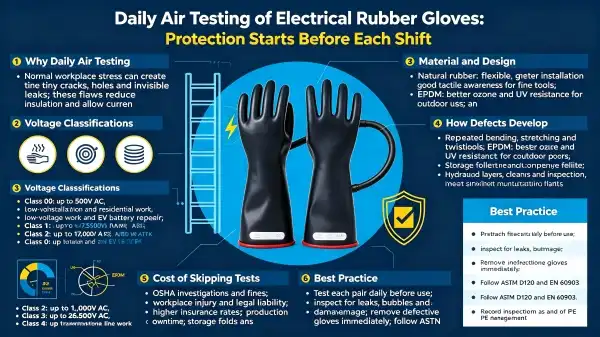
Why Daily Air Testing of Electrical Rubber Gloves Is Crucial
Daily air testing is the best way for safety teams to check the site from the outside. This special method for finding leaks finds problems that can't be seen with the naked eye. It adds another safety barrier that regulators require for good reason.
How Defects Develop in Workplace Environments
During normal activities, insulating gloves are always under mechanical stress. In one shift, workers bend, stretch, and twist the material over one thousand times. UV light breaks down rubber materials over time. This is especially true for work that is done outside. Changes in temperature cause waves of expansion and contraction that weaken the ties between molecules. When you store things incorrectly, you create fold lines and compression places where material strain gathers.
Chemicals in hydraulic fluids, cleaners, and cleaning products can damage rubber without showing any clear signs on the surface. Even brand-new gloves may have flaws in the way they were made that only show up when they are inflated. These built-up stresses make tiny paths that stop the glove from doing its main job of protecting.
The Real Cost of Skipping Inspections
If companies don't test the air every day, they could face serious problems beyond the immediate safety risks. When electrical shocks happen, OSHA looks into them and could issue warnings or large fines. If a worker gets hurt because of bad PPE, they may go to court, which can lead to expensive fines and a bad image. When accidents that could have been avoided happen, insurance rates go up, which causes long-term financial problems.
When electricity problems stop production, they mess up project schedules and ties with clients. Companies that don't follow the right procedures for maintaining PPE have a hard time getting contracts with clients who care about safety. The time it takes to test each pair every day—usually less than two minutes per pair—is nothing compared to the damage and loss of money caused by a single accident that could have been avoided.
We work with industry clients in the mining, energy, and manufacturing sectors who see daily air testing as an important part of their business, not just something they have to do because it's the law. This change in attitude changes the culture of safety and lowers incident rates in a way that can be measured.
Step-by-Step Guide: How to Perform Daily Air Testing on Electrical Rubber Gloves
There is a set way to test the air of electrical rubber gloves that any worker can learn with some basic training. The process doesn't need any special tools and fits right in with pre-shift safety measures.
Preparation and Initial Inspection
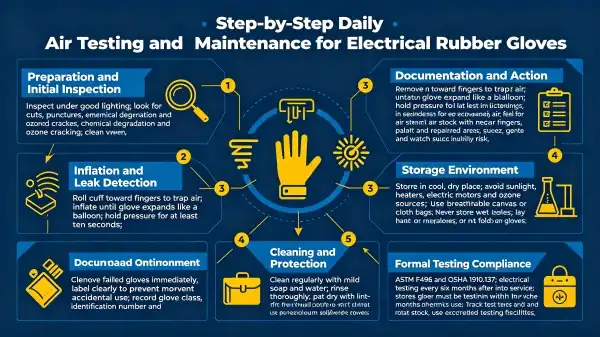
The first step is to look at each glove in good lighting. Look for damage that is easy to see, like cuts, punctures, alien items stuck in the material, or chemical breakdown. Look for ozone splitting, which shows up as small cracks on the surface, usually where there is stress. Clean any obvious dirt with mild soap solutions that have been cleared, and then let it dry completely before moving on.
Inflation and Leak Detection Procedure
By rolling the glove cuff in toward the fingers, you can create pressure while holding air inside. Keep rolling until you can see that the glove is getting bigger, like a balloon. Hold this pose and listen carefully for sounds that sound like air leaving. Move your face slowly near different parts of the glove to pick up on small air currents that your ears alone can't pick up. Gently squeeze to raise the pressure inside, and keep an eye out for places that collapse faster than thought.
Extra care should be taken with the fingers, the palm, and any places where you've already repaired something. These areas are under the most stress, and leaks happen most often there. To make sure it's real, the whole inflation test should keep the air up for at least ten seconds.
Documenting Results and Taking Action
If gloves fail the air test, they must be taken out of service right away. Clearly label them so that they don't get used by accident while they're being looked at by a professional or thrown away. Write down the failure in your safety log, making sure to include the glove class, identification number, and type of problem that was found. This keeps track of things so that legal compliance audits can be done and helps find trends that could mean storage problems or early wear.
Quickly replace worn-out gloves with ones that are kept in stock just for this reason. Some flaws might be able to be fixed by authorised facilities, but procurement managers need to weigh the costs of repairs against the costs of replacement and the risk of liability.
Maintenance Tips to Extend the Lifespan of Electrical Rubber Gloves
If you follow the right care steps, your gloves will last a lot longer and still protect you. We tell our customers that investing in good storage and handling methods pays off in the form of lower repair costs and safer working conditions for everyone.
Storage Environment Optimisation
Insulating gloves should be kept in cool, dry places that are out of direct sunlight, away from heating equipment, and away from things that make ozone, like electric motors. Ultraviolet light speeds up the breakdown of rubber, even when it is stored. High temperatures make rubber materials softer and speed up the ageing process. When ozone strikes molecular bonds, it makes a cracking pattern that weakens the dielectric qualities.
Canvas or cloth bags that let air pass through are great for storing gloves because they keep dust from collecting and let moisture evaporate. When gloves are wet, they should never be stored because the wetness inside them will cause mould to grow and the material to break down. When storing gloves, don't fold or crease them because that's where the stress builds up, and the failure starts. Instead, lay the gloves flat or hang them so that they are naturally bent.
Cleaning and Physical Protection Strategies
To clean gloves regularly, use light soap and water. Do not use petroleum-based solvents or strong chemical cleaners that break down rubber. Rinse well to get rid of any soap residue that might affect the insulating properties. Use lint-free cloths to pat dry instead of heat or forced air, which could damage the surface.
When they are being used, electrical rubber gloves need to be paired with leather guard gloves. The overgloves protect the rubber from cuts, abrasions, and punctures that can happen from rough surfaces, sharp edges, and touching a tool. If the protective rubber below gets damaged by mechanical means, the leather layer will take it.
Formal Testing and Compliance Schedules
In addition to checking the air every day, regulatory standards require authorised labs to test the electricity from time to time. According to ASTM F496 and OSHA 1910.137, equipment must be tested every six months after it is put into service. Gloves that are being stored must be tested within twelve months of being put to use. High-voltage proof testing is used in these official tests to make sure that the dielectric continues to work properly under controlled circumstances.
Make sure the testing dates are clear on each glove, or keep a database that keeps track of licensing status. Make sure that the gloves are used evenly by rotating the stock so that they don't sit around useless past their testing dates. Having relationships with accredited testing facilities that offer quick response times and bulk discounts is helpful for businesses that keep a lot of gloves in stock.
Choosing and Procuring Quality Electrical Rubber Gloves for Your Business
To choose the right insulating gloves, you need to match the product's specs to the real voltage levels in the workplace and think about practical factors that affect worker safety and efficiency.
Voltage Class Selection and Application Matching
Accurate risk assessments are the first step in making procurement choices. Write down the highest voltage levels that workers are exposed to, and then choose glove classes that are rated higher than those levels. Never choose gloves that are rated exactly at the voltage levels you will be dealing with. This is because safety gaps take into account voltage changes and measurement errors. Class 00 gloves are good for electric car technicians who work with 400–800 volt battery systems because they cover well and let you do fine work with your fingers. When utility teams work on distribution networks, they usually need gloves that are rated Class 2 or Class 3 for higher voltage transmission equipment.
Supplier Evaluation and Quality Verification
Working with well-known companies that make electrical rubber gloves guarantees getting goods that are properly approved and come with proof that they meet international standards. Ask for copies of test results that show that the goods meet certain electrical and physical standards, such as ASTM D120 or EN 60903. Check to see if your providers have quality control systems that are certified to ISO 9001 or a similar standard.
Use industry references and customer feedback to find out how trustworthy the company is. Companies that have been around for a long time show that they are stable and dedicated to the PPE field. Companies that offer technical support services can help with more than just buying products. They can help with things like choosing the right products, creating training materials, and making sure they are following the rules.
Strategic Procurement Practices
Through tiered pricing systems, buying in bulk from reputable providers of electrical rubber gloves saves money. You can avoid both the costs and risks of running out of stock by negotiating contracts that include delivery plans that are in line with how much you use. Talk about customisation choices, such as colour-coding systems, size distributions, and packaging setups that make it easier to keep track of your goods.
Set up quality acceptance rules that say packages must be inspected upon arrival before they can be accepted. This method finds problems with the way the goods were made or during shipping before they get into your marketing system. Build relationships with suppliers who show they care about quality problems and are ready to deal with them quickly.
Conclusion
Testing electrical rubber gloves in the air every day is a simple but effective safety habit that keeps electrical accidents from happening, helps companies follow the rules, and keeps them from facing serious legal and financial problems. Systematic leak detection takes only a few minutes each workday, but it pays off in lives saved and operations kept running smoothly. Companies that are serious about electricity safety make this a must, and they back it up with the right training, enough supplies, and leadership that is responsible. When you combine daily testing in the field with proper upkeep, storage rules, and official laboratory approval, you get PPE management systems that meet international standards and show that you care about worker safety.
FAQ
1. How long can workers use insulating gloves before air testing becomes mandatory?
No matter how recently the gloves were worn, they must be tested for air every day before they are used. Even gloves that were used the day before need to be tested before the next shift. This frequency takes into account any damage that may have happened during use, storage, or handling between shifts, which makes the protection structure less strong. The testing requirement is the same for all voltage classes and doesn't rely on what can be seen or on past test results.
2. Do waterproof properties affect the air testing process?
In fact, the fact that these gloves are waterproof makes air testing easier. When the tyre is inflated, the impenetrable rubber material traps air, causing the difference in pressure that is needed to find leaks. This same waterproof feature keeps the insulating qualities even when it's wet, so you can work safely in the rain or other damp places where you can't avoid touching moisture. Because the material doesn't let water through easily, current paths that would have formed through absorbed water can't.
3. Which regulatory standards govern insulating glove testing and use?
OSHA rule 29 CFR 1910.137 sets standards for electrical safety gear, including how it should be inspected and tested. ASTM D120 sets the standards for making electrical rubber gloves and the test methods that must be used. ASTM F496 sets the standards for caring for gloves while they are in use. For similar legal standards, international markets look to IEC 60903. These models set clear liability standards for companies and specific testing times, voltage ratings, and recording practices that keep workers safe.
Partner with PPE MAX for Certified Electrical Rubber Gloves and Expert Guidance
We manufacture electrical rubber gloves that can handle the tough conditions of electrical work in mines, buildings, energy, and utilities. Since 1956, PPE MAX has sold approved insulating gloves to customers in 134 countries, along with full testing records and expert support. We can make electrical rubber gloves in unique sizes, with voltage classes ranging from Class 00 to Class 4, and in both natural rubber and EPDM materials. Email our purchasing experts at marketing@ppemax.comto talk about volume prices, unique needs, and delivery times that support your business safety goals. We test our own goods because we know that people will believe you more if you personally promise to keep them safe. Let us show you how our decades of experience making things and focus on quality can help you meet the safety needs of your workers.
References
1. American Society for Testing and Materials. "ASTM D120-20: Standard Specification for Rubber Insulating Gloves." ASTM International, 2020.
2. Occupational Safety and Health Administration. "Electrical Protective Equipment, 29 CFR 1910.137." U.S. Department of Labour, 2019.
3. American Society for Testing and Materials. "ASTM F496-20: Standard Specification for In-Service Care of Insulating Gloves and Sleeves." ASTM International, 2020.
4. International Electrotechnical Commission. "IEC 60903:2019 - Live Working - Gloves of Insulating Material." IEC Standards, 2019.
5. National Fire Protection Association. "NFPA 70E: Standard for Electrical Safety in the Workplace." NFPA Publications, 2021.
6. Canadian Standards Association. "CSA Z462:2021 - Workplace Electrical Safety." CSA Group Standards, 2021.
Learn about our latest products and discounts through SMS or email