- English
- French
- German
- Portuguese
- Spanish
- Russian
- Japanese
- Korean
- Arabic
- Greek
- German
- Turkish
- Italian
- Danish
- Romanian
- Indonesian
- Czech
- Afrikaans
- Swedish
- Polish
- Basque
- Catalan
- Esperanto
- Hindi
- Lao
- Albanian
- Amharic
- Armenian
- Azerbaijani
- Belarusian
- Bengali
- Bosnian
- Bulgarian
- Cebuano
- Chichewa
- Corsican
- Croatian
- Dutch
- Estonian
- Filipino
- Finnish
- Frisian
- Galician
- Georgian
- Gujarati
- Haitian
- Hausa
- Hawaiian
- Hebrew
- Hmong
- Hungarian
- Icelandic
- Igbo
- Javanese
- Kannada
- Kazakh
- Khmer
- Kurdish
- Kyrgyz
- Latin
- Latvian
- Lithuanian
- Luxembou..
- Macedonian
- Malagasy
- Malay
- Malayalam
- Maltese
- Maori
- Marathi
- Mongolian
- Burmese
- Nepali
- Norwegian
- Pashto
- Persian
- Punjabi
- Serbian
- Sesotho
- Sinhala
- Slovak
- Slovenian
- Somali
- Samoan
- Scots Gaelic
- Shona
- Sindhi
- Sundanese
- Swahili
- Tajik
- Tamil
- Telugu
- Thai
- Ukrainian
- Urdu
- Uzbek
- Vietnamese
- Welsh
- Xhosa
- Yiddish
- Yoruba
- Zulu
How Often Should Class 1 Insulating Gloves Be Tested?
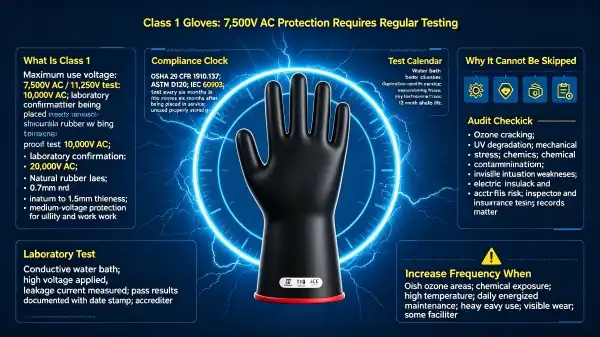
When doing electrical work, some risks must always be taken into account, and safety equipment rules must always be followed. It is important to test Class 1 Insulating Gloves that can handle voltages up to 7,500V AC at a certain frequency. This is required by law and can save lives. Class 1 Insulating Gloves must be tested for electricity every six months after they are put to use, according to OSHA rules (29 CFR 1910.137) and ASTM D120 standards. If the gloves are kept in the right way and aren't used, they can be saved for up to twelve months before they need to be tested for dielectric. This testing cycle makes sure that the rubber keeps its ability to insulate and keeps workers safe from electrical shock, arc flash, and death. Safety managers, buying pros, and compliance officers who are in charge of protecting workers must know these deadlines.
Understanding Class 1 Insulating Gloves and Their Testing Requirements
Class 1 Insulating Gloves are the last line of defence between a worker and voltage exposure, which could be deadly. Over the past 60 years, PPE MAX has worked to improve the safety gear that workers trust with their lives every day.
What Makes Class 1 Gloves Unique?
These gloves are in a very important middle ground when it comes to electrical safety. They can handle up to 7,500V AC and 11,250V DC. They protect people who work for utilities, electricity contractors, and repair companies, and regularly come into contact with medium-voltage systems. The gloves are proof-tested at 10,000V AC and must be able to handle 20,000V AC during laboratory confirmation. At PPE MAX, we use high-quality natural rubber latex in our manufacturing process. This gives our products better flexibility and insulating strength. The thickness is carefully chosen to be between 0.7mm and 1.5mm so that it protects and still allows for the touch awareness needed for complicated electrical work.
Why Regular Testing Matters
Many things, like ozone, UV rays, mechanical stress, and chemical pollution, can break down rubber over time. Even very small flaws that you can't see with the naked eye can seriously damage insulation. Under controlled conditions, dielectric testing puts voltage stress on an electrical system to find weaknesses before they cause a tragedy at work. Regular testing not only keeps accidents from happening, but it also meets the strict rules that are in place in the EU, the US, and other developed markets. During compliance reviews, insurance companies and safety inspectors look closely at testing records. This means that proper documentation is important for keeping operations running.
Testing Protocols at a Glance
Gloves are tested by putting them in a conductive water bath and applying a certain proof test voltage. Technicians look for current loss, which is a sign of insulator failure. These tests are done by accredited labs with regulated high-voltage equipment. When the tests are successful, the laboratories issue a certificate that includes a date stamp. At PPE MAX, our team works closely with testing centres all over the world to make sure that our goods always go above and beyond what is expected.
How Often Should Class 1 Insulating Gloves Be Tested?
How often Class 1 Insulating Gloves are tested is directly related to how they are used, how exposed they are to the world, and where they are regulated. Intelligent safety programs change plans based on real risk factors, not the baseline standard every six months.
Standard Six-Month Testing Cycle
According to ASTM D120 and IEC 60903, gloves that are being used should be tested every six months. This time frame strikes a balance between realistic operations and safety concerns, taking into account the fact that rubber compounds break down over time even in normal situations. OSHA enforces this standard by checking that testing is done correctly by looking at the labelling on gloves and the records of approval. If you don't stick to this plan, you could get fined, have your business shut down, or be held responsible for an accident.
Factors That Influence Testing Frequency
In the real world, testing plans often need to be stricter. Gloves worn in places with a lot of ozone, like near power plants or factories, may need to be tested every three months because the rubber breaks down faster there. In the same way, shorter gaps should be used for tasks that involve chemicals or very high temperatures. Some factories have switched to three-month cycles for gloves that are used in very demanding jobs. This has cut the failure rate by almost forty per cent compared to normal plans.
The level of volume of use is also very important. A utility worker who does daily energised maintenance will wear out their gloves much faster than someone who only does occasional fixing. Safety managers can find high-risk situations that need more attention by looking at historical data that records glove failures in specific job roles.
Storage and Shelf Life Considerations
Gloves that haven't been worn in a year can still be used as long as they are kept in protected glove bags out of the sun, heat, and ozone. But this grace time only applies to material that has been kept in good shape. The six-month clock starts as soon as the disc is taken out of storage and put back into active spinning. Smart procurement teams plan their buying cycles around testing dates. This keeps administrative work to a minimum while still providing constant safety.
Best Practices for Maintaining and Testing Class 1 Insulating Gloves
Effective Class 1 Insulating Gloves management goes far beyond checking gloves every so often in the lab. Daily habits and storage rules have a big effect on how well protective equipment works and how safe workers are.
Pre-Use Visual and Physical Inspections
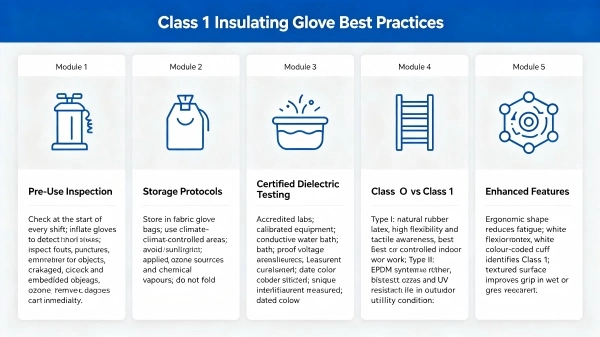
At the start of every shift, workers should carefully check their gloves. This includes rolling down gloves and pumping them up with air to find holes, cuts, or strange items inside them. When you look closely, you can see ozone breaking (small surface breaks), discolouration that means chemicals were used, or damage from sharp edges. Because lab tests can't replace being alert in real time, we teach our own staff at PPE MAX sites how to do these checks perfectly. If a glove passes the dielectric test but later gets mechanical damage, it doesn't protect you at all until it is found and taken out of service.
Proper Storage Protocols
Environmental factors speed up the breakdown of rubber in a quiet and steady way. Gloves should be kept in fabric glove bags that are kept in climate-controlled spaces out of direct sunlight, electrical equipment that makes ozone, and chemical vapours. Don't fold or crease gloves while they're being stored, because the stress builds up at the bend points and makes them more likely to break. Keep rubber gloves and leather covers separate when storing them for a long time to keep their shape. Extreme temperatures need extra attention—freezing temperatures make things less flexible, and too much heat speeds up the breakdown of molecules. Our Xi'an warehouses have strict environmental controls that keep the quality of the gloves safe from the time they are made until they are sent all over the world.
Certified Dielectric Testing Procedures
To test electrical systems, you need trained people and special tools. Testing equipment is regularly calibrated by accredited labs so that it can be traced back to national measurement standards. To do the tests, you have to clean the gloves well, fill them with a conductive solution, and slowly apply voltage while checking for leaking current. If you can measure a current flow, it means that the insulation is failing, and you need to take off your gloves right away. Laboratories put on colour-coded stickers with the date of the test, the date of the next test, and unique identification numbers that make it possible to keep track of records. Keeping detailed records produces a chain of proof that can be checked and shows that regulations are being followed during inspections.
These practices work together to make gloves last longer and keep workers safer. Organisations that only do occasional testing without strong daily inspection and storage practices regularly do worse than those whose safety programs include all three elements.
Comparing Class 1 Insulating Gloves: Testing and Durability Insights
Knowing the differences between voltage classifications helps procurement teams set the right security levels and make the best use of budgets across a range of practical needs for Class 1 Insulating Gloves.
Class 0 versus Class 1: Voltage Ratings and Applications
For low-voltage home and light business work, Class 0 gloves are the right choice. They protect against energies up to 1,000V AC. Class 1 gloves cover up to 7,500V AC, which means they can be used in medium-voltage power systems and industrial settings. In the same way, the tests are different: Class 0 gloves are put through proof testing at 5,000V AC, while Class 1 gloves are put through stress testing at 10,000V AC. This difference in voltage leads to different material thickness profiles and dielectric performance traits. As a minimum, work that involves substations, maintaining major distribution lines, or using industrial electrical tools rated above 1,000V needs Class 1 protection.
Material Composition Impact on Durability
The market is mostly made up of two main types of rubber. Type I gloves are made of natural rubber latex, which is very flexible and sensitive to touch. Workers who need to be able to do specific jobs with their hands, such as wearing these gloves. Type II gloves are made of EPDM synthetic rubber, which is more resistant to ozone damage and UV rays, which are important benefits for utility work that is done outside. At PPE MAX, we use both formulas in our manufacturing process, so customers can choose materials that work best in their particular setting. When tested in tough outdoor conditions, Type II gloves usually last longer between failures, while Type I gloves work best in controlled indoor situations where flexibility is important.
Enhanced Features Supporting Worker Safety
The form of modern gloves goes beyond just keeping your hands warm. Ergonomic shapes keep hands from getting tired after long periods of use, which has a direct effect on worker safety and efficiency. Colour-coded cuffs make it easy to tell right away what voltage class something is—white marks mean Class 1 rating, which keeps lower-rated equipment from being used in risky ways. Textured surfaces are better for gripping when they are wet or sticky, which is common in repair areas. Our design team talks to electrical workers from a wide range of businesses on a daily basis and uses their feedback to make real improvements in performance. These improvements come from decades of experience that is built into every pair of gloves that leaves our factories in Xi'an.
Procurement and Compliance: Buying Tips for Class 1 Insulating Gloves
Strategic choices about where to get Class 1 Insulating Gloves affect not only the costs up front, but also how well the program works in the long run, how well it follows the rules, and how confident workers are in the reliability of their safety gear.
Selecting Trustworthy Manufacturers and Suppliers
Professional procurement is different from commodity procurement because it involves working with well-known makers who offer full certification paperwork. Look for providers that have ASTM D120, IEC 60903, and CE marking certifications that can be checked through the records of an independent testing agency. At PPE MAX, our quality control method includes checking the raw materials, checking the manufacturing process, and making sure the finished product is good before it is shipped. This multi-layer method makes sure that all production runs are the same, which helps 134 countries around the world. Asking for facility checks or looking at third-party quality certifications is one way to make sure that marketing promises about manufacturing skills are true.
Bulk Purchasing Strategies for Large Organisations
The benefits of consolidated buying plans are huge for businesses that do a lot of electrical repairs. Bulk sales lower the cost per unit while making sure that there is enough product to meet the needs of the testing cycle. But when you buy in bulk, you should think about how long the product will last. If you order too much and the shelf life is less than twelve months, you'll have compliance issues that require testing before the product is ready. We work closely with buying teams to figure out the best amount of inventory to order based on the size of the workforce, how it will be used, and when it needs to be tested. Custom packaging options for distributors make it easier to keep track of supplies and get goods to end users.
Evaluating Total Cost of Ownership
The purchase price is only one part of the real cost of the tools. Responding to questions about compliance, supporting defective goods under warranty, and providing technical support during program execution are all things that suppliers do that add a lot of value above and beyond the original transaction amounts. When organisations work with makers that offer integrated testing management, they cut down on administrative costs and make sure that compliance is always met. We have technical support hotlines filled by experts in safety tools who know how hard it is for safety managers to keep up with everything. This consultative method changes relationships with suppliers from transactional to strategic, which helps the program succeed in the long run.
Dependability in delivery also affects the continuation of operations. When packages are late, they mess up testing plans, which could mean that operations have to lay off workers or accept compliance gaps. Our global supply chain infrastructure manages transportation, production, and quality control to keep delivery windows on track across all foreign markets.
Conclusion
Class 1 Insulating Gloves need to be tested in a way that combines the requirements of the law with how they are used in real life. The normal testing for six months gives a base level of security that is changed automatically based on usage level, environmental exposure, and past performance data. Visual checks every day, following the right storing rules, and approved dielectric testing all work together to make sure that gloves protect workers well for as long as they are used. Knowing the differences between voltage classifications helps you choose the right tools, and working with key suppliers makes managing compliance easier and lowers the overall cost of the program. At PPE MAX, we know that behind every testing process and purchase choice is a worker who depends on the quality of the equipment to make it home safely every day. This is a duty we have taken seriously for more than 60 years.
FAQ
1. How do testing requirements differ between the US and EU markets?
Electrical glove testing requirements are very strict in both areas, but the regulatory systems are slightly different. The United States relies on OSHA rules that are based on ASTM D120 standards and require testing every six months with specific voltage proof test requirements. IEC 60903 standards are used in European markets, along with CE marking rules and unified safety laws. Practical testing methods are pretty much the same in all areas: applying electricity in conductive baths and checking for leaking current. International businesses should make sure that the gloves they use have both ASTM and IEC certifications. This will make it easier to follow the rules in several different legal settings.
2. Can visual inspections replace electrical testing?
Visual and physical checks are important daily safety measures, but they can't take the place of electrical insulation testing. Surface inspections find damage that can be seen by workers, like cuts, punctures, or ozone cracks. But tiny flaws, internal delamination, or slow insulation decline can't be found unless high voltage stress is applied in a controlled laboratory setting. Both types of checking are useful. Daily visual checks find problems right away, and electrical tests done on a regular basis make sure that the dielectric is still working well over time.
3. What happens when gloves fail testing?
If a glove shows measurable current loss during dielectric testing, it must be taken out of service and thrown away right away so it can't be used again by chance. Organisations should look into failure trends to find storage problems, environmental factors, or usage habits that might be causing things to break down too quickly. If gloves have passed their expiration date, replacements must be tested before they can be used. When unexpected testing failures happen, keeping enough supplies on hand keeps operations from being interrupted.
Partner with PPE MAX for Certified Electrical Insulation Solutions
PPE MAX sells high-quality Class 1 Insulating Gloves that are backed by 65 years of manufacturing excellence and quality assurance around the world. Our Class 1 Insulating Gloves are safe for workers in factories, building sites, and utility companies around the world because they meet ASTM D120, IEC 60903, and OSHA standards. We offer full support, which includes the ability to customise apps for specific needs, bulk pricing that works best for big businesses, and expert help setting up testing programs. Contact our team at marketing@ppemax.com to talk about your unique needs, get product samples, or set up tours of our cutting-edge Xi'an manufacturing site. When you work with a reliable Class 1 Insulating Gloves maker that cares about worker safety and follows the rules, you get more than just protective gear. You get access to decades of experience that have been devoted to keeping electrical workers safe every shift.
References
1. American Society for Testing and Materials. (2019). ASTM D120: Standard Specification for Rubber Insulating Gloves. West Conshohocken, PA: ASTM International.
2. Occupational Safety and Health Administration. (2021). 29 CFR 1910.137: Electrical Protective Devices. Washington, DC: U.S. Department of Labour.
3. International Electrotechnical Commission. (2018). IEC 60903: Live Working - Electrical Insulating Gloves. Geneva, Switzerland: IEC Publications.
4. National Fire Protection Association. (2021). NFPA 70E: Standard for Electrical Safety in the Workplace. Quincy, MA: NFPA.
5. Institute of Electrical and Electronics Engineers. (2020). IEEE Guide for In-Service Maintenance and Electrical Testing of Live-Line Tools. New York, NY: IEEE Standards Association.
6. Canadian Standards Association. (2019). CSA Z462: Workplace Electrical Safety Standard. Toronto, Ontario: CSA Group.
Learn about our latest products and discounts through SMS or email