- English
- French
- German
- Portuguese
- Spanish
- Russian
- Japanese
- Korean
- Arabic
- Greek
- German
- Turkish
- Italian
- Danish
- Romanian
- Indonesian
- Czech
- Afrikaans
- Swedish
- Polish
- Basque
- Catalan
- Esperanto
- Hindi
- Lao
- Albanian
- Amharic
- Armenian
- Azerbaijani
- Belarusian
- Bengali
- Bosnian
- Bulgarian
- Cebuano
- Chichewa
- Corsican
- Croatian
- Dutch
- Estonian
- Filipino
- Finnish
- Frisian
- Galician
- Georgian
- Gujarati
- Haitian
- Hausa
- Hawaiian
- Hebrew
- Hmong
- Hungarian
- Icelandic
- Igbo
- Javanese
- Kannada
- Kazakh
- Khmer
- Kurdish
- Kyrgyz
- Latin
- Latvian
- Lithuanian
- Luxembou..
- Macedonian
- Malagasy
- Malay
- Malayalam
- Maltese
- Maori
- Marathi
- Mongolian
- Burmese
- Nepali
- Norwegian
- Pashto
- Persian
- Punjabi
- Serbian
- Sesotho
- Sinhala
- Slovak
- Slovenian
- Somali
- Samoan
- Scots Gaelic
- Shona
- Sindhi
- Sundanese
- Swahili
- Tajik
- Tamil
- Telugu
- Thai
- Ukrainian
- Urdu
- Uzbek
- Vietnamese
- Welsh
- Xhosa
- Yiddish
- Yoruba
- Zulu
Why Choose Class 1 Insulating Gloves for 7,500V?
Founded in 1956, PPEMAX stands as a premier global manufacturer and supplier of full-range personal protective equipment. All our products comply with internationally recognized standards including IEC, ASTM, CE, UKCA, NIOSH and ISO9001. Equipped with a 2,000-square-meter modern production plant, we boast over 25 years of mature OEM & ODM capabilities to deliver one-stop customized solutions covering R&D design through worldwide logistics. Our safety gear is distributed across 134 countries globally. Upholding our core tenet “Safety First, Quality Priority”, we serve as a dependable long-term PPE partner for industrial enterprises around the world.
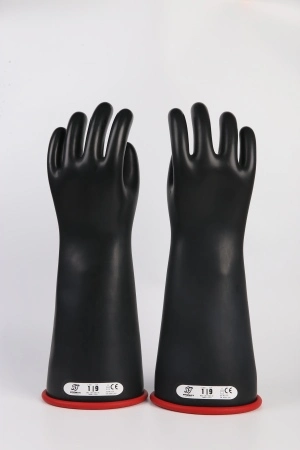
In high voltage conditions, choosing the correct electrical insulating gloves might be the difference between life and death. Class 1 Insulating Gloves provide proven protection from electrical risks up to 7,500 volts AC and 11,250 volts DC. They are the best solution for medium voltage applications in the utility, industrial, and construction industries. The gloves provide superior dielectric strength, flexibility, and comfort to perform complicated electrical tasks and protect workers from threats of shock, arc flash, and electrocution. With over 65 years of industry experience across 134 countries, we at PPE MAX have seen the impact the right choice of gloves can have on the safety results of a workplace.
|
Parameter |
Specification |
|
Voltage Rating |
7,500V AC / 11,250V DC (Maximum Use) |
|
Proof Test Voltage |
10,000V AC / 40,000V DC |
|
Material Type |
Type I (Natural Rubber) / Type II (EPDM Synthetic) |
|
Thickness Range |
1.02mm - 1.52mm |
|
Tensile Strength |
>17.2 MPa |
|
Standards Compliance |
ASTM D120, IEC 60903 |
|
Temperature Resistance |
Category A, H, Z rated |
|
Label Color |
White (Class 1 Standard) |
Understanding Class 1 Insulating Gloves: Specifications and Standards
Gloves that are electrically insulating are the final barrier between you and a possibly deadly electrical contact. If we speak about voltage-rated gloves, we are talking about precisely manufactured PPE that is built to exacting international standards that actually save lives every day.
What Makes Them Different from Other Voltage Classes
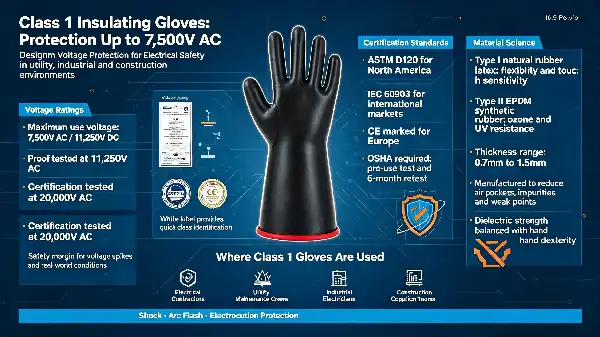
Insulating gloves are classified from the lowest Class 00 (up to 500V AC) to the highest Class 4 (up to 36,000V AC). Class 1 gloves are important because they are in the center of the spectrum. Maximum usage voltage is 7,500V AC and 11,250V DC. This rating makes them well suited for electrical contractors, utility maintenance crews, and industrial electricians working on distribution systems, substations, and manufacturing equipment at medium voltage levels. The gloves are proof tested at 10,000V AC and must pass 20,000V AC during the certification testing, which leaves enough of a safety margin for real-world settings and any voltage spikes.
International Certification Requirements
Following established standards is not optional; it is the essence of electrical safety. Our Class 1 insulating gloves from PPE MAX meet or exceed the standards of ASTM D120 (North American standard), IEC 60903 (international standard), and are CE marked for the European market. These certifications require certain material attributes, dimensional tolerances, and electrical performance characteristics. In the United States, OSHA standards mandate that all electrical insulating gloves be tested before first use and then retested every six months while in operation. The white label on these gloves makes it possible to visually identify the voltage class at a glance, protecting against harmful misapplication on industrial sites. Each pair is marked with traceable batch numbers and test dates, establishing accountability across the supply chain from our production plant in Xi’an, China to your workers’ hands.
Material Science Behind the Protection
These gloves are dielectric because of the precisely developed rubber compositions. Our Class 1 gloves are made from Type I natural rubber latex or Type II EPDM synthetic rubber. The rubber is very flexible and touch sensitive, so technicians may move tiny parts and controls with accuracy. Type II synthetic rubber has better resistance to ozone and UV degradation and is the best material for outdoor utility work when gloves are exposed to environmental stress. Thickness varies between 0.7mm and 1.5mm depending on manufacturer and is a compromise between sufficient insulation and hand dexterity. Advanced manufacturing techniques remove air pockets, impurities, and irregularities that might produce weak places in the dielectric barrier.
Why Class 1 Insulating Gloves Are Essential for 7,500V Operations
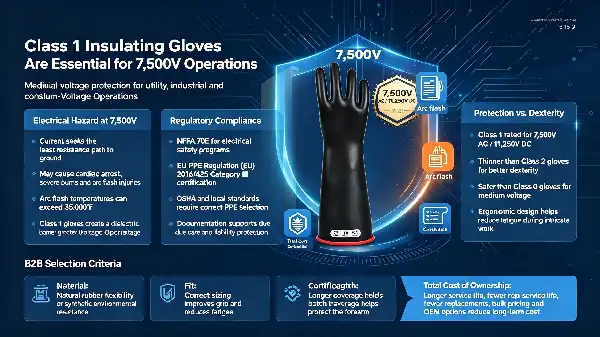
Specialised protection is required for the particular risks of the medium-voltage environment. In a 7,500V operation, energy levels may cause sudden cardiac arrest, serious burns and explosive arc flash occurrences, unlike low-voltage work where Class 00 or Class 0 gloves are enough.
The Physics of Electrical Hazards at Medium Voltage
At 7,500 volts, the electrical current will choose the route of least resistance to ground. Unfortunately, this is typically the human body. Conduction of current through tissue results from inadequate insulation when in contact with energised conductors, which leads to disruption of heart rhythm and heat injury to organs and muscle. At such voltage, the arc flash may be in excess of 35000 degrees F. This vaporises metal parts and causes pressure waves that can inflict catastrophic injuries. The Class 1 Insulating Gloves provide an unbroken insulating barrier with a dielectric strength significantly greater than the operating voltage, which prevents current flow and protects workers even in the event of inadvertent contact with live circuits or equipment failure situations.
Regulatory Compliance and Liability Protection
Across countries, there are safety rules that specify PPE for voltage-graded work. In the United States, NFPA 70E provides guidelines for electrical safety programs, including suitable glove selection depending on voltage exposure. According to EU directives, Regulation (EU) 2016/425 on Personal Protective Equipment, equipment that protects against mortal danger must be certified as category III. This includes electrical insulation at certain voltage levels. Proper glove selection is more than regulatory compliance and shows due care that shields organisations from liability claims. Whether anything goes wrong, investigators look to see whether the right PPE was delivered, maintained, and appropriately utilised. Our customers in government procurement departments, in particular, appreciate paperwork that demonstrates that their safety equipment fulfils all relevant criteria, safeguarding their workers’ safety and the prestige of their organisation.
Balancing Protection with Operational Efficiency
Class 1 gloves are a good middle ground for safety and usefulness. Class 2 gloves (certified to 17,000V) provide more voltage protection, but at the expense of dexterity, since they are thicker, which hampers work and causes tiredness over long periods of time. Class 0 gloves (rated to 1,000V) are very flexible yet afford workers dangerously little protection in 7,500V conditions. Modern Class 1 gloves are ergonomically designed so that electricians are able to grasp tools, handle circuit breakers, and do intricate work without removing protection. This is the balance needed for productivity. Workers who trust their PPE will do their jobs effectively and confidently rather than fearfully, while yet keeping safety margins.
If you're evaluating personal protective equipment suppliers and require batch-specific testing documents before placing an order, PPE MAX is able to provide official Certificates of Analysis, professional laboratory test reports, and product samples for your verification. Feel free to contact our team at marketing@ppemax.com to discuss your sourcing needs and obtain complete documentation for your quality assessment and procurement approval.
Selecting the Best Class 1 Insulating Gloves: Criteria and Brand Insights
The choices made by the PPE industry in its procurement are significant beyond the financial implications. The correct gloves safeguard your personnel. Poor quality items cause unacceptable danger.
Essential Selection Criteria for B2B Buyers
Procurement experts should consider a number of key variables while assessing suppliers and goods. Material composition dictates protection and endurance; natural rubber gives flexibility, synthetic choices withstand environmental deterioration. Sizing correctness is very important. If gloves are too loose, dexterity will be hindered, and they may slide at vital times. If gloves are too tight, hand fatigue will result and use duration will be shortened. Cuff length is vital for forearm safety, especially when reaching inside cabinets or working around live bus bars. Certification documents must be complete, verifiable and include test findings from authorised labs, traceability to production batches and explicit expiry dates. Bulk pricing structures should represent real savings of scale without compromising quality. The ability to customise lets you choose characteristics that suit your operational needs.
Why PPE MAX Stands Out Among Manufacturers
We have been producing electrical safety equipment since 1956 and know what makes the difference between sufficient and extraordinary performance. Our persistent focus on quality control and client needs has made us the biggest provider of PPE in Northwest China. Before any gloves leave our plant, every manufacturing batch is tested in our in-house laboratory under real-world electrical stress circumstances. We use natural rubber latex that is pharmaceutical-grade pure, free of contaminants that might degrade dielectric characteristics. The design has been ergonomically tailored with input from electricians in Australian mining operations, European utility firms, and American telecom contractors. We are both a producer and a user; therefore, we test our equipment ourselves, and we maintain standards that are representative of the real world, not just minimal certification requirements.
Understanding Total Cost of Ownership
Glove economics for Class 1 Insulating Gloves is not only about the price per pair. Procurement managers must determine overall cost across the product lifespan, taking into account durability, frequency of testing, and replacement intervals. Inferior gloves may have a cheaper initial cost, but they fail prematurely, necessitating frequent replacement and creating supply chain disruption. Properly cared for, our gloves will often last 18-24 months, vs 12-15 months for cheaper options. This longer lifespan lessens the administrative load of frequent reordering and disposal. Volume pricing for bulk buys, such as for major construction businesses, mining corporations and utility companies that keep vast stocks, may cut per-unit prices by 20-35% compared to small quantity purchases. You may also add value via OEM agreements with specialised packaging, private labelling and centralised logistics that make it easier to manage your inventory.
Maintenance, Testing, and Longevity: Maximizing the Value of Class 1 Insulating Gloves
Proper care extends glove life and ensures reliable protection. Even premium gloves fail when maintenance protocols are inadequate.
Mandatory Testing Protocols
Electrical insulating gloves require testing at regular intervals to maintain certification. Before each use, workers should perform an air inflation test—filling the glove with air and then rolling it to create pressure while watching and feeling for leaks. This simple procedure detects punctures, cuts, or degradation invisible to casual inspection. Formal electrical testing must occur every six months once gloves enter service, or every twelve months if they remain in storage unopened. Accredited testing facilities apply the appropriate proof test voltage while monitoring for current leakage that would indicate insulation failure. At PPE MAX, we provide testing protocols and can recommend certified testing partners in your region to ensure compliance with local regulations.
Storage and Cleaning Best Practices
Environmental factors accelerate rubber degradation. Gloves should be stored in protective canvas bags away from direct sunlight, heat sources, and ozone-producing equipment like motors and welders. Never fold insulating gloves, as creases create stress points that weaken the dielectric barrier. After use, clean gloves with mild soap and water, avoiding petroleum-based solvents or aggressive chemicals that attack rubber compounds. Allow them to dry thoroughly before storage. When using the complete glove set configuration with leather protectors and cotton liners, store the rubber gloves separately to prevent the rubber from taking on the shape of the leather protector during long-term storage. Temperature extremes also damage rubber—avoid storage areas exceeding 120°F or below freezing.
Recognizing When Replacement Becomes Necessary
Visual inspection before each use should identify obvious damage including cuts, punctures, embedded foreign objects, ozone cracking, or signs of chemical attack. Discoloration, particularly charring or melting, indicates the gloves contacted electrical arcs or excessive heat. Swelling, stickiness, or unusual odors suggest chemical contamination. Any glove failing inspection must be removed from service immediately, regardless of purchase date or testing status. Beyond damage, gloves have finite service lives—rubber compounds degrade over time even with careful storage. We recommend replacing gloves approaching three years from the manufacture date, even if they pass testing, as material properties deteriorate with age.
Where and How to Procure Certified Class 1 Insulating Gloves Globally
The global PPE market presents both opportunities and risks for procurement professionals. Sourcing from the right partners ensures product authenticity and supply chain reliability.
Evaluating Suppliers and Distributors
Trustworthy suppliers demonstrate several characteristics that distinguish them from opportunistic vendors. Look for manufacturers with decades of operational history, which indicates stability and accumulated expertise. Comprehensive certification portfolios covering multiple international standards show commitment to global markets. Transparent manufacturing processes—including facility tours and third-party audits—build confidence in quality control systems. After-sales support including technical consultation, training resources, and responsive customer service reflects genuine partnership rather than transactional relationships. At PPE MAX, we welcome procurement teams to visit our Xi'an manufacturing facilities, observing production firsthand and discussing customization requirements directly with our engineering staff.
Verification and Due Diligence
Counterfeit PPE represents a dangerous reality in global markets. Procurement teams must implement verification procedures to ensure product authenticity. Require complete certification documentation including laboratory test reports with accredited laboratory logos, batch traceability information, and clear statements of compliance with applicable standards. Contact certification bodies directly to verify certificate authenticity using provided reference numbers. Request samples for independent testing before placing large orders, particularly when establishing relationships with new suppliers. Examine packaging quality and labeling accuracy—legitimate manufacturers invest in professional packaging that includes comprehensive usage instructions, safety warnings, and contact information. Our packaging at PPE MAX includes QR codes linking to digital certification documents, enabling instant verification of product authenticity.
Optimizing International Logistics
Global procurement involves coordinating shipments across borders, managing customs procedures, and ensuring product integrity during transit. Experienced PPE manufacturers maintain established logistics networks with reliable freight partners, properly classified tariff codes, and documentation meeting import requirements for various countries. Bulk shipments require sturdy packaging protecting gloves from compression, moisture, and temperature variations during ocean freight or air transport. We package individual glove pairs in polybags, then consolidate them into reinforced cartons designed to withstand stacking and handling. Custom packaging options for distributors building their own brands can include private labeling, modified packaging graphics, and specialized documentation. Our global supply chain reaches 134 countries, with established processes for navigating regulatory requirements in markets from Brazil to Saudi Arabia to Indonesia.
Conclusion
Selecting appropriate electrical insulating Class 1 Insulating Gloves represents a critical decision affecting worker safety, regulatory compliance, and operational efficiency. Class 1 gloves rated for 7,500V operations provide the protection, flexibility, and durability essential for medium-voltage electrical work across utility, industrial, and construction applications. Understanding specifications, maintenance requirements, and procurement strategies enables B2B buyers to make informed decisions that protect their workforce while optimizing total cost of ownership. As you evaluate suppliers, prioritize manufacturers demonstrating genuine expertise, comprehensive certification, and commitment to customer partnership. The right gloves, properly maintained and correctly used, create the foundation for electrical safety programs that bring workers home safely every day.
FAQ
1. How often must Class 1 insulating gloves undergo electrical testing?
Gloves in active service require electrical testing every six months according to ASTM D120 and OSHA regulations. This formal testing applies proof test voltage while monitoring for current leakage indicating insulation breakdown. Gloves in sealed storage can remain unused for twelve months before requiring testing. Beyond formal testing, workers must perform air inflation tests before each use to detect punctures or damage. Leather protectors don't require electrical testing but need daily visual inspection for cuts or damage that could compromise the rubber gloves they protect.
2. Can Class 1 gloves be used on systems exceeding 7,500V?
Absolutely not. Using gloves beyond their rated voltage creates extreme danger. The 7,500V AC maximum use voltage represents the upper limit where these gloves provide adequate safety margins. Systems operating at higher voltages require appropriately rated equipment—Class 2 gloves for voltages up to 17,000V, Class 3 for up to 26,500V, and Class 4 for up to 36,000V. Voltage misapplication remains a leading cause of electrical fatalities. The color-coded white label on Class 1 gloves provides instant visual identification, preventing workers from accidentally using under-rated protection.
3. What distinguishes the complete glove set from rubber gloves alone?
The complete insulating glove set addresses a critical weakness in rubber gloves—mechanical vulnerability. While rubber provides excellent dielectric protection, it punctures easily when contacting sharp edges, tool points, or rough surfaces. The three-component set includes the voltage-rated rubber glove, a leather protector conforming to ASTM F696 standards that absorbs mechanical trauma, and often a cotton liner managing moisture. This configuration protects the insulating integrity of the rubber glove while maintaining comfort during extended wear. Standard practice prohibits using rubber gloves without leather protectors in field environments where mechanical hazards exist.
Partner with PPE MAX for Superior Electrical Protection Solutions
Since 1956, PPE MAX has delivered uncompromising quality in electrical safety equipment to organizations spanning 134 countries. Our Class 1 insulating gloves combine certified dielectric protection, ergonomic comfort, and proven durability backed by over six decades of manufacturing expertise. As Northwest China's largest PPE supplier and a trusted manufacturer for global brands, we offer comprehensive customization capabilities, competitive bulk pricing, and technical support that transforms procurement partnerships. Whether you're an industrial safety distributor seeking reliable inventory, a multinational corporation establishing standardized PPE programs, or a government agency demanding verified compliance, our team delivers solutions matching your exact specifications. Contact our expert team at marketing@ppemax.com to discuss your requirements, request samples, and discover why industry leaders worldwide trust PPE MAX as their preferred Class 1 Insulating Gloves manufacturer.
References
1. American Society for Testing and Materials. (2021). ASTM D120-20: Standard Specification for Rubber Insulating Gloves. West Conshohocken, PA: ASTM International.
2. International Electrotechnical Commission. (2019). IEC 60903:2019 Live Working - Electrical Insulating Gloves. Geneva: IEC Standards.
3. National Fire Protection Association. (2021). NFPA 70E: Standard for Electrical Safety in the Workplace. Quincy, MA: NFPA Publications.
4. Occupational Safety and Health Administration. (2020). 29 CFR 1910.137: Electrical Protective Equipment Standards. Washington, DC: U.S. Department of Labor.
5. Cadick, J., Capelli-Schellpfeffer, M., & Neitzel, D. (2022). Electrical Safety Handbook (5th ed.). New York: McGraw-Hill Professional.
6. European Committee for Standardization. (2020). EN 60903:2019 Live Working - Electrical Insulating Gloves. Brussels: CEN Publications.
Learn about our latest products and discounts through SMS or email