- English
- French
- German
- Portuguese
- Spanish
- Russian
- Japanese
- Korean
- Arabic
- Greek
- German
- Turkish
- Italian
- Danish
- Romanian
- Indonesian
- Czech
- Afrikaans
- Swedish
- Polish
- Basque
- Catalan
- Esperanto
- Hindi
- Lao
- Albanian
- Amharic
- Armenian
- Azerbaijani
- Belarusian
- Bengali
- Bosnian
- Bulgarian
- Cebuano
- Chichewa
- Corsican
- Croatian
- Dutch
- Estonian
- Filipino
- Finnish
- Frisian
- Galician
- Georgian
- Gujarati
- Haitian
- Hausa
- Hawaiian
- Hebrew
- Hmong
- Hungarian
- Icelandic
- Igbo
- Javanese
- Kannada
- Kazakh
- Khmer
- Kurdish
- Kyrgyz
- Latin
- Latvian
- Lithuanian
- Luxembou..
- Macedonian
- Malagasy
- Malay
- Malayalam
- Maltese
- Maori
- Marathi
- Mongolian
- Burmese
- Nepali
- Norwegian
- Pashto
- Persian
- Punjabi
- Serbian
- Sesotho
- Sinhala
- Slovak
- Slovenian
- Somali
- Samoan
- Scots Gaelic
- Shona
- Sindhi
- Sundanese
- Swahili
- Tajik
- Tamil
- Telugu
- Thai
- Ukrainian
- Urdu
- Uzbek
- Vietnamese
- Welsh
- Xhosa
- Yiddish
- Yoruba
- Zulu
Electrical Rubber Gloves: Straight Cuff or Bell Cuff?
Founded in 1956, PPEMAX stands as a premier global manufacturer and supplier of full-range personal protective equipment. All our products comply with internationally recognized standards including IEC, ASTM, CE, UKCA, NIOSH and ISO9001. Equipped with a 2,000-square-meter modern production plant, we boast over 25 years of mature OEM & ODM capabilities to deliver one-stop customized solutions covering R&D design through worldwide logistics. Our safety gear is distributed across 134 countries globally. Upholding our core tenet “Safety First, Quality Priority”, we serve as a dependable long-term PPE partner for industrial enterprises around the world.
Electrical rubber glove cuff type selection is a basic consideration for protective coverage and operational efficiency. Straight cuff styles give tight wrist seals and increased dexterity for delicate electrical work, while bell cuff styles provide quicker donning and added forearm protection for high-voltage work. The selection depends on certain task needs, levels of voltage exposure, and compatibility with leather protectors and other personal protective equipment. Knowing these design differences allows procurement teams to match glove requirements to the safety demands of their personnel in industrial, utility, and construction situations.
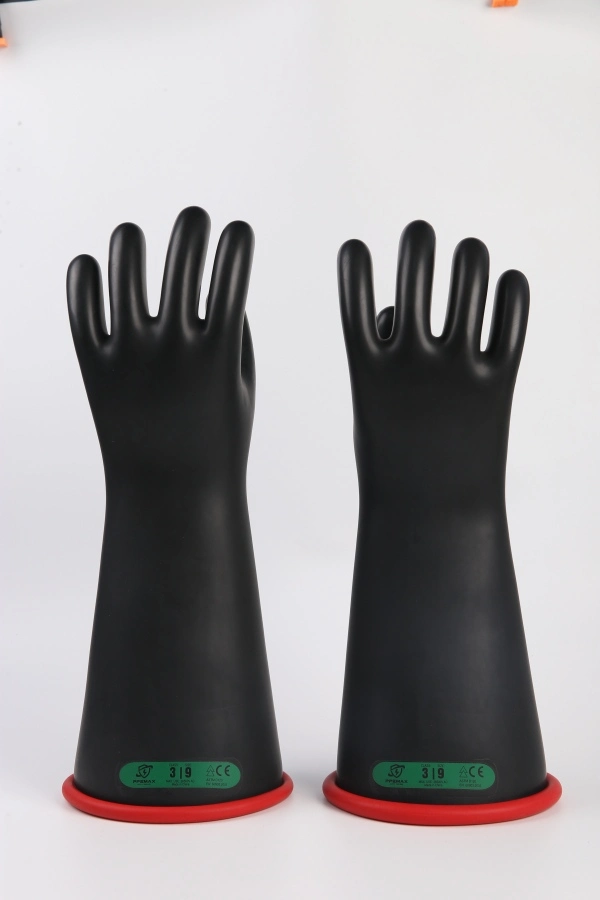
|
Parameter |
Specification |
Standard |
|
Maximum Use Voltage |
26,500V AC / 39,750V DC |
ASTM D120 / IEC 60903 |
|
Proof Test Voltage |
30,000V AC / 45,000V DC |
ASTM D120 |
|
Material Types |
Type I (Natural Rubber) / Type II (EPDM) |
ASTM D120 |
|
Thickness Range |
2.3mm - 2.9mm |
Industry Standard |
|
Length Options |
14" - 18" inches |
Customizable |
|
Label Color |
Green |
International Standard |
|
Temperature Range |
-25°C to +65°C |
Operating Conditions |
Understanding Electrical Rubber Gloves: Basics and Standards
For almost 60 years, PPE MAX has been providing electrical workers in 134 countries with protection, and we believe that successful voltage protection begins with the right equipment. Insulating gloves are the first line of defence against electrocution – forming a barrier between workers and energised conductors. These specialised instruments are required to achieve stringent international criteria for life-saving performance in the field.
Core Function and Dielectric Properties
Rubber insulating gloves work on the basis of the dielectric strength of the material. This is the capacity to resist the passage of electrical current. Natural rubber and EPDM compounds are cured into stable molecular structures which block current routes even under high voltage stress. These gloves are used to safeguard linemen, substation technicians, and industrial electricians working on energised circuits when de-energization is not practicable or achievable during field operations.
The insulation efficiency relies on the thickness of the material, purity of the compound, and the accuracy of manufacture. We test each manufacturing lot personally in our North-west China factory, since we know that minuscule faults may undermine protection. Our staff members examine gloves themselves using the same techniques we offer to our customers.
Global Certification Standards
The quality of insulating gloves is governed by three main standards globally. The American Society for Testing and Materials (ASTM) produced ASTM D120, which defines six voltage classes (00, 0, 1, 2, 3 & 4) based on maximum usage voltage and proof test criteria. IEC 60903, International Electrotechnical Commission, offers equivalent classifications recognised in European and Asian markets. EN 60903 modifies IEC standards for the European Union, including more labelling and documentation requirements.
The voltage ratings range from Class 00 (maximum use voltage 500V ac) to Class 4 (maximum use voltage 36,000V ac), with correspondingly much higher proof test voltages to provide safety margins. B2B procurement pros must check that the certifications of the gloves align with the voltage ranges of their work settings. Our manufacturing lines are dual ASTM & IEC certified and are easily deployable across foreign project locations.
Type I and Type II Material Distinctions
The industry classifies materials into two groups, each with its own set of performance characteristics. Type I gloves are made from natural rubber compounds that provide outstanding flexibility and tactile sensitivity. Preferred for thorough control work and metre installations. Type II gloves are made from EPDM (ethylene propylene diene monomer) compounds that withstand ozone degradation and weathering for longer service life in outdoor utility applications.
Material selection impacts both first cost and lifespan economics of electrical rubber gloves. Natural rubber has superior dexterity for lower voltage classes, and EPDM pays for the additional investment by reducing the replacement frequency in hard environmental conditions. Both kinds are commonly kept in inventory by procurement teams supporting a variety of operational settings so that protection may be optimised across various work circumstances.
Straight Cuff vs Bell Cuff: Key Differences and Applications
One of the most important, but often neglected, features when buying gloves is the cuff design. This structural feature has a direct impact on the efficiency of donning, the extent of protective covering, and the integration with leather protector gloves that give crucial mechanical protection.
Design Characteristics and Fit Profiles
Straight cuff gloves have a uniform diameter from palm to cuff opening, providing a tight fit around the wrist and lower forearm. This contoured form minimises extra material that might interfere with tool usage or snag on equipment. The tight profile also helps tactile feedback, letting workers keep tight control over tiny parts like terminal screws or metre connections.
Bell cuff designs include a bell-shaped aperture that flares out to make insertion and removal easier. The larger diameter makes it easier to put on leather protective gloves, therefore lowering the wearing time in emergency reaction circumstances. Additional surface area on the forearm covered provides further protection while reaching inside energised cabinets or working near exposed bus bars.
Application-Specific Performance Advantages
The choice of cuff designs in different industrial settings is driven by operational considerations. Straight-cuff variants are the best choice for tight locations where extra material might be a concern, such as within control panels or delicate soldering on energised circuits. Electricians installing smart metres and EV charging infrastructure like the better manual dexterity straight cuffs provide while working with tiny fasteners and wire connections.
Bell cuff designs are prevalent in transmission and distribution utility operations when workers are handling high-voltage cables and tools at the same time. Linemen prefer the simplicity of pulling on bell cuff gloves over thick clothing or while operating from overhead platforms with restricted movement. This added covering of the forearm is important when sleeves may ride up during reaching or overhead operations, providing continuous protection between the worker and the voltage source.
Compatibility with Leather Protectors
Both forms of cuffs necessitate the use of leather protective gloves to prevent mechanical damage to the rubber that would affect dielectric integrity. The straight cuffs should be sized with some care to allow the leather protectors to slip over the rubber without excessive bunching, which might inhibit dexterity. Bell cuffs make this layering procedure easier by enabling leather protectors to glide over the flared aperture without binding.
The distance between the edge of the rubber glove and the end of the leather protection might impact safety. Industry best practice recommends the rubber glove be at least two inches longer than the leather cover to avoid electricity tracking across the interface. The bell cuff is a natural for this overlap, but the straight cuff requires more care in selecting the right glove length.
If you're evaluating personal protective equipment suppliers and require batch-specific testing documents before placing an order, PPE MAX is able to provide official Certificates of Analysis, professional laboratory test reports, and product samples for your verification. Feel free to contact our team at marketing@ppemax.com to discuss your sourcing needs and obtain complete documentation for your quality assessment and procurement approval.
How to Choose the Right Electrical Rubber Gloves for Your Business
Effective procurement decisions balance multiple technical parameters against operational requirements and budget constraints for electrical rubber gloves. We guide industrial safety managers through systematic evaluation processes that align equipment specifications with workforce protection needs.
Voltage Class and Insulation Requirements
The selection process begins with accurate voltage exposure assessment. Procurement teams must identify the maximum working voltage encountered across all job tasks, then specify gloves rated for that level plus appropriate safety margins. Class 0 gloves protect workers handling 1,000V AC circuits common in industrial control systems, while Class 2 gloves serve utility workers maintaining 17,000V distribution networks.
Underspecifying voltage class creates unacceptable risk, while overspecifying increases costs and reduces dexterity unnecessarily. Detailed job hazard analyses document actual voltage exposures, enabling precise specification matching. Organizations managing diverse electrical environments often maintain multiple voltage classes to optimize protection and usability across varied tasks.
Size and Fit Precision
Proper sizing directly impacts both safety and productivity. Undersized gloves restrict blood circulation, cause hand fatigue, and may tear during donning. Oversized gloves reduce tactile sensitivity and increase the risk of snagging on equipment. Accurate hand measurements—palm circumference and middle finger length—enable precise size matching using manufacturer sizing charts.
We recommend measuring dominant and non-dominant hands separately, as dimensional differences often exist. Workers should test gloves by making fists and manipulating typical tools to verify adequate dexterity. Large-scale procurement projects benefit from ordering sample sizes for field testing before committing to bulk orders.
Liner Integration and Comfort Factors
Insulating gloves are available with or without integrated fabric liners that absorb perspiration and improve comfort during extended wear. Unlined gloves offer maximum flexibility and tactile sensitivity but can become uncomfortable during prolonged use, particularly in warm environments. Lined versions enhance comfort and facilitate donning but add bulk that may reduce dexterity for precision work.
Some procurement teams specify unlined gloves paired with separate cotton liner gloves that workers can launder between shifts, improving hygiene and extending rubber glove lifespan. This modular approach allows customization to individual comfort preferences while maintaining consistent electrical protection standards.
Chemical Resistance Considerations
While primarily designed for electrical insulation, rubber gloves encounter various chemical exposures during maintenance and repair operations. Natural rubber demonstrates good resistance to alcohols and dilute acids but degrades rapidly when exposed to petroleum products and solvents. EPDM compounds resist ozone and weathering but show limited protection against hydrocarbon contamination.
Procurement specifications should account for anticipated chemical exposures in addition to voltage requirements. Workers handling transformer oil or hydraulic fluids require Type II gloves or supplementary chemical-resistant overgloves. Our technical team evaluates specific exposure scenarios to recommend optimal material selections that address both electrical and chemical hazards.
Maintenance, Testing, and Lifespan of Electrical Rubber Gloves
Even the highest-quality insulating gloves require rigorous maintenance protocols to sustain protection reliability throughout their service life. We've developed comprehensive testing and care procedures based on decades of field experience across demanding industrial environments.
Mandatory Inspection and Testing Protocols
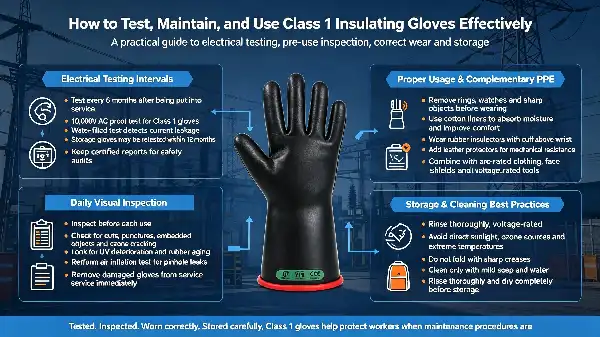
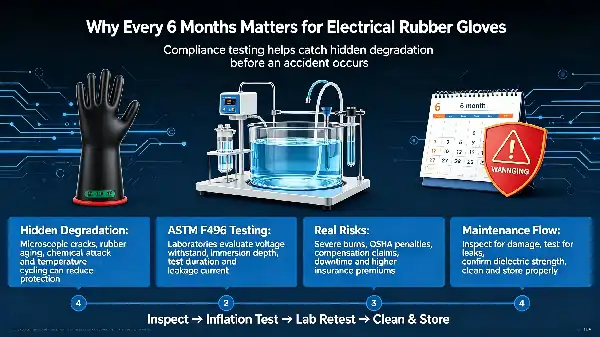
Regulatory standards including OSHA 1910.137 and ASTM F496 mandate periodic electrical testing intervals based on glove usage patterns. Gloves in active service require dielectric testing every six months, while stored inventory must be tested within twelve months of issuance. Testing applies high-voltage current through water-filled gloves while monitoring for leakage current that indicates insulation breakdown.
Before each use, workers perform visual inspections examining rubber surfaces for cuts, punctures, embedded foreign objects, and ozone cracking. The air inflation test—inflating the glove and listening for air leaks—detects pinhole defects invisible to visual examination. These field inspections complement laboratory testing, creating a layered defense against equipment failure.
Cleaning and Storage Best Practices
Proper cleaning removes contaminants that accelerate rubber degradation. After each use, gloves should be washed with mild soap and water, then thoroughly dried inside and out before storage. Avoid petroleum-based cleaners and harsh solvents that attack rubber compounds. Some organizations use UV inspection under black light to detect petroleum contamination invisible under normal lighting.
Storage conditions significantly influence the longevity of electrical rubber gloves. We recommend keeping gloves in cool, dark, dry environments away from ozone sources like electric motors and welding equipment. Canvas storage bags protect against light exposure and physical damage while allowing air circulation. Never store gloves inside out, folded, or compressed, as these conditions create stress points that develop into cracks.
Service Life and Replacement Criteria
Multiple factors determine actual service life, including usage frequency, voltage exposure, environmental conditions, and maintenance quality. Heavy-use applications in harsh environments may necessitate replacement within months, while carefully maintained gloves in controlled conditions can serve reliably for years. However, testing history and physical condition determine fitness for continued service, not age alone.
Organizations should track individual glove test dates and failure rates to identify patterns that inform replacement schedules. Gloves failing electrical tests, exhibiting visible damage, or showing significant stiffening should be immediately removed from service. Establishing clear replacement criteria prevents workers from using compromised equipment while maximizing return on equipment investment.
Market Overview and Procurement Options for Electrical Rubber Gloves
The worldwide insulating gloves market is characterised by the presence of established manufacturers that provide a wide range of products to meet particular industrial needs. Quality, compliance, and cost factors may be optimised by procurement specialists who know supplier capabilities and product differentiation.
Established Brands and Product Portfolios
Major providers such as Honeywell, Ansell and 3M provide a full variety of voltage classes, including straight and bell cuff types. These multinationals spend extensively in research centres and quality systems to ensure that their goods are consistent and well documented, with comprehensive certification paperwork. They have distribution networks that provide quick fulfilment to project locations worldwide.
PPE MAX and other regional manufacturers have niche knowledge and provide customisation that is not readily available from international firms. In our production facility in North-west China, we use modern manufacturing technology with variable production runs to meet particular client needs. Since 1956, we have continually improved our production methods to meet or surpass worldwide quality requirements, while providing prompt customer service.
Bulk Procurement and Pricing Considerations
Consumers purchasing in large quantities will get bulk pricing levels and customisation possibilities not accessible to small-number consumers. For construction consortiums, utility corporations and industrial sites that employ hundreds or thousands of electrical workers, considerable cost reductions may be achieved via yearly supply agreements. These solutions also provide inventory availability, therefore no premium for emergency buying.
Pricing depends on voltage class, material kind, cuff style, and order. The price is entry-level for Class 00 gloves, natural rubber, straight cuffs, and premium pricing for Class 3 or 4 EPDM bell cuff gloves. The higher pricing is justified by the material cost and difficulty of testing. Procurement experts should think about the entire cost of ownership, including testing costs, how often the unit will need to be replaced, and the effect on worker productivity, instead of just the purchase price of the unit.
Customization and Private Label Opportunities
Manufacturers may use their OEM product experience to assist global brands in creating private-label safety equipment that sets them apart. PPE MAX partners with distributors and major end-users to establish bespoke requirements such as unique size, color-coding systems, and package configurations that simplify inventory management and facilitate compliance monitoring.
Custom branding potential increases distributor market positioning and enhances end-user loyalty. We provide full design help, prototype development, and production scaling to turn ideas into market-ready products. “We have quality assurance protocols so that private label goods are held to the same standards as our branded products, protecting reputation and worker safety at the same time.
Conclusion
The choice between straight cuff and bell cuff electrical rubber gloves hinges on a thorough examination of the operational environment, voltage exposures, and labour requirements. The straight cuff offers optimal dexterity for precise electrical work, while the bell cuff offers enhanced donning speed and forearm protection for heavy utility operations. Successful procurement requires a compromise between technical standards (voltage class, material type, size accuracy) and practical concerns such as maintenance needs, testing processes, and lifespan costs. Companies that take worker safety seriously invest in the correct glove selection, stringent maintenance programmes, and collaborations with skilled manufacturers devoted to protection excellence.
FAQ
1. What protection level difference exists between straight and bell cuff designs?
Both cuff styles provide identical electrical insulation when properly manufactured and maintained. The cuff design affects coverage area and fit but does not alter dielectric strength. Bell cuffs extend protection higher on the forearm, beneficial when sleeves shift during overhead work. Protection level depends on voltage class rating, not cuff style.
2. How often must electrical rubber gloves undergo testing?
ASTM F496 and OSHA 1910.137 require gloves in active service to receive electrical testing every six months. Gloves in storage must be tested within twelve months before issuance. Workers should perform visual and air inflation inspections before every use, supplementing laboratory dielectric testing. Damaged gloves require immediate removal from service regardless of testing schedule.
3. Can insulating gloves be used for chemical protection?
Insulating gloves provide limited chemical resistance depending on material composition. Type I natural rubber resists alcohols and dilute acids but degrades when exposed to petroleum products. Type II EPDM offers better ozone resistance but limited hydrocarbon protection. Applications involving significant chemical exposure require compatibility verification or supplemental chemical-resistant gloves worn over insulating gloves.
Partner with PPE MAX for Certified Electrical Rubber Gloves
PPE MAX delivers insulating glove solutions backed by 68 years of manufacturing expertise serving electrical professionals across 134 countries. Our production facility maintains dual ASTM and IEC certifications, offering both straight and bell cuff configurations across all voltage classes from Class 00 through Class 4. We support bulk procurement with competitive pricing, customization capabilities, and responsive technical guidance. Our team personally tests equipment because we understand that your workers' safety depends on uncompromising quality. Connect with our electrical rubber gloves supplier team at marketing@ppemax.com to discuss voltage class requirements, sizing specifications, and volume pricing tailored to your operational needs.
References
1. American Society for Testing and Materials. (2021). ASTM D120-20 Standard Specification for Rubber Insulating Gloves. West Conshohocken: ASTM International.
2. International Electrotechnical Commission. (2019). IEC 60903:2019 Live working – Gloves of insulating material. Geneva: IEC Central Office.
3. Occupational Safety and Health Administration. (2020). 29 CFR 1910.137 – Electrical Protective Equipment. Washington: U.S. Department of Labor.
4. National Fire Protection Association. (2021). NFPA 70E: Standard for Electrical Safety in the Workplace. Quincy: NFPA Publications.
5. Cadick, J., Capelli-Schellpfeffer, M., & Neitzel, D. (2012). Electrical Safety Handbook (4th ed.). New York: McGraw-Hill Education.
6. Floyd, H.L. (2018). Live-Line Maintenance and Bare-Hand Work Techniques for Electric Power Distribution Systems. Boca Raton: CRC Press.
Learn about our latest products and discounts through SMS or email