- English
- French
- German
- Portuguese
- Spanish
- Russian
- Japanese
- Korean
- Arabic
- Greek
- German
- Turkish
- Italian
- Danish
- Romanian
- Indonesian
- Czech
- Afrikaans
- Swedish
- Polish
- Basque
- Catalan
- Esperanto
- Hindi
- Lao
- Albanian
- Amharic
- Armenian
- Azerbaijani
- Belarusian
- Bengali
- Bosnian
- Bulgarian
- Cebuano
- Chichewa
- Corsican
- Croatian
- Dutch
- Estonian
- Filipino
- Finnish
- Frisian
- Galician
- Georgian
- Gujarati
- Haitian
- Hausa
- Hawaiian
- Hebrew
- Hmong
- Hungarian
- Icelandic
- Igbo
- Javanese
- Kannada
- Kazakh
- Khmer
- Kurdish
- Kyrgyz
- Latin
- Latvian
- Lithuanian
- Luxembou..
- Macedonian
- Malagasy
- Malay
- Malayalam
- Maltese
- Maori
- Marathi
- Mongolian
- Burmese
- Nepali
- Norwegian
- Pashto
- Persian
- Punjabi
- Serbian
- Sesotho
- Sinhala
- Slovak
- Slovenian
- Somali
- Samoan
- Scots Gaelic
- Shona
- Sindhi
- Sundanese
- Swahili
- Tajik
- Tamil
- Telugu
- Thai
- Ukrainian
- Urdu
- Uzbek
- Vietnamese
- Welsh
- Xhosa
- Yiddish
- Yoruba
- Zulu
Who Needs a Full Mask Respirator for Workplace Safety?
Founded in 1956, PPEMAX stands as a premier global manufacturer and supplier of full-range personal protective equipment. All our products comply with internationally recognized standards including IEC, ASTM, CE, UKCA, NIOSH and ISO9001. Equipped with a 2,000-square-meter modern production plant, we boast over 25 years of mature OEM & ODM capabilities to deliver one-stop customized solutions covering R&D design through worldwide logistics. Our safety gear is distributed across 134 countries globally. Upholding our core tenet “Safety First, Quality Priority”, we serve as a dependable long-term PPE partner for industrial enterprises around the world.
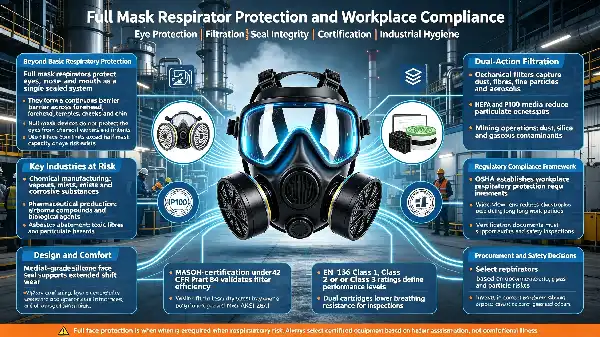
“In industrial settings where workers are exposed to hazardous airborne particles, respiratory protection is not enough. Workers need full face protection. The Full Mask Respirator provides total protection to the complete face, including the eyes, nose, and mouth, forming a sealed barrier against chemical vapours, poisonous gases, fine particles, and biological agents. The modern Personal Protective Equipment is a must for industries such as chemical manufacturing, pharmaceutical production, spray painting, asbestos abatement, and mining operations to protect workers from immediate health hazards and chronic occupational illnesses. • If the levels of exposure are more than the maximum allowed for half-mask devices or if there is a possibility of eye irritation, the use of full-face respiratory protection is suggested or required.
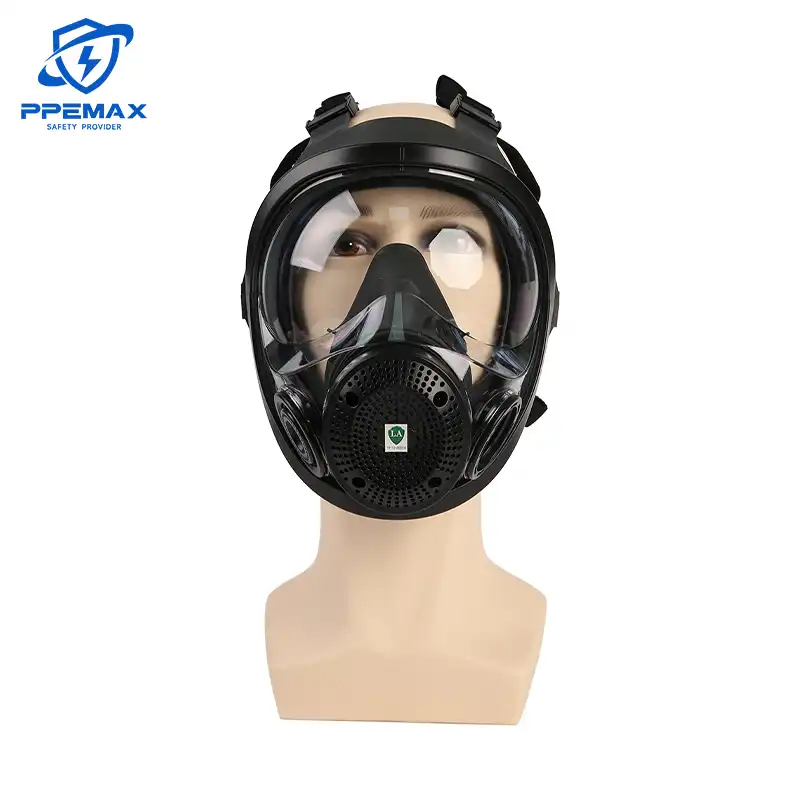
| Parameter | Specification |
|---|---|
| Product Type | Full Face Respirator Gas Mask |
| Mask Body Material | Premium Liquid Silicone (Skin-friendly & Comfort Fit) |
| Visor Material | High-transmittance Polycarbonate (Anti-impact & Anti-scratch) |
| Connection Interface | Standard 40mm NATO Thread (RD40) |
| Head Harness | 5-Point Adjustable System (Even Weight Distribution) |
| Field of Vision | Panoramic View (≥ 85%) |
| Inhalation Resistance | ≤ 30 Pa |
| Exhalation Resistance | ≤ 98 Pa |
| Total Inward Leakage | ≤ 0.05% |
| Anti-Fogging System | Integrated Independent Inner Nose Cup |
| Compatible Filters | All Standard 40mm Chemical/Particle/CBRN Filters |
| Product Weight | Approx. 450g - 500g (Without Canister) |
| Safety Compliance | EN 136 / GB2890-2009 Standards |
| Applications | Industrial Painting, Chemical Handling, Construction, Welding, Ag |
Understanding Full Mask Respirators and Their Role in Workplace Safety
Respiratory protection is a vital component of an industrial hygiene strategy, and full-face devices are the top of the hierarchy of safety. These customised devices offer lung filtration and complete facial protection, addressing a crucial niche that half-mask solutions do not.
Comprehensive Coverage Beyond Basic Protection
Protection of fragile eye tissue from airborne irritants is a huge difference from a half-mask respirator. The full mask respirator covers and protects the eyes. The device forms a continuous seal across the forehead, temples, cheeks and chin, producing a protected breathing
How Advanced Filtration Systems Work
Contemporary respiratory protective devices use dual-action filtering techniques according to the hazard. Cartridges have a mixture of mechanical filtering media (HEPA, P100, etc.) and chemically treated activated carbon layers that absorb gaseous contaminants. This two-pronged approach addresses both the hazard from particles (dust, smells, fibres) and the potential from vapours (solvents, chemical off-gassing). PPE MAX is manufactured with medical-grade silicone face seal materials and impact-resistant polycarbonate visors that meet ANSI Z87.1 criteria. It offers comfort for extended shifts and reliable performance.
Respiratory Protection in the Workplace: Regulatory Requirements
Standards: OSHA, NIOSH, and European EN standards establish compliance frameworks that specify minimum performance criteria for respiratory protection equipment. NIOSH certification under 42 CFR Part 84 requires stringent testing of filter efficiency, inhalation resistance, and seal integrity. EN 136 classifications are assigned Class 1, 2, or 3 performance levels based on optical quality, mechanical strength, and breathing resistance parameters. The regulatory requirements provide procurement professionals with objective criteria to evaluate the acceptability and legality of the equipment. All respirators sent from our Xi’an facility are provided with the right certification documents to make your regulatory audits and workplace safety inspections easy.
This knowledge of the basics may help safety managers and procurement people to make evidence-based choices in defining respiratory protection schemes. Investing in the correct equipment means fewer accidents on the job and improved long-term health for your personnel.
Who Should Use Full Mask Respirators? Identifying Workplace Needs
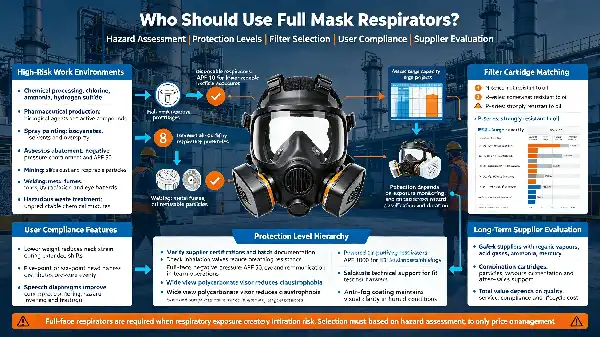
You must make a thorough danger assessment and know the exposure scenarios to choose the correct Full Mask Respirator respiratory protection. In certain industrial procedures, the environment is such that the only adequate protection is full facial protection.
Industries With High-Risk Airborne Exposures
Toxic vapors—chlorine, ammonia, hydrogen sulfide—can be emitted by compounds that are common in chemical processing facilities at concentrations that would exceed the limits of less capable protective equipment. Biological hazards exist in pharmaceutical manufacturing plants. Strong active medicinal compounds that need limited breathing areas. Workers who spray two-component polyurethane coatings or epoxy systems are exposed to isocyanate compounds, which are known to induce occupational asthma and sensitisation reactions. OSHA 29 CFR 1926.1101 requires that asbestos abatement teams working in negative pressure containment areas wear full-face negative pressure respirators with an Assigned Protection Factor of 50.
Silica dust is generated by mineral mining at respirable particle sizes under 10 microns, posing a long-term silicosis risk requiring particulate filtration and eye protection against airborne mineral fragments. Welding conditions produce metal fumes and strong light; hence, a combination of respiratory and optical protection is required. Hazardous waste treatment teams confront difficulties resulting from unexpected chemical combinations, and the whole face sealing affords significant safety margins from the unpredictable nature of the pollutants.
Comparing Protection Levels Across Respirator Types
The hierarchy of respiratory protection comprises disposable filtering facepieces, reusable half-masks and full-face devices with differing Assigned Protection Factors. N95 disposable respirators – APFs of 10 for non-toxic particle exposures up to ten times the permissible exposure limit. The APF 10 is also available as a half mask respirator with interchangeable cartridges, which may provide an extended service life and the ability to filter gases and vapours. Full-face negative pressure respirators have an APF of 50, extending the practical range to fifty times the exposure limit, while also protecting ocular tissue. Full-face devices with powered air-purifying systems may have APF values of 1000 and are appropriate for atmospheres immediately dangerous to life or health.
The decision between these levels of protection is based on reliable data on exposure monitoring, classification of hazards, and duration of exposure. Analysis of real-world incidence data reveals improper respirator selection causes preventable occupational infections. A 2019 workplace safety research study found that the proper use of full-face respirators reduced chemical exposure incidents by 73% in coating operations compared to sites with inadequate half-mask protection.
With this knowledge of the application environment, B2B procurement teams may specify the required equipment stocks that are suitable for the actual hazards of operation and not only accept inadequate protection.
If you're evaluating personal protective equipment suppliers and require batch-specific testing documents before placing an order, PPE MAX is able to provide official Certificates of Analysis, professional laboratory test reports, and product samples for your verification. Feel free to contact our team at marketing@ppemax.com to discuss your sourcing needs and obtain complete documentation for your quality assessment and procurement approval.
Choosing the Right Full Mask Respirator for Your Business Needs
Strategic equipment selection balances protection performance, user acceptance, operational compatibility, and total cost of ownership. Procurement decisions require evaluating multiple technical and supplier-related factors.
Matching Filter Types to Specific Hazards
Respiratory protection effectiveness of a Full Mask Respirator depends entirely on pairing the correct filter cartridge with identified workplace contaminants. Particulate filters carry P, R, or N designations indicating oil resistance properties, with numeric ratings (95, 99, 100) specifying filtration efficiency percentages. P100 filters capture 99.97% of airborne particles, making them appropriate for toxic dust, asbestos fibers, and lead fume exposures. Gas and vapor cartridges contain sorbent materials formulated for specific chemical families—organic vapors, acid gases, ammonia, or mercury vapor—with color-coded labels standardized across manufacturers. Combination cartridges integrate particulate pre-filters with gas/vapor sorbents, addressing mixed-exposure scenarios common in industrial painting and chemical handling.
Our engineering team at PPE MAX designs respirator bodies with standardized RD40 thread or bayonet connection systems, ensuring compatibility with widely available filter options and simplifying inventory management. This interchangeability allows operations teams to maintain single respirator body stock while adjusting filter specifications as tasks vary.
Ergonomic Features That Drive User Compliance
Worker acceptance directly impacts protection program effectiveness, making comfort features critical procurement considerations. Respirator weight affects neck strain during extended wear periods; devices exceeding 600 grams generate fatigue complaints that reduce compliance. Five-point or six-point head harness systems distribute retention force evenly, preventing pressure points that cause headaches or facial marking. Dual inhalation valves reduce breathing resistance, minimizing respiratory work that can discourage consistent use during physically demanding tasks.
Speech diaphragms or voice transmission devices address communication challenges that full-face coverage creates, particularly important in team-based operations or environments requiring radio communication. The wide-view polycarbonate visors we incorporate provide peripheral vision comparable to unprotected sight lines, reducing the claustrophobic sensation some users experience with restricted fields of view. Anti-fog lens coatings maintain visual clarity in humid conditions or during exertion-induced perspiration, eliminating the dangerous practice of breaking seal to wipe condensation.
These user-centered design elements transform respiratory protection from tolerated equipment into accepted safety tools, substantially improving program compliance rates.
Evaluating Suppliers for Long-Term Partnership Value
Beyond product specifications, supplier capabilities significantly impact total protection program costs and effectiveness. OEM manufacturing partnerships enable private labeling and specification customization that align equipment with unique operational requirements. Spare parts availability determines whether minor component failures necessitate complete unit replacement or simple field repairs. Technical support access helps safety managers troubleshoot fit issues, select appropriate filter combinations, and design effective training programs.
Since 1956, PPE MAX has built supplier relationships across 134 countries through consistent quality delivery and responsive after-sales support. Our Xi'an manufacturing facility maintains extensive component inventory, enabling rapid fulfillment of replacement parts that minimize equipment downtime. We provide quantitative fit testing equipment and training program materials that help clients establish compliant respiratory protection protocols aligned with regulatory requirements.
Procurement professionals should evaluate supplier certifications, production capacity for meeting surge demands, and willingness to provide technical documentation supporting regulatory compliance efforts. These relationship factors often deliver greater long-term value than marginal unit cost differences.
Maintaining and Caring for Full Mask Respirators
Proper maintenance protocols directly affect both protection performance and equipment lifecycle costs. Neglected respirators compromise worker safety while increasing replacement expenses.
Cleaning Protocols That Prevent Contamination
After each use, Full Mask Respirators require thorough cleaning to remove accumulated contaminants, sweat, and skin oils that degrade sealing surfaces and foster bacterial growth. Disassemble the device according to manufacturer instructions, removing filters, exhalation valves, and speaking diaphragms before cleaning. Wash facepiece and components in warm water with mild detergent, using soft brushes to clean valve seats and breathing passages without damaging sealing surfaces. Rinse thoroughly to eliminate detergent residue that can cause skin irritation, then air-dry components completely before reassembly. Sanitizing solutions—typically quaternary ammonium compounds or dilute bleach—provide additional disinfection between users when respirators are shared across shifts, though individual assignment remains the preferred practice.
Inspection Routines and Filter Replacement Schedules
Pre-use inspection catches component failures before they compromise protection. Check facepiece for cracks, tears, or distortion that would prevent proper sealing. Examine head straps for elasticity loss and secure attachment points. Test inhalation and exhalation valves for freedom of movement and proper seating. Verify filter cartridges remain within service life limits and show no physical damage. Perform positive and negative pressure seal checks before entering contaminated atmospheres, following the specific procedures outlined in respiratory protection standards.
Filter cartridge replacement depends on contaminant type and exposure concentration. Particulate filters require replacement when breathing resistance increases noticeably or when maximum service time elapses. Gas and vapor cartridges need changing when users detect breakthrough odor or taste, or according to manufacturer-specified service life calculations based on contaminant concentration and work rate. Our technical support team at bettybing@ppemax.com assists clients in developing filter change schedules based on actual workplace exposure monitoring data.
Storage Practices That Extend Equipment Lifespan
Proper storage protects respirators from physical damage and environmental degradation. Store cleaned and inspected units in sealed bags or designated cabinets away from direct sunlight, extreme temperatures, and chemical exposure. Avoid compressing facepieces or bending components in ways that could cause permanent deformation. Silicone and elastomer materials gradually lose elasticity when exposed to ozone, petroleum products, or excessive heat, reducing seal effectiveness even without visible damage.
These maintenance disciplines transform respiratory protection from consumable expenses into durable assets that deliver years of reliable service while maintaining certified protection performance throughout their lifecycle.
Procurement Strategies for Full Mask Respirators in B2B Contexts
Large workforces that need respiratory protection might save costs and enhance programme outcomes using strategic buying methods.
Understanding Price Drivers and Budget Planning
There are several value components in the cost of a respirator unit, above and beyond the basic manufacturing costs. To be certified by NIOSH or European recognised authorities demands a significant expenditure in performance validation, which manufacturers amortise throughout their manufacturing quantities. Additional features such as anti-fog coatings, communication systems and lightweight materials incur further expenses but provide operational advantages that justify price increases. Pricing is affected by supply chain complexity, especially for items that need specialised components or materials that are exposed to commodity price volatility.
Bulk purchase agreements often unlock bulk savings of 15% to 30% based on order quantities and periods of commitment. However, procurement teams need to evaluate discount potential against the expenses of holding inventory and the product's shelf life. We collaborate with business customers to develop supply schedules that are aligned with budget cycles and consumption models to optimise working capital efficiency.
Selecting Reliable Sourcing Channels
Authorised distributor networks provide benefits such as local inventory availability and technical support infrastructure, which may be important for multi-site operations. You may deal directly with manufacturers for bespoke options and the avoidance of distributor markups, which can be very helpful if you have large-volume standardised needs. However, direct sourcing also has the challenge of lengthier lead times and larger minimum order quantities.
Fake respiratory protection equipment is a severe threat to international supply chains, and verification of suppliers is critical. Procurement teams should validate NIOSH clearance numbers via government databases, confirm manufacturer certifications, and ensure supply chain visibility that prevents unauthorised substitutes. With 60 years in production and a presence at global safety fairs such as A+A in Germany, the established reputation is what separates the trustworthy Full Mask Respirator manufacturers from opportunistic vendors.
Logistics Considerations for Global Operations
International procurement involves shipping timeframes, customs procedures, and inventory placement problems. Container transportation generally has 30- 45-day lead periods from Asian industrial hubs to North American distribution centres, requiring planning and buffer stock techniques. - Customs classification and duty optimisation: Coordination with professional freight forwarders knowledgeable with PPE laws is required. We have the relationships for shipping and the paperwork know-how to make international logistics simple, eliminating delays and compliance headaches for our international customers.
Procurement principles move respiratory protection from transactional buying to strategic programmes that continuously safeguard the workers and optimise overall cost structures.
Conclusion
To choose the right kind of breathing protection, you have to carefully evaluate and plan how well the equipment can deal with the real threats in the job. Full face models are the best choice in places where the airborne pollutants might be a hazard to eyes as well as the respiratory system. Achieving success relies on having the right equipment, proper maintenance practices, and training that results in constant compliance. Procurement techniques based on the dependability of the supplier, availability of technical support, and optimisation of the overall cost provide programme effectiveness in the long run. Organisations with complete respiratory protection programmes achieve measurable safety benefits, lower workers’ compensation expenses, and better regulatory compliance positions.
FAQ
1. What protection level does a Full Mask Respirator provide compared to half-mask options?
Full-face negative pressure respirators deliver an Assigned Protection Factor of 50 under OSHA standards, compared to APF 10 for half-mask devices. This means full-face units remain effective at contaminant concentrations fifty times the permissible exposure limit, versus only ten times for half-masks. The additional eye protection prevents corneal damage from vapors and particulates that half-masks leave exposed. When operations involve chemicals above half-mask protection capacity or when eye irritation presents additional hazard, full-face coverage becomes mandatory rather than optional.
2. How do I determine the correct filter type for specific workplace chemicals?
Filter selection requires identifying contaminant physical state (particulate, gas, vapor) and chemical family. Particulate filters use P, R, or N ratings with efficiency numbers; P100 captures 99.97% of particles, including toxic dusts. Gas cartridges specify target chemicals—organic vapor, acid gas, ammonia—through color-coded labeling. Combination cartridges handle mixed exposures. Consult safety data sheets for chemical properties, then match to appropriate filter specifications. Our technical team assists with filter selection based on exposure monitoring data and provides change-out schedule calculations for your specific conditions.
3. What maintenance schedule keeps respirators functioning properly?
Clean respirators after each use with mild detergent, inspecting components for damage or wear. Conduct pre-use seal checks before every donning. Replace particulate filters when breathing resistance increases or maximum service time expires. Change gas/vapor cartridges when breakthrough odor occurs or calculated service life elapses based on exposure concentration. Store cleaned units in sealed containers away from sunlight and contaminants. Annual inspection by trained personnel should verify overall condition and sealing integrity. Proper maintenance extends equipment lifespan while maintaining certified protection performance throughout service life.
Partner With PPE MAX for Your Complete Respiratory Protection Solution
Xi'an PPE MAX brings 65 years of manufacturing excellence to your workplace safety programs. As a trusted Full Mask Respirator supplier, we combine advanced production capabilities with comprehensive technical support that extends beyond simple equipment delivery. Our globally certified devices meet NIOSH, EN 136, and AS/NZS 1716 standards while incorporating user-centered design features that maximize worker acceptance and compliance. Whether you need standardized inventory for immediate deployment or customized OEM solutions tailored to unique operational requirements, our team provides the expertise and manufacturing flexibility your procurement demands. Contact marketing@ppemax.com today to discuss how our respiratory protection solutions can address your specific workplace hazards, streamline your supply chain, and support your workforce safety objectives across your operational footprint.
References
1. National Institute for Occupational Safety and Health. (2018). NIOSH Guide to the Selection and Use of Particulate Respirators. U.S. Department of Health and Human Services, Centers for Disease Control and Prevention, Publication No. 96-101.
2. Occupational Safety and Health Administration. (2020). Respiratory Protection Standard 29 CFR 1910.134. U.S. Department of Labor, Occupational Safety and Health Administration.
3. European Committee for Standardization. (2017). EN 136:1998 Respiratory Protective Devices - Full Face Masks - Requirements, Testing, Marking. CEN Technical Committee 79.
4. American National Standards Institute. (2015). ANSI Z88.2 American National Standard for Respiratory Protection. American Industrial Hygiene Association.
5. International Safety Equipment Association. (2019). Respiratory Protection: A Comprehensive Guide for Industrial Hygiene Professionals. ISEA Technical Publications Division.
6. Cohen, H.J., & Birkner, L.R. (2021). Fundamentals of Industrial Hygiene and Respiratory Protection Program Management. American Conference of Governmental Industrial Hygienists, Seventh Edition.
Learn about our latest products and discounts through SMS or email