- English
- French
- German
- Portuguese
- Spanish
- Russian
- Japanese
- Korean
- Arabic
- Greek
- German
- Turkish
- Italian
- Danish
- Romanian
- Indonesian
- Czech
- Afrikaans
- Swedish
- Polish
- Basque
- Catalan
- Esperanto
- Hindi
- Lao
- Albanian
- Amharic
- Armenian
- Azerbaijani
- Belarusian
- Bengali
- Bosnian
- Bulgarian
- Cebuano
- Chichewa
- Corsican
- Croatian
- Dutch
- Estonian
- Filipino
- Finnish
- Frisian
- Galician
- Georgian
- Gujarati
- Haitian
- Hausa
- Hawaiian
- Hebrew
- Hmong
- Hungarian
- Icelandic
- Igbo
- Javanese
- Kannada
- Kazakh
- Khmer
- Kurdish
- Kyrgyz
- Latin
- Latvian
- Lithuanian
- Luxembou..
- Macedonian
- Malagasy
- Malay
- Malayalam
- Maltese
- Maori
- Marathi
- Mongolian
- Burmese
- Nepali
- Norwegian
- Pashto
- Persian
- Punjabi
- Serbian
- Sesotho
- Sinhala
- Slovak
- Slovenian
- Somali
- Samoan
- Scots Gaelic
- Shona
- Sindhi
- Sundanese
- Swahili
- Tajik
- Tamil
- Telugu
- Thai
- Ukrainian
- Urdu
- Uzbek
- Vietnamese
- Welsh
- Xhosa
- Yiddish
- Yoruba
- Zulu
Electrical Rubber Gloves: 6-Month Retest or Sooner?
Founded in 1956, PPEMAX stands as a premier global manufacturer and supplier of full-range personal protective equipment. All our products comply with internationally recognized standards including IEC, ASTM, CE, UKCA, NIOSH and ISO9001. Equipped with a 2,000-square-meter modern production plant, we boast over 25 years of mature OEM & ODM capabilities to deliver one-stop customized solutions covering R&D design through worldwide logistics. Our safety gear is distributed across 134 countries globally. Upholding our core tenet “Safety First, Quality Priority”, we serve as a dependable long-term PPE partner for industrial enterprises around the world.
Electrical rubber gloves must be thoroughly retested every six months as required by ASTM F496 and OSHA 1910.137 requirements for dielectric integrity and the safety of workers. This is a REQUIRED gap, not a recommendation for the longest allowed period between testing. Environmental issues such as exposure to ozone, mechanical stress, or chemical pollution may need more regular examination. Organisations engaged in electrical work should have internal procedures that require visual examination of insulating gloves before to use and periodic dielectric testing in a laboratory to ensure that insulating gloves continue to provide effective protection against shock dangers. If the integrity of the glove is in doubt, for example, because of obvious damage or abnormal changes in texture, the six-month cycle is replaced by rapid retesting.
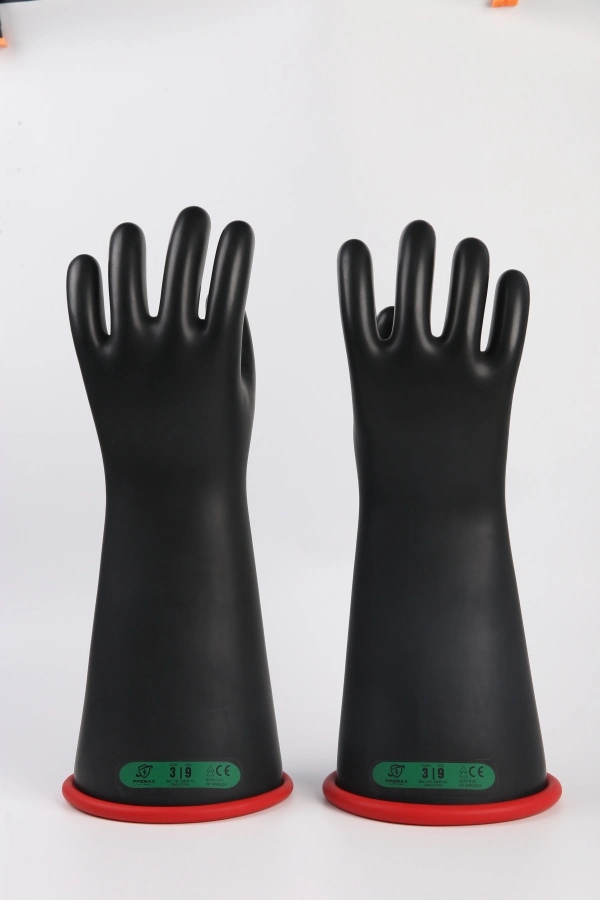
|
Parameter |
Specification |
Standard |
|
Maximum Use Voltage |
26,500V AC / 39,750V DC |
ASTM D120 / IEC 60903 |
|
Proof Test Voltage |
30,000V AC / 45,000V DC |
ASTM D120 |
|
Material Types |
Type I (Natural Rubber) / Type II (EPDM) |
ASTM D120 |
|
Thickness Range |
2.3mm - 2.9mm |
Industry Standard |
|
Length Options |
14" - 18" inches |
Customizable |
|
Label Color |
Green |
International Standard |
|
Temperature Range |
-25°C to +65°C |
Operating Conditions |
Understanding Electrical Rubber Gloves and Their Safety Standards
Insulating gloves are a high-tech method to prevent electrical current from reaching the human body. These gloves are made of natural rubber or synthetic materials ( EPDM ) and are tested for quality. The test measures the dielectric strength of the gloves, which is the highest voltage the gloves can sustain without breakdown.
Classification Systems That Define Protection Levels
The industry divides gloves into several classes depending on the maximum voltage of usage. Class 00 gloves are rated for handling up to 500 volts AC and are suitable for low-voltage control work and electric vehicle maintenance, when technicians are working with tiny parts within the battery housings. Class 0 insulating gloves with red markings per ASTM D120 protect workers at 1,000 volts AC and 1,500 volts DC – ideal for metre installations and secondary distribution line maintenance. Class 3 gloves are rated for use up to 26,500 volts AC and are used by utility personnel working on main distribution systems and are required to be accompanied by leather protectors to safeguard the rubber from mechanical damage.
Standards That Govern Manufacturing and Testing
ASTM D120 specifies exact design, material composition, and performance parameters for electrical rubber gloves. These criteria range from minimum wall thickness to allowable elongation during electrical stress testing. Parallel international regulations in IEC 60903 support worldwide commerce and mutual recognition of certified items. 29 CFR 1910. OSHA standard.137 requires, among other things, that employers have gloves periodically tested for electrical performance. 137 provides the legal basis to make testing a requirement instead of just a best practice. NFPA 70E has workplace safety procedures that complement equipment regulations. It covers arc flash hazards and appropriate glove selection methods.
Type I gloves are made from natural rubber that provides the most flexibility and sensitivity to touch so workers may accurately handle circuit breakers and terminal connections. Type II gloves are made from EPDM compounds that resist ozone degradation, increasing their usable life in outdoor conditions where atmospheric ozone promotes rubber breakdown. Each variety serves distinct operational contexts, and procurement choices should reflect real exposure circumstances rather than presuming that one formulation is suitable for all purposes.
Why the 6-Month Retest Is Critical for Electrical Rubber Gloves
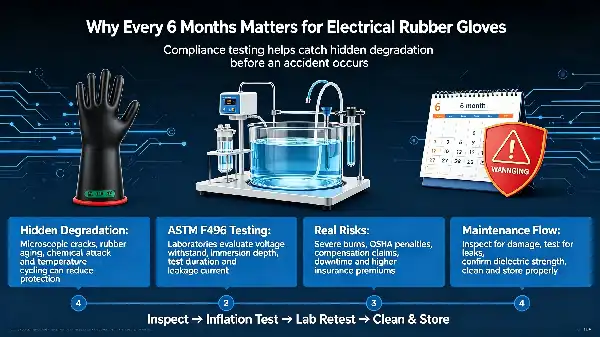
The six-month retesting requirement stems from documented evidence showing how insulating materials degrade through normal use cycles. Microscopic cracks invisible to casual observation can propagate through rubber matrices, creating pathways for electrical current that defeat the glove's protective function. Temperature fluctuations cause expansion and contraction that stress molecular bonds. Chemical exposure from cleaning agents, petroleum products, or industrial solvents alters rubber composition, reducing dielectric strength without obvious visual indicators.
Regulatory Framework That Protects Workers
ASTM F496 specifies the testing procedures laboratories must follow when evaluating glove integrity. This standard defines voltage levels, immersion depths, test durations, and acceptable leakage current thresholds that determine pass or fail results. The six-month interval balances safety assurance against operational disruption—frequent enough to catch degradation before failure yet practical for organizations managing large glove inventories. OSHA enforcement actions consistently cite employers who extend testing intervals beyond regulatory limits, imposing penalties that dwarf testing costs while exposing companies to civil liability when accidents occur.
Consequences of Neglecting Scheduled Testing
A mining operation in Arizona learned this lesson harshly when an electrician suffered severe burns working on a 480-volt motor control center. Investigation revealed his gloves had exceeded the retest deadline by four months. Laboratory analysis found multiple pinhole defects that would have been detected through standard testing. The resulting workers' compensation claim, OSHA fines, and production downtime cost the company over $800,000—contrasted against the $45 per-glove testing fee they had postponed.
Beyond individual incidents, systematic testing failures create organizational vulnerabilities. Safety culture deteriorates when workers perceive management prioritizing convenience over protection. Morale suffers; experienced electricians seek employment elsewhere, and insurance carriers increase premiums upon discovering testing gaps during audits. The compounding costs of neglect far exceed the straightforward expense of maintaining compliant testing schedules.
If you're evaluating personal protective equipment suppliers and require batch-specific testing documents before placing an order, PPE MAX is able to provide official Certificates of Analysis, professional laboratory test reports, and product samples for your verification. Feel free to contact our team at marketing@ppemax.com to discuss your sourcing needs and obtain complete documentation for your quality assessment and procurement approval.
How to Properly Test and Maintain Electrical Rubber Gloves
Effective glove management combines daily user inspections with periodic laboratory evaluation. This dual approach catches obvious damage immediately while verifying electrical properties that only specialized equipment can measure.
Visual Inspection Procedures Every User Should Master
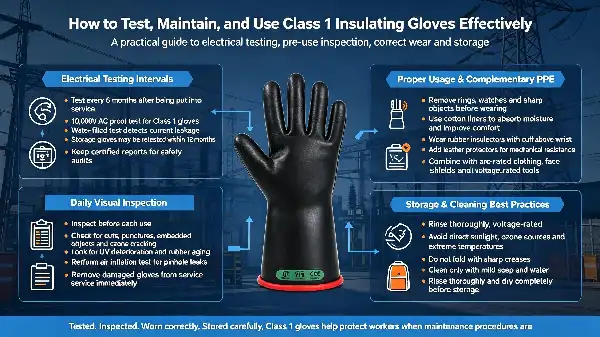
Before each use, workers should examine electrical rubber gloves under adequate lighting, looking for cuts, tears, punctures, or embedded foreign objects. The inflation test provides tactile verification of glove integrity—rolling the cuff to trap air inside creates pressure that reveals leaks through slow deflation or audible hissing. Ozone damage appears as fine surface cracking, particularly in stress areas like fingertips and thumb crotches. Swelling or sticky textures indicate chemical contamination requiring immediate removal from service. Any questionable condition warrants conservative judgment—when doubt exists, retire the glove rather than risking worker safety.
Laboratory Dielectric Testing That Verifies Protection
Certified testing facilities immerse gloves in conductive water baths while applying specified proof test voltages—significantly higher than rated use voltage to establish safety margins. Sophisticated equipment measures leakage current flowing through the rubber, comparing results against maximum allowable limits defined in ASTM F496. Class 0 gloves undergo 6,000-volt AC proof testing despite their 1,000-volt maximum use rating. This testing stress reveals incipient failures before they manifest during actual electrical work. Gloves passing all tests receive new certification dates and return to service; those failing any parameter get permanently retired from electrical protection use.
Storage and Maintenance Practices That Extend Service Life
Proper storage significantly impacts glove longevity and testing success rates. We recommend keeping gloves in canvas bags within climate-controlled environments, away from sunlight, ozone sources like electric motors, and temperature extremes. Folding or compressing gloves creates stress concentration points where cracks initiate. Storing gloves inside-out exposes the inner surface to contaminants and prevents proper air circulation. Clean gloves with mild soap and water, avoiding petroleum-based cleaners or harsh solvents that attack rubber compounds. Thorough drying before storage prevents moisture-related degradation that shortens useful life.
Comparing Electrical Rubber Gloves: Choosing the Best for Your Industrial Needs
Choosing the right gloves is about matching technical characteristics to real-life threats and operational needs. At the same time, procurement teams need to be mindful of protection levels, comfort aspects, durability requirements, and financial limits. Safety standards cannot be compromised.
Technical Parameters That Define Glove Performance
The most important selection criteria is the voltage rating—gloves must be rated for, or exceed, the maximum voltage in the work environment with sufficient safety factors. Wall thickness has implications for both protection level and physical dexterity, resulting in trade-offs between electrical safety and job accuracy. Class 00 gloves are thin enough to do detailed work, such as working on tiny connections within the EV battery packs. Class 3 gloves are bulkier and less flexible, but protect against distribution-level voltages. The length specs provide appropriate covering. Longer gloves safeguard your forearms when you have to approach near energised conductors.
Chemical resistance is critical in locations where workers are exposed to transformer oil, cleaning solvents, or industrial chemicals that attack conventional rubber compositions. Type II gloves based on EPDM are more resistant to ozone and weathering than natural rubber and are used for outdoor utility work. Type I natural rubber gloves are very flexible and elastic, ideal for workers conducting delicate activities requiring tactile sensitivity. Cotton-lined gloves are useful for certain purposes because they absorb sweat and are more comfortable for long-term use, although liners make drying after washing more difficult.
Industry-Specific Application Considerations
Most EV manufacturers and service shops recommend 500-volt AC-rated Class 00 gloves, which is appropriate for the 400-800 volt range often used in battery packs with sufficient margin. In the car industry, they want a glove that is thin and flexible, so a technician can work with tiny connections and get into the tight places of a vehicle chassis. Utility companies that serve residential customers depend largely on Class 0 gloves for metre installations and secondary service work at 240 to 480 volts. On these applications, a compromise has to be made between the need for protection against typical distribution voltages and the need for adequate dexterity for outdoor operations in all weather conditions.
For medium-voltage distribution systems in heavy industrial buildings operating from 4,160 to 13,800 volts, Class 2 or Class 3 gloves will be necessary depending on the system configuration. Mining operations need tough gloves that can stand up to the severe subterranean environment but also provide protection from mobile equipment electrical systems. Procurement of gloves from well-established vendors who have robust quality procedures in place that include stringent documentation of glove certifications and testing records is critical to meeting contract requirements for government infrastructure projects.
Best Practices for Managing Electrical Rubber Gloves Inventory and Compliance
For large organisations with hundreds or thousands of electrical rubber glove pairs, systematic techniques are needed to manage individual glove histories, arrange testing intervals, and keep audit-ready documentation. Digital asset management turns compliance from a pain into a competitive advantage.
Implementing Tracking Systems That Prevent Compliance Gaps
We propose that each pair of gloves should be assigned a unique identification number that links the physical gloves to the database records of production date, test history, assignment records, and retirement choices. Barcode or RFID identification offers fast inventory checks and automatic retest notifications. PPE management software systems will determine impending test due dates, produce work orders to submit to the lab, and highlight equipment that is overdue for urgent removal from service. Automation eliminates the human error associated with manual spreadsheets or paper records that may be lost or changed.
Training Programs That Build Safety Culture
Even the finest equipment would fail without a good understanding of the user and dedication of the organisation. Training sessions should include glove selection principles, inspection approaches, correct donning and doffing procedures, and the need for compliance with retest dates. Hands-on training on inflation testing and damage identification improves competency and confidence. Sharing incident case stories (without identifying people) demonstrates how even little infractions may have disastrous results. Safety recognition programmes that reward consistently safe behaviour create peer responsibility and make safety behaviours the standard for the whole workforce of electrical workers.
Balancing Cost Management With Non-Negotiable Safety Requirements
The first step in procurement optimisation is to get accurate demand predictions based on the number of staff, how often gloves are issued, and the previous damage rates. This allows you to develop a relationship with trusted suppliers and negotiate bulk prices, as well as a steady supply of products. For decades we have worked with industrial customers that know the value of reliable supply networks to avoid costly emergency purchases. Some organisations use glove rotation systems with many pairs rotated in and out of usage and testing, minimising operational disturbance when gloves need lab assessment. This needs a bigger initial outlay for inventory but will provide long-term cost savings and protection without interruption.
Quality-focused procurement delivers better value than price-focused buying. Despite their higher unit price, premium gloves from well-established manufacturers tend to have lower failure rates in testing, longer service lifetimes, and lower overall ownership costs. Cheaper gloves that often fail tests or have to be retired early owing to quality flaws actually cost more in the end, while also leaving safety gaps and administrative hassles. The manufacturers that develop supplier relationships by giving technical assistance, unique size choices, and prompt customer service allow their suppliers to become strategic partners rather than just transactional commodity sources.
Conclusion
The six-month retest requirement is baked into protective legislation based on decades of industry experience. This period offers the reassurance needed that the life-saving characteristics of insulating gloves are retained, even when used on a regular basis and exposed to environmental difficulties. By seeing testing as an investment rather than a cost, organisations equip themselves for operational excellence, regulatory compliance and, most crucially, worker safety. We’ve been making safety gear for 60 years, and we know that no good employer wants to have their workers exposed to the hazards that come with cutting corners on safety standards. Electrical work is inherently dangerous – good glove management prevents unnecessary fatalities, as well as builds cultures in the workplace where people are valued more than production timetables.
FAQ
1. What happens if gloves fail the six-month retest?
Gloves failing electrical testing must be permanently removed from service and destroyed to prevent accidental reuse. Failed gloves cannot be repaired or retested for electrical protection purposes, though they might serve non-electrical applications where insulation properties are irrelevant. Organizations should investigate failure patterns—multiple gloves failing simultaneously suggests storage problems, chemical exposure, or usage practices requiring correction. Maintaining replacement inventory prevents operational disruption when gloves fail testing unexpectedly.
2. Do gloves in storage require testing if unused for months?
ASTM F496 and OSHA standards specify that gloves cannot be issued from storage if they have exceeded 12 months since last testing, regardless of use history. Storage conditions impact rubber properties even without active service wear. Prudent organizations test stored inventory at six-month intervals matching in-service gloves, ensuring immediate availability without compliance concerns. This practice proves especially valuable for specialized high-voltage gloves maintained as emergency backups.
3. Can we extend testing intervals for lightly-used gloves?
Regulations do not permit extended testing intervals based on usage frequency. The six-month maximum applies universally regardless of actual service hours. This standard reflects how environmental factors and aging processes degrade rubber independently of mechanical wear from use.
Partner With PPE MAX for Certified Electrical Safety Solutions
PPE MAX has protected electrical workers across 134 countries since 1956, combining manufacturing expertise with genuine understanding of field conditions where our products face real-world challenges. Our electrical rubber gloves supplier operations maintain rigorous quality controls and testing protocols that exceed minimum regulatory requirements because we recognize that certifications represent promises to workers trusting our equipment with their lives. We offer comprehensive voltage class options from Class 00 through Class 4, accommodating everything from residential service work to transmission-level maintenance.
Our engineering team provides technical consultations, helping organizations match glove specifications with actual operational hazards, optimizing protection without unnecessary cost or reduced dexterity. Custom manufacturing capabilities deliver specialized sizing, chemical resistance formulations, and private labeling for distributors building their own safety product brands. Contact our team at marketing@ppemax.com to discuss your specific requirements, request product samples, or establish supply agreements that ensure your workforce maintains consistent access to certified protective equipment. We understand that B2B procurement decisions impact not just budgets but human lives—a responsibility we have honored throughout our 68-year history serving the global safety community.
References
1. American Society for Testing and Materials. "ASTM D120-20: Standard Specification for Rubber Insulating Gloves." ASTM International, 2020.
2. American Society for Testing and Materials. "ASTM F496-20: Standard Specification for In-Service Care of Insulating Gloves and Sleeves." ASTM International, 2020.
3. International Electrotechnical Commission. "IEC 60903:2019: Live Working – Gloves of Insulating Material." IEC Standards, 2019.
4. Occupational Safety and Health Administration. "29 CFR 1910.137: Electrical Protective Devices." U.S. Department of Labor, Code of Federal Regulations.
5. National Fire Protection Association. "NFPA 70E-2021: Standard for Electrical Safety in the Workplace." NFPA Publications, 2021.
6. Macdonald, James R. "Dielectric Breakdown Mechanisms in Elastomeric Insulating Materials." IEEE Transactions on Dielectrics and Electrical Insulation, Volume 15, Issue 4, 2008.
Learn about our latest products and discounts through SMS or email