- English
- French
- German
- Portuguese
- Spanish
- Russian
- Japanese
- Korean
- Arabic
- Greek
- German
- Turkish
- Italian
- Danish
- Romanian
- Indonesian
- Czech
- Afrikaans
- Swedish
- Polish
- Basque
- Catalan
- Esperanto
- Hindi
- Lao
- Albanian
- Amharic
- Armenian
- Azerbaijani
- Belarusian
- Bengali
- Bosnian
- Bulgarian
- Cebuano
- Chichewa
- Corsican
- Croatian
- Dutch
- Estonian
- Filipino
- Finnish
- Frisian
- Galician
- Georgian
- Gujarati
- Haitian
- Hausa
- Hawaiian
- Hebrew
- Hmong
- Hungarian
- Icelandic
- Igbo
- Javanese
- Kannada
- Kazakh
- Khmer
- Kurdish
- Kyrgyz
- Latin
- Latvian
- Lithuanian
- Luxembou..
- Macedonian
- Malagasy
- Malay
- Malayalam
- Maltese
- Maori
- Marathi
- Mongolian
- Burmese
- Nepali
- Norwegian
- Pashto
- Persian
- Punjabi
- Serbian
- Sesotho
- Sinhala
- Slovak
- Slovenian
- Somali
- Samoan
- Scots Gaelic
- Shona
- Sindhi
- Sundanese
- Swahili
- Tajik
- Tamil
- Telugu
- Thai
- Ukrainian
- Urdu
- Uzbek
- Vietnamese
- Welsh
- Xhosa
- Yiddish
- Yoruba
- Zulu
Which Class 1 Insulating Gloves Offer the Best Grip?
When evaluating electrical protection equipment for your workforce, grip performance can mean the difference between safe productivity and preventable injury. The best Class 1 Insulating Gloves for grip combine high-quality natural rubber formulations with specialized surface textures—sandy finishes, embossed patterns, or contoured designs—that enhance friction and tactile control during live-line work. Brands that balance dielectric integrity with ergonomic handling typically feature material thicknesses between 0.7mm and 1.5mm, maintaining compliance with ASTM D120 and IEC 60903 standards while preserving the dexterity needed for switchgear operations and busbar manipulation. Grip reliability directly impacts operational efficiency and worker safety.
Understanding Class 1 Insulating Gloves and Their Grip Performance
In our 65 years of production experience at Xi'An PPE MAX Co., Ltd., we've seen how grip performance changes the safety of the workplace. Up to 7,500 volts AC and 11,250 volts DC, our Class 1 Insulating Gloves keep us from getting shocked by electricity, but they're not enough on their own. When working with small tools, connecting wires on high-voltage switches, or moving equipment around in small power rooms, workers need to feel confident in their hands.
Why Grip Matters in Electrical Protection
Lack of grip makes accidents much more likely. Technicians who can't safely hold moving parts end up putting their hands in odd positions or putting too much pressure on their grip, both of which make them more tired and lower the safety limits. Occupational safety schools have found that not having a good grip on your gloves is a factor in about 22% of electrical repair accidents where tools are dropped, or control of live equipment is lost.
Material Composition and Electrical Standards
Insulating rubber gloves are safe because they are made of carefully engineered flexible materials. Natural rubber latex is very flexible and moldable, so workers can still feel things even when they are wearing safety layers. The material has to be able to handle a proof test voltage of 10,000V AC and keep its dielectric strength the same from -25°C to +65°C. At PPE MAX, we make both Type I (natural rubber) and Type II (EPDM synthetic) versions. Type II is better at resisting ozone and ultraviolet damage, which are important benefits for outdoor utility uses.
How Surface Design Affects Handling
The outside of the glove has a direct effect on the friction factors and the safety of handling. Smooth natural rubber surfaces work fine in dry indoor settings, but they become very dangerously slippery when they come in contact with water, oils, or the dust that is common in industrial settings. That's why modern makers use finishes with different textures. Sandy coatings make it easier to hold on in any direction, and raised diamond designs or hexagonal embossing make tool surfaces mechanically connect with each other. At PPE MAX, our engineering team tests how well grips work in twelve different work environments, ranging from dry assembly work to pole repair in the rain.
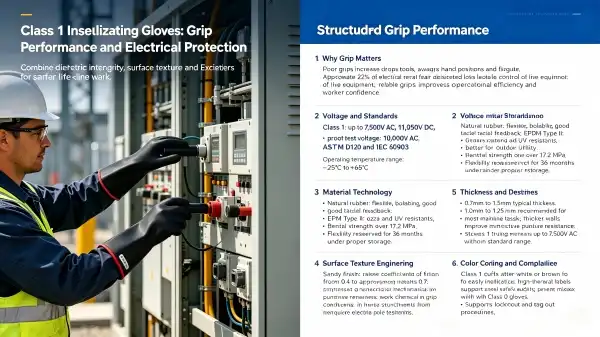
Key Features Influencing the Grip of Electrical Insulating Gloves
Teams in charge of buying PPE for large-scale projects need to know the technical differences between good gloves and great ones. The quality of the grip for Class 1 Insulating Gloves comes from the interaction of several design factors, each of which affects the general handling performance.
Material Technology and Elasticity
Natural rubber has better elastic memory than synthetic rubber; it returns to its original shape after being bent many times. This feature keeps the grip pressure constant throughout a shift, while lower-quality materials get stiffer over time and lose their ability to bend. When we make things at PPE MAX, we use plasticizers and anti-aging agents that keep the flexibility for 36 months if they are stored properly. The tensile strength is higher than 17.2 MPa, which means the material won't tear even when it's being used hard in industry, while still being flexible enough for tricky hand jobs.
Surface Texture Engineering
Improving grip starts at the level of the molecules' surfaces. Several finishing methods make changes that can be measured:
- Sandy Finish Application: Tiny, gritty particles mixed in with the top layer of rubber make the surface rougher without changing its dielectric qualities. This process raises the coefficient of friction from 0.4 to about 0.7. This nearly doubles the grip security when the surface is dry and makes a big difference even when light oils get on it.
- Embossed Pattern Design: Geometric patterns that are molded right into the surface of the glove give it functional benefits. At PPE MAX, our curved grip patterns have raised elements that are placed 3–5 mm apart. These elements were chosen through finite element analysis to make the contact pressure distribution work best for a wide range of tool shapes.
- Chemical Grip Enhancers: Some companies use special polymer coats that stay tacky at a lot of different temperatures. These solutions work great in harsh conditions, but they need to be carefully tested to make sure they don't mess up electrical tests or leave behind dust on equipment.
Which of these tools you choose will rely on how you run your business. Maintenance on equipment in climate-controlled substations is different from maintenance on distribution lines in humid areas.
Thickness and Dexterity Balance
Procurement workers have to make a basic trade-off when it comes to glove thickness. Thicker walls (about 1.5 mm) offer better dielectric security and mechanical puncture resistance, but they also lower physical feedback and make wearing them for long periods of time more tiring. Thinner structures (0.7–1.0 mm) make it easier to move, but they also have smaller safety gaps.
After testing in the field, we've found that thicknesses between 1.0mm and 1.25mm work best for most workplace repair tasks. This range provides strong electrical protection while still letting workers tell the difference between wire sizes by touch and use small fasteners while wearing protective gear. The voltage rating stays at 7,500V AC even if the thickness changes within the Class 1 standard. This means that buying teams can focus on handling qualities without putting electrical safety at risk.
Color Coding and Compliance Management
Color-coding methods make safety compliance programs easier to follow, but they don't change your grip directly. Class 1 gloves usually have white or brown cuffs that make them easy to spot when storing tools from more than one class. Workers could make dangerous mistakes if they choose Class 0 gloves (1,000V grade) for Class 1 voltage levels. This method stops that from happening. At PPE MAX, our color-coded solutions come with high-contrast labels that can be read even after months of use in the field. This helps your company follow lockout/tagout processes and meet safety audit requirements.
Comparing Leading Electrical Insulation Glove Options for Grip Performance
There are many makers on the global market, and each one offers different benefits to grip performance and total value. Knowing these differences helps procurement pros match Class 1 Insulating Gloves with the wants of the workforce.
A number of companies have built strong names by consistently delivering high-quality products and coming up with new ideas. Klein Tools focuses on making designs that are easy for contractors to use by adding extra grip areas. Ansell's workplace safety products all use surface treatments that have been tried in the lab. Salisbury has been around since 1920 and keeps a lot of certification paperwork that compliance-focused buying offices value.
At PPE MAX, our competitive edge comes from the fact that we are vertically integrated. We're in charge of the whole production process, from mixing the raw rubber to doing the final electrical tests. This lets us make changes that meet the needs of specific industries. A telecommunications contractor recently asked us to help them get a better grip on polymer insulator surfaces, which was a unique task. Our engineering team came up with a special surface treatment that made smooth plastics 40% less slippery than normal sandy finishes. Because we manufacture directly, we were able to offer this treatment at prices that were 15-20% lower than similar foreign options.
Material Technology Differences
The effectiveness and life of natural rubber formulations from different sources vary a lot. Advanced anti-oxidants and ozone-resistant compounds used by high-end makers make products last longer than the usual 18–24 months, up to 36 months or more. This difference has a huge effect on the total cost of ownership for big projects that buy things. The synthetic EPDM options don't stretch as well, but they are very resistant to the environment, which is important for utility workers in cities with a lot of ozone or in warm areas with a lot of UV light.
Thickness Variations and Applications
Gloves that meet the Class 1 standard usually have a width that is between 0.7mm and 1.5mm. Thinner features are better for precise jobs like putting together electrical panels, where workers have to hold and move small parts for long periods of time. For heavy industrial repair tasks that put people at higher risk of mechanical damage, thicker designs are better. At PPE MAX, we make all of these different types of products. This means that procurement managers can choose different sizes for different types of jobs within the same company while still meeting the same electrical safety standards.
Real-World Performance Validation
User comments from real-world settings give us a lot of useful information that can't be found in a lab. Mining companies say that textured-grip gloves keep hands from getting tired about 30% more during full-shift wear than smooth gloves. Utility line crews always choose gloves with a better grip that goes all the way to the fingers, not just the palms. This is because climbing poles and handling conductors require a firm grip on the whole hand.
We constantly ask our marketing partners in 134 countries for feedback from the field, and we use this information to keep improving our products. Our Class 1 Insulating Gloves have recently been updated with longer grip texturing on the finger sides and stronger thumb crotch areas. These changes were made specifically at the request of telecoms workers who are installing overhead cables.
Pricing Strategies and Bulk Value
Cost factors include more than just the single price; they also include the total cost of the program. When you buy premium gloves that cost 20–30% more than budget gloves, they usually last 50–70% longer, which saves you money over the life of the purchase. Arrangements for buying in bulk offer extra benefits. When you buy in bulk from PPE MAX, you can get savings starting at 500 pairs, and we offer custom packaging choices that lower your shipping costs. We've helped government procurement departments cut program costs by 25% by buying strategically and following the right storage rules to make gloves last as long as possible.
Customization for Specialized Requirements
For some uses, changes need to be made that aren't available in the catalogue. Facilities that make batteries and use 800V+ DC equipment need better safety against DC voltage. People who work in data centers need gloves that can be used in cleanrooms. These specialised solutions are made possible by OEM partnerships. At PPE MAX, we can make unique products with private labelling, different cuff lengths, specialised sizes for a wide range of workers, and grip patterns that are best for certain tasks. For custom specs, the minimum order quantity starts at 1,000 pairs, so even mid-sized procurement programs can use these choices.
Procurement Best Practices: Selecting Voltage-Rated Gloves with Superior Handling
Choosing the right electrical safety gear requires a thorough analysis that takes into account dangers in the workplace, government rules, and practical issues. Strategic buying protects both the safety of workers and the funds of businesses.
Matching Specifications to Workplace Voltage
Class 1 Insulating Gloves protect against electrical dangers up to 7,500 volts AC. This means they can be used to maintain major distribution lines, work on industrial switchgear, and service medium-voltage equipment. Teams in charge of buying things have to make sure that the voltage levels in the workplace stay within the equipment's values and include enough safety gaps. We suggest keeping at least a 20% voltage cushion. Class 1 gloves are enough to protect you if the highest voltage you expect to be exposed to is 6,000V, but gloves for higher voltage settings need to be Class 2 or higher.
Supplier Certification Assessment
Certifications from the maker are the first step in quality guarantee. Suppliers with a good reputation keep up with ISO 9001 quality control systems and show that they follow ASTM D120, IEC 60903, and any OSHA rules that apply. At PPE MAX, we have a lot of different approvals, such as the CE mark for European markets. Our quality control methods are also regularly checked by a third party. When evaluating a provider, make sure that testing procedures include both new product validation and in-service inspection rules. Also, ask for proof of licensing. Manufacturers should be clear about how often to check and when to remove an item.
Strategic Negotiation and Bulk Ordering
Strategic buying is a way for large-scale purchase projects to save a lot of money. To get the most out of volume savings, combine purchases made by different parts of the company. We've worked with infrastructure companies that cut costs per unit by 18% just by organising purchases across regional offices instead of letting each spot buy on its own. Set up vendor-managed inventory agreements so that suppliers keep stock at your sites. This will lower your moving costs and make sure that you always have what you need. This method works especially well for businesses that know how much PPE they will need. As part of buying deals, talk about testing and inspection services. Regular electrical testing makes gloves last longer and keeps records of compliance. Some companies, like PPE MAX, offer testing services that are grouped together, which makes compliance management easier.
Trial Testing Before Large Commitments
The performance specs of gloves only tell you part of the story. If safety gear is used correctly in the field, it depends on how well workers accept it. Set up training programs that put potential gloves to the test in real working situations before you commit to buying a lot of them. Pick job categories that are typical and give out sample amounts for 30 to 60-day review times. Find out how well the grip works, how comfortable it is to wear for long periods of time, and if there are any task-specific limits. We offer discounted trial amounts to approved procurement programs because we're sure that trying our goods in the field will prove how well they work. This method has helped us build long-term partnerships with large companies and government bodies that value the risk reduction that testing offers before making big purchases.
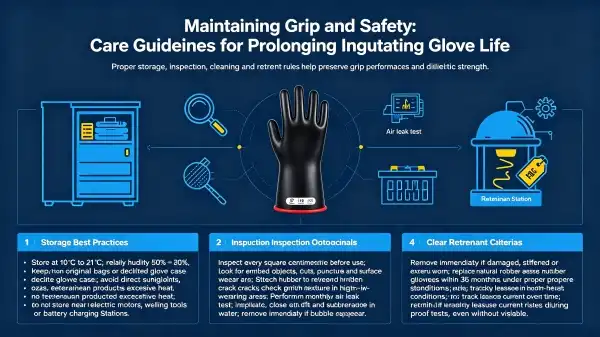
Maintaining Grip and Safety: Care Guidelines for Prolonging Insulating Glove Life
Using the right repair methods for Class 1 Insulating Gloves has a direct effect on both how well the gloves work and how much the program costs. When equipment is well taken care of, it keeps its grip properties and lasts a lot longer than the average in the business.
Storage Best Practices
When safety gear is stored incorrectly, it gets damaged before it even gets to the field. When natural rubber is exposed to ozone, strong sunlight, petroleum products, or too much heat, it breaks down quickly. Set up places just for storage that stay between 10°C and 21°C and have a relative humidity of 50 to 70%. Keep gloves in their original bags or in glove cases made just for them that keep out light and airborne contaminants. Do not store near electric motors, welding tools, or charge stations for batteries. These things give off ozone, which breaks down rubber compounds.
Routine Inspection Protocols
The last line of defence against equipment failure is a visual and physical check before each use. Workers should be taught to look at every square centimetre of the glove's surface in good lighting, looking for buried objects, cuts, punctures, or wear and tear on the surface. When you stretch the rubber, you can see small cracks that you can't see normally. Make sure that the grip features are still there and haven't worn down in places where they will be used a lot. Active-use gloves should be checked for air leaks once a month. Inflate the glove, close the cuff, and soak it in water while applying light pressure. If bubbles appear, there are leaks that need to be fixed right away.
Cleaning and Conditioning
Gloves that are dirty lose their strength and break down faster than clean ones. Set up cleaning routines that only use light soap and water at room temperature. Never use cleaners or agents that are based on petroleum or that break down rubber compounds. Rinse well and let dry in the air, away from heat sources. Some makers offer conditioning treatments that keep the grip and return suppleness. To keep the dielectric qualities from being compromised, these goods must be specially made for electrical insulating tools. Professional cleaning services may be needed if there is a lot of pollution from oils or industrial chemicals.
Clear Retirement Criteria
Setting clear standards for retirement stops people from doing the risky thing of keeping gloves on longer than is safe. If you notice any harm to the gloves, too much stiffening, or wear on the grip surface, take them out of service right away. Set maximum service life limits for everything, no matter how good or bad it looks. For example, most safety experts say that natural rubber gloves should be replaced every 36 months if they are stored properly, and more often if they are used in difficult circumstances. Keep track of the results of electricity tests over time. Gradual rises in leakage current during proof tests show that the material is breaking down and needs to be thrown away, even if there are no clear flaws when looking at it.
Conclusion
To choose the best Class 1 Insulating Gloves for grip, you need to find the right balance between electrical protection requirements and useful working features that keep workers safe and productive. For safe electrical work, natural rubber mixtures with designed surface textures provide the friction and tactile feedback needed. The right material thickness keeps flexibility without sacrificing voltage protection. Leading producers show their dedication by following strict approval guidelines, letting customers make changes, and offering a wide range of support services that go beyond just delivering products. Strategic procurement practices, such as checking the licensing of suppliers, buying in bulk, and sample testing programs, improve both safety and the cost-effectiveness of the program. Maintaining equipment by storing it correctly, checking it regularly, and retiring it at the right time will make sure that the grip performance stays the same throughout the product lifecycle. This will protect your workers and help industrial electrical applications run more efficiently.
FAQ
1. How do I determine the right glove thickness for my applications?
Think about how to balance safety and skill in the jobs you need to do. When doing precise work, like putting together panels, thinner profiles (0.7–1.0 mm) are best because they keep the sensitivity of the touch. On the other hand, thicker builds (approximately 1.5 mm) are needed in heavy upkeep areas where mechanical hazards are present. The electrical protection grade stays the same for different thicknesses that meet Class 1 Insulating Gloves standards at 7,500V AC, so you can focus on working qualities without sacrificing voltage safety. Talk to the people who are actually doing the work. Their opinion on things like fatigue and control can give you a lot of useful information that specs alone can't give you.
2. What's the difference between Type I and Type II rubber formulations?
Type I gloves are made from natural rubber materials that are very flexible and moldable, making them perfect for controlled indoor settings. Type II gloves are better for outdoor service work or working in factories with a lot of ozone because they are made with synthetic EPDM rubber, which is more resistant to ozone and solar damage. As a trade-off, Type II formulas have slightly worse elastic performance, but this difference is much smaller now than it was in earlier synthetic generations thanks to improvements in production technology.
Partner with PPE MAX for Premium Class 1 Insulating Gloves
Xi'An PPE MAX Co., Ltd has been in the electrical safety business for over 65 years and can help procurement workers find trusted Class 1 Insulating Gloves suppliers. Our gloves offer protection that is approved by ASTM D120 and IEC 60903 and have engineered grip surfaces that make handling safer in a wide range of workplace settings. We offer competitive bulk prices without lowering the quality standards needed by utility companies, building companies, and manufacturing operations in 134 countries. We are the biggest PPE manufacturer in Northwest China. We can make private labelling, custom sizes, and changes that are specific to an application possible, and the minimum order size is just 1,000 pairs. Email our technical team at marketing@ppemax.com to talk about your company's unique needs, ask for sample amounts to test in the field, or set up a visit to our factories in Xi'an. We provide responsive support throughout the buying process, from advising on specifications to providing service after the sale. This way, we can make sure that your employees get safety gear that meets both legal requirements and business needs.
References
1. American Society for Testing and Materials. "ASTM D120-20: Standard Specification for Rubber Insulating Gloves." ASTM International, 2020.
2. International Electrotechnical Commission. "IEC 60903:2019 Live Working - Electrical Insulating Gloves." IEC Standards Publication, 2019.
3. Occupational Safety and Health Administration. "1910.137 - Electrical Protective Equipment." OSHA Technical Manual, U.S. Department of Labor, 2021.
4. National Safety Council. "Electrical Safety in Industrial Environments: Equipment Selection and Maintenance Protocols." NSC Press, 2022.
5. Institute of Electrical and Electronics Engineers. "IEEE Guide for Testing and Evaluating Electrical Insulating Equipment." IEEE Standards Association, 2021.
6. European Committee for Electrotechnical Standardization. "EN 60903:2003 - Live Working - Gloves of Insulating Material." CENELEC European Standard, 2003.
Learn about our latest products and discounts through SMS or email