- English
- French
- German
- Portuguese
- Spanish
- Russian
- Japanese
- Korean
- Arabic
- Greek
- German
- Turkish
- Italian
- Danish
- Romanian
- Indonesian
- Czech
- Afrikaans
- Swedish
- Polish
- Basque
- Catalan
- Esperanto
- Hindi
- Lao
- Albanian
- Amharic
- Armenian
- Azerbaijani
- Belarusian
- Bengali
- Bosnian
- Bulgarian
- Cebuano
- Chichewa
- Corsican
- Croatian
- Dutch
- Estonian
- Filipino
- Finnish
- Frisian
- Galician
- Georgian
- Gujarati
- Haitian
- Hausa
- Hawaiian
- Hebrew
- Hmong
- Hungarian
- Icelandic
- Igbo
- Javanese
- Kannada
- Kazakh
- Khmer
- Kurdish
- Kyrgyz
- Latin
- Latvian
- Lithuanian
- Luxembou..
- Macedonian
- Malagasy
- Malay
- Malayalam
- Maltese
- Maori
- Marathi
- Mongolian
- Burmese
- Nepali
- Norwegian
- Pashto
- Persian
- Punjabi
- Serbian
- Sesotho
- Sinhala
- Slovak
- Slovenian
- Somali
- Samoan
- Scots Gaelic
- Shona
- Sindhi
- Sundanese
- Swahili
- Tajik
- Tamil
- Telugu
- Thai
- Ukrainian
- Urdu
- Uzbek
- Vietnamese
- Welsh
- Xhosa
- Yiddish
- Yoruba
- Zulu
Do Dielectric Gloves Degrade Faster in Humid Climates?
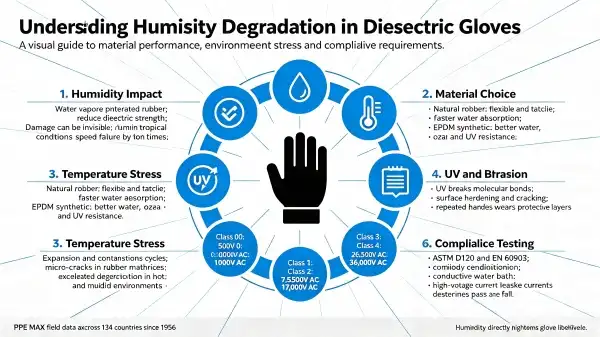
According to research, dielectric gloves break down faster in damp places. Rubber materials lose their dielectric strength and protective structure when they get wet. Different types of natural rubber absorb water vapour more quickly, but manmade materials like EPDM are better at resisting water. Since 1956, PPE MAX has seen this trend in 134 countries, proving that humidity is directly linked to shorter glove lifespan. Knowing these effects on the environment helps procurement professionals choose the right materials, set up strict checking procedures, and make replacement plans that keep workers safe when they are handling electrical equipment.
Understanding Dielectric Gloves and Their Degradation Factors
Core Technical Properties Define Protection Standards
Dielectric gloves work by using precise material science to make them strong enough to handle high voltage. Different types of these specialised products are available, ranging from Class 00 protection for 500V environments to Class 4 protection for 36,000V environments. Maximum Use Voltage requirements tell you how to use the gloves safely, and Proof Test Voltage requirements make sure they can handle electrical stress tests up to 40,000V AC without breaking.
The composition of a material has a big impact on its function and ability to withstand external stresses. Natural rubber is very flexible and sensitive to touch, which lets techs work carefully with small parts and tools while they are working on energised equipment. However, this organic substance is naturally weak against oxidative stress and water uptake. These flaws are made up for by EPDM synthetic formulations, which are better at resisting ozone and lasting longer when exposed to UV light and air pollution.
Multiple Environmental Stressors Compound Over Time
Degradation rarely happens because of a single cause. Instead, it happens over time from being exposed to dangerous environments over and over again. Changes in temperature cause cycles of expansion and contraction that make tiny cracks in rubber matrices. Ultraviolet light breaks the links between molecules, which makes the surface harder and eventually cracks. The protective layers are worn away by repeated handling and touch with rough surfaces, which leaves the base material open to contamination.
Unfortunately, moisture entry is the most sneaky threat because damage can't be seen at first glance. Water molecules move into rubber structures, messing up the arrangement of molecules and making paths for electricity to flow that lower the dielectric strength. In places with a lot of humidity, where the air is saturated with wetness, this process speeds up by a factor of ten. The interaction between high humidity and extreme temperatures, which is common in tropical industrial zones, speeds up the rate of failure beyond what could be predicted from controlled lab tests.
Compliance Standards Validate Performance Under Stress
Because environmental factors have such a big effect on the dependability of safety gear, there are rules for international approval. North American markets are governed by ASTM D120 standards, which require strict electrical testing methods and physical property verification. EN 60903 standards control European supply chains with the same level of strictness, making sure that gloves keep their ability to insulate across certain voltage ranges even when they are exposed to environmental problems.
Before performance testing, these models require makers to use conditioning processes to simulate being exposed to humidity. Gloves are put in conductive water baths, and high-voltage current is run through them. Leakage readings are used to decide whether the gloves pass or fail. Products that meet these standards have been proven to be resilient, giving buying workers concrete criteria for judging suppliers and comparing products.
Analysis of Dielectric Glove Performance in Humid Climates
Material Chemistry Determines Moisture Vulnerability
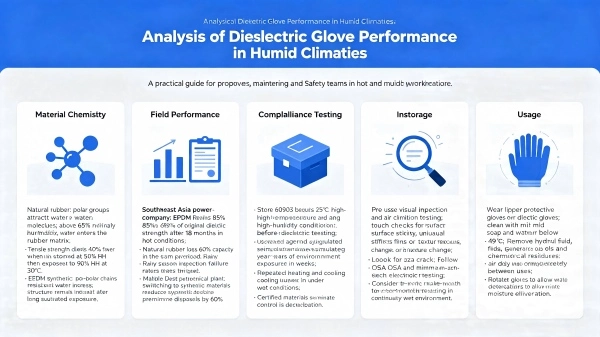
The chemical structure of natural rubber has polar groups that hydrogen bond with water molecules and pull them together. When the relative humidity is higher than 65%, this attraction pulls water into the dielectric glove's matrix, filling up tiny holes and weakening its mechanical properties. Occupational safety centres have confirmed that samples of natural rubber that are stored at 50% humidity and are exposed to 90% humidity at 30°C lose their tensile strength 40% more quickly than samples that are kept at 50% humidity.
The behaviour of synthetic replacements made especially for harsh settings is very different. EPDM materials have non-polar chemical chains that stop water from getting in. This means that the structure stays intact even after being exposed to saturated atmospheres for a long time. Field studies that followed the performance of gloves in Southeast Asian power companies found that EPDM versions kept 85% of their original dielectric strength after 18 months in hot conditions, while natural rubber versions lost 60% of their capacity in the same amount of time.
This important difference has huge effects on lifetime costs and safety gaps. Synthetic choices cost more to buy at first, but they usually have a lower total cost of ownership because they last longer in wet areas. We've helped distributors that work with refineries on the Gulf Coast and building projects in Central America do climate-adjusted cost analyses that showed how choosing materials strategically based on local environmental profiles could save them 30%.
Standards Compliance Ensures Validated Performance
Certification groups know that the climate can affect protective gear, so they include tests for humidity protection in the approval process. Manufacturers must prepare gloves at high temperatures and humidity levels according to IEC 60903 standards before putting them through dielectric testing. In the real world, weaknesses only show up in tropical or subtropical working conditions, but this simulation shows them off.
Products with these approvals go through tests that speed up the ageing process. These tests take years of contact to the environment and turn them into weeks of controlled laboratory stress. The gloves are heated and cooled several times while staying at their wettest. After this, they are tested for electrical breakdown, and their physical properties are recorded. Certification is only given to materials that show minimal degradation. This gives buyers faith that the specs reflect real performance, not just idealised lab conditions.
Industrial Case Evidence Reveals Real-World Patterns
Performance data from power company maintenance systems that work in humid areas is very convincing. An electricity grid operator in Southeast Asia who was keeping track of Class 2 glove failures found that inspection failure rates tripled during rainy seasons compared to dry seasons. A close examination showed that moisture had caused the surface to break down and the breakdown voltage to drop, which made the gloves dangerous even though they looked like they could still be used.
On the other hand, a petrochemical plant in the Middle East switched from natural rubber to manufactured materials after finding that coastal humidity caused repair costs to be too high. After the changes were made, audits showed that 60% fewer gloves were thrown away before they were due to wear out. Longer testing intervals led to better safety ratings and higher business efficiency. These results show that climate-conscious buying requirements are important from a strategy point of view.
Practical Guidelines for Using and Maintaining Dielectric Gloves in Humid Climates
Storage Protocols Minimise Moisture Exposure
Controlling the environment when it's not being used is just as important as protecting it when it is. Dielectric gloves should be kept in cool, dry places away from direct sunlight and machines that make ozone, like electric motors and welding tools. When gloves are put inside canvas storage bags with the ends facing down, they keep dust from collecting and let air flow, which stops wetness from condensing.
In hot areas, glove service lives are greatly increased by climate-controlled storage facilities that keep the temperature below 25°C and the relative humidity between 40 and 60%. When controlling the environment isn't possible, desiccant packets put inside storage bins soak up the moisture in the air, making safe microclimates. Specifications for buying things should require moisture-barrier packing for packages going to humid areas. This would keep the goods from breaking down in transport and in storage before they are sent to customers.
Inspection Frequency Increases With Environmental Stress
Standard procedures say that an eye inspection and air inflation testing should be done before use to find pinholes and inserted wires. In places with a lot of humidity, we recommend adding touch checks to these to look for surface stickiness, odd stiffness, or changes in texture that mean the material is breaking down. When you check for ozone, you can see surface cracks that look like thin lines running parallel to stress spots.
The required electrical re-testing period of every six months, set by OSHA and ASTM guidelines, is the minimum level of compliance. Companies that work in areas that stay wet for a long time can benefit from shorter testing rounds, maybe once every three months for gloves that are exposed to harsh environments. This extra care finds a decline before the dielectric strength drops below safe levels. This stops accidents that happen when faulty equipment is still in use.
Proper Usage Techniques Complement Material Selection
When handled incorrectly, even the best materials break down early. When worn over dielectric gloves, leather protective gloves protect against mechanical damage. This is very important in the field, where sharp edges, rough surfaces, and tool contact can damage gloves. With this stacked method, holes that let water in and speed up internal degradation are avoided.
Cleaning gloves after they've been used gets rid of contaminants that speed up breakdown. This is especially important in industrial settings where hydraulic fluids, generator oils, and chemical leftovers touch the gloves' surfaces. Cleaning with light soap and water below 49°C and then letting it dry completely in the air stops degradation caused by contamination. Setting up cycle systems so that gloves have time to dry out between uses lets absorbed wetness evaporate, which extends their useful life compared to using them every day.
Choosing the Right Dielectric Gloves for Humid Environments
Voltage Rating and Material Resilience Form Selection Foundation
Baseline standards are set by application needs, and then external factors make them better. When working with 4,160V distribution lines, electrical work needs at least Class 2 security that can withstand a 17,000V proof test. In seaside substations that are prone to humidity, choosing Type II synthetic construction over Type I natural rubber solves the problem of moisture without lowering the electrical safety margins.
Both the amount of protection and the resistance to moisture entry are affected by how thick the dielectric gloves are. Materials with a heavier gauge last longer mechanically and make it harder for water vapour to move through them. But as the thickness goes up, the sensitivity to touch goes down. This creates mechanical trade-offs that affect worker happiness during long periods of wear. To find the best balance between these factors, you need to know what the task takes and how bad the surroundings is so that you can protect yourself without sacrificing dexterity.
Anatomical Design Impacts Compliance and Longevity
Curved-hand construction that matches natural resting positions keeps workers from getting tired after long periods of use, which makes them more likely to follow safety rules. This practical benefit is especially useful in hot places where workers might take off their safety gear too soon because the heat is making them uncomfortable. Colour-coded inner and exterior layers make visible inspections easier and make it easier to find holes and other damage that mean the layer needs to be replaced.
Certified Suppliers Deliver Validated Performance
Buying from companies that have a history of stable quality and a wide range of certifications lowers the risks that come with buying things. Industry leaders like 3M, Ansell, and Honeywell keep a wide range of products designed to meet specific weather needs. These products have been tested in the field for decades and are always getting better thanks to advances in material science. Their investment in testing infrastructure and compliance checking gives them peace of mind that the specs they use are accurate and not just marketing promises.
Procurement Strategies: Buying Dielectric Gloves for Humid Climate Use
Cost Analysis Must Incorporate Lifecycle Factors
Comparing unit prices can be misleading when goods have very different useful lives when they are used. The total cost of ownership is lower for dielectric gloves that cost 30% less than a manufactured one, but need to be replaced twice as often. To find the true comparison value, comprehensive economic modelling takes into account how often testing is done, how much it costs to dispose of things, how much it costs to keep goods, and the risk of safety incidents.
By making bulk purchases with approved providers, you can save money and keep the supply chain running smoothly. When you make a volume promise, you can negotiate for longer warranties, faster technical support, and special testing schedules that fit with your company's safety programs. These services that add value are especially helpful for big businesses that have processes spread out in many places with different weather conditions.
Customisation Addresses Unique Operational Requirements
Standard product lines work well for most uses, but customised specs are often better for specific industrial settings. Longer cuffs cover more of the arm when reaching into small areas, which is dangerous because you might touch electrical parts. Better grip surfaces make it easier to control tools when doing repairs outside in the rain, which is common in tropical areas. Custom manufacturing lets businesses find the best safety for their unique operational problems instead of having to change their processes to work with limited off-the-shelf equipment.
Supplier Qualification Protects Against Substandard Products
The global PPE market has a lot of different producers with a wide range of skills and quality promises. Buying fake or low-quality goods isn't possible because suppliers are carefully checked for certification legitimacy, quality control processes, and tracking systems. Site audits that check manufacturing practices, inspection schedules, and the calibration of testing equipment give buyers even more confidence that sellers can always deliver goods that are in line with regulations.
Having good relationships with providers and clear lines of communication makes it easier to solve quality issues quickly and let customers know about product improvements or changes to specifications. When legal requirements change or new application problems come up that need expert advice to find the best answers, these relationships are very helpful.
Conclusion
Humidity speeds up the breakdown of dielectric gloves by letting moisture in, making the material grow, and lowering the dielectric strength. When choosing products, procurement workers need to think about the environment. They need to know that the security reliability in harsh climates depends on the type of material used, how it is stored, how often it is inspected, and the supplier's abilities. Because natural rubber and synthetic materials don't work as well in humid areas, you should carefully weigh the costs and benefits of the original investment against the costs over the product's lifetime and any safety gaps. Organisations in charge of electricity safety programs in tropical, subtropical, and coastal areas get the best results by using buying strategies that are tailored to the climate, along with strict upkeep procedures and partnerships with suppliers that focus on quality and technical knowledge.
FAQ
1. How often should gloves be replaced in humid conditions?
Instead of having set dates, replacement intervals rely on how often they are used and how harsh the surroundings are. Dielectric gloves that are used every day in tropical substations may need to be thrown away after six months, even if they pass electrical tests, because of the effects of prolonged moisture exposure. Organisations should set up replacement processes that are based on inspection results instead of random time frames. This should be paired with forced retirement after proof testing fails.
2. Can gloves be used safely after moisture exposure?
Rain or humidity for a short time while dielectric gloves are being used does not automatically mean they can't be used again. It is determined if wetness damaged the structure by letting it dry completely in a climate-controlled space, trying the air flow, and then visually inspecting the work. However, gloves that were kept incorrectly in wet places or submerged in water should be electrically tested again before being used again, because the dielectric properties may have been damaged by the wetness that was absorbed inside the gloves.
3. What certifications ensure humid climate suitability?
Certifications like ASTM D120, EN 60903, and IEC 60903 include conditions that make sure the performance works well when there is a lot of dampness. Products with these marks have been tested in conditions that are similar to those found in humid areas. Instead of believing certification promises without checking them, buyers should ask for proof of certification, such as test results that show the equipment is working according to the rules.
Partner With PPE MAX for Climate-Optimised Protection
PPE MAX makes dielectric gloves that are designed to work well in harsh, wet conditions. With 68 years of experience, they have helped people in 134 countries. As the biggest provider of dielectric gloves in Northwest China, we use cutting-edge material science and strict quality control systems to make sure that every product can stand up to the everyday challenges that your workers face. Our expert team helps you choose the right materials, make sure they meet all the requirements, and come up with lifetime optimisation strategies that are specific to your business. Contact marketing@ppemax.comto talk about buying in bulk, get access to certified product catalogues with ASTM D120 and EN 60903-compliant options, and look into OEM manufacturing partnerships that match your protection needs with the climate challenges and voltage levels in your area.
References
1. American Society for Testing and Materials. (2019). "Standard Specification for Rubber Insulating Gloves." ASTM D120-19, West Conshohocken, PA: ASTM International.
2. International Electrotechnical Commission. (2018). "Live Working – Gloves of Insulating Material." IEC 60903 Edition 4.0, Geneva: IEC Central Office.
3. Occupational Safety and Health Administration. (2020). "Personal Protective Equipment for Electrical Workers: OSHA Standards and Guidelines." Washington, D.C.: U.S. Department of Labour.
4. National Institute for Occupational Safety and Health. (2017). "Environmental Effects on Rubber Protective Equipment Performance in Electrical Utility Operations." DHHS Publication No. 2017-145, Cincinnati, OH: NIOSH.
5. European Committee for Electrotechnical Standardisation. (2016). "Live Working – Gloves of Insulating Material (EN 60903:2003 + A11:2011)." Brussels: CENELEC Management Centre.
6. International Labour Organisation. (2021). "Guidance on Personal Protective Equipment in Tropical and Humid Industrial Environments." Geneva: ILO Publications.
Learn about our latest products and discounts through SMS or email