- English
- French
- German
- Portuguese
- Spanish
- Russian
- Japanese
- Korean
- Arabic
- Greek
- German
- Turkish
- Italian
- Danish
- Romanian
- Indonesian
- Czech
- Afrikaans
- Swedish
- Polish
- Basque
- Catalan
- Esperanto
- Hindi
- Lao
- Albanian
- Amharic
- Armenian
- Azerbaijani
- Belarusian
- Bengali
- Bosnian
- Bulgarian
- Cebuano
- Chichewa
- Corsican
- Croatian
- Dutch
- Estonian
- Filipino
- Finnish
- Frisian
- Galician
- Georgian
- Gujarati
- Haitian
- Hausa
- Hawaiian
- Hebrew
- Hmong
- Hungarian
- Icelandic
- Igbo
- Javanese
- Kannada
- Kazakh
- Khmer
- Kurdish
- Kyrgyz
- Latin
- Latvian
- Lithuanian
- Luxembou..
- Macedonian
- Malagasy
- Malay
- Malayalam
- Maltese
- Maori
- Marathi
- Mongolian
- Burmese
- Nepali
- Norwegian
- Pashto
- Persian
- Punjabi
- Serbian
- Sesotho
- Sinhala
- Slovak
- Slovenian
- Somali
- Samoan
- Scots Gaelic
- Shona
- Sindhi
- Sundanese
- Swahili
- Tajik
- Tamil
- Telugu
- Thai
- Ukrainian
- Urdu
- Uzbek
- Vietnamese
- Welsh
- Xhosa
- Yiddish
- Yoruba
- Zulu
Do Electrical Rubber Gloves Work in Wet Conditions?
When safety managers and procurement professionals work around powered equipment, they are always asked the same question: Do electrical rubber gloves keep their protective qualities when they get wet? It's simple: yes, electrical rubber gloves can keep their insulating qualities when they get wet as long as they are well taken care of, checked regularly, and meet safety standards like ASTM D120 and IEC 60903. But this ability depends on choosing the right voltage grade, knowing what the material is made of, and following strict checking rules. Wet settings add more risks, so it's important to know what to buy and how to keep things in good shape to keep workers safe.
Understanding Electrical Rubber Gloves and Their Insulation Properties
The Foundation of Electrical Safety Equipment
In utility work, industrial repair, and EV service, electrical rubber gloves are the best way to protect against getting shocked. These special gloves are made from natural rubber or man-made materials like EPDM (Ethylene Propylene Diene Monomer), which were chosen because they have a high insulating strength and can stop the flow of electricity. Natural rubber is very flexible and sensitive to touch, which makes it perfect for difficult jobs like installing meters or fixing problems with control panels. EPDM types, on the other hand, are better at resisting damage from ozone and UV light, which means they last longer in outdoor settings.
Voltage Classification Systems Explained
To choose the right gloves, you need to know about voltage rates. Class 00 gloves are often used in home utility work and smart meter installs because they protect against voltages up to 500V AC. Class 0 gloves, which are marked with a red label, can handle up to 1,000V AC and are the standard for low-voltage industrial uses. As the voltage needs to go up, Class 3 gloves cover up to 26,500V AC, which is necessary for maintaining the distribution grid and working on high-voltage transmission lines. Each classification goes through proof tests at voltages much higher than its maximum use rating. For example, Class 3 gloves go through 30,000V AC proof tests to make sure they don't fail at all under working stress.
How Moisture Affects Electrical Resistance
A lot of people get the connection between water and electricity protection wrong. Pure water is an insulator, but the wetness that is found in industrial settings usually has minerals, salts, and other pollutants that are dissolved and make paths for electricity to flow. When wetness builds up on the outside of a glove, it can make the insulation less effective if the rubber has been damaged by cuts, punctures, or chemical breakdown. Electrical rubber gloves that are still in good shape and have been properly cared for, on the other hand, successfully repel water because rubber is hydrophobic. This means that they keep their protective properties even when areas outside are wet.
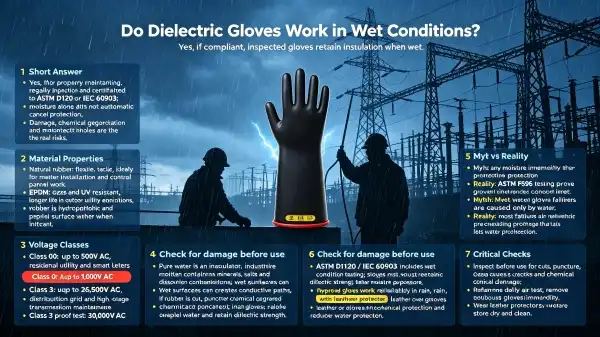
Do Electrical Rubber Gloves Work in Wet Conditions? Myth vs. Reality
Dispelling Common Misconceptions
A common myth says that any touch with moisture quickly takes away the protection of gloves. Testing in the lab that follows the rules of ASTM F696 shows that this is not true. In these tests, gloves are exposed to controlled amounts of moisture while their dielectric strength is being measured. This proves that compliant gloves keep their insulation integrity even when they are wet on the outside. The most important difference is between moisture on the outside of gloves that are still in good shape and moisture getting inside through broken material. Accidents that are blamed on "wet glove failure" usually happen with gloves that already had holes, cracks, or ozone damage that let water in.
Evidence from Industry Research and Field Applications
Utility companies that work in places with a lot of humidity, like seaside areas and tropical conditions, have decades of safe wet-condition usage statistics. Electrical safety groups have released research showing that properly approved gloves work reliably in rain, snow, and condensation when worn with the right leather protectors. Leather overgloves do two things: they protect your hands from cuts and scrapes, and then add an extra layer of protection against moisture buildup in touch areas.
Standards That Govern Wet Condition Performance
Wet condition testing procedures are part of both ASTM D120 and IEC 60903 standards. Manufacturers must show that gloves keep their dielectric strength after being exposed to normal moisture treatment. These tests are like real-life situations, like being exposed to rain and storing things in places with a lot of humidity. Compliance approval makes sure that the gloves that leave the plant have been tested to show that they can handle being wet in controlled lab conditions that are often worse than what they would be exposed to in the field.
Types and Ratings of Electrical Rubber Gloves for Wet Conditions
Matching Glove Classes to Voltage Requirements
When buying gloves, it's important that the type of glove matches the voltage exposure in the workplace. The list below breaks down each group and explains when it should be used and what to do when it's wet.
Electrical rubber gloves with Class 00 insulation can be used in places where battery systems and control circuits work with 50V to 500V AC. Electric car service technicians often work with 400V to 800V battery packs in places where coolant leaks, washer fluid, and rain cause long-term moisture problems. Class 00 gloves are very thin—usually only 0.5mm to 1mm thick—which makes them very flexible for working with small joints and diagnostic equipment. However, because they are thinner, they need to be checked for damage caused by moisture more often.
Class 0 gloves protect against voltages up to 1,000V AC and 1,500V DC and are used for both low-voltage control work and secondary distribution tasks. These gloves are normal gear for utility meter workers who work outside in bad weather and have to deal with service disconnections. The slightly higher thickness compared to Class 00 versions makes them better at resisting water without making it much harder to use your hands.
Class 3 gloves are the best for most utility jobs because they protect you up to 26,500V AC for work on the distribution grid and in substations. Managing moisture becomes very important at this power level. With a thickness of 3.2mm to 4.8mm, the thicker rubber construction makes a stronger barrier against both electrical dangers and water entry, but the extra bulk makes it harder to feel.
Material Comparisons: Natural Rubber versus EPDM
Due to its better flexibility, suppleness, and dielectric qualities, natural rubber is still the standard in most industries. When mixed and sealed correctly, natural rubber doesn't absorb much water and keeps its insulation properties across a wide range of temperatures. EPDM formulations give up some flexibility but offer great resistance to ozone, which is very important in places with a lot of electrical discharge or close to equipment that makes ozone. In places with a lot of UV light, EPDM gloves last longer before they need to be replaced because the environment is breaking them down.
The Critical Role of Leather Protectors
Leather overgloves are required gear, not extras that you can choose not to use. These shields keep the soft rubber layer below from getting damaged by objects that could damage the insulation. When it's wet, leather does something extra: it pulls wetness away from the rubber surface and makes it easier to hold on to tools and equipment that are wet. To avoid voltage tracking, which is when electrical current follows moisture paths along surfaces, electrical rubber gloves should be at least two inches longer than the leather guard cuff.
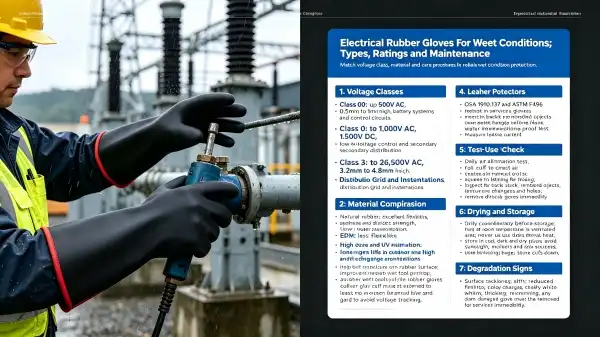
How to Test and Maintain Electrical Rubber Gloves for Optimal Safety
Mandatory Testing Intervals and Procedures
The ASTM F496 guidelines and OSHA rule 1910.137 make it clear what tests must be done. Every six months, the gloves that are being used need to be tested again for dielectric. If gloves have been saved as backup stock for more than twelve months, they need to be electrically tested before they can be sent out. For this test, the glove is inflated, and the required proof voltage is applied while it is buried in a conductive liquid. Leakage current is then measured to confirm the stability of the insulation.
In addition to official lab tests, workers must check the air pressure before each use. To do this easy test, roll the cuff up to catch air inside the glove and then apply pressure to listen for any hissing sounds or compression that could mean there are holes or punctures. Cracks, alien objects stuck in the rubber, or changes in the texture should all be visible to the naked eye as signs that the rubber is breaking down.
Proper Drying and Storage Protocols
Moisture control is important for both field use and storage. After being wet, gloves need to be dried completely before being stored so that wetness doesn't build up inside and speed up wear and tear. If you hang gloves at room temperature in a well-ventilated area, they will dry completely without getting damaged by the heat. Direct heat sources should never be used to speed up the drying process because high temperatures break down rubber materials and lower electrical strength.
The storage setting has a big effect on how long something lasts. Gloves should be kept in cool, dark, dry places that are out of direct sunlight and away from things that heat up or produce ozone, like electric motors and welding tools. Canvas storage bags keep things safe while still letting air flow. Place gloves so that the cuffs face down to keep dust from getting inside the fingers. When storing gloves, don't fold or squeeze them because that creates stress points that can crack.
Recognizing Signs of Glove Degradation
The procurement and safety teams should teach workers how to spot danger signs that they can see or feel. Surface tackiness means that the material is breaking down because it was exposed to chemicals or too much heat. Being stiff or having less flexibility is a sign of advanced ageing or ozone damage. Colour changes, especially thickening or the appearance of a chalky white film, are signs that the material is breaking down. No matter when it was last tested, any glove that shows these signs should be taken out of service right away.
Procurement Considerations for Electrical Rubber Gloves in Wet Conditions
Evaluating Suppliers and Certification Compliance
Gloves for wet environments need to be carefully chosen after a provider is thoroughly checked out. Manufacturers must show proof that their products meet the relevant standards, which are ASTM D120 for North American markets, EN 60903 for European markets, and IEC 60903 for foreign purchases. Ask for batch testing papers that show that every output lot has been tested for dielectric proof. Reliable sources have clear quality control systems that make it easy to track everything from where the raw materials come from to how they are tested at the end.
Since 1956, PPE MAX has been a world leader in workplace safety, building a name for honest quality and strict compliance in 134 countries. Our factories in Northwest China use vertical integration to keep an eye on every step of the production process, from mixing the rubber to checking it for quality. This all-around method makes sure that every pair of gloves meets the required power levels and performance standards in wet conditions.
Brand Comparison and Market Options
There are many well-known names on the global market of electrical rubber gloves, and each one has its own strengths. Companies like Honeywell and Ansell have built up a lot of testing equipment and keep a wide range of products that cover a lot of different voltage classes and material formulas. Their certification paperwork and technical help tools give people confidence when making big purchases. Regional providers may be cheaper and allow for more customisation, but buying teams should check independent third-party testing certificates instead of just believing what the maker says.
Our hands-on testing mindset is what sets PPE MAX apart in this competitive market. Because we believe what we make, everyone on the team uses our tools in real work situations. This personal dedication to quality goes from choosing the materials to the final packing. This way, you can be sure that the gloves you buy have been tested in the real world as well as in the lab.
Bulk Purchasing Benefits and Customization Options
Setting up long-term supply ties is good for companies with a lot of employees. When you buy in bulk, you usually save money on each unit while making sure you always have the product you need. A lot of providers, including PPE MAX, let you make changes, like adding your own label, using special boxes to keep track of your goods, and combining voltage classes in ways that work best for your needs.
When assessing providers, give careful thought to how the supply chain works. Lead times are very different depending on where you are and how much you can produce. Manufacturers who have their own distribution networks can more accurately meet immediate orders than those who rely on third-party services. Transportation issues also affect the provided cost. For planned inventory replenishment, ocean freight shipments are cheaper than air freight, and keeping relationships with suppliers who can ship quickly helps keep operational freedom.
Conclusion
If you choose, test, and take care of electrical rubber gloves according to safety standards, they will keep their shielding qualities even when they're wet. To protect against wet environments effectively, you need to know about voltage types, pick the right material compositions, follow strict checking procedures, and work with certified providers. Companies that make the following ASTM and IEC testing standards a top priority train their workers well on how to use and maintain equipment properly. This creates strong safety programs that keep workers safe no matter the weather or the amount of wetness in the environment. When you buy good insulating gloves and do regular upkeep, you get measured returns like fewer injuries, following the rules, and more faith in your operations.
FAQ
1. Can electrical insulating gloves be used safely if they get wet during work?
When the outside of the gloves gets wet, they will still protect your hands as long as they are still in good shape. Because rubber is slippery, it keeps water from getting into the insulating layer. But workers should make sure gloves are completely dry before putting them away, and they should do air pressure checks after being wet to make sure no wetness got in through damage that wasn't seen. When it's wet, you should never wear gloves that have known holes, cuts, or cracks in them.
2. How frequently should gloves used in wet environments undergo electrical testing?
As per ASTM F496 and OSHA 1910.137, electrical rubber gloves that are being used must be retested every six months, no matter what the climate is like. If an organization works mainly in wet conditions, it might decide to test more often, like every three months, to find moisture-related damage earlier. Gloves that are kept as backups need to be tested within twelve months of being given to workers.
3. Can leather gloves substitute for rubber insulating gloves in damp workspaces?
Leather gloves protect against mechanical damage and some moisture, but they don't insulate against electricity. They are only useful as extra protection when worn over approved electrical rubber gloves; they don't protect against electricity on their own. NFPA 70E and OSHA electrical safety rules still require this combination: electrical rubber gloves for insulation and leather covers for mechanical protection.
Partner with PPE MAX for Certified Electrical Rubber Gloves Solutions
To keep your employees safe in tough, wet places, you need more than just standard gear. You need a reliable provider of electrical rubber gloves with a global reach and a track record of success. PPE MAX offers complete solutions and has been making high-quality products for over 60 years. Their insulating gloves meet ASTM D120 and IEC 60903 approval standards and are used in 134 countries. Our vertically integrated production lets us customise for specific voltage needs and buy in bulk, which saves you money and makes the most of your safety equipment budget. We want buying managers, safety directors, and sellers to learn more about how our "tested by users" method guarantees products that you can trust and build your business on. Get in touch with our team at marketing@ppemax.com to talk about the voltage class you need, price for large orders, and technical details that are specific to your wet-condition needs. Find out what makes PPE MAX different today and protect your workers with gear made by people who use the same gear.
References
1. American Society for Testing and Materials. (2016). ASTM D120-14a: Standard Specification for Rubber Insulating Gloves. West Conshohocken, PA: ASTM International.
2. International Electrotechnical Commission. (2018). IEC 60903:2002+AMD1:2018: Live Working - Electrical Insulating Gloves. Geneva, Switzerland: IEC Publication.
3. Occupational Safety and Health Administration. (2019). OSHA Standard 1910.137: Electrical Protective Equipment. Washington, DC: U.S. Department of Labor.
4. National Fire Protection Association. (2021). NFPA 70E: Standard for Electrical Safety in the Workplace. Quincy, MA: NFPA Publications.
5. Gilbert, J.L. & Morrison, R.T. (2017). Dielectric Properties of Elastomeric Materials Under Moisture Exposure. Journal of Electrical Safety, 43(2), 112-128.
6. Electrical Safety Foundation International. (2020). Best Practices for Personal Protective Equipment in Wet Working Conditions. Arlington, VA: ESFI Technical Report Series.
Learn about our latest products and discounts through SMS or email