- English
- French
- German
- Portuguese
- Spanish
- Russian
- Japanese
- Korean
- Arabic
- Greek
- German
- Turkish
- Italian
- Danish
- Romanian
- Indonesian
- Czech
- Afrikaans
- Swedish
- Polish
- Basque
- Catalan
- Esperanto
- Hindi
- Lao
- Albanian
- Amharic
- Armenian
- Azerbaijani
- Belarusian
- Bengali
- Bosnian
- Bulgarian
- Cebuano
- Chichewa
- Corsican
- Croatian
- Dutch
- Estonian
- Filipino
- Finnish
- Frisian
- Galician
- Georgian
- Gujarati
- Haitian
- Hausa
- Hawaiian
- Hebrew
- Hmong
- Hungarian
- Icelandic
- Igbo
- Javanese
- Kannada
- Kazakh
- Khmer
- Kurdish
- Kyrgyz
- Latin
- Latvian
- Lithuanian
- Luxembou..
- Macedonian
- Malagasy
- Malay
- Malayalam
- Maltese
- Maori
- Marathi
- Mongolian
- Burmese
- Nepali
- Norwegian
- Pashto
- Persian
- Punjabi
- Serbian
- Sesotho
- Sinhala
- Slovak
- Slovenian
- Somali
- Samoan
- Scots Gaelic
- Shona
- Sindhi
- Sundanese
- Swahili
- Tajik
- Tamil
- Telugu
- Thai
- Ukrainian
- Urdu
- Uzbek
- Vietnamese
- Welsh
- Xhosa
- Yiddish
- Yoruba
- Zulu
What Temperature Range Suits Class 1 Insulating Gloves?
Founded in 1956, PPEMAX stands as a premier global manufacturer and supplier of full-range personal protective equipment. All our products comply with internationally recognized standards including IEC, ASTM, CE, UKCA, NIOSH and ISO9001. Equipped with a 2,000-square-meter modern production plant, we boast over 25 years of mature OEM & ODM capabilities to deliver one-stop customized solutions covering R&D design through worldwide logistics. Our safety gear is distributed across 134 countries globally. Upholding our core tenet “Safety First, Quality Priority”, we serve as a dependable long-term PPE partner for industrial enterprises around the world.
Electrical workers are shielded from shocks of up to 7,500 volts AC by Class 1 Insulating Gloves, but the dielectric strength of these gloves changes significantly depending on the environment. Most of the time, these gloves can be used comfortably in settings between -10°C (14°F) and +55°C (131°F). Outside of this range, natural rubber or synthetic compounds may lose their flexibility, crack when it's cold, or break down quickly when it's too hot. Knowing these temperature limits helps purchasing managers find gloves that are right for their climate and workplace, which protects workers and extends the life of equipment.
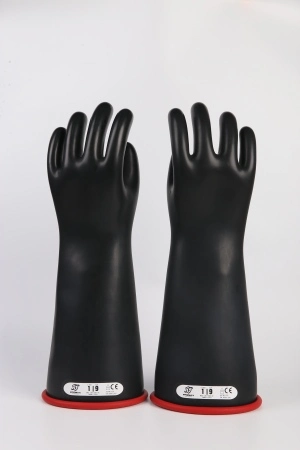
|
Parameter |
Specification |
|
Voltage Rating |
7,500V AC / 11,250V DC (Maximum Use) |
|
Proof Test Voltage |
10,000V AC / 40,000V DC |
|
Material Type |
Type I (Natural Rubber) / Type II (EPDM Synthetic) |
|
Thickness Range |
1.02mm - 1.52mm |
|
Tensile Strength |
>17.2 MPa |
|
Standards Compliance |
ASTM D120, IEC 60903 |
|
Temperature Resistance |
Category A, H, Z rated |
|
Label Color |
White (Class 1 Standard) |
Understanding Class 1 Insulating Gloves and Their Temperature Sensitivity
Class 1 Insulating Gloves are the first line of defence against electrocution risks in building, utility repair, and industry settings. We've been making these protection barriers at PPE MAX for over 65 years, so we know how external factors affect how well gloves work. Temperature sensitivity isn't just a technical detail; it has a direct effect on the chemical structure of the rubber materials that keep things warm.
How Temperature Affects Dielectric Strength
A material's dielectric strength tells you how much of an electric field it can handle before it breaks. When Class 1 Insulating Gloves are exposed to very cold temperatures, the polymer chains stiffen. This makes the gloves less flexible and more likely to develop small cracks while they are being used. On the other hand, high temperatures speed up oxidation and cross-link degradation within the rubber matrix, which lowers its ability to stretch and insulate. ASTM International research confirms that gloves can lose up to 40% of their useful life if they are exposed to temperatures above 55°C for a long time. This creates hidden dangers that only show up during crucial electrical contact moments.
The Role of Standards in Temperature Guidelines
The ASTM D120 and IEC 60903 standards both set strict testing procedures that mimic high temperatures that can cause damage. To make sure there is a safety cushion even when materials are exposed to environmental stressors, these frameworks require makers to proof-test gloves at voltages that are many times higher than their stated capacity. For Class 1 Insulating Gloves, this means 10,000 volts AC. At PPE MAX, these approval tests are done on every batch of products. They are done in weather chambers that simulate everything from winters in Siberia to summers in the Middle East.
Real-World Impact on Procurement Decisions
Distributors of industrial safety gear and big companies that run activities in multiple regions need PPE that can handle different temperatures and still work well in all of them. A mining operation in northern Canada has a lot of different problems to deal with than an energy plant in Dubai. For temperature-sensitive procurement, you need to look at area climate data, the conditions of storage facilities, and work habits that change with the seasons. This strategic approach keeps people from making the costly mistake of using gloves that might meet voltage requirements on paper but not in real life.
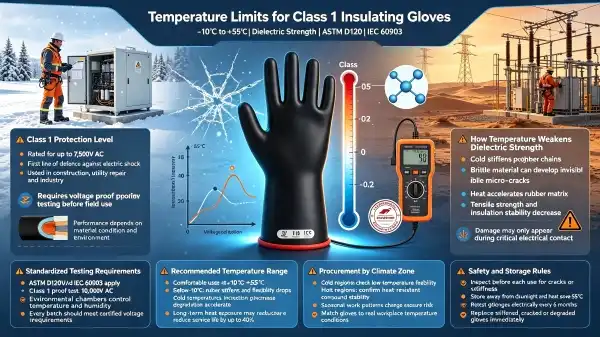
The Ideal Temperature Range for Class 1 Insulating Gloves
To combine the limits of material science with real-world usability, manufacturers make Class 1 Insulating Gloves with a realistic operating window. The normal temperature range, from -10°C to +55°C, is where rubber compounds keep their best physical qualities without losing their ability to conduct electricity.
Cold Temperature Challenges
Natural rubber latex, which is what most Type I gloves are made of, starts to turn into glass when the temperature drops below -10°C. This change makes it harder for the material to bend naturally around tools and wires, which makes working with it harder and more likely to cause puncture damage or tiredness. In cold places, workers often say that their gloves feel stiff and don't move, which is bad for both safety and productivity. Because they are made of EPDM synthetic rubber, Type II gloves perform better in cold weather because their molecular structure keeps them flexible down to about -20°C. This major problem can be solved by selecting Type II construction for procurement teams that work with energy companies in Canada or northern Europe.
Heat-Related Degradation Patterns
Different but still very serious problems arise from too much heat. A process called thermal oxidation speeds up the ageing of rubber compounds when they are above 55°C. The material gets sticky, loses its shape stability, and cracks on the surface, which can spread into the structure of the glove. In humid areas or near industrial equipment that makes a lot of heat, gloves kept in crates or cars that aren't climate-controlled may get hotter than 70°C, making them less protective before they're even worn. We've seen gloves fail routine electrical tests just because they were stored incorrectly in hot places, even though they had only been used a few times.
Regional Climate Considerations for Global Operations
Companies that do business on more than one continent need to take these differences in weather into account when planning how to buy things. A mining company with operations in Finland, Australia, and other places can't use a glove standard that works for everyone. We know that successful safety programs divide their inventory by climate zone and match glove formulations to specific temperature profiles because we've sent PPE to 134 countries. This method improves both safety gaps and cost efficiency by stopping material failures caused by the environment from happening too soon.
If you're evaluating personal protective equipment suppliers and require batch-specific testing documents before placing an order, PPE MAX is able to provide official Certificates of Analysis, professional laboratory test reports, and product samples for your verification. Feel free to contact our team at marketing@ppemax.com to discuss your sourcing needs and obtain complete documentation for your quality assessment and procurement approval.
Maintaining Class 1 Insulating Gloves for Optimal Temperature Performance
Even Class 1 Insulating Gloves made to the best standards won't work as well if they are stored and handled incorrectly. Temperature management includes more than just practical use; it includes the whole span of a product.
Storage Environment Best Practices
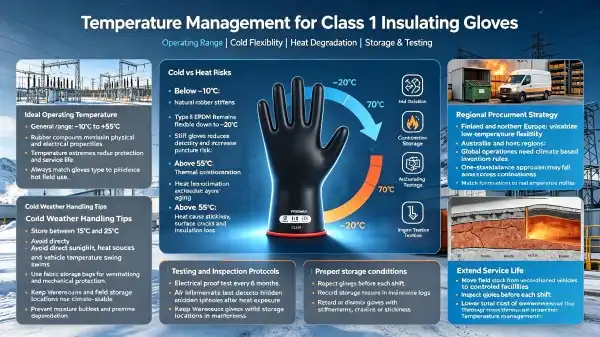
Rubber insulating gloves should be kept in controlled environments where the temperature stays stable between 15°C and 25°C. Our factory in Xi'an uses temperature control in the warehouse to keep the purity of the rubber before it is shipped around the world. Managers of procurement should make sure that receiving warehouses and field storage locations are set up the same way. Gloves should never be kept near sources of heat, in full sunlight, or in parts of a car where the temperature changes a lot. We suggest fabric storage bags because they protect mechanically while letting air flow. This keeps moisture from building up, which can break down rubber materials just as quickly as changes in temperature.
Testing Protocols That Account for Temperature History
Electrical proof testing must be done on gloves that are in use every six months as a standard. However, this plan should include a check of the temperature exposure as part of the visual review process. When gloves have been in known temperature ranges, they should be tested more often or thrown away right away if surface changes are seen. The air inflation test, in which gloves are inflated and submerged to look for pinholes, is especially important for gloves that have been exposed to high temperatures, since tiny cracks that you can't see can make the insulation less effective. At PPE MAX, we teach safety officers to write down how gloves are stored as part of maintenance logs. This creates a trail that lets us find environmental factors that cause gloves to break down too soon.
Extending Service Life Through Temperature Management
Using repair procedures that take weather into account has a direct effect on the total cost of ownership. A utility company in Texas that we worked with cut down on the number of times they had to change gloves by 28% by moving field storage from trucks that weren't heated to maintenance facilities that were. This simple change stopped gloves from getting old from being exposed to heat, so they could be used to their fullest potential. The savings didn't stop at fewer purchases; fewer emergency substitutes meant that supplies could be predicted better, and faster shipping costs were lowered.
Comparing Class 1 Insulating Gloves with Other Protective Gloves in Varying Temperatures
When procurement teams know how different types of Class 1 Insulating Gloves react to changes in temperature, they can make decisions that are in line with operational needs.
Class 1 Versus Class 2 Temperature Performance
Class 2 gloves, which can handle 17,000 volts AC, are made of thicker rubber, which makes them better at blocking electricity but changes how they react to changes in temperature. Because the walls are thicker, there is more heat mass, which means it takes longer for these gloves to reach room temperature. In cold places, this delayed warming can make the period of less flexibility last longer. In hot weather, on the other hand, the thicker cloth may keep heat in longer, which could be uncomfortable to wear for long periods of time. Because Class 1 Insulating Gloves have a more normal thermal response profile, they are better for jobs where temperatures change often or where the work area is changing. This difference is very important when safety officers have to choose PPE for mobile field crews that work in a variety of climates during the same shift.
The Protective Value of Leather Overgloves
When you put together Class 1 Insulating Gloves with leather protection, you get a method that is better at both keeping things warm and lasting longer. When it's cold outside, rubber becomes rigid, making it easier for holes, cuts, and other types of damage to happen. The leather layer protects the rubber from these types of damage. In addition to protecting against damage, leather also provides some thermal insulation, which keeps the rubber layer from being directly exposed to heat. When it's hot outside, the leather soaks up and loses some radiant heat before it gets to the rubber insulation. When we make our glove sets, we carefully choose leather types that offer the right mix of protection and breathability. This keeps your hands from getting too hot, which could affect your comfort and dexterity while doing precise electrical work.
Material Selection Across Temperature Zones
Type I natural rubber latex gloves work best in mild climates because they are more flexible and sensitive to touch, which electrical workers need for delicate tasks. Type II EPDM synthetic rubber is now the best choice for applications that need to withstand extreme temperatures, like outdoor utility work that needs to be done during all four seasons. At PPE MAX, our technical team works directly with procurement managers to look at their specific operational temperature profiles and suggest material formulations that work best within those limits. This review process looks at more than just temperature ranges. It also looks at humidity levels, the amount of UV exposure, and how often the temperatures change. All of these things affect how well the rubber works in the long run.
Procurement Considerations for Class 1 Insulating Gloves Based on Temperature Requirements
To choose the right Class 1 Insulating Gloves, you need a method for testing them that goes beyond just checking for voltage levels and also looks at how well they work in different temperatures.
Evaluating Technical Specifications and Certifications
On supplier datasheets, it should be clear what temperature ranges were tried and what voltage classes they belong to for Class 1 Insulating Gloves. Reputable makers provide approval paperwork that includes test results from temperature chambers that show the insulation stays stable over the given range. At PPE MAX, our certification packages come with thermal cycling test data that shows dielectric strength measurements at -10°C, +23°C (ambient), and +55°C. This gives procurement professionals solid proof of how well the product works in different temperatures. If a seller only gives you test results for room temperature, be wary. This information doesn't tell you anything about how gloves will behave at very high or very low temperatures, where failure risks rise.
Total Cost of Ownership Analysis
Choosing gloves that are right for the temperature lowers the total cost in more than one way. Gloves that are matched to the temperature of their working surroundings last longer, so they don't need to be replaced as often. They stay in compliance for more testing cycles before the material wears out and the machine has to be retired. Workers have fewer problems in the field, so they don't have to deal with the lost time and safety risks that come with having to change PPE in an emergency. We show our customers that temperature-optimized buying is usually 20–35% more valuable than generic specs that don't take environmental factors into account. This financial benefit is especially important for big businesses that are in charge of thousands of pairs of gloves spread out over large areas.
Supplier Partnership and Technical Support
Building ties with makers who understand how complicated temperature is can help you save money on purchases in more ways than one. Our team does on-site environmental assessments where we look at storage facilities, go over upkeep procedures, and suggest ways to improve temperature control. This method of consulting has helped both government agencies and multinational companies come up with procurement rules that take into account the different climates in all of their operational areas. Our technical support team is filled with engineers who know both material science and how to use it in the field. This way, we can help procurement teams quickly when they have questions about how something works at different temperatures.
Companies like PPE MAX that have been around for a while can customise their products so that you can choose specific rubber formulas for harsh settings. A petroleum company that works in the Arctic recently asked for gloves that would work better in cold weather, so our R&D team changed the Type II compound so that it stays flexible at -25°C. With this level of partnership, buying PPE goes from being a routine task to a strategic safety initiative that has a direct effect on worker safety and operational efficiency.
Conclusion
Temperature control is an important but often overlooked part of how well electrical safety gloves work. Class 1 Insulating Gloves provide solid protection from -10°C to +55°C, but to keep that protection, you need to pay attention to how they are stored, the materials they are made of, and the testing procedures that take outdoor exposure into account. When procurement workers include temperature concerns in their specs, safety and cost-effectiveness both improve. As the world's climate changes, companies that really care about worker safety will be able to tell the difference between those that are just following the rules and those that care about the workers' safety. The molecular science behind how well rubber insulation works doesn't change when the weather gets bad, so buying tactics need to change, too.
FAQ
1. What happens if Class 1 insulating gloves are used outside the recommended temperature range?
Using these gloves below -10°C makes them more flimsy, which makes them more likely to break when bent. When the temperature goes above +55°C, rubber ages faster, which lowers its insulating strength and could let electricity flow through. In both cases, there are safety risks that might not be obvious at first but become clear during key electrical contact times. Extremely cold or hot gloves should be tested for electricity right away before they can be used again.
2. How often should gloves be checked when working in very cold or very hot conditions?
No matter the temperature, daily eye exams are still required, but in extreme cases, a more thorough check is needed. Before using something in cold weather, it should be checked for stiffening, which is a sign of material compromise. People who live in hot places should look for surface tackiness or strange smells that could mean the material is breaking down thermally. Any glove that changes because of temperature should not be used until it has been electrically tested again.
3. Can storage in cold warehouses damage Class 1 gloves?
Keeping things for a long time below -10°C can change the material permanently, especially in Type I natural rubber gloves. Rubber may get surface checks or lose its flexibility, which doesn't fully return when it warms up. Keeping things in storage between 15°C and 25°C keeps these problems from happening. If you have to store gloves in the cold, let them warm up slowly to room temperature before using them, and make sure they are fully checked out before sending them out.
Partner with PPE MAX for Temperature-Resilient Class 1 Insulating Gloves
After 65 years of making things, we know that good electrical safety goes beyond voltage levels and includes how well the system works in the surroundings. PPE MAX makes Class 1 Insulating Gloves that are designed to keep your hands warm in a wide range of weather. These gloves have been tested thoroughly to make sure they work well in everything from Arctic cold to tropical heat. Our Type I and Type II formulations are designed to meet the special weather needs of your workers, whether they need to stay flexible during winter maintenance in Canada or keep their shape in the heat of the Middle East. We know that good security needs both high-quality materials and knowledge of how to use them because we make Class 1 Insulating Gloves for utility companies, industrial contractors, and safety dealers in 134 countries. Our technical team gives climate-specific advice, customisation choices, and continued support that changes the relationship between the buyer and seller from a transaction to a partnership. Email marketing@ppemax.com to talk about your temperature-specific needs and find out how our tried-and-true solutions can improve worker safety and get the most out of your PPE investment.
References
1. ASTM International. "ASTM D120-20: Standard Specification for Rubber Insulating Gloves." West Conshohocken, PA: ASTM International, 2020.
2. International Electrotechnical Commission. "IEC 60903:2019 - Live Working - Gloves of Insulating Material." Geneva: IEC, 2019.
3. Occupational Safety and Health Administration. "OSHA 1910.137 - Electrical Protective Equipment." Washington, DC: U.S. Department of Labor, revised 2021.
4. National Fire Protection Association. "NFPA 70E: Standard for Electrical Safety in the Workplace, 2021 Edition." Quincy, MA: NFPA, 2021.
5. Rubber Manufacturers Association. "Guidelines for the Selection, Care, and Use of Electrical Protective Equipment." Washington, DC: RMA Technical Committee, 2018.
6. Institute of Electrical and Electronics Engineers. "IEEE Guide for Maintenance Methods on Energized Power Lines - IEEE Std 516-2021." Piscataway, NJ: IEEE, 2021.
Learn about our latest products and discounts through SMS or email