- English
- French
- German
- Portuguese
- Spanish
- Russian
- Japanese
- Korean
- Arabic
- Greek
- German
- Turkish
- Italian
- Danish
- Romanian
- Indonesian
- Czech
- Afrikaans
- Swedish
- Polish
- Basque
- Catalan
- Esperanto
- Hindi
- Lao
- Albanian
- Amharic
- Armenian
- Azerbaijani
- Belarusian
- Bengali
- Bosnian
- Bulgarian
- Cebuano
- Chichewa
- Corsican
- Croatian
- Dutch
- Estonian
- Filipino
- Finnish
- Frisian
- Galician
- Georgian
- Gujarati
- Haitian
- Hausa
- Hawaiian
- Hebrew
- Hmong
- Hungarian
- Icelandic
- Igbo
- Javanese
- Kannada
- Kazakh
- Khmer
- Kurdish
- Kyrgyz
- Latin
- Latvian
- Lithuanian
- Luxembou..
- Macedonian
- Malagasy
- Malay
- Malayalam
- Maltese
- Maori
- Marathi
- Mongolian
- Burmese
- Nepali
- Norwegian
- Pashto
- Persian
- Punjabi
- Serbian
- Sesotho
- Sinhala
- Slovak
- Slovenian
- Somali
- Samoan
- Scots Gaelic
- Shona
- Sindhi
- Sundanese
- Swahili
- Tajik
- Tamil
- Telugu
- Thai
- Ukrainian
- Urdu
- Uzbek
- Vietnamese
- Welsh
- Xhosa
- Yiddish
- Yoruba
- Zulu
What Makes Class 1 Insulating Gloves Fail Inspection?
Founded in 1956, PPEMAX stands as a premier global manufacturer and supplier of full-range personal protective equipment. All our products comply with internationally recognized standards including IEC, ASTM, CE, UKCA, NIOSH and ISO9001. Equipped with a 2,000-square-meter modern production plant, we boast over 25 years of mature OEM & ODM capabilities to deliver one-stop customized solutions covering R&D design through worldwide logistics. Our safety gear is distributed across 134 countries globally. Upholding our core tenet “Safety First, Quality Priority”, we serve as a dependable long-term PPE partner for industrial enterprises around the world.
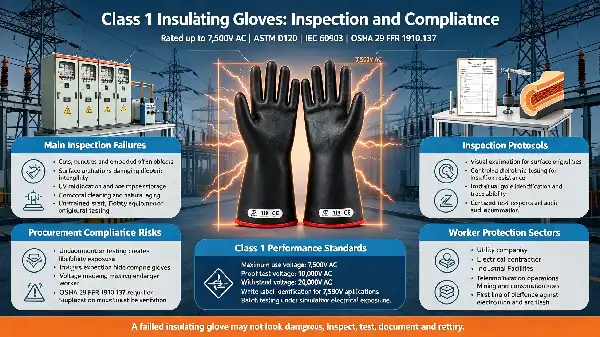
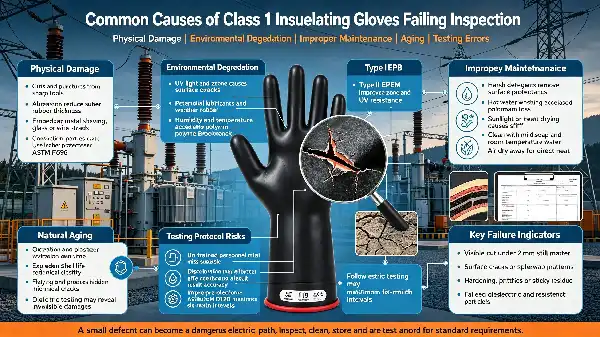
Electrical Insulation gloves up to 7,500 volts AC Fail Inspection (mostly Physical Damage): cuts, punctures, foreign items implanted, surface abrasions damaging their dielectric integrity. The deterioration of rubber is accelerated by environmental factors such as long-term UV radiation, ozone depletion, chemical pollution, and unsuitable storage conditions. Inappropriate cleaning techniques may decrease material qualities, and natural ageing due to prolonged usage or improper maintenance procedures decreases the efficiency of the insulation. Untrained staff or faulty equipment lead to testing irregularities, resulting in undiscovered failures which put workers at risk and breach compliance requirements for Class 1 Insulating Gloves.
Understanding Class 1 Insulating Gloves and Inspection Standards
For more than 60 years, PPE MAX has been developing electrical safety solutions to safeguard workers in high-risk areas. Utility companies, electrical contractors, industrial facilities, and telecommunications operations depend on our insulating gloves, rated for voltages up to 7,500 volts AC, as the first line of defence against electrocution and arc flash accidents. These rubber insulating materials are not just accessories; they are life-saving barriers between energised circuits and human skin.
The regulatory frameworks for these protection devices are strict and harsh. There are performance criteria as per ASTM D120 and IEC 60903 that any reputable producer must fulfil. In order to retain the insulation integrity of gloves under stress circumstances above normal operating norms, the standards provide proof test voltages of 10,000 volts AC and withstand voltages of 20,000 volts AC.
Why Inspection Protocols Matter for Procurement Teams
Inspection procedures combine visual examination and dielectric testing to identify compromised gloves before they reach the field. Visual checks detect surface irregularities, while dielectric testing applies controlled electrical stress to verify insulation resistance. Procurement professionals managing large workforce safety programs understand that undocumented or irregular testing exposes organizations to catastrophic liability and regulatory penalties. OSHA 29 CFR 1910.137 mandates strict compliance, making supplier certification and testing documentation non-negotiable elements of any purchase agreement.
The Critical Link Between Standards and Worker Safety
Every batch of gloves made at our Xi’an facilities is tested to imitate real-world electrical exposure. Our products are colour-coded with white labels to easily identify them as suitable for 7,500-volt applications, eliminating hazardous mismatches between glove ratings and real voltage exposure. This alignment across global markets—from building sites in Texas to mining operations in Chile—ensures uniform protection, regardless of geography or industrial sector.
Common Causes of Class 1 Insulating Gloves Failing Inspection
Understanding failure mechanisms helps procurement teams select suppliers with superior quality control and advise end users on proper handling of Class 1 Insulating Gloves. Our six-plus decades in PPE manufacturing have revealed patterns that consistently compromise glove performance.
Physical Damage from Mechanical Stress
Insulation failures are caused by tiny punctures due to sharp instruments, rough surfaces, and unintentional contact with metal edges. Cuts shorter than 2mm are nonetheless important in that they provide paths for electrical current. Repeated contact with coarse objects wears away the surface, making the rubber thinner and lowering the dielectric strength below a safe level. Foreign particles embedded in the insulation – metal shavings, glass shards or wire strands – form conductive bridges, nullifying the insulating characteristics.
We have formulated our gloves to be puncture resistant; however, no material is impervious to abuse or incorrect combination with leather protectors. Protective outer gloves are designed to protect the rubber from mechanical harm when handling cables and working on equipment, and the ASTM F696 standard exists for that purpose.
Environmental Degradation Accelerates Aging
Both natural rubber latex and synthetic polymers degrade when exposed to UV light and ozone. Oxidation is accelerated by storage in intense light, such as warehouses or near windows, and causes surface breaking that looks like small spider-web patterns. Over time, when they are exposed, these fractures become larger, and finally form channels through the insulation.
Chemical pollution is another major danger. Petroleum-based lubricants, hydraulic fluids, and industrial solvents degrade rubber molecular structure. A single exposure to an incompatible material may diminish the dielectric strength by 40% or more. Humidity and temperature changes exacerbate these problems—gloves kept in damp basements or too-hot storage units tear down their polymer chains faster.
Our Type II EPDM formulations also have a higher resilience to ozone and UV degradation than normal natural rubber, which may result in a longer service life in outdoor utility applications where environmental exposure is a factor.
Improper Maintenance Practices Weaken Material Integrity
Many failures in testing are due to the destruction of glove qualities by cleaning techniques, rather than their preservation. Harsh detergents such as petroleum distillates, chlorine bleach, or harsh surfactants remove the protective chemicals on the surface of rubber. Polymer breakdown is accelerated by hot water washing at 65°C (150°F). Stiffness and loss of flexibility are the result of thermal stress caused by air drying in bright sunshine or near sources of heat.
Since the maintenance approach directly affects inspection pass rates, we provide precise cleaning instructions with each shipment. Mild soap solutions, room temperature water, and air drying away from direct heat will not introduce any new failure mechanisms and will preserve the qualities of the materials.
Natural Aging and Usage Cycles
Even properly maintained Class 1 Insulating Gloves degrade over time. Rubber polymers undergo continuous oxidation, cross-linking, and plasticizer migration. Gloves stored beyond shelf life recommendations exhibit reduced elasticity and increased brittleness—characteristics that become apparent during dielectric testing but may not show visible symptoms.
Usage frequency matters significantly. Gloves subjected to daily donning and doffing cycles experience mechanical fatigue at stress concentration points near the cuffs and fingers. Flexing during gripping motions creates internal micro-cracks that propagate slowly until they compromise insulation.
Testing Protocol Inconsistencies
Human error and equipment calibration issues create false negatives that allow defective gloves into service. Personnel lacking proper training may overlook subtle indicators during visual inspection—slight discoloration suggesting chemical exposure, minor surface irregularities indicating embedded particles, or texture changes signaling early degradation.
Dielectric testing equipment requires regular calibration against known standards. Voltage measurement inaccuracies, improper electrode positioning, or inadequate test duration produce unreliable results. Some operations attempt to extend testing intervals beyond the six-month maximum specified in ASTM D120, gambling that nothing has changed since the last inspection.
If you're evaluating personal protective equipment suppliers and require batch-specific testing documents before placing an order, PPE MAX is able to provide official Certificates of Analysis, professional laboratory test reports, and product samples for your verification. Feel free to contact our team at marketing@ppemax.com to discuss your sourcing needs and obtain complete documentation for your quality assessment and procurement approval.
Best Practices to Prevent Inspection Failures and Extend Glove Life
Implementing structured protocols transforms glove management from reactive crisis response to proactive risk mitigation. Organizations that systematically address storage, handling, cleaning, and testing dramatically reduce inspection failure rates while maximizing equipment investment returns.
Storage environments require careful control. Temperature should remain between 10°C and 21°C (50°F to 70°F), with relative humidity below 60%. Darkness prevents UV degradation, while segregation from chemicals eliminates contamination risks. Our glove bags protect against light and physical damage during storage periods. Avoid folding or creasing gloves—hang them loosely or store flat to prevent permanent deformation that creates stress concentration points.
Establishing Rigorous Cleaning Standards
Develop written procedures specifying approved cleaning agents, water temperatures, and drying methods. Train personnel on the rationale behind each requirement so they understand the consequences of deviations. Implement quality checks where supervisors periodically verify adherence to protocols. Document cleaning dates and personnel responsible, creating accountability and enabling root cause analysis if failures occur.
After each use, rinse gloves with clean water to remove surface contaminants before they penetrate the rubber. Apply mild soap solution and gently scrub interior and exterior surfaces. Rinse thoroughly to eliminate soap residue that can degrade material properties. Air-dry away from heat sources and sunlight, allowing moisture to evaporate naturally without introducing thermal stress.
Implementing Comprehensive Inspection Schedules
Combine pre-use visual checks with scheduled dielectric testing to create a layered defense against defective gloves entering service. Daily visual inspection by the end user identifies obvious damage before voltage exposure occurs. Qualified technicians perform thorough examinations monthly, documenting findings in maintenance logs.
Dielectric testing must occur every six months for in-service gloves and annually for unused inventory. Partner with accredited testing laboratories or invest in calibrated equipment operated by certified personnel. Document every test with voltage readings, duration, and pass/fail determination. Tag tested gloves with dates and next inspection due date.
Immediate removal from service applies to any glove showing damage, suspicious indicators, or test failure. Never attempt field repairs—the stakes are too high, and the cost savings illusory compared to worker injury expenses and regulatory fines.
Partnering with Certified Manufacturers
Supplier selection profoundly impacts long-term inspection success rates. Manufacturers with comprehensive quality systems produce consistent products that predictably pass testing throughout their service life. At PPE MAX, our quality control begins with raw material verification and continues through every production stage. We test samples from each batch, maintaining statistical process control that identifies variations before they reach customers.
Request certification documentation proving compliance with ASTM D120, IEC 60903, and relevant regional standards. Verify the manufacturer maintains accreditation from recognized bodies and participates in industry testing programs. Suppliers offering technical support, training resources, and responsive customer service demonstrate commitment beyond transactional relationships.
Comparing Class 1 Insulating Gloves: What to Look for When Purchasing
Decisions on procurement entail a balance of many factors: the amount of protection, comfort, durability, certification status, the dependability of the provider, and the overall cost of ownership. Savvy purchasers look at items in the round, and not just at the buying price.
The choice of material has a profound effect on the performance characteristics. The natural rubber latex is very flexible and touch-sensitive, so you can work precisely on microscopic parts and wire connections. Workers enjoy comfort throughout long durations of use. Type I formulations perform well in situations with little ozone exposure and regulated conditions.
Type II EPDM synthetic rubber compromises some flexibility for better environmental resistance. If you are out in the field doing utility work, especially in areas with high ozone or extreme sunshine, you will need Type II construction. The little loss in dexterity is offset by the longer service life and the less frequent need for replacement.
Evaluating Supplier Capabilities and Support
In addition to the goods, look at the infrastructure and services the supplier offers. Bulk purchase schemes should feature bulk savings reflecting economies of scale, but not at the expense of quality. Dependable worldwide shipping networks that reach scattered enterprises in different countries on schedule.
Premium providers are differentiated from commodity providers by their technical assistance. • Questions about storage requirements, compatibility with certain chemicals, or troubleshooting odd wear patterns need expert answers from qualified staff. We also provide a technical support hotline for procurement and safety managers who are dealing with difficult requirements.
Customisation support is crucial for organisations with special needs. Standard catalogue products cannot provide production flexibility such as custom packaging for distribution networks, changed cuff lengths for particular purposes, or specialised formulas under uncommon weather circumstances.
Certification Documentation and Warranty Terms
Require full certification packages showing conformance to the appropriate standards. European markets want CE labelling, North American operations require ASTM D120 compliance, and worldwide deployments need IEC 60903 conformity, all of which must be accompanied by test results from recognised labs.
The warranty terms are an indication of the trust of the producer in the quality of his goods. We have a flexible return and replacement policy based on 65 years of manufacturing experience and statistical information that gloves that are properly used seldom fail prematurely. Suppliers that are reluctant to support their goods are showing quality problems that make shopping elsewhere a good idea.
The value of a product is not just the transaction but the after-sales service. Responsive customer assistance, answering queries regarding use, storage, or unanticipated challenges, develops relationships, not one-time purchases. We encourage visits from customers to our facilities in Xi'an, and we openly show our production processes and quality control systems.
Case Studies: Real-World Examples of Inspection Failures and Solutions
Systematic methods to issue solving have been shown to work in the real world, and have led to improvements in safety results with Class 1 Insulating Gloves. These are themes we’ve seen over decades of working with industrial customers throughout the world.
Manufacturing Plant Storage Issues
A Midwest automobile manufacturing plant was suffering from frightening inspection failure rates hovering close to 35%—well over industry standards. The investigation indicated that the gloves were kept in a maintenance shop with big windows and uneven temperature regulation. Summer temperatures topped 32°C (90°F), and the storage shelves were exposed to the sun for hours each day.
The answer was to move the gloves to an indoor temperature-controlled storage area, use opaque storage containers, and teach the maintenance staff on environmental standards. Within six months, the failure rate reduced to 8%, lowering the expenses of replacement and avoiding the dangers of exposure of workers to faulty equipment.
Utility Company Chemical Contamination
A regional electric provider noticed exceptional surface tackiness on gloves during periodic inspections. Testing indicated chemical contamination from a common hand cleanser used across their operations. The petroleum distillates in the cleaner damaged the molecular structure of the rubber and decreased the dielectric strength even when there was no obvious damage to the surface.
The source of contamination was removed using manufacturer-certified cleaning chemicals. The implementation of a training program that explained why particular goods were needed, as opposed to just listing permitted items, led to better adherence to the regimen. They stopped contamination issues and improved the glove service life by an average of four months.
Improved Outcomes Through Certified Suppliers
A construction firm with projects spanning South America was receiving uneven glove quality from several low-cost vendors. The variable inspection pass rates made safety management difficult and resulted in additional administrative effort to trace the varied product batches.
We consolidated our purchases via PPE MAX, with standardised quality, easier paperwork and volume reductions that more than made up for the somewhat higher unit pricing. Stable pass rates lowered testing expenses and administrative burden. Enhanced supplier engagement includes customised training materials and technical assistance in Spanish and Portuguese, resulting in improved end-user adherence to safety procedures.
Conclusion
Systematic procedures may successfully address recognised reasons for inspection failure. Glove integrity is affected by physical damage, environmental deterioration, lack of adequate maintenance, natural ageing, and irregularities in testing, although each of these has its own solutions. Proper storage, cleaning methods, planned inspections and supplier agreements significantly minimise failure rates and prolong equipment life for organisations. Investing in quality goods from recognised manufacturers and extensive training programs pays returns in lower replacement costs, better safety metrics and regulatory compliance. In global operations, procurement experts who grasp these dynamics make educated choices that safeguard workers and the interests of the firm.
FAQ
1. How often do electrical insulating gloves require dielectric testing?
Gloves placed in service must undergo dielectric testing every six months according to ASTM D120 requirements. Unused inventory stored properly can remain on the shelf for up to 12 months before requiring testing. This schedule ensures hidden defects are detected before they create hazardous conditions. Organizations operating under strict safety protocols often implement more frequent testing, particularly for gloves in harsh environments or high-use applications.
2. Can I repair insulating gloves that fail inspection?
Never attempt to repair failed insulating gloves. The dielectric properties that protect against electrical shock cannot be reliably restored through patching, gluing, or other repair methods. Even professional repair services cannot guarantee the uniform insulation integrity required for electrical safety applications. Discard failed gloves immediately and replace them with certified new equipment. The modest cost of replacement pales compared to potential injury expenses and regulatory penalties.
3. What certifications should I verify when purchasing?
Verify compliance with ASTM D120 for North American markets, IEC 60903 for international operations, and relevant OSHA requirements. CE marking indicates European market compliance. Request test reports from accredited laboratories proving the specific glove model meets stated voltage ratings. Documentation should include proof test voltages, withstand voltages, and material specifications. Legitimate manufacturers provide comprehensive certification packages without hesitation—reluctance signals potential quality concerns warranting deeper investigation.
Secure Reliable Protection with PPE MAX: Your Trusted Class 1 Insulating Gloves Manufacturer
PPE MAX delivers certified electrical insulating gloves that consistently pass inspection because we've refined manufacturing processes over 65 years. Our comprehensive quality control system, from raw material verification through final testing, ensures every glove meets ASTM D120 and IEC 60903 standards. We serve utility companies, electrical contractors, manufacturing plants, and construction sites across 134 countries with products engineered for durability, flexibility, and regulatory compliance. Our Xi'an manufacturing facilities combine advanced materials science with decades of field experience, producing gloves that balance worker comfort with uncompromising protection. Contact marketing@ppemax.com today to discuss bulk procurement for your organization and discover how partnering with an established Class 1 Insulating Gloves supplier enhances your electrical safety program while reducing total ownership costs.
References
1. American Society for Testing and Materials. (2022). Standard Specification for Rubber Insulating Gloves (ASTM D120-21). West Conshohocken, PA: ASTM International.
2. International Electrotechnical Commission. (2020). Live Working – Gloves of Insulating Material (IEC 60903:2019). Geneva, Switzerland: IEC Publishing.
3. Occupational Safety and Health Administration. (2021). Electrical Protective Equipment, 29 CFR 1910.137. Washington, DC: U.S. Department of Labor.
4. National Fire Protection Association. (2021). Standard for Electrical Safety in the Workplace (NFPA 70E). Quincy, MA: NFPA Publications.
5. Cadick, J., Capelli-Schellpfeffer, M., & Neitzel, D. (2019). Electrical Safety Handbook, 4th Edition. New York: McGraw-Hill Education.
6. Jones, R. A., & Saunders, P. (2018). "Failure Analysis of Rubber Insulating Gloves in Utility Applications." Journal of Electrical Safety Engineering, 12(3), 45-62.
Learn about our latest products and discounts through SMS or email