- English
- French
- German
- Portuguese
- Spanish
- Russian
- Japanese
- Korean
- Arabic
- Greek
- German
- Turkish
- Italian
- Danish
- Romanian
- Indonesian
- Czech
- Afrikaans
- Swedish
- Polish
- Basque
- Catalan
- Esperanto
- Hindi
- Lao
- Albanian
- Amharic
- Armenian
- Azerbaijani
- Belarusian
- Bengali
- Bosnian
- Bulgarian
- Cebuano
- Chichewa
- Corsican
- Croatian
- Dutch
- Estonian
- Filipino
- Finnish
- Frisian
- Galician
- Georgian
- Gujarati
- Haitian
- Hausa
- Hawaiian
- Hebrew
- Hmong
- Hungarian
- Icelandic
- Igbo
- Javanese
- Kannada
- Kazakh
- Khmer
- Kurdish
- Kyrgyz
- Latin
- Latvian
- Lithuanian
- Luxembou..
- Macedonian
- Malagasy
- Malay
- Malayalam
- Maltese
- Maori
- Marathi
- Mongolian
- Burmese
- Nepali
- Norwegian
- Pashto
- Persian
- Punjabi
- Serbian
- Sesotho
- Sinhala
- Slovak
- Slovenian
- Somali
- Samoan
- Scots Gaelic
- Shona
- Sindhi
- Sundanese
- Swahili
- Tajik
- Tamil
- Telugu
- Thai
- Ukrainian
- Urdu
- Uzbek
- Vietnamese
- Welsh
- Xhosa
- Yiddish
- Yoruba
- Zulu
Insulating Gloves: How to Choose a Reliable Supplier?
Founded in 1956, PPEMAX stands as a premier global manufacturer and supplier of full-range personal protective equipment. All our products comply with internationally recognized standards including IEC, ASTM, CE, UKCA, NIOSH and ISO9001. Equipped with a 2,000-square-meter modern production plant, we boast over 25 years of mature OEM & ODM capabilities to deliver one-stop customized solutions covering R&D design through worldwide logistics. Our safety gear is distributed across 134 countries globally. Upholding our core tenet “Safety First, Quality Priority”, we serve as a dependable long-term PPE partner for industrial enterprises around the world.
A dependable insulating gloves provider must be selected based on a thorough assessment of certifications, production capabilities, product consistency, and long-term support. A trusted supplier adheres to ASTM D120 and IEC 60903 standards, has defined quality control procedures in place, offers customised solutions for large orders, and provides full after-sales support. Manufacturers with a strong track record servicing the utilities, telecom and industrial markets are also providing technical training, inspection assistance and timely response to new safety standards, in addition to certified voltage-rated gloves. This means your procurement spend goes a long way to protecting workers, while reducing supply chain risks and operational downtime.
Understanding Insulating Gloves and Their Importance
Electrical safety gloves are Personal Protective Equipment (PPE) intended to guard against electric shock, arc flash injuries and contact burns while working on active systems. These products are different from general-purpose gloves in that they include dielectric materials, often natural rubber latex or synthetic polymers, that provide critical insulating barriers between workers and high voltage conductors. All gloves are given a voltage rating, from Class 00 (rated for 500V AC max use) to Class 4 (used in 36,000V AC conditions), which gives the opportunity to match equipment demands with dangers existing on the job site.
Why Voltage Ratings and Compliance Matter
The voltage rating shows the maximum operating level that is safe for each type of glove. Before they reach the customer, Class 00 gloves are submitted to a rigorous proof test of 2,500V AC to ensure their integrity. Standards such as ASTM D120 and IEC 60903 offer uniform testing processes, regulations for material composition, and visual mark standards that allow procurement teams to validate authenticity and consistent performance across global supply chains. Certified goods are stamped with voltage class, size, inspection date, and manufacturer identification, making compliance audits and workplace safety inspections easier.
Key Material Properties That Ensure Worker Safety
The flexibility, tactile sensitivity, and dielectric strength needed for intricate electrical repair work are provided by good-grade natural rubber latex. They add chemicals to boost resistance to ozone, UV stability, and low-temperature flexibility and thus prolong the life of the gloves in difficult industrial settings. It is ergonomically designed for safety and flexibility and allows workers to manipulate microscopic parts, use equipment, and remain aware of their surroundings while working on live lines. This blend of material science and functional engineering solves the primary problem that electrical workers face: complete insulation without the loss of hand dexterity or comfort when worn for extended periods of time.
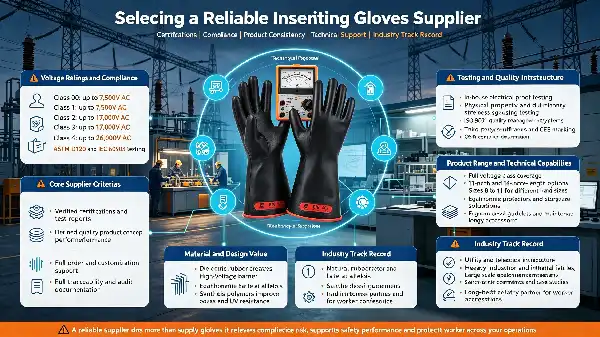
Core Criteria for Evaluating Insulating Glove Suppliers
The first step in finding a manufacturing partner is to understand the unique procurement needs of your firm. Industrial safety distributors with multiple site operations need constant product availability, competitive bulk pricing, and flexible purchase quantities for insulating gloves. Government agencies tend to choose suppliers with proven quality management systems, clear traceability procedures, and compliance with local safety requirements. OEM partners are seeking manufacturers that can customise products, private label, and co-develop specialised protective solutions for new market sectors.
Verified Certifications and Testing Infrastructure
Reliable vendors maintain recognised in-house testing facilities, capable of performing regular electrical proof testing, physical property testing, and environmental stress testing. Check for ISO 9001 quality certificates. This means they have well-controlled processes for raw material selection, manufacturing processes, and final inspection. Another level of confidence that you comply is external certification by known organisations (e.g., CE marking for European countries or OSHA compliance certifications for North American businesses). Manufacturers should be transparent and accountable in their production processes and ready to give test results, batch traceability records, and certification papers when asked.
Product Range Diversity and Technical Capabilities
Established manufacturers provide full voltage class coverage, and several length choices (11-inch and 14-inch configurations) and size ranges from 8 through 11 to fit different hand sizes. Competent vendors supply leather protection gloves, storage bags, inspection guidelines, and maintenance accessories that complete a comprehensive electrical safety program in addition to regular items. Technical support teams need to provide application-specific advice to assist procurement experts match glove specifications to the voltage exposures, ambient conditions, and task complexity of a construction site. This consultative strategy makes vendors your strategic safety partner, not just transactional vendors, who care about your worker protection results.
Reputation and Industry Track Record
A supplier’s history provides insight into previous dependability, innovation and customer satisfaction. Partners who support utilities, telecoms infrastructure firms and heavy industrial sectors have put up with market hiccups, regulatory changes and technology innovations for decades, all while maintaining constant quality standards. Customer testimonials, case studies of successful large-scale deployments, and collaborations with industry-known companies are concrete proofs of operational competence. Suppliers that are active participants in standards development committees, safety conferences, and industry groups display thought leadership and a dedication to developing electrical safety practices beyond their immediate economic interests.
If you're evaluating personal protective equipment suppliers and require batch-specific testing documents before placing an order, PPE MAX is able to provide official Certificates of Analysis, professional laboratory test reports, and product samples for your verification. Feel free to contact our team at marketing@ppemax.com to discuss your sourcing needs and obtain complete documentation for your quality assessment and procurement approval.
Comparing Insulating Glove Types and Supplier Offerings
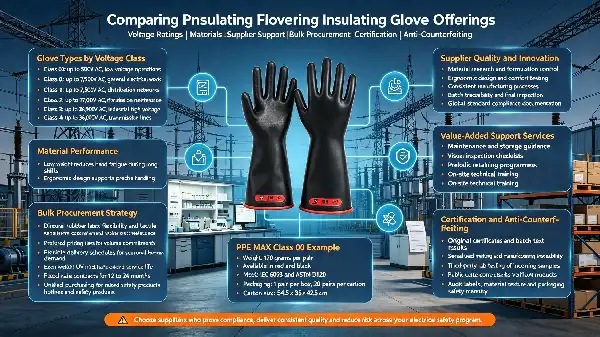
Electrical protective gloves vary widely in structure, voltage rating, and applicability for use. Class 00 models are the first class for low-voltage operations, suitable for control circuits, meter installations, and telecommunications infrastructure with maximum exposure not exceeding 500V AC. The higher categories of Class 0, 1, 2, 3, and 4 are designed for more demanding voltage situations that are encountered in distribution networks, substation maintenance, and transmission line operations. Material composition affects performance factors other than voltage rating. Natural rubber latex is good for flexibility and tactile input but needs protection from ozone and UV deterioration. Synthetic alternatives have superior chemical resistance and heat stability, making them ideal for certain industrial applications where exposure to hydrocarbons or harsh climatic conditions would be a factor.
Evaluating Supplier Product Quality and Innovation
The leading manufacturers put money into researching materials, improving ergonomic design, and optimising manufacturing processes to create gloves that provide a balance between protection and user comfort. PPE MAX Class 00 Insulating Gloves reflect these principles with a low weight of 170 grams, reducing hand fatigue when worn for long periods of time, and are available in red and black colours for customer choice and visibility. The gloves meet both IEC 60903 and ASTM D120 standards, so they are acceptable in worldwide markets and make sourcing easier for organisations that operate in several regulatory countries. Packaging: 1 pair/box, 20 pairs/carton, 54.5 x 35 x 42.5 cm (21.5 x 13.7 x 16.7 in.) Good packaging allows for inventory management and distribution logistics, as well as product integrity while in storage and transit.
Comprehensive Support Services That Enhance Value
Excellent suppliers not only supply products, but also advise on maintenance, periodic inspection training, and technical problems. Correct handling procedures, such as the storage conditions, regular visual inspections and retest intervals, directly affect the dependability of the protection and the service life of a glove. Manufacturers are equipping safety managers to develop effective glove management programs with extensive instruction manuals, inspection checklists and access to technical support hotlines. Some partners provide on-site training for electrical staff on understanding voltage categorisation systems, identifying indicators of glove deterioration, and performing proper donning procedures. These value-added services change the equation for buying choices from a cost per unit to a total cost of ownership that includes risk reduction, compliance assurance, and operational continuity.
Procurement Strategies for Buying Insulating Gloves Online and in Bulk
Strategic sourcing of electrical safety equipment is a careful balancing act between cost effectiveness and quality assurance and regulatory compliance. By dealing directly with manufacturers, you cut out the middleman markups and get access to technical knowledge, customisation capabilities and priority fulfilment when supply chains are disrupted. Regional inventory placement, better delivery times and unified purchase of related safety items help to streamline logistics for multi-category procurement projects. Advantages of online platforms are the ability to compare prices and product specifications and the possibility of purchasing at any time of the day, but they need careful vendor verification to eliminate the danger of counterfeits.
Negotiating Favorable Terms for Bulk Purchases
Volume commitments provide you access to preferred price tiers, longer payment periods, and specialised account management that simplifies re-ordering and speeds up problem resolution. Set minimum purchase quantities according to your consumption patterns: quarterly safety equipment renewals, yearly budget cycles, or project-based deployments. Negotiate flexible delivery dates that suit seasonal demand swings and warehouse capacity restrictions without premium freight expenses. Talk about price stability methods like fixed-rate contracts for 12 to 24 months to mitigate against raw material cost volatility and currency exchange variations that affect international transactions. Set warranty scope, defect replacement processes, and return policies in advance to avoid disagreements and guarantee fast resolution of quality problems.
Certification Verification and Counterfeit Prevention
Counterfeiting of electrical safety items may have devastating consequences, including worker injuries, regulatory fines, and reputational harm. Establish verification methods which require the suppliers to give original certification certificates, test results for each batch and serialised marking on products which can be traced back to the date of manufacture and quality control records. Consult publicly accessible certification databases of standards organisations and testing facilities to compare supplier claims. Conduct regular product authenticity audits, which include visual checks for correct labelling, tactile evaluations of material quality, and third-party lab testing of sample units from incoming shipments. Working with reputable manufacturers with a multi-decade business history greatly decreases the susceptibility to counterfeits vs buying via unknown middlemen or unvetted e-commerce merchants.
Best Practices for Long-Term Supplier Relationships and Risk Mitigation
Sustainable procurement agreements are based on clear communication, shared expectations, and a common commitment to ongoing improvement for insulating gloves. Clearly establish quality standards by developing thorough product specifications, acceptable quality levels (AQLs), and inspection criteria that clearly state performance objectives. Establish key performance indicators (KPIs) to measure on-time delivery rates, order correctness, defect incidence, and reaction to technical questions. Establish regular business reviews (quarterly or bi-annually) to evaluate supplier performance, analyse market trends, and work on developing difficulties before they become serious.
Proactive Risk Management Strategies
You may also diversify your supplier base geographically and between production sites to reduce concentration risk and ensure continuity if a particular facility is disrupted by a natural catastrophe, labour conflict, or regulatory closure. Keep safety stocks of a strategic nature equal to 60 to 90 days of normal consumption, to protect against variations in lead time and unexpected surges in demand. Monitor the financial health of your suppliers using credit checks and industry news, watching out for any red flags that might signify possible problems with their capacity to meet your needs. Establish robust legal agreements outlining quality standards, intellectual property rights, liability limits, and dispute resolution methods. These agreements provide accountability mechanisms that safeguard the interests of both parties and promote collaborative problem resolution when issues emerge.
Adapting to Evolving Safety Standards and Technologies
Regulatory environments are always changing, bringing more testing needs, more danger categories, and more documentation requirements. Work with suppliers who actively track standards development, engage in industry working groups, and proactively convey any future changes to product specifications or certification needs. By being proactive, you may plan for critical equipment updates, arrange worker retraining, and ensure ongoing compliance in all operating jurisdictions. Investing in product innovation (lighter materials, improved tactile sensitivity, antimicrobial treatments) creates opportunities to improve worker comfort, increase compliance rates, and differentiate your safety program as a competitive advantage for recruiting and retaining talent.
Conclusion
For a dependable provider of voltage-rated electrical protection equipment, you should check their certification validation, production capacity, product spectrum, and long-term cooperation possibilities. Globally, established manufacturers like PPE MAX, servicing markets since 1956, offer stringent quality standards with complete technical assistance and flexible sourcing to meet the needs of industrial safety suppliers, utilities, and government agencies. When you choose providers who can show confirmed adherence to ASTM and IEC standards, clear testing paperwork, and an established history within your sector, you can be certain your workforce is protected, consistently and dependably. By using strategic procurement strategies, such as negotiating bulk purchases, verifying certifications, and proactively managing risks, supplier relationships may be transformed into long-term partnerships that protect operational continuity and worker well-being in a changing regulatory environment.
FAQ
1. What voltage rating do I need for my electrical work environment?
Voltage classification selection depends on the maximum system voltage your workers encounter during energized operations. Class 00 gloves rated for 500V AC suit low-voltage control work, telecommunications installations, and residential electrical service. Class 0 (1,000V AC) and Class 1 (7,500V AC) address distribution network maintenance. Higher classes protect against substation and transmission line voltages. Always select gloves rated above your maximum exposure level, accounting for transient overvoltages and providing a safety margin. Consult with safety engineers or qualified suppliers to match glove specifications precisely to job site hazards and regulatory requirements.
2. How often should insulating gloves undergo electrical testing?
ASTM F496 and OSHA 1910.137 standards mandate routine electrical retesting at intervals determined by voltage class and usage conditions. Class 00 and Class 0 gloves require testing every six months when in service. Higher voltage classes extend to 12-month intervals under normal conditions. Gloves exposed to suspected damage, showing visible deterioration, or involved in electrical incidents require immediate testing before returning to service. Maintain detailed testing records documenting test dates, equipment serial numbers, and pass/fail results to demonstrate compliance during safety audits and regulatory inspections.
Partner with PPE MAX for Reliable Insulating Glove Supply
PPE MAX has manufactured certified electrical safety equipment since 1956, serving utilities, industrial facilities, and safety distributors across 134 countries. Our Class 00 Insulating Gloves meet rigorous ASTM D120 and IEC 60903 standards, delivering proven protection for low-voltage applications with superior dexterity and comfort. We offer competitive bulk pricing, customization options, and comprehensive technical support to simplify your procurement process. Contact marketing@ppemax.com today to discuss your specific requirements with our team and discover why leading organizations trust PPE MAX as their insulating gloves supplier for mission-critical safety solutions.
References
1. American Society for Testing and Materials. (2022). ASTM D120-20: Standard Specification for Rubber Insulating Gloves. West Conshohocken: ASTM International.
2. International Electrotechnical Commission. (2023). IEC 60903:2023 Live Working – Gloves of Insulating Material. Geneva: IEC Publications.
3. Occupational Safety and Health Administration. (2021). 29 CFR 1910.137: Electrical Protective Equipment Standards. Washington: U.S. Department of Labor.
4. National Fire Protection Association. (2023). NFPA 70E: Standard for Electrical Safety in the Workplace. Quincy: NFPA Publications.
5. Institute of Electrical and Electronics Engineers. (2022). IEEE 1584: Guide for Performing Arc-Flash Hazard Calculations. Piscataway: IEEE Standards Association.
6. Canadian Standards Association. (2023). CSA Z462: Workplace Electrical Safety Standard. Toronto: CSA Group Publications.
Learn about our latest products and discounts through SMS or email