- English
- French
- German
- Portuguese
- Spanish
- Russian
- Japanese
- Korean
- Arabic
- Greek
- German
- Turkish
- Italian
- Danish
- Romanian
- Indonesian
- Czech
- Afrikaans
- Swedish
- Polish
- Basque
- Catalan
- Esperanto
- Hindi
- Lao
- Albanian
- Amharic
- Armenian
- Azerbaijani
- Belarusian
- Bengali
- Bosnian
- Bulgarian
- Cebuano
- Chichewa
- Corsican
- Croatian
- Dutch
- Estonian
- Filipino
- Finnish
- Frisian
- Galician
- Georgian
- Gujarati
- Haitian
- Hausa
- Hawaiian
- Hebrew
- Hmong
- Hungarian
- Icelandic
- Igbo
- Javanese
- Kannada
- Kazakh
- Khmer
- Kurdish
- Kyrgyz
- Latin
- Latvian
- Lithuanian
- Luxembou..
- Macedonian
- Malagasy
- Malay
- Malayalam
- Maltese
- Maori
- Marathi
- Mongolian
- Burmese
- Nepali
- Norwegian
- Pashto
- Persian
- Punjabi
- Serbian
- Sesotho
- Sinhala
- Slovak
- Slovenian
- Somali
- Samoan
- Scots Gaelic
- Shona
- Sindhi
- Sundanese
- Swahili
- Tajik
- Tamil
- Telugu
- Thai
- Ukrainian
- Urdu
- Uzbek
- Vietnamese
- Welsh
- Xhosa
- Yiddish
- Yoruba
- Zulu
What Industries Commonly Use Class 1 Insulating Gloves?
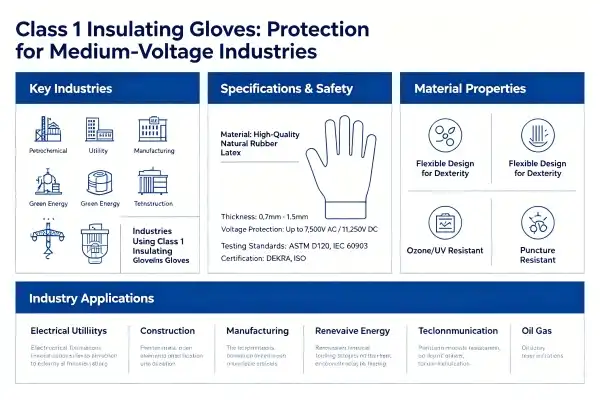
Class 1 Insulating Gloves are very important for protecting workers in industries that use medium-voltage electrical equipment. Electrical professionals in the petrochemical, building, utilities, manufacturing, green energy, telecommunications, and construction industries can protect their hands with these special gloves from dangers up to 7,500 volts AC. When procurement teams, safety managers, and electrical technicians know what industries use this important PPE the most, they can make decisions that balance operational needs with strict safety compliance. This keeps workers who handle powered equipment safe in a wide range of industrial settings.
Overview of Class 1 Insulating Gloves and Their Specifications
What Defines Voltage-Rated Electrical Gloves
If you want to avoid getting an electric shock, Class 1 Insulating Gloves are very important. They protect you from voltages up to 7,500 volts AC and 11,250 volts DC. These safety hurdles are proof-tested at 10,000 volts AC and must be able to handle 20,000 volts AC during the licensing process. These gloves are mostly made of high-quality natural rubber latex. They have the right amount of dielectric strength and physical awareness for precise electrical work. The thickness of the material is usually between 0.7mm and 1.5mm, which is thick enough to protect without limiting the flexibility needed for complicated tasks.
Standards Compliance and Certification Requirements
Every step of making and testing insulated gloves is governed by international electrical standards. As a result of ASTM D120 and IEC 60903, producers must meet strict standards in order to get their products certified as safe. At PPE MAX, our Class 1 gloves are put through a lot of tests, such as dielectric tests and physical checks, to make sure they are reliable in the field. During the whole production process, certification groups like DEKRA and ISO check for quality and compliance. The unique white sticker color-coding on Class 1 gloves makes voltage ratings instantly visible. This keeps workers from making mistakes that could be fatal when they choose the right safety gear for the job. Before leaving our plant, each glove has to pass its own electrical test. This makes sure that all production batches provide the same level of safety.
Material Properties That Ensure Protection
Natural rubber latex is better at being flexible and gripping, which are both important for electrical work. Our flexible design makes it easier to use and more comfortable to wear for long amounts of time. The makeup of the material doesn't break down when exposed to ozone or UV light, so it can be used for longer in harsh weather conditions. The design is resistant to punctures and can handle standard mechanical stress while still keeping the dielectric integrity. These material benefits directly lead to better working conditions and less replacement frequency for procurement teams that run large-scale operations.
Industries That Commonly Use Class 1 Insulating Gloves
Electrical Utilities and Power Distribution
Every day, workers in electrical services are exposed to medium-voltage dangers while maintaining the grid and working on live lines. When building transformers, fixing overhead lines, or using hot sticks on live wires, people who work on distribution lines need gloves that can handle high voltage. When checking switchgear, keeping circuit breakers, or making changes to relays, substation workers need reliable hand protection. Power companies make sure that OSHA 1910.137 rules are strictly followed. This means that approved Class 1 Insulating Gloves have to be a part of all personal safety equipment programs. The governing system makes sure that utility workers are always safe, no matter where they are or what they are doing.
Construction and Infrastructure Development
When electricians work on building sites, they have to deal with a wide range of power situations that need the right insulation levels. Panel work, pipe testing, and system setup are all parts of building electrical installations that put people at risk of medium-voltage exposure. Highways, bridges, and public buildings are all examples of infrastructure projects that use electrical systems that need to be installed and troubleshot with the right safety gear. Electrical workers and general builders buy insulating gloves in large quantities to outfit whole teams working on multiple projects at the same time. Construction sites have special problems, like being exposed to weather, physical trash, and limited room, that require long-lasting, dependable safety gear.
Manufacturing and Industrial Facilities
The electrical systems that run heavy equipment, conveyor systems, and automatic production lines are taken care of by plant repair teams. Maintenance on the control panel, fixing problems with the motor, and repairing the programmable logic controller are all things that can cause shocks in the Class 1 voltage range. Gloves that protect while still letting you feel things are needed in manufacturing settings where small parts and diagnostic tools are used. Costs of production downtime put pressure on electrical repairs to be done quickly. To be efficient without lowering safety standards, gloves that are soft and flexible are needed. To make sure that everyone in the building follows the same safety rules, industrial safety managers like to buy from sellers whose quality stays the same over big orders.
Renewable Energy Operations
Technicians who work on wind turbines have to work at high levels to fix electrical problems in the nacelles and towers. During system assembly and testing, solar installation teams connect inverters, combiner boxes, and lines of panels that carry medium voltages. Operators of hydroelectric facilities have to take care of engine controls and distribution equipment in places that are wet and have electrical dangers. The green energy industry is growing quickly, which means that more approved electrical protective equipment is needed. For these specific tasks, you need gloves that are resistant to both electrical current and harsh weather conditions, like those found outside and in high temperatures.
Telecommunications and Data Infrastructure
When telecommunications techs work near power lines or in buildings with backup power systems, they face electrical dangers. For repairs on cell towers, you have to work close to electrical equipment that powers temperature control units and transmission systems. The operations staff in a data center are in charge of the electrical systems that power the servers and other vital equipment. Even short power outages can cost a lot of money. There are strict safety rules in the telecoms business because of the risks of electrical shock and falling from high places of work.
Oil, Gas, and Petrochemical Industries
Maintenance workers at refineries work on electrical systems in secret areas that are dangerous because of the risk of arc flashes and flammable atmospheres. Electricians who work on offshore platforms are often trapped in small areas with few ways to get help in an emergency. Having reliable safety gear can actually save their lives. Pipeline tracking stations and compressor facilities need regular electrical repairs, but they are far from hospitals and other medical facilities. In these fields, thorough safety programs are used, and good electrical safety gear is only one part of many layers of strategies used to lower risks. The providers that consistently meet international safety standards and provide reliable global shipping support are given top priority by procurement teams.
Comparison and Selection Criteria for Class 1 Insulating Gloves
Understanding Voltage Class Distinctions
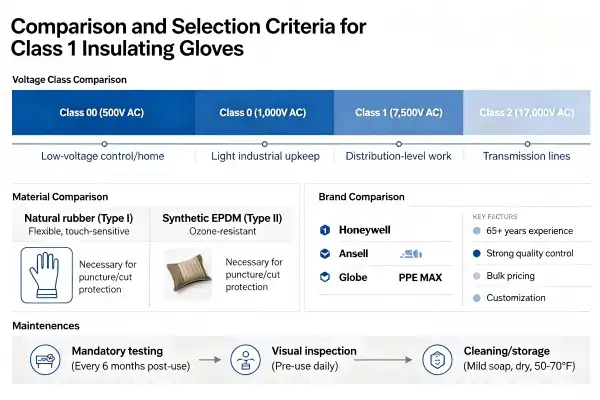
To pick the right insulated gloves, you need to know the differences between Class 00, Class 0, Class 1 Insulating Gloves, and Class 2 gloves based on their highest use voltages. Class 00 gloves are good for low-voltage control systems and home use because they protect against 500 volts AC. Class 0 gloves that can handle up to 1,000 volts AC are good for light upkeep work in businesses and factories. Class 1 gloves protect against medium voltages up to 7,500 volts AC, giving you the freedom to move while still giving you security for work at the distribution level. Class 2 gloves with a rating of 17,000 volts AC are used in higher voltage transmission lines, but they are thicker and less flexible than Class 1 gloves. Matching glove classification to real working voltages stops both not protecting enough and costing too much or not working as well as it should because of too much specification.
Material Variations and Leather Protector Importance
Natural rubber Type I latex is the most flexible and sensitive to touch in controlled settings where it is not exposed to ozone. When used outside or in a variety of storage situations, synthetic EPDM Type II materials are better at resisting ozone. When properly kept and tested, both types of material offer the same level of electrical safety. It turns out that leather guards are necessary rather than extra because they protect against punctures, cuts, and abrasions that instantly damage dielectric properties. For all electrical jobs, workers must wear rubber insulating gloves with leather covers that are the right size. The two-part system makes sure that touching sharp edges or tools by mistake doesn't make a way for electricity to flow through broken insulation.
Brand Comparison and Procurement Factors
Honeywell, Ansell, Globe, and PPE MAX are just a few of the top makers that offer unique benefits that can help with procurement choices. PPE MAX stands out because it has been making things for over 65 years, has strong quality control systems, and offers reasonable bulk prices. Because we can customize, we can offer private labels and make changes to specifications to meet the specific needs of each operation. Beyond base product pricing, sellers are distinguished by their certification documents, warranty terms, and expert help after the sale. Professionals in procurement look at the total cost of ownership, which includes how often something needs to be replaced, how easily it can be tested, and how quickly it can be restocked in an emergency. Checking the trustworthiness of suppliers through facility audits and calling past customers keeps fake or low-quality goods from getting into safety equipment stores.
How to Maintain, Test, and Ensure the Longevity of Class 1 Insulating Gloves
Mandatory Testing Intervals and Procedures
Electrical testing must be done on Class 1 Insulating Gloves every six months after they are put to use, according to OSHA 1910.137 and ASTM F496 guidelines. Stock that hasn't been used and is kept correctly can stay on shelves for twelve months before the initial testing requirements start to kick in. In dielectric testing, gloves are inflated, and high voltage is applied while current loss is looked for to show that the insulation has broken down. To get accurate results, testing centers must keep their tools calibrated and their staff trained. If gloves fail electrical tests, they must be taken out of service and thrown away right away to keep others from using them by chance. Systems that keep track of each glove's serial number, testing dates, and service history make it possible to check for compliance and help with guarantee claims.
Daily Visual Inspection Protocols
For both rubber gloves and leather protectors, workers must do full eye checks before each use. As part of the inspection process, holes, tears, strange objects lodged inside, and signs of chemical pollution are looked for. Ozone cracking shows up as small surface cracks that mean the material is breaking down and needs to be replaced right away. If there is swelling, stiffness, or stickiness, it means that chemicals have been exposed and are affecting the insulator. Blowing up gloves and hearing for air leaks means there are holes; air testing provides extra proof. Leather protectors need to be checked for damage that makes mechanical security less effective, like too much wear or broken stitching. These daily checks catch any damage that happens between official electrical testing sessions, making sure that safety is always maintained.
Proper Cleaning and Storage Practices
To clean, use light soap and water. Do not use solvents based on gasoline or harsh chemicals that break down rubber materials. To keep germs from growing and materials from breaking down, gloves must be completely dry before being stored. Temperatures in storage areas should stay stable between 50°F and 70°F. Extreme heat or cold should not happen. Direct sunlight speeds up UV degradation, so things need to be stored in dark places or in safe cases. Electric motors, welding tools, and some light bulbs are examples of ozone sources that need to be kept away from places where gloves are stored. When rubber gloves are stored inside leather protectors, they can get creases and stress spots. For long-term storage, it is better to store them separately. Canvas glove bags make it easy to keep provided gloves safe and airy between shifts, and they also keep the gloves from getting damaged while being transported.
Procurement Insights: Buying Class 1 Insulating Gloves for Large-Scale Operations
Supplier Verification and Certification Validation
When buying Class 1 Insulating Gloves in bulk, suppliers must be carefully checked out to make sure the products are real and the quality is always the same. The first step in verification is to check the manufacturer's credentials, such as ISO 9001 quality management systems and accreditations for product-specific testing laboratories. Ask for full scientific information, such as material specs, testing procedures, and approvals from certification bodies. Physical building audits show how the manufacturing capabilities, quality control methods, and inventory management systems affect the dependability of delivery. At PPE MAX, we encourage customers to visit our cutting-edge factories in Xi'an, China. This shows that we are open about how we make our products. Third-party testing of received inventory samples confirms that shipped goods match specs and certification claims. This keeps fake equipment from getting into safety programs.
Global Logistics and Bulk Purchasing Strategies
International purchasing adds complications like wait times, customs processes, and figuring out the best way to save money on freight costs. When you buy by the container load, you save a lot of money per unit, but you need space for storage and tools to keep track of your goods. Setting up vendor-managed inventory systems gives sellers control over storage while making sure that products are always available. When you need to replace quickly, having multiple regional distribution points cuts down on shipping costs and delivery times. Our global supply chain network, which includes 134 countries, helps buying projects that are run from one place with local support. Understanding the licensing needs of each country keeps shipments from being turned down at customs stops, which can be very expensive. By negotiating framework deals with volume promises, you can get better prices and still be flexible when demand changes across various facilities.
Total Cost Analysis and Value Optimization
The purchase price is only one part of figuring out the total cost of owning. Long-term costs are affected by how often something needs to be replaced based on how long it lasts and how well it is maintained. The availability of testing services affects business costs by deciding whether to build internal testing programs or hire a third-party testing service. Warranty terms and repair policies protect against products that break down too soon or are poorly made. Implementing new tools across a staff costs less when there is training help and technical documentation.
Conclusion
When procurement workers know which businesses use Class 1 Insulating Gloves, they can find the right safety gear to meet specific operational needs. Electrical utilities, building companies, factories, green energy operations, phone companies, and the petrochemical industry all need medium-voltage hand protection to keep their workers safe. To make the right choice, you need to look at voltage levels, material qualities, certification compliance, and the supplier's skills. Maintenance rules, such as required testing intervals, daily checks, and the right way to store products, keep their defensive integrity over their entire lives. Verifying suppliers, managing global shipping, and doing a total cost analysis that balances price concerns with quality and service needs are all important for large-scale buying to go well. Since 1956, our only goal has been to make reliable electrical safety equipment. Every product that bears the PPE MAX name comes with decades of experience.
FAQ
What voltage levels are Class 1 insulating gloves certified to protect against?
Up to a maximum use voltage of 7,500 volts AC and 11,250 volts DC, Class 1 Insulating Gloves protect you. To meet ASTM D120 and IEC 60903 standards, they are proof-tested at 10,000 volts AC and must be able to handle 20,000 volts AC during approval. The clear white sticker shows the voltage grade right away so you can make the right choice.
How often must electrical testing occur for Class 1 gloves?
Once gloves are in use, they have to be electrically tested every six months. If you keep unused items properly, they can stay unused for twelve months before they are used for the first time. Leather covers don't need to be tested electrically, but they do need to be looked at every day before each use.
Can Class 1 gloves be used without leather protectors?
Without a doubt, not. Rubber insulation gloves can get punctures and cuts, which are mechanical damage that quickly loses their electrical protection. Abrasion resistance is an important feature of leather shields, which are required safety equipment for electrical work and not just extras.
What determines selection between Type I and Type II rubber materials?
If you need to use gloves outside or store them in a variety of conditions, choose Type II EPDM rubber because it doesn't crack when exposed to ozone. Choose Type I natural rubber latex when you need the most flexibility and ability and when you don't need to worry about ozone exposure because you are inside.
Partner with PPE MAX for Certified Electrical Protection Solutions
These Class 1 Insulating Gloves are the result of over 65 years of making the best products possible. PPE MAX is a reliable maker and supplier that does business in 134 countries. They offer the best electrical safety through strict quality control, low bulk prices, and full technical support. Our gloves are compliant with ASTM D120, IEC 60903, and OSHA standards. They also have the CE marking for European markets, which makes sure that all of your activities are legal around the world. Whether you're in charge of safety programs for utilities, construction fleets, factories, or green energy installations, our team can help you find solutions that meet your exact voltage security needs. Email us at marketing@ppemax.com to talk about your purchasing needs, get full technical specs, or set up a visit to our facility. Everything we do is based on our desire to keep workers safe, since we test and believe in our own gear. Feel the difference that decades of experience and a real commitment to safety make.
References
1. American Society for Testing and Materials. (2021). ASTM D120-20 Standard Specification for Rubber Insulating Gloves. West Conshohocken: ASTM International.
2. International Electrotechnical Commission. (2020). IEC 60903:2019 Live Working - Electrical Insulating Gloves. Geneva: IEC Central Office.
3. Occupational Safety and Health Administration. (2019). 29 CFR 1910.137 Electrical Protective Devices. Washington: U.S. Department of Labor.
4. National Fire Protection Association. (2021). NFPA 70E Standard for Electrical Safety in the Workplace. Quincy: NFPA Publications.
5. Cadick, J., Capelli-Schellpfeffer, M., & Neitzel, D. (2019). Electrical Safety Handbook (4th ed.). New York: McGraw-Hill Education.
6. Jones, R. A., & Smith, G. H. (2020). Personal Protective Equipment for Electrical Workers: Selection, Testing, and Maintenance Protocols. Journal of Occupational Safety Engineering, 45(3), 112-128.
Learn about our latest products and discounts through SMS or email