- English
- French
- German
- Portuguese
- Spanish
- Russian
- Japanese
- Korean
- Arabic
- Greek
- German
- Turkish
- Italian
- Danish
- Romanian
- Indonesian
- Czech
- Afrikaans
- Swedish
- Polish
- Basque
- Catalan
- Esperanto
- Hindi
- Lao
- Albanian
- Amharic
- Armenian
- Azerbaijani
- Belarusian
- Bengali
- Bosnian
- Bulgarian
- Cebuano
- Chichewa
- Corsican
- Croatian
- Dutch
- Estonian
- Filipino
- Finnish
- Frisian
- Galician
- Georgian
- Gujarati
- Haitian
- Hausa
- Hawaiian
- Hebrew
- Hmong
- Hungarian
- Icelandic
- Igbo
- Javanese
- Kannada
- Kazakh
- Khmer
- Kurdish
- Kyrgyz
- Latin
- Latvian
- Lithuanian
- Luxembou..
- Macedonian
- Malagasy
- Malay
- Malayalam
- Maltese
- Maori
- Marathi
- Mongolian
- Burmese
- Nepali
- Norwegian
- Pashto
- Persian
- Punjabi
- Serbian
- Sesotho
- Sinhala
- Slovak
- Slovenian
- Somali
- Samoan
- Scots Gaelic
- Shona
- Sindhi
- Sundanese
- Swahili
- Tajik
- Tamil
- Telugu
- Thai
- Ukrainian
- Urdu
- Uzbek
- Vietnamese
- Welsh
- Xhosa
- Yiddish
- Yoruba
- Zulu
Are Insulating Gloves Required for Live Electrical Work?
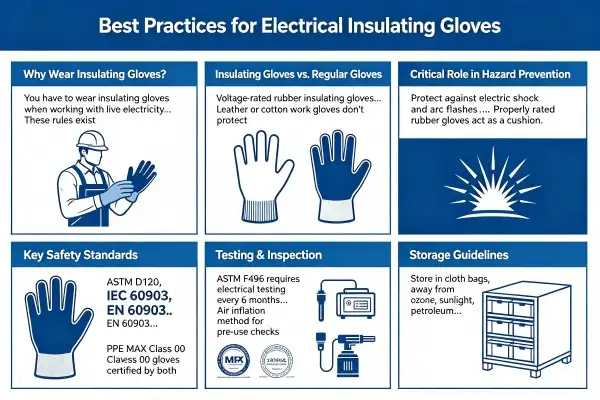
You have to wear insulating gloves when working with live electricity. When electrical workers are working on live lines, these special gloves are the only thing that keeps them from getting a fatal shock. NFPA 70E and OSHA 29 CFR 1910.137 say that electrical insulating gloves must be worn whenever there is a chance that the hands or arms could come into touch with live wires or circuit parts. Electrical injuries cause thousands of accidents at work every year, and many of them could have been avoided with the right safety gear. That's why these rules exist.
Understanding Insulating Gloves and Their Necessity for Live Electrical Work
There is one important piece of safety gear that always comes up when we talk about protecting electricity workers: voltage-rated rubber insulating gloves. These job gloves aren't like most. They are carefully made shields that are meant to keep electric current from reaching people while activities are being powered up.
What Makes Electrical Insulating Gloves Different
The main difference is in the materials used and how they are built. Electrical insulating gloves are made from vulcanized natural rubber latex or manmade elastomers that are very good at conducting electricity. These materials go through a special curing process that aligns the chemical structures to stop the flow of electrons, making an electrical wall that can't be broken through. Leather or cotton work gloves for mechanics don't protect against electricity at all, but voltage-rated gloves are put through a lot of tests to make sure they can.
We've been making these life-saving items at PPE MAX since 1956, and our testing standards are stricter than the industry standard. Every pair of gloves we make goes through proof testing, which involves applying voltage that is many times higher than the listed capacity to make sure there are no weak spots in the insulation.
The Critical Role in Hazard Prevention
These gloves protect against more than just electric shock. Another danger is arc flashes, which can release temperatures of more than 35,000°F, which is hotter than the sun's surface. When an arc fault happens, workers need all the safety measures that can be found. Properly rated rubber gloves act as that important cushion, stopping the flow of electricity through the body and lowering the intensity of burns.
The comfortable shape of current electrical safety gloves has changed a lot. Now, workers can do difficult jobs like installing meters, cutting wires, and checking circuits without losing the ability to feel things. Professional-grade gear is different from cheap imitations because it strikes the right balance between safety and maneuverability.
Key Safety Standards and Testing Protocols for Insulating Gloves
Compliance is more than just checking off boxes; it means making sure that every pair of gloves will work when lives are at stake. Manufacturers and users must follow the rules set by international norms.
Global Certification Requirements
Three main rules control how electrical insulating gloves are made and used all over the world. In North America, ASTM D120 sets the standards, IEC 60903 sets the rules for the whole world, and EN 60903 covers all of Europe. These guidelines spell out types of voltage, material requirements, testing frequencies, and factors for physical performance.
At PPE MAX, our Class 00 insulating gloves are certified by both IEC 60903 and ASTM D120. This means they can be used in several different legal settings. This dual certification is very important for international companies and wholesalers that are in charge of making sure safety rules are followed in many different countries. Buyers can choose one line of products, understanding that it meets the needs of different jurisdictions.
Mandatory Testing and Inspection Procedures
ASTM F496 rules say that gloves must be tested for electricity every six months after they are put to use. As part of this test, gloves are submerged in water and a proof test voltage (2,500V AC for Class 00 gloves) is applied while current loss is watched for signs of insulation failure.
Before each use, workers should do eye checks in between electricity tests. We suggest the air inflation method: blow up the glove, then roll down the cuff to catch the air. Finally, listen and feel for air escape, which could mean the glove is worn down or has holes in it. Any cracks that can be seen, alien items that are lodged, or changes in the texture should be taken out of service right away.
How gloves are stored has a direct effect on how long they last. Rubber breaks down faster when it is exposed to ozone, solar rays, petroleum products, or high or low temperatures. Gloves should be kept flat or slightly bent in cloth bags that let air flow, out of direct sunlight, and away from electrical devices that make ozone.
Types of Insulating Gloves and Their Appropriate Use Cases
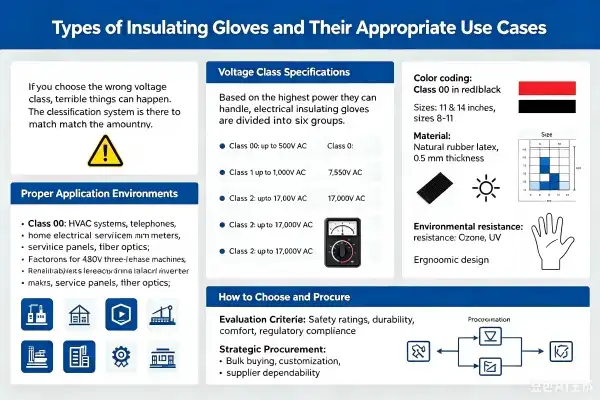
If you choose the wrong voltage class, terrible things can happen. The classification system is there to match the amount of safety with the risk of being exposed to electricity.
Voltage Class Specifications
Based on the highest power they can handle, electrical insulating gloves are divided into six groups. Class 00 can handle up to 500V AC, Class 0 can handle up to 1,000V AC, Class 1 can handle up to 7,500V AC, Class 2 can handle up to 17,000V AC, Class 3 can handle up to 26,500V AC, and Class 4 can handle up to 36,000V AC. For safety reasons, each class is proof-tested at voltages that are much higher than their stated ability.
Our Class 00 insulating gloves are the most basic level of electrical safety. They are perfect for low-voltage tasks that are common in HVAC systems, telephones, and home electrical service. They offer guaranteed safety for work on branch circuits, lighting systems, and low-voltage distribution equipment with an AC maximum use voltage of 500V and an AC proof test value of 2,500V.
Proper Application Environments
Careful voltage assessment is needed to match the right glove class to the job needs. Class 00 gloves are used by utilities and telecom companies to put in meters, work on service panels, and set up fiber optics in places where electrical lines and communication systems meet. In factories, they are used for repair work on 480V three-phase machines. Technicians who work with renewable energy use Class 00 safety when they work on solar setups' inverter links and battery management systems.
Color coding makes it easy to see right away what the voltage level is. Our Class 00 gloves come in both red and black, which makes them stand out from gloves for higher voltage classes. This quick identification keeps dangerous mix-ups from happening on job sites where more than one type of glove may be present.
The electrical grades are important, but the actual sizes are even more so. We make these gloves in two lengths—11 and 14 inches—so that they can fit a wide range of arm sizes. Longer cuffs keep you from touching live wires or panels by mistake when you're working near them or reaching into them. Sizes 8 through 11 make sure that gloves fit everyone in the workforce properly. Gloves that don't fit right are dangerous and poor at their job.
Material Composition and Environmental Resistance
Because it is more flexible and has higher insulating strength, natural rubber latex is the best material for most uses. Class 00 gloves have an average thickness of 0.5 mm, which is thick enough to keep your hands warm while still letting you feel things clearly enough for precise work. This is important when techs have to use their hands to find out the length of a wire or turn small terminal screws.
Our gloves are resistant to ozone damage and UV rays, which means they will last longer when used outside. The ergonomic design makes it easier on the hands to wear for long amounts of time, which is something that is often ignored but greatly valued by workers who wear gloves for many hours every day.
It is required, not a choice, to wear electrical insulating gloves with leather protector gloves. The rubber keeps the electricity from flowing, and the leather protects against cuts, abrasions, and holes that could damage the insulator. For all voltage classes, this two-layer method is the best way to do things in the business.
How to Choose and Procure the Best Insulating Gloves for Your Business Needs
Procurement decisions involve more than just technical details. They also involve practical and financial factors that have an effect on the long-term success of the program.
Evaluation Criteria for B2B Buyers
Safety managers and buying workers should look at a lot of things at the same time. Electrical safety scores must match the voltage exposure that was recorded in job hazard analyses. Durability affects how often something needs to be replaced and how much it costs to own overall. High-quality materials and lower failure rates make testing times longer.
Comfort and skill affect how well workers do their jobs. Insulating gloves that make your hands too tired or stop you from finishing a job are taken off, so they no longer cover you. We've seen this happen over and over again: the safest glove is the one that workers wear all the time.
Verification of regulatory compliance needs proof. Ask for certification test results, production quality system certificates, and information about the materials used. Reputable manufacturers easily give out this information; manufacturers who don't want to share it should raise issues.
Strategic Procurement Approaches
When you buy in bulk, you save a lot of money. This is especially true for big building projects, utility fleets, or factories with lots of electrical repair staff. This is how our packaging is set up: one pair per box, twenty pairs per carton, and each carton is 54.5 x 35 x 42.5 cm and weighs 6.5 kg. These standards make it easier to plan processes and store things efficiently.
Some customization options are private labeling for wholesalers who want to make their own safety brands, different color choices for internal inventory management systems, and changes to the packaging to fit different routes of distribution. We've helped partners in 134 countries make goods fit the needs of their local markets while still meeting basic safety standards.
Supplier dependability includes the ability to produce, consistent quality, and quick contact. Decades of experience show that systems are stable and the supply chain is well-established. That's because we've been around since 1956, through economic downturns and changes in standards, and we've always put money into improving factory technology.
Conclusion
Electrical insulating gloves are a must-have safety item for anyone who works near live electrical lines. It's not just legal compliance that's needed; it's basic risk management based on avoiding accidents that happen in milliseconds but have effects that last a lifetime. Choosing the right voltage-rated gloves, keeping them in good shape through strict testing procedures, and matching them with leather protectors that work with them forms a defense system that has saved many lives in many industries. We've seen how getting the right PPE can change safety attitudes, lowering the number of accidents and boosting worker trust. When you buy qualified, properly described electrical insulating gloves, you get back more than just money: you get people back home safely to their families.
FAQ
How often must electrical insulating gloves be tested?
According to OSHA and ASTM F496 standards, gloves need to be tested for electricity every six months after they are put to use. Gloves that haven't been worn and are still in their original packaging can last up to twelve months before they are tested for the first time, but the six-month cycle starts as soon as they are given to workers. Before each use, they should be looked at visually to see if there is any harm, particles stuck in them, or changes in the texture that show it is breaking down.
Can Class 00 gloves be used for voltages above 500V AC?
Without a doubt, not. The strict safety limit of 500V AC is the highest voltage that can be used. When you use Class 00 gloves on higher volts, the insulation will break under too much electrical stress, putting your life in instant danger. There are different voltage classes that fit the amount of exposure to the danger. For example, working on 480V three-phase systems with measured line-to-line voltages of 480V is within Class 00, but any system over 500V needs Class 0 or higher protection.
Partner with PPE MAX for Certified Electrical Safety Solutions
Purchasing managers looking for dependable providers of insulating gloves can rely on our 60 years of experience and ability to reach customers all over the world. PPE MAX sells Class 00 insulating gloves that meet IEC 60903 and ASTM D120 standards. These gloves can be bought in bulk at reasonable prices that are meant for big projects. Our ability to customize helps OEM partnerships and private label programs, and we offer full technical support and quick response times to questions. Email our team at marketing@ppemax.com to talk about your unique voltage protection needs, ask for proof of certification, or look into group prices for your next purchase. We test our own goods, and that dedication to quality has kept workers safe in 134 countries since 1956.
References
1. Occupational Safety and Health Administration. (2021). "Electrical Protective Equipment: 29 CFR 1910.137." U.S. Department of Labor Standards and Regulations.
2. ASTM International. (2019). "ASTM D120-19: Standard Specification for Rubber Insulating Gloves." ASTM Technical Standards for Electrical Protective Equipment.
3. International Electrotechnical Commission. (2018). "IEC 60903: Live Working – Gloves of Insulating Material." International Safety Standards for Electrical Work.
4. National Fire Protection Association. (2021). "NFPA 70E: Standard for Electrical Safety in the Workplace." Consensus Standards for Arc Flash Protection.
5. IEEE Industry Applications Society. (2020). "Electrical Safety in Industrial Environments: Testing and Maintenance of Protective Equipment." IEEE Standards and Guidelines Journal.
6. American Society of Safety Professionals. (2022). "Best Practices for Electrical PPE Program Management in High-Risk Industries." Occupational Safety Research Publications.
Learn about our latest products and discounts through SMS or email