- English
- French
- German
- Portuguese
- Spanish
- Russian
- Japanese
- Korean
- Arabic
- Greek
- German
- Turkish
- Italian
- Danish
- Romanian
- Indonesian
- Czech
- Afrikaans
- Swedish
- Polish
- Basque
- Catalan
- Esperanto
- Hindi
- Lao
- Albanian
- Amharic
- Armenian
- Azerbaijani
- Belarusian
- Bengali
- Bosnian
- Bulgarian
- Cebuano
- Chichewa
- Corsican
- Croatian
- Dutch
- Estonian
- Filipino
- Finnish
- Frisian
- Galician
- Georgian
- Gujarati
- Haitian
- Hausa
- Hawaiian
- Hebrew
- Hmong
- Hungarian
- Icelandic
- Igbo
- Javanese
- Kannada
- Kazakh
- Khmer
- Kurdish
- Kyrgyz
- Latin
- Latvian
- Lithuanian
- Luxembou..
- Macedonian
- Malagasy
- Malay
- Malayalam
- Maltese
- Maori
- Marathi
- Mongolian
- Burmese
- Nepali
- Norwegian
- Pashto
- Persian
- Punjabi
- Serbian
- Sesotho
- Sinhala
- Slovak
- Slovenian
- Somali
- Samoan
- Scots Gaelic
- Shona
- Sindhi
- Sundanese
- Swahili
- Tajik
- Tamil
- Telugu
- Thai
- Ukrainian
- Urdu
- Uzbek
- Vietnamese
- Welsh
- Xhosa
- Yiddish
- Yoruba
- Zulu
What Filters Work with a Full Mask Respirator?
Founded in 1956, PPEMAX stands as a premier global manufacturer and supplier of full-range personal protective equipment. All our products comply with internationally recognized standards including IEC, ASTM, CE, UKCA, NIOSH and ISO9001. Equipped with a 2,000-square-meter modern production plant, we boast over 25 years of mature OEM & ODM capabilities to deliver one-stop customized solutions covering R&D design through worldwide logistics. Our safety gear is distributed across 134 countries globally. Upholding our core tenet “Safety First, Quality Priority”, we serve as a dependable long-term PPE partner for industrial enterprises around the world.
If you don't choose the right filter for your Full Mask Respirator, your workers might not be protected enough from airborne hazards or may be put at unnecessary risk. Particulate filters, which collect solid and liquid aerosols, gas and vapour cartridges, which contain chemical sorbents like activated carbon; and mixture filters, which deal with settings with a mix of contaminants, are all accommodated by a Full Mask Respirator. The compatibility depends on how the respirator is connected. Most of the time, it uses bayonet-style mounts that meet EN 148-1 (RD40 thread) standards or designs that are unique to the maker. The first step in creating a legal and effective respiratory protection program is to figure out which filter is best for the dangers you face at work, such as dust from construction sites, organic vapours in paint booths, or acid gases in chemical plants.
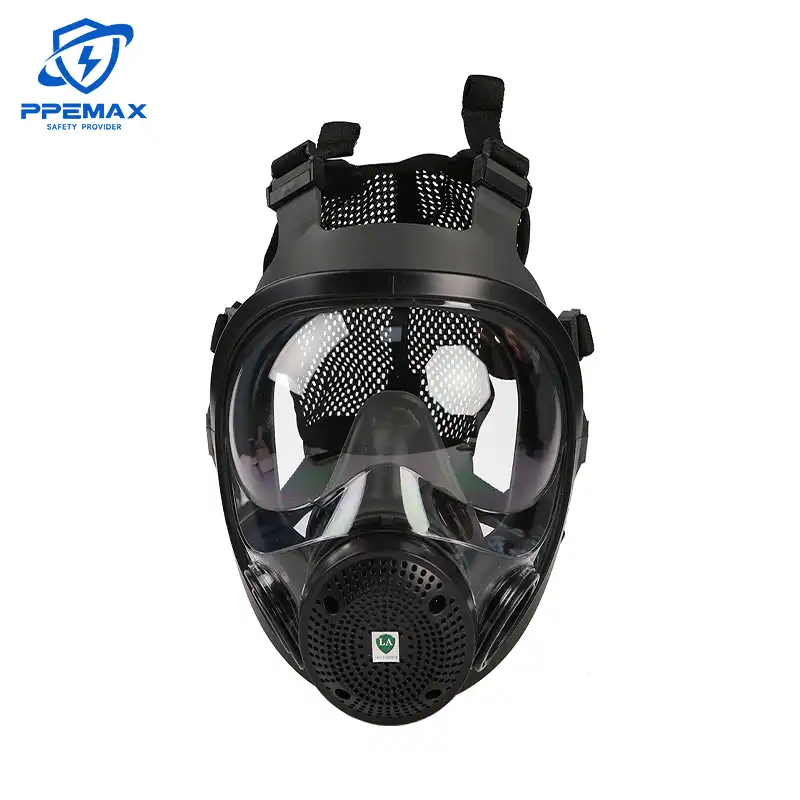
| Parameter | Specification |
|---|---|
| Model Number | 4019 |
| Product Type | Full Face Respirator Gas Mask |
| Mask Body Material | Premium Liquid Silicone (Skin-friendly & Comfort Fit) |
| Visor Material | High-transmittance Polycarbonate (Anti-impact & Anti-scratch) |
| Connection Interface | Standard 40mm NATO Thread (RD40) |
| Head Harness | 5-Point Adjustable System (Even Weight Distribution) |
| Field of Vision | Panoramic View (≥ 85%) |
| Inhalation Resistance | ≤ 30 Pa |
| Exhalation Resistance | ≤ 98 Pa |
| Total Inward Leakage | ≤ 0.05% |
| Anti-Fogging System | Integrated Independent Inner Nose Cup |
| Compatible Filters | All Standard 40mm Chemical/Particle/CBRN Filters |
| Product Weight | Approx. 450g - 500g (Without Canister) |
| Safety Compliance | EN 136 / GB2890-2009 Standards |
| Applications | Industrial Painting, Chemical Handling, Construction, Welding, Agriculture |
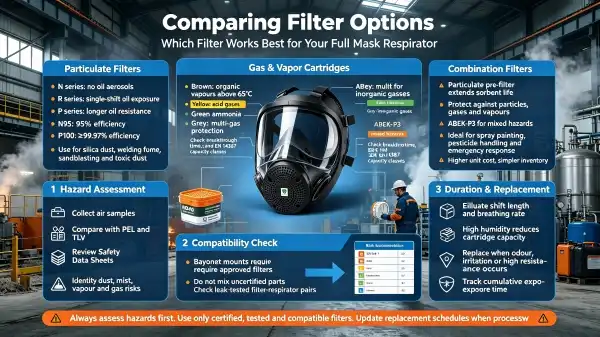
Understanding Full Mask Respirator Filters: Types and Functions
In industrial settings, respiratory protection programs depend on matching the right type of filter to known hazards at work. Each type of filter has a different protective purpose. Knowing these differences helps procurement managers make full safety lists that meet all kinds of business needs.
Particulate Filters: Your Defense Against Airborne Particles
Particulate screens are the first line of defence against solid and liquid aerosols that are floating in the air at work. Synthetic fibres that are negatively charged and grouped in multiple layers are used in these screens to catch particles through mechanical and electrostatic means. The level of filtration varies from 95% for N95-rated filters to 99.97% for P100 and HEPA-rated filters. The number shows the lowest rate of particle capture for 0.3-micron particles.
We have given particulate screens to mines in Africa and Asia where workers are at a high risk of getting silicosis from breathing in silica dust. The P100 filters we make offer the best protection against particulates, as certified by NIOSH 42 CFR Part 84 standards. They are also resistant to oil, which is very important in places where mist and metalworking fluids are present. OSHA 29 CFR 1926.1101 rules say that construction companies working on asbestos removal projects must provide this level of protection. Only full-face respirators with the right filters can meet this requirement of a minimum Assigned Protection Factor (APF) of 50.
Our particle filters are built with pleated media designs that make the most of the surface area. This lowers breathing pressure and increases the service life of the filter. This engineering consideration has a direct effect on how comfortable workers are during long shifts, which in turn affects the rate of compliance in real-world settings. Each batch of filters made in our Xi'an factory is tested for spray entry and airflow resistance. This makes sure that all production runs that are sent to 134 countries are the same.
Gas and Vapor Cartridges: Chemical Protection Through Adsorption
When it comes to safety, chemical dangers need a very different method than particulate filtration. Gas and vapour cartridges have beds of activated carbon or other chemical sorbents that stick to molecules and pick up gaseous contaminants. This is called adsorption, and it happens because the sorbent material has a lot of surface area. Activated carbon capsules are good at collecting organic vapours that have boiling points above 65°C. This includes toluene, xylene, acetone, and other popular industrial solvents.
Specialised cartridges are made to deal with certain types of chemicals. Acid gas tubes have soda lime or other alkaline sorbents in them to neutralise gases like chlorine, hydrogen chloride, sulphur dioxide, and others that are used to make chemicals and work with metal. Different chemistry is used in ammonia containers that works best with basic gases. Multi-gas cartridges have more than one sorbent layer, so they can protect against a wider range of chemicals. However, they are less effective at removing each contaminant than single-purpose designs.
Our clients who make medicines in Europe and North America have to deal with a lot of different kinds of exposure when volatile organic chemicals are used in the preparation process. When we tell you which cartridge to use, we take into account the breakthrough time, which is the amount of time before the concentration of contaminants at the cartridge outlet goes over safe levels. This time varies depending on the concentration of contaminants, the humidity, the breathing rate, and the size of the cartridge. According to EN 14387, workers can quickly find the right cartridge by its colour: brown for organic vapours, grey for artificial gases, yellow for acid gases, and green for ammonia.
Combination Filters: Integrated Protection for Mixed Hazards
Single-hazard settings are rare in the workplace. When you spray paint, you get both fine overspray and solvent vapours with a Full Mask Respirator. Aerosol clouds and gaseous active ingredients are used to apply pesticides. Combination filters protect against particles, gases, and vapours all at the same time by combining particulate filtration media with chemical sorbent beds in a single unit.
As a general rule, the particulate pre-filter is placed on top. Its job is to catch droplets before they reach the chemical sorbent bed. This arrangement makes the sorbent last longer by stopping the buildup of particles that would block binding sites and make breathing harder. Our ABEK-P3 combination filters, which are certified to EN 14387 standards, protect against organic compounds, inorganic gases, acid gases, ammonia, and particulates at the highest European filtration class. This makes them perfect for emergency response teams and people who work with dangerous materials and come across unpredictable mixtures of contaminants.
A big group of people who use combination screens is industrial painting companies. The isocyanates in two-component polyurethane coatings can make you more sensitive to them if you breathe them in, and the particles in overspray can get stuck in your lungs. Customers who run auto refinishing shops and shipyard coating operations say that using combination filters makes their inventory simpler. However, these filters are more expensive per unit than keeping separate stocks of particulate and chemical cartridges.
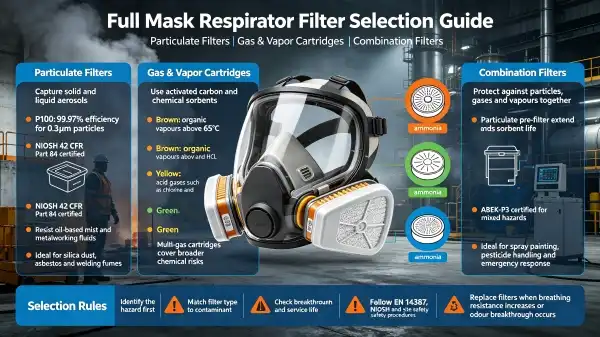
Comparing Filter Options: Which Filter Works Best for Your Application?
To choose an informed filter, you need to match the filter's safety levels to the risks you face at work. Because different industries face different types of risks, procurement workers need to know how each type of filter works in order to improve both safety and cost-effectiveness.
Particulate Filter Comparison: Efficiency Levels and Applications
Based on oil resistance, the NIOSH classification system sets up three filter series: the N-series is for places where oil aerosols don't exist, the R-series is for single-shift use, and the P-series is for longer oil-resistant service. Within each series, ratings of 95, 99, and 100 show the lowest filtration percentages for the tiniest particles that can get through.
95% of airborne particles are caught by N95 screens, which are the standard for many uses. Construction sites that make wood dust, cement particles, or non-toxic mineral dusts often say that N95 protection is enough for the amount of danger and doesn't cost too much. During infectious disease outbreaks, many healthcare facilities used N95 respirators to protect against the spread of pathogens through the air. In these cases, disposable filtering facepiece respirators were used more often than full-face reuse units.
The best level of security is provided by P100 filters, which have oil-resistant properties and a minimum filtration rate of 99.97%. This level of protection is needed in heavy industrial settings where metal is ground, sandblasted, pharmaceutical powder is handled, and toxic dust is present. Energy sector clients who run coal-fired power plants ask for P100 screens to be used during boiler repair and ash handling tasks, where exposure levels can suddenly rise. Due to thicker media, the pressure drop across P100 filters is higher than that across N95 filters. This means that workers with breathing problems may have to work harder to breathe during hard jobs.
We make sure that the factories we work with all over Asia use P100 protection for grinding, welding fume exposure, and making composite materials, all of which release tiny fibres into the air. The longer life of our P100 filters—they are approved to keep working well until the breathing resistance gets too high—saves money in places with a lot of dust where lower-efficiency filters would quickly get clogged.
Gas and Vapor Cartridge Selection: Matching Chemistry to Contaminants
To choose the right chemical capsules, you need to accurately identify the hazards by tracking the air in the workplace and reading Material Safety Data Sheets. Most industrial solvent exposures can be handled by organic vapour cartridges, but the breakthrough time is very different for each compound. Chemicals with a low boiling point, like methanol and formaldehyde, can break through carbon beds faster than solvents with a higher boiling point, sometimes in minutes instead of hours. This means that they are not good options for defence based on cartridges.
In chlor-alkali plants, dentist offices, and some mining activities, mercury vapour is a unique danger. Standard activated carbon doesn't protect well against elemental mercury, so cartridges that are filled with sulphur compounds are needed. These compounds chemically change mercury vapour into solid mercury sulphide. In the same way, carbon monoxide needs catalytic conversion cartridges with a hopcalite catalyst. However, these designs have limited capacity and are mostly used for escape rather than protecting workers during the work shift.
We work with chemical processing plants all over the Middle East that are exposed to more than one thing, so they need cartridge sets or multi-gas designs. Chemical plants and refineries that work with sulphur compounds, aromatic hydrocarbons, and acidic process gases need combination ABEK cartridges that protect against a wide range of chemicals. According to the European EN 14387 standard, there are three capacity classes. These classes show how many grams of test contaminant the cartridge can hold before breaking down. This helps safety managers figure out how often to replace the cartridges based on how much exposure there is.
End-of-service-life indicators built into newer cartridge designs let you see when the sorbent's capacity is almost full. These markers change colour in response to certain chemicals, so you don't have to guess when to replace them. However, they can only pick up the compounds they're meant to, so workplaces with a range of chemical exposures still need change-out plans that are based on the contaminant that sticks to them the fastest.
If you're evaluating personal protective equipment suppliers and require batch-specific testing documents before placing an order, PPE MAX is able to provide official Certificates of Analysis, professional laboratory test reports, and product samples for your verification. Feel free to contact our team at marketing@ppemax.com to discuss your sourcing needs and obtain complete documentation for your quality assessment and procurement approval.
How to Select the Right Filter for Your Full Mask Respirator
Single-hazard settings are rare in the workplace. When you spray paint, you get both fine overspray and solvent vapours with a Full Mask Respirator. Aerosol clouds and gaseous active ingredients are used to apply pesticides. Combination filters protect against particles, gases, and vapours all at the same time by combining particulate filtration media with chemical sorbent beds in a single unit.
Conducting Workplace Hazard Assessment
A full risk review is the first step in choosing the right filters. The job of industrial hygienists is to collect air samples to find contaminants in the air and compare the amounts to standards set by groups like OSHA, NIOSH, and ACGIH. By comparing the amounts that were recorded to the Permissible Exposure Limits (PEL) or Threshold Limit Values (TLV), it is possible to tell if respiratory protection is needed and what the lowest APF level is.
By looking at the Safety Data Sheets for all the chemicals that are used or made at work, you can find out what contaminants might be there, how they behave, and how they might affect your health. This information helps you choose the right filter type: particulate filters for dusts and mists, vapour cartridges for chemicals that evaporate quickly, and combination units for exposures that are a mix of these. Because risk profiles change over time, reconsideration is needed whenever there are process changes, new materials, or changes to equipment.
Tiered assessment procedures are used by the construction and mining businesses we work with around the world. Standard filter specs are used for regular tasks with well-known exposures. However, enhanced protection labels are given for non-routine maintenance, confined space entry, and emergency reaction situations. This risk-based method strikes a balance between safety and realistic issues like cost, comfort, and the need to communicate.
Ensuring Filter and Respirator Compatibility
Filter attachment systems are different for each respirator model and manufacturer. The EN 148-1 standard sets the RD40 threading measurements that many European and foreign respirator brands use, so they can be used with ease. But companies like 3M, Honeywell, Dräger, and Avon Protection often use their own bayonet connections to make sure that users only install filter pairs that have been approved and tried.
Using filters that aren't approved or that don't work with each other lowers the level of protection that was set during NIOSH or EN tests and certification. The seal between the filter and the facepiece must be able to withstand breathing pressures without leaking, and the filter's airflow resistance must be within the range that the respirator's inhalation valves are made to handle. If you mix brands or use fake filters, your certifications will not be valid, and if a worker gets hurt, the employer could be held responsible.
Our respirators are made with standard RD40/EN 148-1 threading, which means they work with our approved filter line and make managing the global supply chain easier for clients from different countries. Our technical paperwork lists the approved filter models that have been tried with each respirator design, and we keep thorough compatibility grids that procurement teams handling different types of equipment in multiple sites can access.
Evaluating Duration and Intensity Factors
The length and intensity of the exposure have a direct effect on the choice of filter and how often it should be replaced. For eight- or twelve-hour shifts, filters need to be able to hold enough and have low enough breathing pressure to keep workers from getting tired. When you're working hard, you breathe faster, which speeds up the loading of particulate filters and chemical cartridges and raises the comfort demands.
Filters can last longer when they are exposed to light at different times. When emergency response teams go into contaminated areas for short periods of time, they can use the same cartridge for more than one incident as long as the total exposure time stays within the cartridge's capacity limits and the storage conditions keep the sorbent from breaking down. On the other hand, filters need to be changed often to keep safety levels high during ongoing high-concentration exposures.
Our usage-tracking guidance documents help safety managers set up replacement schedules that are specific to each site, which is helpful for infrastructure companies with large teams working in remote areas. Environmental factors like humidity, high temperatures, and storage conditions can shorten the life of filters. This is especially true for chemical cartridges, where humid air lowers the ability to absorb organic vapour by replacing adsorption sites with water molecules.
Maintenance Best Practices: Cleaning and Replacing Filters for Optimal Safety
Maintaining respirators and filters properly increases their useful life, makes sure they always protect, and shows that you follow the rules during workplace audits and inspections.
Cleaning and Sanitizing Respirator Components
The mask facepiece needs to be cleaned regularly to get rid of dirt, sweat, and skin oils that build up and damage rubber seals and make lenses less clear. Workers should clean surfaces that have been touched with disinfectant wipes or cloths that have been wet with a light detergent solution after each use. Cleaners and chemicals made from gasoline will damage elastomers and polycarbonate lenses, so stay away from them.
To clean the mask completely, you need to follow the manufacturer's directions and take out the filters and exhalation valves. Put the parts of the facepiece in warm water with a neutral pH cleanser. Use soft brushes to clean the valve seats and cracks. Rinse well with clean water to get rid of any detergent residue that could irritate the skin or stop the valve from working. Before putting the parts back together, let them dry completely in the air. If moisture gets trapped in the inhalation valves, it can freeze in cold places or help microbes grow.
When multiple workers from different jobs use the same respirators, they need to be cleaned between uses to stop the spread of disease. Commercial cleaning products made for breathing equipment find a good mix between killing germs and not harming the materials. Our clients who work in continuous-process industries set up central cleaning stations where trained workers clean, inspect, decontaminate, and put respirators back together according to written procedures. Equipment tracking systems keep track of who does what and where.
Establishing Filter Replacement Schedules
Particulate filters need to be replaced when breathing becomes more difficult, when visible contamination builds up on the filter media, or on a set plan based on data from tracking exposure at work. Unlike chemical cartridges, which have set limits on how much they can hold, particulate filters keep working well until they become physically loaded and stop letting air flow. Workers say that harder breathing is the main sign of a change-out.
When replacing a chemical refill, you need to be more careful. In many cases, a breakthrough happens before workers can smell or feel irritation. This is especially true for toxins that don't have good warning qualities, which means they don't smell or cause irritation at levels below the health-hazard level. Maximum use time limits are set by safety managers using maker data on capacity, measures of workplace concentration, and safety factors that take into account differences in breathing rates and environmental conditions.
Using Occupational Safety and Health Administration (OSHA) guidelines and manufacturer capacity specifications, our technical support team helps procurement managers figure out how often to replace things at each site. We suggest using permanent markers or tracking labels to write down the times that each filter was installed, rotating the inventory so that the first item that comes in is the first one that goes out, and teaching workers to report any smells or tastes of contaminants right away if they think they might be showing signs of premature breakout.
Storage and Inventory Management
With the right storage, filters don't break down before they are used. Chemical tubes are shipped in covered boxes that keep the sorbent from getting too wet from air or other contaminants. When capsules are opened and exposed to air in the workplace, they start to absorb contaminants and water vapour, even when they're not being used. This shortens their useful life. After using an opened cartridge, put it back in a sealed bag or container and keep track of the total exposure time instead of the date and time.
Extreme temperatures and strong sunlight break down Full Mask Respirator screen materials. The temperature in storage areas should stay reasonable, and UV light should be kept away from filters so that the elastomeric seals don't harden. Following the first-in, first-out rule for inventory rotation keeps things from being stored for too long, which could mean they go beyond the manufacturer's recommended shelf life, which for sealed chemical cartridges is usually five years from the date they were made.
Large companies and distributors that keep a lot of inventory can benefit from centralised storage sites with environmental controls. We work with mining companies that have rural sites to come up with field storage solutions that keep filters working properly in harsh temperatures like the Arctic and the desert. Good inventory management also makes sure that the right types of filters are available when they are needed, so the wrong filters aren't used as emergency replacements.
Procurement Strategy: Buying Filters for Full Mask Respirators at Scale
Organisations that run respiratory protection programs in many places and countries need to find smart ways to buy things that balance low costs with quality control, supply stability, and compliance with the rules.
Sourcing from Certified Manufacturers and Distributors
There is a growing problem with fake lung protection gear on the world's markets, with fake items not providing the safety that is claimed. This risk can be reduced by only buying filters from certified manufacturers and authorised distributors. Well-known brands like 3M, Honeywell, Dräger, MSA Safety, and Avon Protection have networks of authorised distributors who sell only real products with proof of certification.
For products sold in the US, manufacturer certification papers include NIOSH approval numbers; for products sold in the EU, they include CE marking with notified body numbers; and for markets outside of the EU, they include standards compliance certifications that are relevant to those markets. Before making big purchases, procurement teams should ask for and check these certificates. This is especially important when looking at new suppliers whose prices are much lower than the market average, which could mean the goods are fake.
We keep up with quality standards, such as AS/NZS 1716 certification for users in Australia and New Zealand, NIOSH approval for our respirator and filter product lines that are sold in North America, and compliance with EN 136 and EN 14387 for European markets. As a leading manufacturer in Northwest China since 1956, we have the manufacturing know-how and quality control infrastructure to meet a wide range of international standards. Also, because we deal directly with manufacturers, we don't have to pay markups to distributors, which would otherwise drive up prices.
Implementing Bulk Purchase Programs
Through producer quantity discounts, lower per-unit shipping costs, and lower purchase processing costs, buying in bulk can save you a lot of money. Companies that know how much filtering they will need can benefit from annual or multi-year supply agreements that set fixed prices. This protects them from changes in the market and gives them budget certainty.
Buying in bulk adds costs to keeping goods and room for storage that need to be taken into account when figuring out the total cost. Filters have set shelf lives, so keeping too many on hand could cause them to go bad before they can be used. This problem can be solved by consignment inventory programs, which let producers keep stock at customer sites and only get paid when it is used up. This method works well for heavy users who need immediate access and don't want to keep their money in inventory.
Because we can supply goods to 134 countries around the world, we can help multinational companies that need to make sure that all of their operations, no matter where they are located, use the same product specifications. We offer a variety of ways to buy our products, such as direct container shipments for big distributors, consolidated orders that include a number of different filter types and related PPE products, and custom packaging with distributor branding for markets where the products will be sold again. Customers who buy in bulk get specialised account management, access to technical help, and first choice when supplies are low.
Evaluating Total Cost of Ownership
The cost of buying filters is only one part of the overall cost of a lung protection scheme. Total cost of ownership includes costs for training on how to choose and use the right filters, fitting tests to make sure the seal is good, upkeep labour and supplies, getting rid of used filters, and managerial costs for keeping records and making sure compliance is met. Choosing sturdy filters with long service lives may mean higher unit costs, but lower total ownership costs because they don't need to be replaced as often.
Resistant breathing makes workers less productive and less likely to follow the rules. When workers are doing hard work, high-resistance filters make them tired, so they take off their respirators or don't use them when they should. Wearer acceptance and program success are improved by lower-resistance filter designs that maintain protection levels. This makes the premium price more reasonable by reducing compliance violations and exposure incidents.
We put money into filter media technology that finds the best mix between how well it filters, how long it lasts, and how much air it lets through. Our pleated P100 filter designs have a large surface area that keeps the pressure drop low, even though they filter very well, and our large-capacity chemical refills last longer than compact designs, so they don't need to be replaced as often. When companies figure out their true ownership costs instead of just looking at the purchase price, these engineering investments save them money over the lifecycle of the equipment.
Conclusion
In conclusion, when you match the right filters to full-face respirator systems, you protect your workers while also lowering the costs of your safety program and making sure you're following the rules. Knowing the main differences between particulate, gas, and vapour, and combination filters helps you make decisions based on real hazards in the workplace instead of guesswork. Professional respiratory protection programs that show care for worker health are set up with systematic hazard assessment, compatibility verification, and maintenance protocols. Strategic buying from approved makers makes sure that products are real and work well across all global businesses. When companies spend money on the right filters, training, and upkeep, they make workplaces safer, lower the health effects of exposure, and create cultures that put safety first.
FAQ
1. What is the difference between N95 and P100 filters for full-face respirators?
N95 filters can catch at least 95% of airborne particles, but they can't handle oil, so they can be used in building, woodworking, and other similar fields where non-oil aerosols are used. P100 filters have an oil-resistant surface that achieves a minimum filtration efficiency of 99.97%. They offer the highest level of protection against toxic dusts, metal fumes, and environments where oil mist is present. P100 filters are more expensive, but they protect better in high-risk industrial settings that need the highest level of particle removal. Both types keep working well until the breathing resistance goes up. However, P100 filters usually last longer in dusty places because they have more surface area.
2. How often should I replace chemical cartridges on full mask respirators?
How often you replace it depends on the type of contamination, its concentration, the temperature, the humidity, and how fast you breathe. Manufacturers give safety managers data on breakthrough times for standard test conditions, which they then change to reflect the real-life conditions of the workplace. Most guidelines set maximum use times that range from hours for high-concentration doses to several shifts for low-level, occasional use. Replace cartridges right away if workers smell contaminants or have symptoms, if the maximum use time runs out, if they get hit or damaged, or if the maker says the cartridges should be kept for a certain amount of time after being opened. Conservative replacement schedules give you safety margins that take into account how different people are and how the workplace is changing.
3. Can I use filters from different manufacturers on my full mask respirator?
Respirator certification can be lost if you use filters that aren't allowed. It may also lower your security. Some manufacturers make respirators with standard EN 148-1 (RD40) threading, but thread compatibility doesn't guarantee good filtration, breathing resistance, or seal integrity by itself. Manufacturers approve full respirator-filter systems by testing them. Combining parts from different brands makes new combos that haven't been tested and whose protection levels are unknown. Only use filters that have been approved by the company that made your respirator and are listed in the product documentation. Organisations that manage equipment from more than one brand should keep different stocks of filters for each type of respirator to avoid putting together filters that don't work with each other.
Partner with PPE MAX for Certified Full Mask Respirator Solutions
Xi'an PPE MAX Co., Ltd makes excellent respiratory protection products and has been doing so for almost 70 years. As a reliable Full Mask Respirator supplier to industrial safety distributors, construction companies, mining operations, and government procurement departments around the world, we know how important it is to choose the right filters and make sure they work with each other. Our filter product lines are NIOSH-certified and EN-compliant. They include particulate, gas, and vapour, and mixed types made for tough industrial uses. Our technical team can help you match the right filter specs to the dangers in your workplace, whether you need to buy a lot of filters for a global business or make your own OEM products. Get in touch with us at marketing@ppemax.com to talk about your respiratory protection needs and find out how our wide range of products, ability to ship around the world, and professional after-sales service can help your employees in 134 countries.
References
1. National Institute for Occupational Safety and Health. "NIOSH Guide to the Selection and Use of Particulate Respirators Certified Under 42 CFR 84." Department of Health and Human Services Publication, 2017.
2. European Committee for Standardization. "EN 14387:2004+A1:2008 - Respiratory Protective Devices - Gas Filters and Combined Filters - Requirements, Testing, Marking." CEN Standards, 2008.
3. Occupational Safety and Health Administration. "Respiratory Protection Standard 29 CFR 1910.134." United States Department of Labor, 2019.
4. Bollinger, Nancy J. "NIOSH Respirator Selection Logic 2004." National Institute for Occupational Safety and Health Technical Report, 2004.
5. American Industrial Hygiene Association. "Respiratory Protection: A Manual and Guideline, Fourth Edition." AIHA Press, 2015.
6. International Safety Equipment Association. "Best Practices for Respiratory Protection Programs in Industrial Settings." ISEA Technical Guidance Document, 2018.
Learn about our latest products and discounts through SMS or email