- English
- French
- German
- Portuguese
- Spanish
- Russian
- Japanese
- Korean
- Arabic
- Greek
- German
- Turkish
- Italian
- Danish
- Romanian
- Indonesian
- Czech
- Afrikaans
- Swedish
- Polish
- Basque
- Catalan
- Esperanto
- Hindi
- Lao
- Albanian
- Amharic
- Armenian
- Azerbaijani
- Belarusian
- Bengali
- Bosnian
- Bulgarian
- Cebuano
- Chichewa
- Corsican
- Croatian
- Dutch
- Estonian
- Filipino
- Finnish
- Frisian
- Galician
- Georgian
- Gujarati
- Haitian
- Hausa
- Hawaiian
- Hebrew
- Hmong
- Hungarian
- Icelandic
- Igbo
- Javanese
- Kannada
- Kazakh
- Khmer
- Kurdish
- Kyrgyz
- Latin
- Latvian
- Lithuanian
- Luxembou..
- Macedonian
- Malagasy
- Malay
- Malayalam
- Maltese
- Maori
- Marathi
- Mongolian
- Burmese
- Nepali
- Norwegian
- Pashto
- Persian
- Punjabi
- Serbian
- Sesotho
- Sinhala
- Slovak
- Slovenian
- Somali
- Samoan
- Scots Gaelic
- Shona
- Sindhi
- Sundanese
- Swahili
- Tajik
- Tamil
- Telugu
- Thai
- Ukrainian
- Urdu
- Uzbek
- Vietnamese
- Welsh
- Xhosa
- Yiddish
- Yoruba
- Zulu
What Voltage Can Class 2 Electrical Rubber Gloves Handle?
Founded in 1956, PPEMAX stands as a premier global manufacturer and supplier of full-range personal protective equipment. All our products comply with internationally recognized standards including IEC, ASTM, CE, UKCA, NIOSH and ISO9001. Equipped with a 2,000-square-meter modern production plant, we boast over 25 years of mature OEM & ODM capabilities to deliver one-stop customized solutions covering R&D design through worldwide logistics. Our safety gear is distributed across 134 countries globally. Upholding our core tenet “Safety First, Quality Priority”, we serve as a dependable long-term PPE partner for industrial enterprises around the world.
With a proof test voltage of 20,000 volts AC, Class 2 electrical rubber gloves are designed to shield workers from voltages of up to 17,000 volts AC (alternating current). Insulating gloves like these are very important for keeping electrical workers safe around medium- to high-voltage hazards in places like power distribution, utility maintenance, and factories. Knowing the exact voltage they can handle and what applications they can't be used in helps buying teams choose the right PPE that matches the practical voltage levels. This keeps people safe and in line with international safety standards. We'll look at how these protection barriers work in real-world electrical settings throughout this guide.
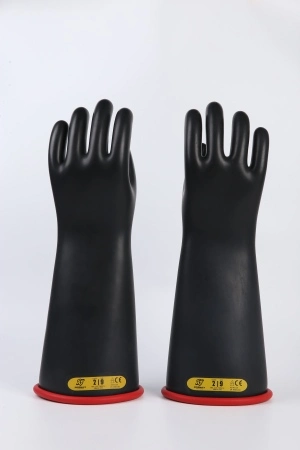
|
Parameter |
Specification |
|
Voltage Rating |
7,500V AC / 11,250V DC (Maximum Use) |
|
Proof Test Voltage |
10,000V AC / 40,000V DC |
|
Material Type |
Type I (Natural Rubber) / Type II (EPDM Synthetic) |
|
Thickness Range |
1.02mm - 1.52mm |
|
Tensile Strength |
>17.2 MPa |
|
Standards Compliance |
ASTM D120, IEC 60903 |
|
Temperature Resistance |
Category A, H, Z rated |
|
Label Color |
White (Class 1 Standard) |
Understanding Class 2 Electrical Rubber Gloves
Voltage Ratings and Classification Standards
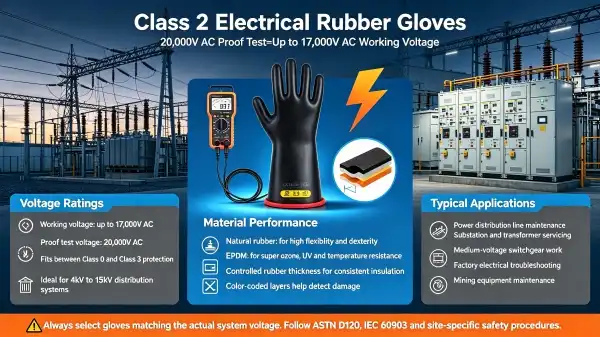
When used with voltages up to 17,000 volts AC phase-to-phase, Class 2 electrical rubber gloves provide solid protection. The method for classifying things set up by ASTM D120 in North America and IEC 60903 around the world makes a standard framework that buying teams in different markets can trust. These gloves must be able to handle a proof test voltage of 20,000 volts AC without breaking while they are being made and every so often after that. This gives them an extra safety gap above their rated working voltage. This gap takes into account voltage jumps, transient swells, and the normal wear and tear that happens over time.
The rating system puts Class 2 gloves between Class 1 (which can handle up to 7,500V AC) and Class 3 (which can handle up to 26,500V AC). Safety managers can better match glove ratings to specific work environments when they know where Class 2 fits in this range. Class 2 protection is usually used by people who work on distribution lines that service secondary systems, in substations that maintain power plants, and in factories that work with medium-voltage switchgear. Because they can handle a wide voltage range, these gloves are perfect for 4kV to 15kV distribution systems that are widespread in city power grids and big factories.
Material Composition and Insulating Properties
The two main types of materials used to make high-quality electrical insulating gloves are natural rubber and EPDM (Ethylene Propylene Diene Monomer). Since natural rubber is more flexible and dexterous than synthetic rubber, workers can move tools and parts precisely, even when wearing thick safety gear. When joining connections, adjusting fasteners, or handling sensitive instruments in energised areas, this tactile awareness comes in very handy. EPDM formulations, on the other hand, are better at resisting ozone damage, UV radiation, and extreme temperatures. This makes them last longer in harsh industrial settings and outdoor settings.
These materials are strong because their chemical structure stops electrons from moving, even when they are under a lot of energy stress. To make sure that every glove meets strict electrical resistance standards, the manufacturing process carefully controls the thickness of the rubber, the drying conditions, and the quality consistency. Colour-coded layers, which often have different surfaces on the inside and outside, make it easier to see holes, cuts, or contamination that could affect the insulation. These parts of the design turn the gloves from simple barriers into high-tech safety systems that are made to work reliably in tough situations.
Application Environments and Operational Context
Power utilities are the major group of people who use Class 2 gloves. They are used for upkeep on distribution networks, servicing transformers, and installing meters. These gloves are the main way that line crews who work on overhead distribution circuits with ratings between 4kV and 15kV stay safe while they're doing their jobs. The voltage range is perfect for the kind of distribution equipment that you'd find in cities and suburbs. De-energising lines would cause thousands of customers to lose service.
For the same reason, maintenance workers in factories with medium-voltage electrical systems need Class 2 protection. For upkeep on switchgear, work in motor control centers, and electrical troubleshooting, these gloves are required by industrial plants with 4.16kV or 13.8kV distribution systems, which are popular in large production areas. Class 2 gloves are part of the PPE that mining companies use for maintaining equipment and fixing power systems. This is especially true for underground mines with large electrical distribution networks. The safety capacity takes into account the voltage levels in the mine infrastructure while still allowing enough flexibility for the mechanical tasks needed to service the equipment.
Safety Standards and Testing Protocols for Class 2 Gloves
Regulatory Compliance and Certification Requirements
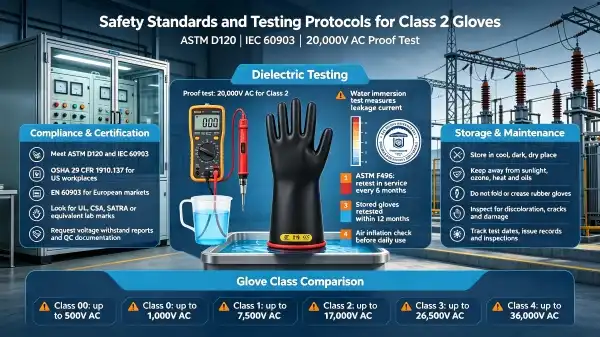
Meeting the requirements set by ASTM D120 and IEC 60903 is a must for Class 2 electrical rubber gloves that are meant to be used in professional workplace settings. As a result of these standards, producers must make sure that their products meet exact testing methods, voltage withstand criteria, and physical property requirements. These standards must be confirmed by an independent laboratory. In the US, OSHA rules (29 CFR 1910.137) say that electrical work must be done with approved insulating gloves. There are also paperwork requirements that buying teams must check when they evaluate suppliers.
The rules that apply to European markets are called EN 60903, and they are the same as the international IEC standard, but also include local compliance rules. When buying gloves for global companies or for markets in a lot of different places, it's important to understand these legal landscapes. Gloves that have been through a thorough evaluation can be seen to have certification marks from well-known testing laboratories like UL, CSA, SATRA, and others. Procurement managers should ask for full certification paperwork, such as test reports that explain how well the product can withstand voltage, its physical properties, and the quality control procedures used during production. This paperwork serves two purposes: it backs up what suppliers say during the sourcing process, and it helps with safety checks while the gloves are being used.
Dielectric Testing and Quality Verification
Before going into service, and at regular intervals during its useful life, every Class 2 glove must go through dielectric testing. For water testing, which is the usual way in the industry, gloves filled with water are put on, and the proof test voltage (20,000V AC for Class 2) is applied while current leakage is watched for signs of insulation failure. This testing method finds flaws in the way the product was made, damage from use, or wear and tear that could affect its defensive effectiveness. ASTM F496 says that gloves that are being used must be tested every six months, and gloves that are being stored must be tested within 12 months of being given to workers.
In testing facilities, special tools are used to carefully control the rates of voltage application, the length of exposure, and the accuracy of leakage current measurements. A preliminary checking method called "air testing" can be used by field workers before each use to find clear physical damage like holes or tears. When you roll the glove tightly from the wrist down to the fingers, you trap air inside. This creates pressure that makes holes visible or audible by making hissing sounds. Even though air testing can't replace electrical testing, it is a useful way to check for damage every day before workers are exposed to electrical dangers.
Storage and Maintenance Best Practices
Proper storage has a direct effect on how long gloves last and how well they work. Keeping gloves in cool, dark, dry places that are out of direct sunlight, ozone sources, and petroleum products will keep the rubber compounds from breaking down too quickly. When the glove cuffs are positioned downward on canvas storage bags, they let wetness drain away while protecting against damage and contamination. When you don't fold or squeeze something, you stop stress concentration points that could turn into cracks or weak spots over time.
The environment has a big effect on how fast rubber ages. Ozone is made by electrical equipment, welding, and ultraviolet light. It breaks down the molecular bonds in rubber, which leads to surface cracks and lower dielectric strength. Chemicals break down faster in hot conditions, and oils and solvents can get into rubber products and make them less protective. Setting up different places to store gloves away from these contaminants protects the integrity of the gloves and gets the most out of the money spent on purchase. Regular visual checks for discolouration, changes in surface texture, or physical damage should be part of maintenance procedures. It is also important to keep detailed records of each glove's testing history, issue dates, and inspection results. This paperwork helps with checking compliance and finding trends that could mean there are storage or usage problems that need to be fixed.
If you're evaluating personal protective equipment suppliers and require batch-specific testing documents before placing an order, PPE MAX is able to provide official Certificates of Analysis, professional laboratory test reports, and product samples for your verification. Feel free to contact our team at marketing@ppemax.comto discuss your sourcing needs and obtain complete documentation for your quality assessment and procurement approval.
Comparison of Class 2 Electrical Rubber Gloves with Other TypesVoltage-Based Classification Differences
The glove classification system sets clear voltage limits that help workers choose the right safety gear for each job. Class 00 gloves, which can handle up to 500V AC, are used for electrical work in homes, making electronics, and low-voltage control systems where handling is more important than high-voltage safety. Class 0 gloves cover up to 1,000V AC and can be used to work on utility meters, make secondary service hookups, and maintain industrial control panels. Class 1 gloves can connect to 7,500V AC and help with primary distribution work in smaller utility networks and rural systems.
The 17,000V AC rating of Class 2 electrical rubber gloves makes them suitable for use in urban distribution systems and medium-voltage industry settings where lower classes are not enough to protect. Class 3 gloves can handle 26,500V AC and are used for work on transmission lines and high-voltage industrial systems. Class 4 gloves can handle 36,000V AC and are used in transmission substations and large industrial facilities. This structure, with increasing voltage, lets procurement teams precisely match protection levels to operating dangers. This way, neither too little protection, which puts worker safety at risk, nor too much protection, which raises costs and limits dexterity needlessly, happens. Choosing between classes that are next to each other is often based on the highest voltage that workers could possibly be exposed to. This includes brief overvoltage situations and safety gaps set by company safety policies.
Material-Based Protection Distinctions
The main purpose of electrical insulating gloves made of rubber materials is very different from that of leather safety gloves or general work gloves. The dielectric barrier that is needed for voltage safety is made of rubber, which has qualities that are designed to stop the flow of electricity. People who wear leather guard gloves over rubber insulation gloves are mechanically protected against cuts, scrapes, and holes that could damage the rubber layer. The two-layer method combines electrical insulation with durability, which is important for electrical work situations with a lot of different types of hazards.
General work gloves made of cotton, synthetic fibres, or thin leather don't protect against electricity and can be dangerous if worn while doing electrical work. The main difference is testing and certification. Electrical protection is only guaranteed for gloves that meet ASTM D120 or IEC 60903 standards. To avoid dangerous substitutions, procurement specifications must make a clear distinction between these types of gloves. Some companies sell combined glove systems that have thin rubber insulating gloves that fit inside leather shells. These systems combine different types of protection into one product. People who do jobs that are both electrically and mechanically dangerous like these hybrid designs, but they usually make it harder to move your fingers than thin rubber gloves worn alone.
Reusable Versus Limited-Use Considerations
If you take good care of your traditional electrical rubber gloves and test them every so often, they will protect you for years to come. Because they last a long time, they are a good investment for businesses that need to do a lot of electrical work and already have PPE management programs in place. The higher starting cost per pair of gloves—often between $100 and $300, based on class and features—is spread out over hundreds of uses, which greatly lowers the cost per use. Operations that use reusable gloves should have centralised testing facilities, trained PPE coordinators, and tracking systems that keep track of testing schedules and glove lifecycles.
There are now limited-use or disposable electrical gloves that can be used in situations where reusable gloves aren't practical because of concerns about contamination, limited space, or infrequent electrical work. These gloves usually have lower voltage values and cost less at first, but because they can only be used once, they cost more in the long run for businesses that need to do regular electrical repair. The effects on the environment are also very different. Gloves that can be used more than once produce less waste than throwaway ones, which is in line with companies' environmental goals. Instead of just looking at the initial unit price, procurement decisions should take into account the total cost of ownership, which includes the purchase price, testing costs, storage infrastructure, and disposal costs.
Procurement Considerations for Class 2 Electrical Rubber Gloves
Supplier Evaluation and Certification Verification
If you buy from providers who have a history of making electrical safety goods, you can be sure that you will get certified electrical rubber gloves with the right technical support. Well-known companies have testing labs, quality management systems that are ISO 9001-certified, and expert staff who can answer questions about particular applications. Procurement teams should ask for proof of certification when looking at possible sources. This could include copies of test results from reputable labs and proof that quality checks are still being done on a regular basis.
The credibility of a supplier goes beyond just getting a product certified. It also includes the reliability of the supply chain, the availability of technical support, and helpful customer service. With roots in manufacturing going back to 1956 and distribution in 134 countries, PPE MAX is a great example of the kind of supplier that can help with large-scale purchasing operations. Suppliers that offer both OEM and ODM services give businesses that want to customise sizes, logos, or packages a lot of useful options. This customisation helps to keep things the same across international businesses and the brand's safety programs. As part of your due research, you should check the sites of the factories, learn about the limits of their production, and see how well they can adapt to rising demand.
Pricing Structures and Volume Economics
Class 2 glove prices are based on how much it costs to certify, the quality of the materials, how precisely they are made, and how the brand is positioned. At first, cheap options from sources you can't trust may seem appealing, but they come with the risk of not following the rules, failing too soon, or not providing enough safety, all of which have much more expensive outcomes than the high price. Mid-range items from well-known brands usually strike a good mix between price and quality, offering certified protection at prices that are cheap enough for bulk purchases. Premium names cost more because they last longer, are easier to use, or have functions that are only useful for certain tasks.
By using tiered prices, lowering shipping costs per unit, and streamlining the purchase process, buying in bulk can save you a lot of money. Economies of scale work well for businesses that combine orders from various locations or use group buying organisations to coordinate their purchases. Different suppliers and product lines have different minimum order numbers. Some makers need hundreds of pairs per order, while others can handle smaller amounts for custom sizes or shapes. When choosing a supplier, making sure you know the MOQ requirements will keep your organization's needs and the supplier's abilities from not matching up. Long-term supply agreements offer stable prices and guaranteed availability, which are very helpful in markets where raw material prices change a lot or where there are problems in the supply chain.
Sizing, Customization, and Inventory Management
The right size of gloves has a direct effect on both safety and user satisfaction. Gloves that are too small make your hands tired and cut off blood flow after a while of use, while gloves that are too big make it harder to move your fingers and raise the risk of catching on things. Manufacturers usually offer sizes 7 to 12 in half-size increments, and three length options—short, standard, and extended—to fit hands of different sizes and meet coverage needs. Before placing big orders, procurement teams should hold fitting clinics where workers can try on clothes in different sizes while being watched. This way, they can make sure that the clothes fit right.
Customisation options go beyond just choosing a size. They also include colour coding for different voltage classes, coatings on the inside that make putting them on and taking them off easier, and shaped designs that keep your hands from getting tired. Some operations need marks on the outside that show who owns something, when it was tested, or who is responsible for a certain building. These changes help keep track of inventory and compliance while stopping gloves from moving between facilities or departments. Strategies for managing inventory should take into account both how quickly something can be used and how much it costs to store and how long it lasts. Even when they are stored, rubber materials break down over time, so having too much on hand is useless. Setting par levels based on the size of the workforce, the rate of use, and the length of the testing cycle makes sure that there are enough supplies without building up old stock that might fail testing before it can be used.
Ensuring Optimal Use and Long-Term Safety of Class 2 Gloves
Proper Application and Handling Procedures
Before putting on electrical rubber gloves, they should be carefully checked for cuts, punctures, foreign objects lodged inside, or changes in texture that could mean they've been exposed to chemicals or ozone. Users should test the air as we've already talked about and then look for discolouration or contamination. Clean, dry hands make putting on gloves easier and keep moisture from building up inside them, which could help fungi grow or make them less comfortable to wear for long periods of time. To keep electrical current from tracking—crossing the gap between the leather and the worker's skin—the leather guard gloves must be at least two inches shorter than the rubber gloves.
When gloves are stored, rolling or folding them up can make them less safe. So can exposing them to oil or solvents or using damaged gloves "just one more time" before replacing them. Workers sometimes try to fix holes in wires with tape or glue, which only gives them a fake sense of security and doesn't fix the electrical integrity. Education programs should stress that if the rubber layer gets damaged, the gloves can't be used for electrical work and need to be taken out of service and replaced right away. When you take off dirty gloves the right way, you don't spread chemicals or oils to storage areas or clean gloves.
Inspection Protocols and Compliance Tracking
Along with pre-use checks, post-use inspections find damage that happened during job activities before the gloves are put away again. This checking cycle finds problems quickly, so broken gloves don't get to other people who could use them. Formal inspection methods write down what they find, making records that can be used for compliance checks and finding trends that show training is needed or there are hazards in the workplace that need to be fixed. Digital tracking systems that use barcode or RFID technology make paperwork easier and give people in different places real-time information about the state of tests, inspections, and where gloves are located.
Tracking compliance includes testing schedules, inspection records, and training materials that show users know how to choose the right gloves, put them on correctly, and take care of them properly. OSHA and other similar regulatory bodies around the world expect employers to keep these records and show them when they are inspected. Companies with strong safety cultures include glove management as part of their overall PPE plans. To find ways to make things better, safety groups look at things like how often gloves are used, how often they break, and reports of accidents. Gloves are kept out of service longer than they need to be because they are automatically reminded of when testing deadlines are coming up.
Real-World Performance and Deployment Examples
For its distribution repair teams working on 12.47kV circuits, a big utility company with 2.3 million customers put in place a full Class 2 glove program. The program made sure that all 45 service centers used the same specifications for gloves. It also set up central testing facilities to serve regional clusters and put in place barcode tracking to connect each glove to its full service history. Within 18 months, the utility cut the number of electrical events involving gloves by 67% and increased the average glove's useful life from 14 months to 23 months by teaching users better storage techniques and how to use them. The program worked because gloves were seen as important safety assets that needed to be managed in a planned way, not as supplies that were used up quickly.
It was hard for a global mining company with operations in four countries to keep track of glove specifications, testing needs, and supplier ties in different regulatory settings. The company achieved standardisation by working with a global PPE distributor that could handle differences in regional compliance while keeping product quality consistent. This made it easier to buy things, train employees, and keep track of inventory. Gloves that meet uniform performance standards and local legal requirements are used in underground mines in Australia, surface mines in South America, and processing plants in Africa. This method simplified the buying process and backed a safety culture by making sure that everyone was protected the same way, no matter where they were.
Conclusion
Class 2 electrical rubber gloves are very important for protecting against voltage because they provide reliable insulation for medium-voltage uses up to 17,000 volts AC in a wide range of industry settings. Knowing the voltage levels, compliance requirements, and correct use of these items helps procurement pros make smart choices that protect workers and make the supply chain run more smoothly. During the selection process, it's important to pay close attention to more than just the original buy price. You need to check the supplier's trustworthiness, make sure the sizes are correct, and calculate the total cost of ownership. Companies that have complete glove management programs that include proper storage, regular testing, thorough training, and careful tracking of compliance get the most out of their PPE investments and improve worker safety. These programs create long-lasting protection systems that work well for years.
FAQ
1. What happens if Class 2 gloves are exposed to voltages exceeding 17,000 volts?
When Class 2 gloves are used above their 17,000-volt AC limit, they pose a major risk of shock and death. If there is too much voltage stress, the insulation could break, letting current flow to the person wearing it. Always check to see what the highest voltage level is in the area where you work, and choose glove classes that have enough safety gaps above that level.
2. How frequently should Class 2 electrical rubber gloves undergo testing?
ASTM F496 standards say that the gloves that are being used must be electrically tested every six months. Before being given to workers, gloves that have been kept without being used must be tested within 12 months. These time frames are the longest that testing should be done between visits. More frequent testing may be needed in harsh environments or after damage is suspected.
3. Can natural rubber and EPDM gloves be used interchangeably for the same applications?
When made and checked correctly, both materials meet the Class 2 voltage standards. Natural rubber is more flexible and easier to work with, which is good for fine work. EPDM is more resistant to ozone, UV light, and changes in temperature, which means it lasts longer in open settings. Pick based on the environment and the need for dexterity.
4. Are leather protector gloves mandatory when wearing Class 2 rubber insulating gloves?
Even though they aren't always required by law, leather guards are highly suggested and needed by many groups. They keep the rubber gloves safe from cuts, scrapes, and holes that could compromise the insulation of the electricity inside. To stop current tracking, the leather must be at least two inches shorter than the rubber.
Partner with PPE MAX for Certified Electrical Rubber Gloves
Since 1956, PPE MAX has made insulating gloves that meet the strict needs of power companies, factories, and building projects all over the world, protecting electrical workers in 134 countries. Our Class 2 electrical rubber gloves are tested thoroughly to meet ASTM D120 and IEC 60903 standards. This makes sure that they provide reliable protection for medium-voltage applications. We are a major provider of electrical rubber gloves and have been making them for almost 70 years. We offer OEM and ODM services that allow you to customise the size, branding, and packing to meet the needs of your organization. Our technical team gives application advice, which helps procurement managers choose the right glove classes and configurations for a range of work settings. Large global companies and regional distributors looking for trusted supply partners can both use volume price structures and flexible MOQ choices. Email our team at marketing@ppemax.com to talk about your needs for electrical rubber gloves, get full product specs, or get volume discounts that are suited to your buying needs. We back up every pair of gloves with paperwork that can be used for compliance checks and the quick service that global businesses need.
References
1. American Society for Testing and Materials. (2016). ASTM D120-14a: Standard Specification for Rubber Insulating Gloves. ASTM International, West Conshohocken, PA.
2. International Electrotechnical Commission. (2002). IEC 60903:2002: Live Working – Gloves of Insulating Material. International Electrotechnical Commission, Geneva, Switzerland.
3. Occupational Safety and Health Administration. (2007). OSHA Standard 29 CFR 1910.137: Electrical Protective Equipment. U.S. Department of Labor, Washington, DC.
4. American Society for Testing and Materials. (2016). ASTM F496-14: Standard Specification for In-Service Care of Insulating Gloves and Sleeves. ASTM International, West Conshohocken, PA.
5. National Fire Protection Association. (2018). NFPA 70E: Standard for Electrical Safety in the Workplace. National Fire Protection Association, Quincy, MA.
6. Lloyd, P.J., & Murray, R.T. (2013). Electrical Safety Engineering: Principles and Practice for High-Voltage Power Systems. Institution of Engineering and Technology, London, United Kingdom.
Learn about our latest products and discounts through SMS or email