- English
- French
- German
- Portuguese
- Spanish
- Russian
- Japanese
- Korean
- Arabic
- Greek
- German
- Turkish
- Italian
- Danish
- Romanian
- Indonesian
- Czech
- Afrikaans
- Swedish
- Polish
- Basque
- Catalan
- Esperanto
- Hindi
- Lao
- Albanian
- Amharic
- Armenian
- Azerbaijani
- Belarusian
- Bengali
- Bosnian
- Bulgarian
- Cebuano
- Chichewa
- Corsican
- Croatian
- Dutch
- Estonian
- Filipino
- Finnish
- Frisian
- Galician
- Georgian
- Gujarati
- Haitian
- Hausa
- Hawaiian
- Hebrew
- Hmong
- Hungarian
- Icelandic
- Igbo
- Javanese
- Kannada
- Kazakh
- Khmer
- Kurdish
- Kyrgyz
- Latin
- Latvian
- Lithuanian
- Luxembou..
- Macedonian
- Malagasy
- Malay
- Malayalam
- Maltese
- Maori
- Marathi
- Mongolian
- Burmese
- Nepali
- Norwegian
- Pashto
- Persian
- Punjabi
- Serbian
- Sesotho
- Sinhala
- Slovak
- Slovenian
- Somali
- Samoan
- Scots Gaelic
- Shona
- Sindhi
- Sundanese
- Swahili
- Tajik
- Tamil
- Telugu
- Thai
- Ukrainian
- Urdu
- Uzbek
- Vietnamese
- Welsh
- Xhosa
- Yiddish
- Yoruba
- Zulu
Are Class 1 Insulating Gloves Ozone Resistant?
Founded in 1956, PPEMAX stands as a premier global manufacturer and supplier of full-range personal protective equipment. All our products comply with internationally recognized standards including IEC, ASTM, CE, UKCA, NIOSH and ISO9001. Equipped with a 2,000-square-meter modern production plant, we boast over 25 years of mature OEM & ODM capabilities to deliver one-stop customized solutions covering R&D design through worldwide logistics. Our safety gear is distributed across 134 countries globally. Upholding our core tenet “Safety First, Quality Priority”, we serve as a dependable long-term PPE partner for industrial enterprises around the world.
Understanding ozone protection is very important when looking at electrically insulating gloves for large-scale purchases because it ensures long-term safety and cost-effectiveness. Yes, many Class 1 Insulating Gloves are made to be resistant to ozone. This is especially true for those made with Type II synthetic rubber compounds or naturally treated rubber formulations that have been treated in a certain way. This resistance keeps the material of the glove from breaking down in the surroundings, which could weaken the dielectric strength. At PPE MAX, our Class 1 Insulating Gloves are made with modern material technology that makes them resistant to ozone and UV damage. This means that workers in 134 countries who work for utility companies, electricity contractors, and factories are always safe.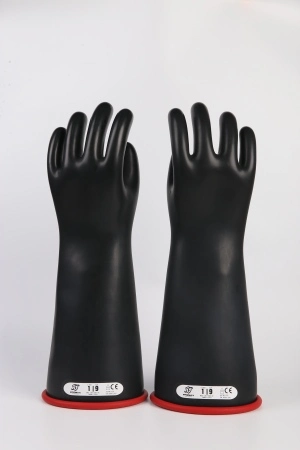
|
Parameter |
Specification |
|
Voltage Rating |
7,500V AC / 11,250V DC (Maximum Use) |
|
Proof Test Voltage |
10,000V AC / 40,000V DC |
|
Material Type |
Type I (Natural Rubber) / Type II (EPDM Synthetic) |
|
Thickness Range |
1.02mm - 1.52mm |
|
Tensile Strength |
>17.2 MPa |
|
Standards Compliance |
ASTM D120, IEC 60903 |
|
Temperature Resistance |
Category A, H, Z rated |
|
Label Color |
White (Class 1 Standard) |
Understanding Electrical Insulation and Ozone Degradation
Electrical insulating gloves are the most important thing that keeps workers from being exposed to voltage, which could be fatal. These special safety gear items have to stay strong in a wide range of conditions, such as being exposed to ozone, which is a reactive gas that is common in industrial settings, especially near high-voltage equipment and electrical arcing operations.
What Makes Voltage-Rated Gloves Essential
Wearing rubber gloves that are approved for voltage is the best way to avoid getting an electrical shock at work. Unlike regular work gloves, these devices are put through strict insulation tests to make sure they can handle certain voltage levels. The system for rating gloves is based on ASTM D120 and IEC 60903 standards. Gloves are put into four groups, Class 00 through Class 4, with each group having a maximum use voltage of 500V to 36,000V AC.
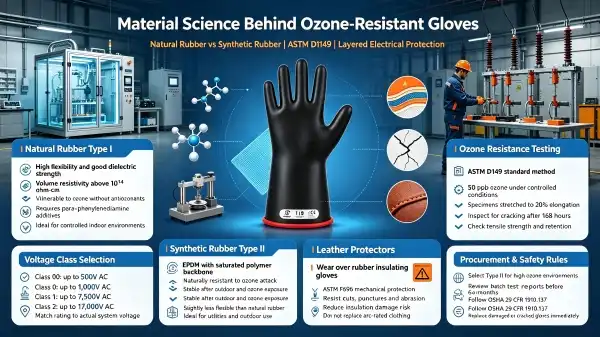
Class 1 Insulating Gloves are very important in this range because they protect workers who are working with devices that have up to 7,500 volts AC and 11,250 volts DC. Their proof test voltage goes up to 10,000V AC, which gives them a lot of safety. Because of this, electrical contractors, telecommunications technicians, and maintenance workers who work with distribution systems, substations, and industrial power infrastructure can't do their jobs without them.
How Ozone Attacks Rubber Compounds
Degradation by ozone is one of the sneakiest threats to safety gear made of rubber. This very reactive type of oxygen goes after the molecular structure of rubber polymers, mainly going after double bonds in molecules that are not saturated. The chemical reaction makes surface cracks that move deeper into the material when it is stressed mechanically. This makes the glove less insulating in the long run.
Corona discharge from high-voltage lines, electrical motors, welding tools, and UV sterilisation systems raises the amount of ozone in the air for Class 1 Insulating Gloves. Even low amounts of ozone in the air (measured in parts per billion) can cause damage after months of use and storage. The cracks that form may look like thin lines going across stress points. They are often hard to see at first glance, but they are big enough to let electricity flow through the insulation.
The Rubber Manufacturers Association has research that shows natural rubber that hasn't been handled can crack when exposed to ozone amounts as low as 25 parts per hundred million within weeks. This weakness has a direct effect on how reliable gloves are, so ozone resistance is an important requirement for procurement professionals who are in charge of worker safety programs.
Material Science Behind Ozone-Resistant Formulations
The main thing that decides how resistant electrical insulating gloves are to weather degradation is what they are made of. Through chemical engineering and careful choice of materials, modern production methods have changed to deal with the dangers of ozone.
Natural Rubber Versus Synthetic Compounds
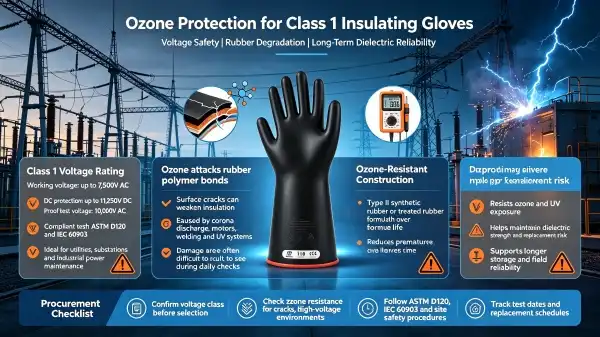
Natural rubber latex was used in traditional insulation gloves because it is very flexible and has great dielectric qualities. With a volume resistivity greater than 10^14 ohm-centimeters, natural rubber is a great electrical insulator. It also has great elongation properties that help workers keep their flexibility while doing difficult jobs. But the unsaturated polymer chains in natural rubber are still easily damaged by ozone unless they are protected with additives that protect them.
When making Type I gloves out of natural rubber, they need special antiozonant chemicals, which are usually para-phenylenediamine derivatives, to protect the surface of the rubber. These additives move to areas that are exposed to ozone and deal with it before it can hurt the polymer matrix underneath. The effectiveness of this protection depends on how well the ingredients are balanced. If there is too much antiozonant, it can damage the electrical properties or change the colour.
Synthetic elastomers, mostly ethylene propylene diene monomer (EPDM) rubber, are used in Type II gloves. The saturated polymer backbone of EPDM is naturally resistant to ozone breakdown, which takes away natural rubber's main weakness. This man-made mixture keeps its stable properties even after being outside for a long time or being stored near equipment that makes ozone. In exchange, synthetic rubber is a little less flexible than natural rubber, but current production techniques have made this difference less noticeable.
At PPE MAX, we smartly use both types of materials during the manufacturing process. Our Type II formulas are made for utilities and outdoor uses where maximum ozone protection is needed because of the environment. On the other hand, our Type I variants with improved antiozonant packages are made for controlled indoor environments that need the utmost flexibility.
Testing Protocols That Verify Protective Capacity
Standardised testing methods that mimic fast-aging conditions are used to make sure the quality of ozone resistance. The ASTM D1149 standard lays out the steps for putting rubber samples through controlled levels of ozone (usually 50 parts per billion) while they are under certain temperature, humidity, and pressure conditions. Test specimens are stretched to 20% of their original length and watched for 168 hours to see if cracks form.
Manufacturers who are dedicated to making voltage-rated safety equipment that works well test each batch of their products in this way. The fact that there are no obvious cracks under a microscope proves that the ozone resistance is good enough for the planned service life. To make sure that the material doesn't break down too much during the glove's useful life, extra steps are taken to check its tensile strength retention and elongation properties after being exposed to the environment.
Once gloves are in use, they are tested electrically every six months to make sure the dielectric integrity stays strong. For Class 1 Insulating Gloves, the proof test voltage of 10,000V AC is used while the hand is immersed in water. Any current loss greater than 16 milliamperes means the insulation is failing and needs to be replaced right away. OSHA 29 CFR 1910.137 requires this thorough testing program, which sets up several proof steps that keep workers safe from broken equipment.
If you're evaluating personal protective equipment suppliers and require batch-specific testing documents before placing an order, PPE MAX is able to provide official Certificates of Analysis, professional laboratory test reports, and product samples for your verification. Feel free to contact our team at marketing@ppemax.com to discuss your sourcing needs and obtain complete documentation for your quality assessment and procurement approval.
Performance Comparison Across Glove Classifications
Procurement professionals can choose the best protection for each job by knowing how different glove classes and materials work in different situations.
Voltage Rating Impact on Material Selection
Class 1 Insulating Gloves protect against electricity while still being useful for work at the distribution level. With a maximum use voltage of 7,500V AC, they can handle most industrial power systems, such as 480V, 2.4kV, and 4.16kV three-phase circuits that are popular in factories and office buildings. The fairly modest thickness—between 0.7mm and 1.5mm—keeps the tactile awareness needed to move control components, circuit breakers, and fuses.
Class 2 gloves protect against 17,000V AC, but they are made of thicker rubber, which makes them less flexible. This better classification is needed for utility cable work and substation upkeep, but the extra weight makes it harder to do small jobs. It is important for procurement choices to match voltage ratings with actual system voltages. This way, over-specification doesn't hurt worker output without really improving safety.
Class 00 (500V AC) and Class 0 (1,000V AC) are lower classifications that are used for specific tasks in automotive electrical systems, battery maintenance, and low-voltage control circuits. These smaller gloves make it easier to move your fingers, but they don't protect well enough against voltages at the distribution level. By making things easy to see—beige for Class 00, red for Class 0, and white for Class 1—the colour-coding scheme stops dangerous misuse.
Why Leather Protectors Complement Rubber Insulation
Electrical safety rules say that you should always wear leather protective gloves over rubber insulating gloves. This mix protects against a major weakness: the fact that rubber compounds are easily broken. Even versions that are resistant to ozone can still be cut, punctured, and worn down by tools, sharp edges, and rough surfaces that are used in electrical work.
Leather covers that meet ASTM F696 standards are resistant to mechanical damage that would damage the insulation layer otherwise. The protector needs to fit well without leaving too many gaps that shorten the distance of the flashover along the rubber cuff. Good leather covers can also help with arc flash protection, but they can't replace clothing that is rated to be arc-resistant.
The defense-in-depth safety theory is shown by this layered method. Multiple security barriers make sure that worker injuries don't happen when one point fails. The leather on the outside of the rubber glove keeps the surface from getting damaged, which extends its useful life. The rubber on the inside keeps electrical protection in place. They work together to make a system that is stronger than the sum of its parts.
Maintenance Practices That Preserve Ozone Resistance
How long electrical shielding gloves keep their protective properties is directly related to how well they are cared for. Strategic care increases the life of an asset while keeping it safe.
Cleaning Methods That Avoid Chemical Damage
Rubber can break down faster than just being exposed to ozone because of oils, solvents, and industrial waste. These things are taken out of the gloves before they can get inside them by cleaning them regularly. Mild soap solutions, which are pH-neutral detergents without harsh solvents, and lukewarm water are what you should use. When washing gloves by hand, workers should be careful not to scrub too hard because that could damage the surface.
Solvents made from gasoline, chlorinated hydrocarbons, and strong alkaline cleaners are all cleaning products that are not allowed. These chemicals break down rubber compounds, making them swell, become soft, or break easily. This weakens both their mechanical strength and their ability to conduct electricity. Even alcohol-based hand sanitisers need to be used with care, since repeated use can remove protective ingredients from the rubber matrix.
Gloves should be hung up to dry completely in the air after being washed so that they don't wrinkle or fold. Mould can grow in storage where there is still some moisture, and chemicals break down faster. The drying area must not have any sources of ozone, direct sunlight, or too much heat, as these are all things that speed up the ageing process.
Storage Conditions That Minimize Environmental Exposure
Voltage-rated safety equipment has a much longer useful life when it is stored properly. Gloves should be kept in cool, dark places where the temperature stays steady between 10°C and 21°C (50°F to 70°F). Between 50% and 70% relative humidity keeps things from drying out too much or getting too wet.
Electrical equipment that makes ozone, like motors, transformers, and battery charge stations, must be kept away from storage areas. UV rays from sunshine or fluorescent lighting speed up the breakdown of polymers, which is why they need to be stored in opaque cases or boxes that are just for that purpose. Canvas glove bags are movable and protect your hands while you're travelling, while still letting air flow.
When gloves are being stored, they should never be folded or strongly bent because the fold lines are where mechanical stress builds up, and ozone cracks are most likely to happen. This stress buildup can be avoided by hanging storage systems or putting things horizontally in shallow boxes. By keeping rubber compounds separate from copper, manganese, and other catalytic metals, chemical reactions that can break down the compounds are avoided.
Inspection Protocols for Early Damage Detection
Systematic visual and physical inspection before each use finds problems as they start to form, before they become dangerous. By blowing up the glove and listening for air leaks while applying light pressure, the air inflation test finds pinhole flaws that can't be seen with the naked eye. Technicians should roll the cuff of the glove to trap air inside it, then carefully look over the whole surface while gently squeezing it.
Visual inspection in good lighting looks for certain signs, such as surface cracks, especially those that run perpendicular to stress points; discolouration that could mean chemicals are present; swelling or soft spots that mean the compound is breaking down; foreign objects embedded in the material; and breakdown at stress points close to the fingers and thumbs. Any condition that raises questions should be taken out of service right away until a professional can look at it.
Documentation systems that keep track of test results, review dates, and service records make it possible to repair things before they break. A lot of companies use barcode or RFID tracking that is built into their maintenance management systems to make sure that no glove goes past its test interval or recommended service life. This data-driven method changes the way safety equipment is managed from being reactive to being proactive.
Procurement Strategies for B2B Buyers
To find suppliers and goods that regularly provide ozone-resistant electrical insulating gloves, you need to carefully consider a lot of different factors.
Certification Verification and Compliance Documentation
Manufacturers who are serious about their business provide a lot of proof that their products meet international safety standards. For North American markets, procurement workers should check that ASTM D120 is followed, and for foreign operations, they should check that IEC 60903 is followed. If it has the CE mark, it means it meets the requirements of the European Personal Protective Equipment Regulation (EU) 2016/425. If it has the OSHA mark, it means it can be used in US workplaces.
Ask for test reports from approved third-party labs that show the dielectric withstand testing, ozone resistance evaluation, and physical property measurements were completed successfully for Class 1 Insulating Gloves. These papers should have data that is specific to the batch, not general product specs. Manufacturers who keep their ISO 9001 quality management systems and ISO 45001 health and safety at work certifications show that they are committed to consistently high product quality.
Be wary of sellers who offer surprisingly low prices without showing the necessary certifications. Electrical safety equipment that isn't real is very dangerous because you can't be sure that the materials used meet the claims made about them. The price difference between real safety gear and worker injury claims, fines, and damage to your image makes certification proof a good investment.
Supplier Evaluation Beyond Price Considerations
Long-term partnerships with suppliers offer more value than just figuring out the unit cost. Manufacturers should be judged on their professional support, which should include things like pre-purchase advice, product training, and helpful customer service. Instead of just fulfilling orders, suppliers should help customers choose the right classifications for their needs.
When a company has a lot of employees working in different places, production capacity and supply chain dependability become very important. Equipment shortages can stop operations from running smoothly if vendors can keep their stock levels stable and meet delivery dates. Customisation options, such as private labelling, custom sizes, and changed packaging, make it more valuable for distributors who are building their own brands.
Over the past 65 years, PPE MAX has built its name by putting customer ties ahead of product quality. Our global supply chain delivers reliably to 134 countries, and our technical support team gives advice based on decades of knowledge in the field and your unique needs. Visitors are welcome to come see how our factories work in Xi'an. This gives people confidence in our dedication to worker safety.
Negotiating Bulk Orders and Long-Term Agreements
Buying in bulk can help you get better prices and make sure you always have a supply. When discussing bulk orders, you should talk about more than just unit prices. You should also talk about payment terms, delivery plans, and help with managing your supplies. Some makers offer vendor-managed inventory programs or consignment deals that lower the amount of working capital needed while still keeping enough stock on hand.
Long-term supply deals are good for both parties because they make sure that prices stay stable and demand is reliable. There should be quality promises, performance standards, and ways to deal with defective goods in these contracts. You might want to include provisions for reviewing the specifications regularly as technology improves or operational needs change.
Before committing to big sales, ask for samples. End users, like the electricians who will be using this equipment, can give information that isn't in the specifications sheets. Comfort, agility, and accurate size all have a direct effect on how well people follow the rules for using PPE. If workers find tools too heavy, they might not follow safety rules, which takes away from the value of high-quality goods.
Conclusion
Ozone protection is an important feature that electrical insulating gloves must have when they are used in real-life industry settings. Rubber compounds are chemically vulnerable to ozone degradation, which directly threatens the safety workers depend on when they approach powered systems. Modern manufacturing techniques, especially Type II synthetic formulations and improved antiozonant treatments, effectively fix this weakness while keeping the dielectric strength and flexibility needed for electrical work. Instead of just looking at unit cost, procurement workers should look at suppliers' certifications, material specifications, and how reliable they are in the long run. The glove's ozone protection stays high as long as it is cleaned properly, stored properly, and inspected regularly as part of a comprehensive care plan. When companies do these things and work with reputable makers, they make strong safety plans that protect workers and keep operations running.
FAQ
1. How can I determine if my current gloves have adequate ozone resistance?
Check the manufacturer's instructions for the material makeup. Type II gloves made of EPDM rubber are naturally resistant to ozone, but Type I natural rubber gloves need antiozonant chemicals. Check the certifications for the results of the ASTM D1149 ozone protection test. Check the gloves visually for small surface cracks that run perpendicular to areas of stress, especially along the palm and near the fingers. If gloves have been used for more than six months without being tested for electricity or if the surface looks like it might be breaking, they should be tested right away for dielectric and maybe even replaced. Suppliers should give detailed specs and material safety data sheets that describe how resistant the material is to ozone.
2. What environmental factors accelerate ozone damage to insulating gloves?
Ozone exposure goes up when things are stored or used near high-voltage equipment, electrical motors, welding, and UV sterilisation systems. UV radiation from direct sunlight and fluorescent lighting makes the damage done by ozone even worse. When temperatures are above 25°C (77°F), ozone and rubber plastics respond more quickly chemically. Ozone cracking starts more often in places where there is mechanical stress from folding or creasing. More damage is done than just by ozone contact when oils, solvents, or copper chemicals get into the material.
3. Can damaged gloves be repaired, or must they be replaced?
Once they are broken, electrical shielding gloves can't be fixed. Any damage to the insulating material, like cuts, punctures, cracks, or strange items stuck in it, needs to be taken out of service right away and replaced. The stability of the dielectric rests on continuous insulation that doesn't have any flaws that could let electricity flow. Trying to fix something breaks safety rules and makes the electricity behave in unpredictable ways. Companies should keep enough gloves on hand so that they can repair broken ones right away without stopping work.
Partner with PPE MAX for Reliable Electrical Protection Equipment
For electrical safety, every piece of your protective equipment program must be of the highest quality. PPE MAX has been a star in the Class 1 Insulating Gloves business for more than 60 years. They make voltage-rated gloves that are resistant to ozone and are designed for tough industrial settings. Our goods meet or go beyond ASTM D120, IEC 60903, and OSHA standards. They come with full testing records that meet the strictest requirements for buying things. We know that business-to-business buyers need more than just products. You need quick technical support, reliable delivery times, and low prices for large orders. Our team would love the chance to talk about your unique application needs and suggest the best products from our wide range. Get in touch with our purchasing experts at marketing@ppemax.com to find out how our OEM partnerships, ability to customise, and global distribution network can help your worker safety programs while also helping you meet your operational and financial goals.
References
1. American Society for Testing and Materials. "ASTM D120-20: Standard Specification for Rubber Insulating Gloves." ASTM International, 2020.
2. International Electrotechnical Commission. "IEC 60903:2019: Live Working - Electrical Insulating Gloves." Third Edition, 2019.
3. Occupational Safety and Health Administration. "29 CFR 1910.137: Electrical Protective Equipment." United States Department of Labor, 2021.
4. Rubber Manufacturers Association. "Environmental Degradation of Rubber Compounds: Mechanisms and Prevention Strategies." RMA Technical Report Series, 2018.
5. National Institute for Occupational Safety and Health. "Personal Protective Equipment for Electrical Hazards: Selection and Use Guidelines." NIOSH Publication No. 2017-145, 2017.
6. Institute of Electrical and Electronics Engineers. "IEEE Std 1584-2018: Guide for Performing Arc-Flash Hazard Calculations." IEEE Standards Association, 2018.
Learn about our latest products and discounts through SMS or email