- English
- French
- German
- Portuguese
- Spanish
- Russian
- Japanese
- Korean
- Arabic
- Greek
- German
- Turkish
- Italian
- Danish
- Romanian
- Indonesian
- Czech
- Afrikaans
- Swedish
- Polish
- Basque
- Catalan
- Esperanto
- Hindi
- Lao
- Albanian
- Amharic
- Armenian
- Azerbaijani
- Belarusian
- Bengali
- Bosnian
- Bulgarian
- Cebuano
- Chichewa
- Corsican
- Croatian
- Dutch
- Estonian
- Filipino
- Finnish
- Frisian
- Galician
- Georgian
- Gujarati
- Haitian
- Hausa
- Hawaiian
- Hebrew
- Hmong
- Hungarian
- Icelandic
- Igbo
- Javanese
- Kannada
- Kazakh
- Khmer
- Kurdish
- Kyrgyz
- Latin
- Latvian
- Lithuanian
- Luxembou..
- Macedonian
- Malagasy
- Malay
- Malayalam
- Maltese
- Maori
- Marathi
- Mongolian
- Burmese
- Nepali
- Norwegian
- Pashto
- Persian
- Punjabi
- Serbian
- Sesotho
- Sinhala
- Slovak
- Slovenian
- Somali
- Samoan
- Scots Gaelic
- Shona
- Sindhi
- Sundanese
- Swahili
- Tajik
- Tamil
- Telugu
- Thai
- Ukrainian
- Urdu
- Uzbek
- Vietnamese
- Welsh
- Xhosa
- Yiddish
- Yoruba
- Zulu
Top-Rated Electrical Rubber Gloves for Live Work & Arc Flash
Founded in 1956, PPEMAX stands as a premier global manufacturer and supplier of full-range personal protective equipment. All our products comply with internationally recognized standards including IEC, ASTM, CE, UKCA, NIOSH and ISO9001. Equipped with a 2,000-square-meter modern production plant, we boast over 25 years of mature OEM & ODM capabilities to deliver one-stop customized solutions covering R&D design through worldwide logistics. Our safety gear is distributed across 134 countries globally. Upholding our core tenet “Safety First, Quality Priority”, we serve as a dependable long-term PPE partner for industrial enterprises around the world.
When working on energized systems or handling potential arc flash hazards, electrical rubber gloves serve as the frontline defense against life-threatening injuries. These insulating gloves are meticulously engineered to prevent electrical current from passing through your body, offering crucial protection across voltage ranges from residential service work to high-voltage industrial applications. Selecting the right gloves involves understanding voltage classifications, certification standards, and material properties that directly impact worker safety and regulatory compliance.
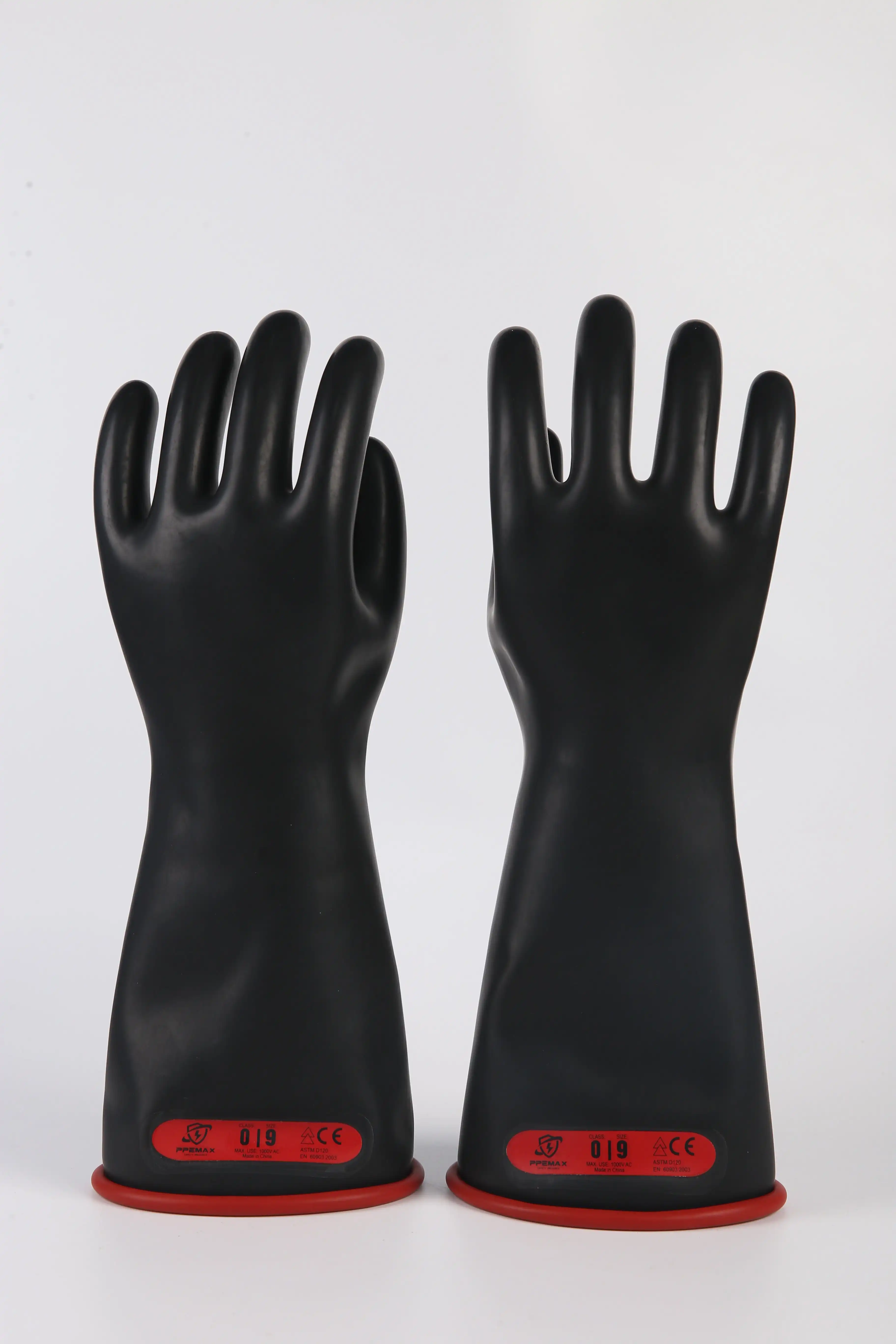
|
Parameter |
Specification |
|
Maximum Use Voltage |
1,000V AC / 1,500V DC |
|
Proof Test Voltage |
5,000V AC / 20,000V DC |
|
Label Color |
Red (ASTM D120/IEC 60903) |
|
Material Type |
Type I (Natural Rubber) / Type II (EPDM) |
|
Thickness |
1.02mm (0.040 inches) |
|
Length Options |
11", 14", 16" inches |
|
Cuff Styles |
Straight, Bell, Contour |
|
Standards Compliance |
ASTM D120, IEC 60903, OSHA 29 CFR 1910.137 |
Understanding Electrical Insulating Gloves: Classes and Applications
There is no one size that fits all when it comes to voltage-shielding gloves. Based on their maximum use voltage, the industry divides them into different classes. Each class is designed for a certain set of operational conditions and safety needs.
Class 00 Gloves: Low-Voltage Precision Work
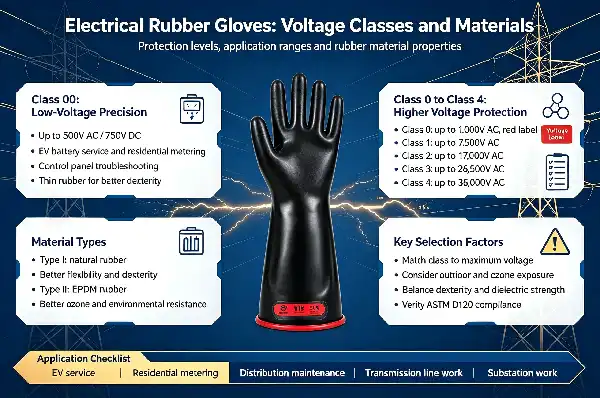
The highest power that Class 00 gloves can handle is 500V AC or 750V DC. Electric vehicle service technicians who work on battery systems, residential utility workers who install meters, and industrial maintenance engineers who troubleshoot control panels all wear these gloves. The thin rubber shape gives workers great flexibility, so they can work with small terminal links and touchscreens without taking off their safety gear. When disconnecting high-voltage EV battery packs that usually operate between 400V and 800V, which is a dangerous job that requires a lot of mechanical precision, automotive technicians really appreciate these gloves.
Class 0 Through Class 4: Scaling Protection for Higher Voltages
According to ASTM D120 standards, Class 0 insulating gloves can handle voltages of up to 1,000V AC and 1,500V DC. They can be identified by their red labels. These gloves are useful for both working on control circuits and maintaining the distribution grid. They make the dielectric stronger while still letting you move your hands easily enough for meter installations and other confined-space electrical tasks.
As the voltage level goes up, Class 1 gloves protect workers up to 7,500V AC, Class 2 gloves up to 17,000V AC, Class 3 gloves up to 26,500V AC, and Class 4 gloves up to 36,000V AC. Each class that goes up needs a thicker rubber build, which makes the product less sensitive to touch but gives it the dielectric stability needed for work on transmission lines and in substations.
Material Types: Natural Rubber Versus EPDM
When we make insulated gloves, we use two main types of rubber materials, and each one performs differently. Type I gloves are made of natural rubber, which gives them better flexibility and dexterity, which workers like when they have to wear them for long periods of time. EPDM (ethylene propylene diene monomer) is used to make Type II electrical rubber gloves because it is better than natural rubber at resisting ozone cracking and environmental degradation when used outside or in high-ozone industrial settings.
Certification Standards Ensuring Worker Protection
Global safety rules control the making and testing of insulating gloves. These rules build trust in the procurement process by setting high-quality standards that protect workers and businesses.
ASTM Standards: The North American Benchmark
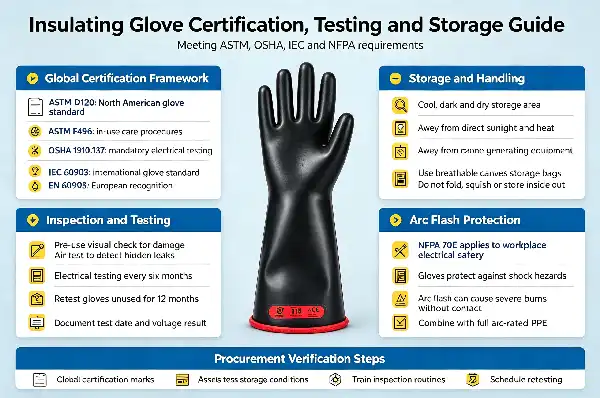
In North America, ASTM D120 sets the standards for rubber insulation gloves that are used for electrical work. This standard tells manufacturers what voltage class ratings, physical properties, and performance standards they need to meet. ASTM F496 adds to D120 by laying out care procedures that can be done while the equipment is still in use. For example, OSHA 29 CFR 1910.137 requires that electrical testing be done every six months. Together, these standards make a complete safety system that is used from the time the product is made until it is used in the field.
International Standards: IEC and EN Recognition
IEC 60903 is the international version of ASTM D120, which helps multinational companies buy things in the same way all over the world. The European Standard EN 60903 is similar to the IEC standards and also includes local licensing requirements. When purchasing managers understand these different certification systems, they can find gloves that meet local regulations in different operational areas without lowering the level of protection.
NFPA 70E and Arc Flash Considerations
The NFPA 70E standard from the National Fire Protection Association covers electrical safety in the workplace and has specific rules for arc flash defense. Insulating gloves are mostly used to protect against shock hazards, but they can also be used as part of a full arc-rated PPE set. Arc flashes create intense heat and pressure waves that can burn badly even if there is no direct electrical contact. This is why full protection systems are necessary for working with live electricity.
Inspection and Maintenance Protocols
To keep thermal gloves in good shape, they need to be inspected regularly and stored in a way that keeps them safe and extends their useful life.
Pre-Use Visual and Physical Inspection
Before each use, workers must visually check for holes, tears, strange objects lodged inside, or changes in the material's texture that could mean it has been damaged by ozone or chemicals. The air test is still the best way to do an inspection in the field. Workers blow up the glove by trapping air inside it and then roll it up toward their fingers while listening and feeling for air escaping, which would mean the rubber barrier isn't working right.
Electrical Testing Requirements
Electrical testing must be done on gloves every six months after they are put to use according to ASTM F496 and OSHA rules. During testing, gloves are put in a conductive solution, and a certain proof test voltage is applied while current leakage is watched for signs of dielectric breakdown. Gloves that have been stored and not used for more than twelve months cannot be given to workers until they have been tested again. This testing can only be done by approved labs with properly adjusted tools, and each glove comes with paperwork that lists the date of the test, the voltage that was used, and the pass/fail results.
Storage and Handling Best Practices
How you store your electrical rubber gloves has a big effect on how long they last and how well they work. Gloves should be kept in cool, dark, dry places that are away from direct sunlight, heat sources, and machines that make ozone. Canvas storage bags keep things from being squished and folded, which can cause stress points in rubber. If you want to keep gloves in good shape, you should never store them inside out or when they are wet. When leather guard gloves are not being used, they should be kept separate from rubber gloves so that chemicals from the leather treatments don't get into the rubber.
If you're evaluating personal protective equipment suppliers and require batch-specific testing documents before placing an order, PPE MAX is able to provide official Certificates of Analysis, professional laboratory test reports, and product samples for your verification. Feel free to contact our team at marketing@ppemax.com to discuss your sourcing needs and obtain complete documentation for your quality assessment and procurement approval.
Procurement Strategies for B2B Buyers
When looking for insulating gloves for safety programs that cover multiple sites and a wide range of electrical work settings, large buyers have to think about a number of things that smaller buyers don't have to.
Volume Requirements and Customization
Industrial safety wholesalers and building companies usually keep a stock of gloves that can protect hundreds or thousands of workers from different amounts of voltage. Ordering in bulk saves money and makes sure that the quality of the products is the same across the whole organization. A lot of makers, including ours, let you make changes to their products. For example, they can add your own label or meet specific length needs. They also have color-coding systems that make it easier for businesses to keep track of glove classes and inspection plans.
Sizing Across Diverse Workforces
Gloves that keep you warm usually come in sizes 7 to 12, and many product lines offer half sizes. The right size affects both safety and productivity. Gloves that are too big make it harder to control your fingers and can slip off during important tasks. Gloves that are too small make it hard to move and make your hands tired. Companies with a lot of employees can benefit from hand-measuring programs that set an average size distribution. This helps them buy the right amount of each size and get rid of extra stock in sizes that aren't used as often.
Supplier Qualification and Authentication
There are unfortunately fake electrical safety gloves on the market that look like real ones but don't meet the actual dielectric or physical property requirements. Managers in charge of buying things should make sure that sellers give them all of their certification paperwork, including test records from recognized labs. From the time they are made until they are delivered, authorized distributors keep proper storage conditions and chain-of-custody documentation that keep gloves in good shape. Building relationships with well-known companies that stand behind their goods with technical help and warranties is valuable in the long run, even after the initial cost of the purchase.
Why Partner With PPE MAX for Your Insulating Glove Needs
Personal protective equipment that meets the tough needs of electrical work in the industrial, utility, and construction sectors is what we've been making since 1956. Our shielding glove line includes gloves for all voltage classes and is made of both natural rubber and EPDM. Before leaving our plant, each batch goes through strict quality checks.
As the biggest PPE maker in Northwest China, we serve customers in 134 countries by combining decades of production experience with quick technical support that helps procurement managers choose the right protection for the job. As users, not just makers, our team personally tries the gear we make, which leads to constant improvements in comfort, durability, and safety.
We know that B2B buying is more than just looking at product specs. It also includes making sure the supply chain is reliable, helping with paperwork to make sure regulations are followed, and making sure that partnerships are flexible enough to meet the changing needs of organizations. Because we offer OEM and ODM services, distributors and global brands can make their own solutions while still using our well-established quality systems and large production scale. Whether you need standard certified products delivered on a regular basis or custom-engineered solutions for specific uses, our technical staff works directly with your team to make sure that workers are safe and that purchases are made quickly and easily.
Conclusion
To choose the right voltage-insulating electrical rubber gloves, you need to know about classification systems, licensing standards, and upkeep requirements that have a direct effect on worker safety and compliance with company policy. Class grades from 00 to 4 cover a range of voltage exposures, and ASTM, IEC, and EN standards make sure that the quality of the manufacturing process and the stability of the product while it is in use. Systematic inspections and the right way to store gloves increase their useful life while keeping their protective qualities. If a business wants to buy something from another company, they need to weigh the technical requirements against the supplier's dependability, ability to provide documentation support, and ability to make changes that fit with the company's safety programs across various sites and working environments.
FAQ
1. What is the mandatory retesting interval for voltage-rated gloves?
According to ASTM F496 and OSHA 1910.137, electrical testing of gloves must be done every six months after they are put to use. Before they can be given to workers, gloves that have been stored must be tested within twelve months of the date they were last certified. This test makes sure that the rubber still has its insulating qualities and hasn't changed in any way that would make it less protective.
2. Are leather protector gloves always required?
When working with electricity, leather protectors are required for all voltage classes. In case the rubber's electrical insulation is compromised by cuts, abrasions, or punctures, they protect against those mechanical problems. To keep energy from spreading across the glove's surface, the rubber glove needs to be at least two inches longer than the leather cover.
3. Can insulating gloves be used for DC voltage applications?
Voltage-rated gloves can handle both AC and DC voltages, but the highest voltages that can be used with each type of current are different. It is safe to wear Class 0 gloves at 1,500V DC as well as 1,000V AC. Workers need to make sure that their gloves are rated for the type of power they will be dealing with at work.
Contact PPE MAX: Your Trusted Electrical Rubber Gloves Supplier
Improve your electrical safety program with insulated gloves that have been used by world leaders in industry for years and are trusted. When you buy certified voltage-rated gloves from PPE MAX, you get full technical help and a solid global delivery network. Our skilled team helps purchasing managers find the best classification rules, volume discounts, and customization choices that meet the needs of your business. Get in touch with us at marketing@ppemax.com to talk about your needs, get detailed product specs, or get a quote that is made just for your business. As a well-known company that makes electrical rubber gloves for customers in six countries, we bring decades of experience to every relationship. This means that you can be sure that your workers are safe and that your company stays in line with changing safety rules.
References
1. American Society for Testing and Materials. (2022). ASTM D120-20: Standard Specification for Rubber Insulating Gloves. West Conshohocken, PA: ASTM International.
2. American Society for Testing and Materials. (2021). ASTM F496-20: Standard Specification for In-Service Care of Insulating Gloves and Sleeves. West Conshohocken, PA: ASTM International.
3. International Electrotechnical Commission. (2023). IEC 60903:2023: Live Working—Gloves of Insulating Material. Geneva, Switzerland: IEC Publications.
4. Occupational Safety and Health Administration. (2020). 29 CFR 1910.137: Electrical Protective Devices. Washington, DC: U.S. Department of Labor.
5. National Fire Protection Association. (2021). NFPA 70E: Standard for Electrical Safety in the Workplace. Quincy, MA: NFPA Publications.
6. European Committee for Electrotechnical Standardization. (2019). EN 60903:2019: Live Working—Gloves of Insulating Material. Brussels, Belgium: CENELEC Standards.
Learn about our latest products and discounts through SMS or email