- English
- French
- German
- Portuguese
- Spanish
- Russian
- Japanese
- Korean
- Arabic
- Greek
- German
- Turkish
- Italian
- Danish
- Romanian
- Indonesian
- Czech
- Afrikaans
- Swedish
- Polish
- Basque
- Catalan
- Esperanto
- Hindi
- Lao
- Albanian
- Amharic
- Armenian
- Azerbaijani
- Belarusian
- Bengali
- Bosnian
- Bulgarian
- Cebuano
- Chichewa
- Corsican
- Croatian
- Dutch
- Estonian
- Filipino
- Finnish
- Frisian
- Galician
- Georgian
- Gujarati
- Haitian
- Hausa
- Hawaiian
- Hebrew
- Hmong
- Hungarian
- Icelandic
- Igbo
- Javanese
- Kannada
- Kazakh
- Khmer
- Kurdish
- Kyrgyz
- Latin
- Latvian
- Lithuanian
- Luxembou..
- Macedonian
- Malagasy
- Malay
- Malayalam
- Maltese
- Maori
- Marathi
- Mongolian
- Burmese
- Nepali
- Norwegian
- Pashto
- Persian
- Punjabi
- Serbian
- Sesotho
- Sinhala
- Slovak
- Slovenian
- Somali
- Samoan
- Scots Gaelic
- Shona
- Sindhi
- Sundanese
- Swahili
- Tajik
- Tamil
- Telugu
- Thai
- Ukrainian
- Urdu
- Uzbek
- Vietnamese
- Welsh
- Xhosa
- Yiddish
- Yoruba
- Zulu
Are Your Dielectric Gloves Stored Correctly to Preserve Dielectric Strength?
Founded in 1956, PPEMAX stands as a premier global manufacturer and supplier of full-range personal protective equipment. All our products comply with internationally recognized standards including IEC, ASTM, CE, UKCA, NIOSH and ISO9001. Equipped with a 2,000-square-meter modern production plant, we boast over 25 years of mature OEM & ODM capabilities to deliver one-stop customized solutions covering R&D design through worldwide logistics. Our safety gear is distributed across 134 countries globally. Upholding our core tenet “Safety First, Quality Priority”, we serve as a dependable long-term PPE partner for industrial enterprises around the world.
Proper storage of dielectric gloves directly impacts their ability to protect workers from electrical hazards. When stored correctly in cool, dry, and contamination-free environments, these voltage-rated gloves maintain their insulating properties and dielectric strength. However, exposure to temperature fluctuations, ozone, ultraviolet light, petroleum products, or physical damage from improper folding significantly reduces their protective capability. Procurement managers and safety professionals must implement structured storage protocols that align with ASTM D120 standards to ensure compliance, extend glove lifespan, and safeguard personnel working in high-voltage environments across construction, energy, mining, and manufacturing sectors.
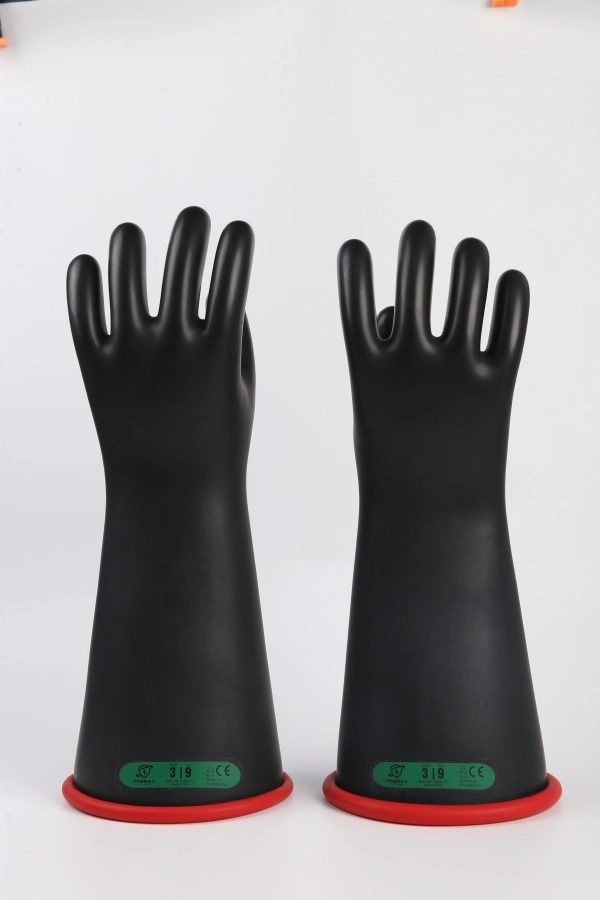
|
Parameter |
Specification |
Standard |
|
Maximum Use Voltage |
26,500V AC / 39,750V DC |
ASTM D120 / IEC 60903 |
|
Proof Test Voltage |
30,000V AC / 45,000V DC |
ASTM D120 |
|
Material Types |
Type I (Natural Rubber) / Type II (EPDM) |
ASTM D120 |
|
Thickness Range |
2.3mm - 2.9mm |
Industry Standard |
|
Length Options |
14" - 18" inches |
Customizable |
|
Label Color |
Green |
International Standard |
|
Temperature Range |
-25°C to +65°C |
Operating Conditions |
Understanding Dielectric Gloves and Their Dielectric Strength
Voltage-rated electrical safety gloves are the main thing that keeps workers safe from electrical currents that could kill them. Since 1956, PPE MAX has been making these important safety gears, so we know very well how the materials used and how they are put together affect how well they work. Natural rubber is still the most common material because it is better at insulating, but manufactured rubbers are used in some commercial settings.
Material Composition and Voltage Classifications
Electrical shielding gloves are put through a lot of tests based on ASTM D120 and IEC 60903 standards. These standards divide them into six different voltage classes, from Class 00 (500 volts AC) to Class 4 (36,000 volts AC). The molecular structure of the rubber substance determines how well it blocks the flow of electricity. This means that material consistency is very important for worker safety.
Why Dielectric Strength Matters to Your Operations
The dielectric strength tells you how much of an electric field a substance can take before it breaks down and lets electricity flow through it. This important safety factor has a direct effect on how safe your workers are when they come into contact with live equipment, power lines, or wires buried in the ground. When buying insulating gloves, procurement teams need to make sure that the manufacturer has the right certifications and know that dielectric strength decreases over time, especially when the storage conditions aren't good for the material.
Compliance Requirements for Industrial Procurement
Government agencies and big businesses that are in charge of electrical safety programs must follow OSHA 1910.137 rules, which say that rubber-insulated equipment must be tested for electricity on a regular basis and kept in good shape. Because of these rules, procurement teams need to make sure they only work with certified makers who can provide paperwork, traceability, and a quality guarantee all along the supply chain.
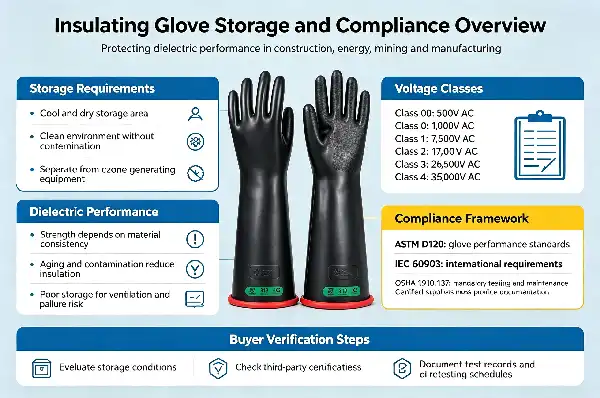
Common Causes of Dielectric Strength Loss in Gloves
The environment and the way dielectric gloves are handled can slowly weaken their defensive power, and there are often no obvious signs of this. We've learned from decades of manufacturing experience and feedback from 134 countries that there are specific ways that materials break down that procurement managers need to know about in order to protect their investments in workers.
Environmental Degradation Factors
Exposure to ozone is one of the environmental threats that hurts natural rubber compounds the most. Ozone is produced by electric motors, welding equipment, and ultraviolet light. It attacks the molecular chains in rubber, which makes tiny cracks that let heat escape. Extreme temperatures speed up this chemical breakdown. Storage areas that get above 32°C (90°F) or below freezing make rubber rigid or too soft, both of which lower its insulating performance.
Mold grows, and materials break down when the humidity is above 70%, and ultraviolet light from direct sunshine breaks down rubber and plastics at the molecular level. In industrial settings, these things often happen together, making degradation worse and cutting glove service life by a large amount.
Physical Damage from Improper Handling
When you fold something, press it down under heavy objects, or touch it on a rough surface, it can cause sharp lines that are more likely to cause an electrical breakdown. Petroleum-based products, like hand lotions, hydraulic fluids, and cleaning solvents, attack rubber compounds chemically. This makes them swell, soften, or lose their surface integrity, which makes them less insulating.
The Hidden Cost of Storage Neglect
When procurement departments don't follow the right storage rules, the number of replacements goes up a lot. We've seen operations replace voltage-rated gloves every six months because they break down from being stored incorrectly, even though gloves that are properly cared for should last three years or longer. This early replacement costs a lot of money that wasn't needed and hurts business budgets and the efficiency of buying.
If you're evaluating personal protective equipment suppliers and require batch-specific testing documents before placing an order, PPE MAX is able to provide official Certificates of Analysis, professional laboratory test reports, and product samples for your verification. Feel free to contact our team at marketing@ppemax.com to discuss your sourcing needs and obtain complete documentation for your quality assessment and procurement approval.
Best Practices for Storing Dielectric Gloves to Maintain Dielectric Strength
Using organized storage rules will protect your investment in good electrical safety gear and make sure that workers are always safe. The following practices are based on industry norms and PPE MAX's 60 years of experience making things, and they have been tried in a wide range of industrial settings around the world.
Optimal Environmental Conditions
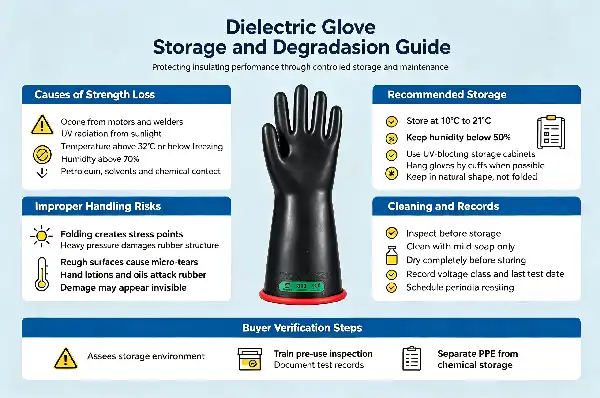
Electrical insulating gloves should be kept in climate-controlled areas that stay between 10°C and 21°C (50°F to 70°F) and have less than 50% relative humidity. Cabinets or rooms used for storage should be kept away from equipment that makes ozone, direct sunlight, and areas where chemicals are stored. We suggest putting in windows that block UV rays and using sealed containers that are made for voltage-rated safety equipment.
Proper Physical Storage Methods
When you put your gloves down, they should stay in their natural shape, not folded, creased, or squished. Made from breathable, non-reactive materials, purpose-designed glove bags keep out dust and dirt while letting moisture escape. When gloves are hung by their cuffs, hanging storage systems work well because gravity keeps the gloves in the right shape without putting too much stress on any one area.
Tracking information for each pair must include the date it was bought, the voltage class, the date of the last test, and the date of the next inspection. This paperwork helps procurement teams keep track of performance across different makers or production batches, rotate supplies, and plan tests.
Contamination Prevention Strategies
Before gloves can be put away, they need to be carefully checked over, cleaned with mild soap solutions that have been approved, and dried completely. Keep gloves away from metals (they can react chemically) and oily substances (they break down rubber) when you store them. Dedicated storage areas should stay separate from general tool storage so that industrial substances don't get on electrical protective equipment.
Maintenance, Testing, and Replacement Tips to Ensure Consistent Performance
Systematic testing and inspection programs are the building blocks of good electricity safety management. Procurement managers who are in charge of large glove inventories at multiple sites need standardized procedures that make sure everyone follows the rules, keeps workers safe, and gets the most out of replacement cycles.
Routine Visual Inspection Protocols
Before each use, users must carefully look at and feel the item to see if it has any holes, tears, foreign objects lodged inside, changes in texture, or discoloration that could mean chemical damage. The air inflation test, in which gloves are rolled up and inflated to find air leaks, is still the best way to find damaged areas in the field that an eye check might miss.
Electrical Testing Requirements
As per ASTM D120, electrical testing must be done on Class 00, 0, and 1 dielectric gloves gloves everyonths at most, and on Class 2, 3, and 4 gloves every twelve months. Controlled high-voltage stress is used in these tests to make sure that gloves keep their stated dielectric strength. These very important safety checks should only be done by trained testing labs with properly calibrated tools.
To keep operations running smoothly without breaking safety rules, procurement teams need to build relationships with vendors that include coordinating tests, keeping track of paperwork, and providing new gloves during testing times.
Strategic Replacement Planning
When deciding what to replace, you should look at the manufacturer's instructions, the test results, any obvious signs of wear, and the service records. If gloves fail electrical tests, show surface damage, or are getting close to the end of their manufacturer-specified service life, they must be thrown away right away, no matter how they look. Including a planned replacement schedule in procurement budgets stops buying things on the spot and makes sure there is enough inventory.
We suggest keeping 15 to 20 percent of extra inventory on hand to account for testing cycles, unexpected failures, and growing the workforce without creating safety gaps. This strategic cushion also gives you more power when dealing with suppliers for large purchases.
Choosing the Right Dielectric Gloves and Storage Solutions for Your Procurement Needs
To choose the right voltage-rated gloves, you have to weigh technical specs, operational needs, budget constraints, and the reliability of the supply chain. Professionals in charge of buying safety tools for big industrial operations need sellers who can do more than just send products.
Technical Selection Criteria
The voltage class chosen must be higher than the highest level of exposure that can be expected by the required safety limits as outlined in NOSH rules. The length of the gloves depends on how close the worker is to live equipment; longer gauntlets offer more safety for high-voltage tasks. Material thickness changes how flexible and sensitive it is to touch. This means that there are trade-offs between the level of protection and operational efficiency that should be tested in the field before they are bought on a large scale.
When working in harsh environments, temperature ratings are very important. Chemical protection ratings are important in places where insulating gloves might come into contact with oil, solvents, or industrial fluids. For these specific needs, suppliers need to have a lot of technical knowledge and be able to make things in a variety of ways.
Supplier Qualification Standards
Certified manufacturers should show all the paperwork needed to track their products, such as certifications for the raw materials they use, records of the quality of their production, and proof from independent testing. Look for providers that have quality management systems that are in line with ISO 9001 and show that they consistently follow ASTM D120 and IEC 60903 standards across multiple production runs.
Since 1956, PPE MAX has been Northwest China's biggest maker of safety gear. This shows how committed we are to quality, stability, and technical innovation. Our testing team, who are real people who use the equipment we make, brings real-world experience to the process of making new products. This makes sure that technical specs are met in the real world.
Integrated Storage Solutions
Controlling the surroundings, making things easier to find, and keeping things clean are all things that good storage systems do. Custom-made glove cabinets with separate sections, temperature control, and inventory tracking systems make it easier to keep track of paperwork and protect the equipment investment. Mobile storage carts help spread out work sites and keep things in good shape when they're out in the field.
When looking at different storage options, you should think about how easy they are to get to for regular checks, how much space they take up, and how well they work with other safety management systems you already have. When an organization uses the right mix of high-quality gloves and storage systems that have been approved by experts, it shows that it cares about electrical safety and gets real practical benefits like longer equipment life and lower replacement costs.
Conclusion
By storing electrical safety dielectric gloves properly, you can keep their insulating strength, which turns them from disposable costs into long-term safety investments. Environmental control, preventing contamination, systematic inspection, and strategic buying are some of the rules that are laid out here. They will protect both your employees and your business budget. Through disciplined storage practices, we've seen operations cut the cost of replacing gloves by 60% while also making sure that safety rules are followed more closely. When procurement managers work with experienced makers, they get access to technical know-how, consistent quality, and a reliable supply chain that goes beyond just delivering goods.
FAQ
1. How often should dielectric gloves undergo electrical testing?
As per ASTM D120, electrical testing must be done on Class 00, 0, and 1 gloves every six months. It must also be done on Class 2, 3, and 4 gloves used in high-voltage applications every twelve months. These time periods are the longest for which gloves can be used safely. More often, testing is recommended, especially for gloves that are used a lot or that are in harsh environments.
2. Can properly stored dielectric gloves last beyond manufacturer recommendations?
Proper storage greatly increases the useful life of gloves, but they still need to pass electrical tests and an eye check, no matter how old they are in terms of time. Manufacturer recommendations give you a general idea of how long something should last, but the actual service life depends on how much it is used, how it is stored, and its performance history.
3. What distinguishes dielectric glove storage from standard rubber glove storage?
Voltage-rated insulating gloves need to be protected from UV rays, ozone, oil products, sharp objects, and other things that might not be too bad for general-use rubber gloves. Because these gloves are used to protect lives in electrical work settings, they are kept in a controlled environment, each one is tracked, and check procedures are written down.
Partner with PPE MAX for Certified Dielectric Gloves and Expert Storage Solutions
Electrical safety options from PPE MAX are backed by nearly seven decades of excellent manufacturing. Our voltage-rated insulating gloves are made to strict ASTM D120 and IEC 60903 standards. They are used by procurement teams in 134 countries in the construction, energy, mining, and manufacturing industries. We do more than just sell certified products. We also offer technical advice on how to design storage systems, coordinate testing, and make the most of your investment in safety equipment. Our OEM manufacturing helps wholesalers build their own brands by giving them access to stable supply chains and quality products that have already been tested. Get in touch with our expert team at marketing@ppemax.com to talk about your specific needs for dielectric gloves supplier partnerships, large buying programs, or custom manufacturing solutions that solve the electrical safety problems your company is facing.
References
1. American Society for Testing and Materials. "ASTM D120-20 Standard Specification for Rubber Insulating Gloves." West Conshohocken: ASTM International, 2020.
2. International Electrotechnical Commission. "IEC 60903:2019 Live Working - Electrical Insulating Gloves." Geneva: IEC Publications, 2019.
3. Occupational Safety and Health Administration. "1910.137 Electrical Protective Equipment." Washington: U.S. Department of Labor, Federal Register Standards, 2018.
4. National Institute for Occupational Safety and Health. "Electrical Safety: Safety and Health for Electrical Trades Student Manual." Cincinnati: NIOSH Publications, 2017.
5. Institute of Electrical and Electronics Engineers. "IEEE Guide for Testing Procedures for Temporary Grounding and Bonding Equipment." New York: IEEE Standards Association, 2019.
6. Canadian Standards Association. "CSA Z462-21 Workplace Electrical Safety Standard." Toronto: CSA Group Publications, 2021.
Learn about our latest products and discounts through SMS or email