- English
- French
- German
- Portuguese
- Spanish
- Russian
- Japanese
- Korean
- Arabic
- Greek
- German
- Turkish
- Italian
- Danish
- Romanian
- Indonesian
- Czech
- Afrikaans
- Swedish
- Polish
- Basque
- Catalan
- Esperanto
- Hindi
- Lao
- Albanian
- Amharic
- Armenian
- Azerbaijani
- Belarusian
- Bengali
- Bosnian
- Bulgarian
- Cebuano
- Chichewa
- Corsican
- Croatian
- Dutch
- Estonian
- Filipino
- Finnish
- Frisian
- Galician
- Georgian
- Gujarati
- Haitian
- Hausa
- Hawaiian
- Hebrew
- Hmong
- Hungarian
- Icelandic
- Igbo
- Javanese
- Kannada
- Kazakh
- Khmer
- Kurdish
- Kyrgyz
- Latin
- Latvian
- Lithuanian
- Luxembou..
- Macedonian
- Malagasy
- Malay
- Malayalam
- Maltese
- Maori
- Marathi
- Mongolian
- Burmese
- Nepali
- Norwegian
- Pashto
- Persian
- Punjabi
- Serbian
- Sesotho
- Sinhala
- Slovak
- Slovenian
- Somali
- Samoan
- Scots Gaelic
- Shona
- Sindhi
- Sundanese
- Swahili
- Tajik
- Tamil
- Telugu
- Thai
- Ukrainian
- Urdu
- Uzbek
- Vietnamese
- Welsh
- Xhosa
- Yiddish
- Yoruba
- Zulu
Are Your Class 1 Insulating Gloves Rated for 7,500V AC?
Founded in 1956, PPEMAX stands as a premier global manufacturer and supplier of full-range personal protective equipment. All our products comply with internationally recognized standards including IEC, ASTM, CE, UKCA, NIOSH and ISO9001. Equipped with a 2,000-square-meter modern production plant, we boast over 25 years of mature OEM & ODM capabilities to deliver one-stop customized solutions covering R&D design through worldwide logistics. Our safety gear is distributed across 134 countries globally. Upholding our core tenet “Safety First, Quality Priority”, we serve as a dependable long-term PPE partner for industrial enterprises around the world.
Yes, authentic electrical protective Class 1 Insulating Gloves bearing the "Class 1" designation are explicitly rated for a maximum use voltage of 7,500 volts AC and 11,250 volts DC. This rating isn't arbitrary—it reflects rigorous adherence to ASTM D120 and IEC 60903 standards, which mandate proof testing at 10,000V AC and a withstand capacity of 20,000V AC. These specifications ensure that workers handling energized circuits in utility maintenance, manufacturing plants, and construction sites receive reliable dielectric protection. Understanding this voltage threshold is essential for procurement professionals tasked with safeguarding personnel against electrical shock and arc flash hazards in medium-voltage environments.
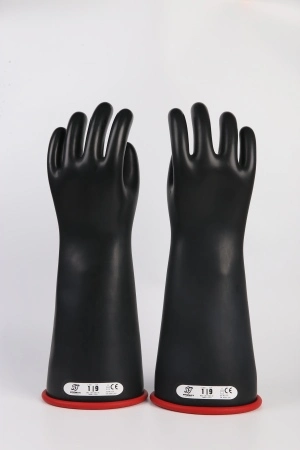
|
Parameter |
Specification |
|
Voltage Rating |
7,500V AC / 11,250V DC (Maximum Use) |
|
Proof Test Voltage |
10,000V AC / 40,000V DC |
|
Material Type |
Type I (Natural Rubber) / Type II (EPDM Synthetic) |
|
Thickness Range |
1.02mm - 1.52mm |
|
Tensile Strength |
>17.2 MPa |
|
Standards Compliance |
ASTM D120, IEC 60903 |
|
Temperature Resistance |
Category A, H, Z rated |
|
Label Color |
White (Class 1 Standard) |
Understanding Class 1 Insulating Gloves and Their Voltage Ratings
To choose the right electrical safety gear, you need to know what makes one type of glove different from another. This difference is based on voltage ratings, which are closely linked to the amounts of risk in different industrial uses.
What Defines Class 1 Voltage Protection?
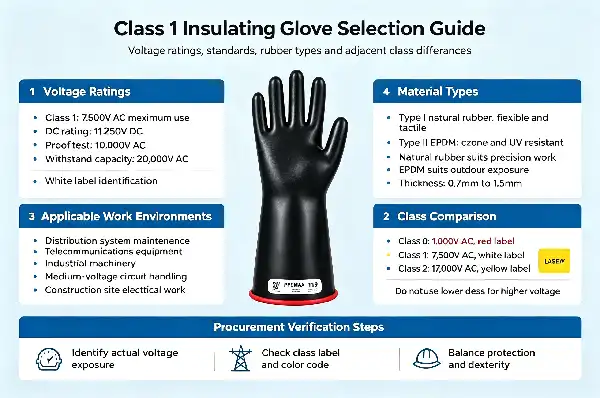
Electrical shielding gloves are grouped by their maximum use voltage, which is the highest voltage at which they can keep workers safe while they do normal tasks. Class 1 gloves are an important middle ground in terms of safety. While Class 0 gloves protect against up to 1,000V AC and Class 2 gloves up to 17,000V AC, Class 1 devices cover situations up to 7,500V AC, bridging the gap between the two. Because of this, electrical workers who work on distribution systems, telecommunications equipment, and industrial machinery that could be damaged by medium-voltage electricity can't do their jobs without them. The 10,000V AC proof test voltage adds an extra safety cushion and makes sure the glove is solid before it is used in the field.
Material Composition and Electrical Resistance
The dielectric strength of these gloves comes from the rubber compounds that were used. Natural rubber latex is used in Type I gloves because it is highly valued for its high elasticity and tactile sensitivity, which allow workers to work precisely with small parts and wires. Type II gloves are made of man-made materials like EPDM (ethylene propylene diene monomer), which are better at protecting against harmful weather factors like ozone and UV radiation. Over the past 65 years, PPE MAX has improved its manufacturing process so that it can make gloves with thicknesses between 0.7mm and 1.5mm, which provide the right amount of insulation while still allowing the hands to move freely. This specific knowledge directly addresses the procurement problem of discovering protective gear that doesn't slow down operations.
Comparing Glove Classes: Class 0, Class 1, and Class 2
Knowing about adjacent glove classes helps procurement teams make precise choices that are in line with real hazards in the workplace. Class 0 gloves, which have red marks, can handle voltages up to 1,000V AC, making them good for installing meters and doing low-voltage control work. With white labels on them, Class 1 gloves can handle voltages up to 7,500V AC, which is what most distribution panels and medium-voltage equipment do. Class 2 gloves with yellow marks protect up to 17,000V AC for work on power lines and in substations. The difference is very important: using a Class 0 glove in a Class 1 setting creates a huge risk, while using Class 2 gloves in a Class 1 setting may make dexterity worse for no reason. We help procurement managers make the right choice by looking at their specific voltage exposures and operating needs. This way, we can make sure that the right amount of safety is met for their workers.
How to Verify and Maintain Your Class 1 Insulating Gloves for Optimal Safety
Even the best electrical gloves lose their ability to protect when they get broken or aren't taken care of properly. By setting up strong verification and maintenance procedures, these devices can be turned from passive inventory items into active safety assets.
Testing Protocols: Visual and Dielectric Inspections
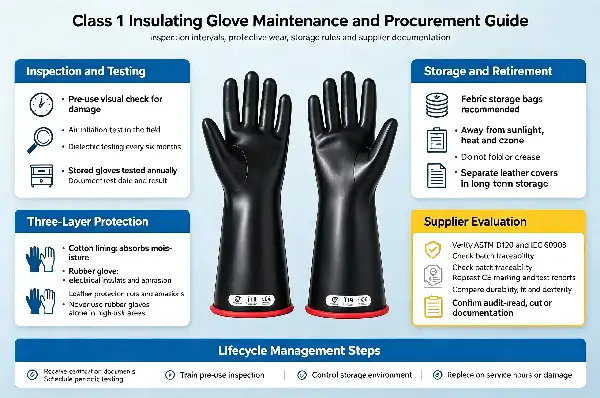
Regulations say that rubber insulating gloves must be tested for electricity every six months if they are used, or once a year if they are stored. Before each use, the Class 1 Insulating Gloves should be looked at visually. Technicians should do this in good lighting, looking for holes, tears, foreign items stuck inside, or ozone cracks. The air inflation test is still the most useful way to check in the field: trap air at the cuff to inflate the glove, then listen and feel for leaks while applying light pressure. Dielectric testing by accredited labs checks the glove's real voltage resistance to make sure it stays at the level of safety it's supposed to provide. At PPE MAX, we include full testing paperwork with every package. This includes batch test certificates that can be traced back to our factory in Xi'an. This paperwork makes compliance checks easier and shows safety inspectors that proper care was taken.
Proper Wearing Procedures and Leather Protectors
Rubber protective gloves should never be used by themselves in dangerous places. According to ASTM F696 standards, they must be worn with leather protector gloves that protect against cuts, abrasions, and punctures that could immediately damage the dielectric integrity. When workers put on their gloves, they should start with a thin cotton lining to soak up moisture, then move on to the rubber insulating gloves, and finally to the leather protector. This three-layer method protects against mechanical and electrical dangers at the same time. If the leather protection doesn't fit right, it can shorten the rubber cuff or bunch up at the fingers. This is because the wrong size can decrease the flashover distance and create arc paths.
Storage and Retirement Best Practices
To keep things safe and extend their useful life, you need to pay attention to how they are stored. To keep gloves safe, keep them in fabric bags that are kept out of direct sunlight, ozone sources, and high temperatures. When storing rubber gloves, never fold or crease them. Doing so creates stress points that speed up the wear and tear. When storing rubber gloves for a long time, take off the leather covers to keep moisture out and keep the rubber from deforming. When deciding to retire, you should look at the product and follow the manufacturer's instructions. If you see a puncture, deep cut, chemical contamination, or failed dielectric test, you should take it out of service right away. When purchasing departments use systematic retirement schedules—that is, changing gloves based on service hours instead of waiting for damage to show up—they have lower incident rates and more stable budgets. Our technical support team helps large buyers make these lifecycle management programs that work best for how they use them.
If you're evaluating personal protective equipment suppliers and require batch-specific testing documents before placing an order, PPE MAX is able to provide official Certificates of Analysis, professional laboratory test reports, and product samples for your verification. Feel free to contact our team at marketing@ppemax.com to discuss your sourcing needs and obtain complete documentation for your quality assessment and procurement approval.
Making Informed Purchasing Decisions: Comparing Top Insulating Glove Suppliers
To do a great job of purchasing electrical safety tools, you need to look at more than just the unit cost. Having the right relationship with your suppliers affects your organization's safety, compliance, and ability to keep running.
Essential Product Attributes for B2B Procurement
When reviewing products from different brands, there are a few things that need close attention. The total cost of ownership is directly related to how durable something is. Gloves that need to be replaced too soon because the material is wearing out raise both the cost of buying them and the safety risk. Flexibility affects how well workers accept and do their jobs. Gloves that feel stiff or heavy make field workers less likely to follow instructions. User comfort includes things like the finish on the inside, the design of the cuffs, and how well the sizes fit. International certification compliance is a must; make sure that potential providers have up-to-date ASTM D120, IEC 60903, and any related OSHA licenses. PPE MAX stands out because it has improved its designs through decades of user reviews, making them more comfortable to wear. Our color-coded cuff system—white for Class 1—keeps you from getting confused about voltage class when choosing tools, and our naturally contoured patterns keep your hands from getting tired after long wear.
Every order should come with proof of certification. We offer full test results, CE marking for shipping in Europe, and the ability to track back to individual production batches. This paperwork is very helpful for safety audits and investigations into accidents at work. Our quality control system includes tests that go above and beyond what the law requires. This is because we believe that protecting lives requires going above and beyond standards, not just meeting them. When procurement managers work with PPE MAX, they can access this library of documentation, technical data sheets, and application guidance that makes running a safety program easier.
Global Supplier Landscape and Regional Considerations
There are both big-name and small, specialized companies in the market for electrical protective tools. Well-known brands like Honeywell, Klein Tools, and 3M have a lot of products that are sold in a lot of places. These brands are used by buying teams that want well-known names and a single source for a lot of different products. Different regions have different levels of availability. Some names are more popular in North America, while others are better in Europe or Asia. Lead times reflect this geographical spread, with domestic suppliers usually being able to fulfill orders faster than manufacturers overseas.
As a dedicated manufacturer with 65 years of specialized focus, PPE MAX works in a different way. As Northwest China's biggest PPE supplier, we have the manufacturing scale and customization flexibility that you don't usually find in large industrial conglomerates. We serve 134 countries through a global supply chain that is meant to be reliable. Purchasing managers can get the cost savings of working directly with manufacturers without losing the quality of service. Customers are welcome to visit our Xi'an facilities, which gives them trust in our output and quality systems. We often show off new products at big industry events, like Germany's A+A Safety Exhibition, where buyers can look at the goods and talk to our expert team about their specific needs.
Pricing Structures and Bulk Order Advantages
Knowing how prices work helps you negotiate and plan your spending better. Unit costs go down a lot as you buy more. Discounts for large orders usually start at 500 pairs and go up as you buy more. Different suppliers have different minimum order quantities (MOQs). We've set ours so that they can work for both big fleet owners and smaller distributors growing inventory. In addition to the unit price, you should also think about the total delivered cost. Shipping logistics, customs clearance, and payment terms can all affect how much you actually pay for something.
Because we are a direct manufacturer and have efficient production systems, we can offer competitive prices. Long-term supply deals keep prices stable, which makes making a yearly budget easier and ensures that resources are allocated fairly during times of high demand. Custom packaging options, such as different sizes of polybags for each customer or branded boxes for distributor partners, increase value without making the price too high. Our responsive quote process usually sends back detailed proposals with clear price breakdowns, product specs, and certification paperwork within 48 hours. This makes it easier for buying teams to meet tight deadlines for requests and correctly compare products.
Safety Guidelines and Best Practices for Using Electrical Protective Gloves in Industrial Environments
Getting certified equipment is only the first step in making an electrical safety program work. The success of implementation relies on thorough safety systems that include training for workers, following the rules, and assessing risks.
Regulatory Frameworks Governing Electrical PPE
Choosing and using electrical safety tools must follow rules set by several governing groups. According to OSHA 29 CFR 1910.137, companies must give workers the right electrical safety gear for the voltage and energy amounts they are exposed to and make sure they use it. ASTM D120 lists the rules for making rubber insulating gloves, how they should be tested, and how well they should work. International harmonization is provided by IEC 60903, which is especially useful for global businesses that need to coordinate safety standards across countries. Electrical safety at work is covered by NFPA 70E, which has rules for arc flash protection and full risk assessments.
Compliance goes beyond just buying the right tools. Employers need to set up inspection programs, keep records of tests, and quickly get rid of broken equipment. We help procurement managers meet these duties by giving them paperwork packages, training materials, and expert advice. As part of our after-sales service, we offer a technical support hotline run by experts who know both the product's powers and the rules that need to be followed. This is a very useful tool for answering questions from inspectors or updating safety routines.
Risk Assessment and Glove Selection Matching
Effective hazard research comes before choosing the right tools. Safety managers should do detailed electrical studies of the workplace to find out all the possible voltage exposures, such as standard working voltages and fault conditions. This evaluation helps choose the right glove class by matching the expected highest voltage to the right safety gear. Think about the environment. For example, working in wet conditions, small spaces, or on elevated platforms all add extra risks that may mean you need more protection than just gloves.
Using good matching in the real world shows how useful it is. A factory that had a lot of blown fuses gave its workers Class 0 gloves rated for 1,000V AC at first, thinking that their 480V three-phase system was safe within that range. A full risk assessment showed that workers could be exposed to voltages higher than 2,000V during maintenance on breakers when there are faults. Getting our Class 1 Insulating Gloves gave them the extra safety they needed without getting in the way of their ability to do complicated panel work. This case shows why we encourage procurement teams to include safety professionals and electrical engineers in the process of writing specifications: a small investment in proper analysis can stop equipment mismatches that could be very dangerous.
Training Programs and Standard Operating Procedures
If end users aren't properly trained, technical specs don't mean much. Effective programs teach how to check gloves, the right way to put them on, how to pair leather protectors, and how to spot signs of damage. Workers should know how to use voltage class color coding, what the limits of use are, and how important it is to do pre-use inspections. Many electricians think that "breaking in" new gloves by folding them makes them more comfortable, but this actually creates failure points. This is something that should be covered in training.
For people who buy in bulk, we offer training support materials like how-to films, inspection forms, and quick-reference guides that can be put up in tool rooms. For big accounts, our technical team holds on-site training meetings where they show workers how to use and maintain the equipment properly and answer their questions. Standard operating procedures should include all of the steps needed to handle a glove's lifetime, including how to buy, inspect upon arrival, track issues, conduct required field inspections, testing schedules, and when the glove should be thrown away. Organizations that use official SOP models regularly have lower incident rates and better compliance with regulations than those that use informal practices.
Where and How to Source Certified Electrical Insulating Gloves for Your Business
The way you buy things has a direct effect on the quality of the tools, how much it costs, and how long you can get them. Building ties with dependable suppliers gives you a competitive edge that goes beyond individual deals.
Identifying Reputable Suppliers and Distributors
Some things that make a seller good are up-to-date approvals from well-known testing labs, clear production processes, lots of technical documents, and helpful customer service. Some ways to check are to ask for facility audit reports, look at customer references, and check the authenticity of certifications through the organizations that issue them. Established suppliers keep batch traceability systems that connect finished goods to lots of raw materials and production dates. This is a very important feature for handling recalls or looking into why equipment broke down.
When compared to direct manufacturer ties, distribution partnerships may add a markup, but they are more convenient and keep supplies close by. Regional distributors offer benefits like same-day shipping and easy returns, which are useful for small orders or replacements that need to be made right away. Check to see how technically knowledgeable the dealer is. The best partners know how to use the product and can help you make a choice beyond just handling your order.
Direct Manufacturer Engagement Advantages
For medium- to large-sized procurement processes, working directly with producers has clear benefits. Getting rid of markups in the middle makes cost structures better. It's now possible to make changes to the length of the cuffs, get them in special packaging, or put your company's safety brand on them privately. Lead times may be longer than when a wholesaler has stock, but being able to see the production schedule lets you plan better. When you talk to real product engineers instead of sales reps, you get better technical support.
PPE MAX is happy to work directly with sourcing workers who are in charge of large PPE needs. Our global supply chain works with 134 countries and is reliable because we've been exporting for decades. We know how to handle international shipping logistics, customs paperwork, and the different markets' needs for quality certification. Our customization options include OEM and ODM partnerships, which help brands make their own lines of safety gear without having to spend a lot of money on manufacturing infrastructure. Our service is unique because we offer quick customer service, easy return policies, and personal account management. We know that partnership ties, not transactional ones, are key to successful buying. Your trust in our goods and services directly affects safety at work.
Sample Evaluation and Specification Development
A smart way to buy things is to evaluate samples before committing to big sales. Ask for example samples that show the quality of the finished product instead of specially made display pieces. Test the equipment with people who will actually be using it in the field. Their feedback on comfort, dexterity, and durability can give you information that lab specifications can't. When comparing samples from different suppliers, use the same evaluation criteria every time: how well they fit across all sizes, how consistent the material is, how well the seams and cuffs are finished, and how complete the documentation is.
Potential business partners are welcome to ask for samples of our Class 1 Insulating Gloves. When you get these test units, they come with full certification paperwork, technical data sheets, and directions on how to use them. During the time you are evaluating, our team is available to help you with technical questions and get feedback that will be used to make final specifications. This collaborative approach makes sure that orders exactly meet your needs instead of forcing you to settle for what's in the catalog. Our decades of application experience help procurement managers choose the best products for your needs. We've supplied equipment for a wide range of environments, from mining operations in the Arctic to infrastructure projects in the tropics.
Conclusion
To keep workers safe from electrical dangers, it's not enough to just follow the rules; you need to make smart purchasing choices based on a deep understanding of the equipment's capabilities, the rules, and the supplier's dependability. In medium-voltage settings like utilities, manufacturing, building, and telecommunications, Class 1 Insulating Gloves rated for 7,500V AC play a crucial part. When choosing the right protection, you need to look at things like voltage ratings, material properties, certification compliance, and supplier partnerships that help the safety program succeed in the long term. PPE MAX has been making safety gear for 65 years, and they can help with these problems by providing certified goods and quick service that turn purchasing into a strategic safety project. In addition to selling products, we are also committed to providing full support that helps your organization avoid electrical incidents.
FAQ
1. How frequently must Class 1 insulating gloves undergo electrical testing?
As soon as gloves are put to use, they have to be tested for dielectric properties every six months. This time may be shorter in places with a lot of use or after chemicals, extreme temperatures, or damage that is thought to have happened. Every twelve months, gloves that are being stored need to be tested before they can be used. No matter when the tests are done, every use is preceded by a visual check. For bulk buyers, we offer testing tracking tools that make it easier to keep records that are required for safety audits.
2. Can I use Class 1 gloves on systems exceeding 7,500V AC?
Not at all. The highest use voltage is the safest level that can be reached. When voltages are higher than the rating, there is a chance of electrical breakdown, which could lead to shock or death. Systems with more than 7,500V AC need gloves that are at least Class 2 (rated to 17,000V AC). When figuring out the right voltage, you need to look at more than just the standard system voltage. This is because transient overvoltages can happen during switching or problems and be higher than regular working levels.
3. What storage conditions preserve glove protective properties?
Gloves should be kept in protective canvas bags out of the sun, away from equipment that makes ozone, and at room temperature. Do not fold or crease while storing. When storing rubber gloves for a long time, take off the leather covers to keep moisture out. If you can, keep the temperature in the storage area between 50°F and 70°F. Check the storage conditions on a regular basis, because chemical vapors or outdoor pollutants can break down rubber materials even when they are not being used.
Partner With PPE MAX for Certified Class 1 Insulating Gloves
PPE MAX is a trusted supplier of electrical safety gear in 134 countries and is a leading manufacturer of Class 1 Insulating Gloves with more than 60 years of experience. Our thorough quality control systems, international certifications like ASTM D120 and IEC 60903, and focused expert support make sure that your employees are safe from medium-voltage dangers. We have reasonable bulk prices, the ability to customize for OEM partnerships, and open purchasing options that can be changed to fit your needs. Email our team at marketing@ppemax.com to talk about your unique safety needs, get product samples, or look into supply deals that will help you reach your goal of having no electrical incidents. Feel the difference when you buy workplace safety equipment with real manufacturing knowledge and a responsive relationship.
References
1. American Society for Testing and Materials. (2021). ASTM D120 Standard Specification for Rubber Insulating Gloves. West Conshohocken, PA: ASTM International.
2. International Electrotechnical Commission. (2019). IEC 60903 Live Working – Gloves of Insulating Material. Geneva: IEC Central Office.
3. Occupational Safety and Health Administration. (2020). 29 CFR 1910.137 Electrical Protective Equipment Standards. Washington, DC: U.S. Department of Labor.
4. National Fire Protection Association. (2021). NFPA 70E Standard for Electrical Safety in the Workplace. Quincy, MA: NFPA Publications.
5. Electrical Safety Foundation International. (2022). Guidelines for Selection and Use of Electrical Protective Equipment in Industrial Settings. Arlington, VA: ESFI.
6. American National Standards Institute. (2020). ANSI Z359 Fall Protection and ANSI Z87 Eye and Face Protection Coordination with Electrical PPE. Washington, DC: ANSI Standards Development.
Learn about our latest products and discounts through SMS or email