- English
- French
- German
- Portuguese
- Spanish
- Russian
- Japanese
- Korean
- Arabic
- Greek
- German
- Turkish
- Italian
- Danish
- Romanian
- Indonesian
- Czech
- Afrikaans
- Swedish
- Polish
- Basque
- Catalan
- Esperanto
- Hindi
- Lao
- Albanian
- Amharic
- Armenian
- Azerbaijani
- Belarusian
- Bengali
- Bosnian
- Bulgarian
- Cebuano
- Chichewa
- Corsican
- Croatian
- Dutch
- Estonian
- Filipino
- Finnish
- Frisian
- Galician
- Georgian
- Gujarati
- Haitian
- Hausa
- Hawaiian
- Hebrew
- Hmong
- Hungarian
- Icelandic
- Igbo
- Javanese
- Kannada
- Kazakh
- Khmer
- Kurdish
- Kyrgyz
- Latin
- Latvian
- Lithuanian
- Luxembou..
- Macedonian
- Malagasy
- Malay
- Malayalam
- Maltese
- Maori
- Marathi
- Mongolian
- Burmese
- Nepali
- Norwegian
- Pashto
- Persian
- Punjabi
- Serbian
- Sesotho
- Sinhala
- Slovak
- Slovenian
- Somali
- Samoan
- Scots Gaelic
- Shona
- Sindhi
- Sundanese
- Swahili
- Tajik
- Tamil
- Telugu
- Thai
- Ukrainian
- Urdu
- Uzbek
- Vietnamese
- Welsh
- Xhosa
- Yiddish
- Yoruba
- Zulu
Is a Full Mask Respirator Suitable for Painting and Spray Work?
When it comes to workplace safety, respirators are the first line of defense. This is especially true in places where painting and spraying create airborne chemicals that are harmful to long-term health. Choosing the right breathing protection is important for making sure that your team stays in line with safety rules at work while staying comfortable and productive during long shifts. We know that purchasing managers, safety engineers, and marketers have a lot of choices to make when they are looking at breathing protective equipment for painting in factories. This blog combines technical specs with useful procurement advice to help you make choices that protect your employees and improve business efficiency. Our objective is to give B2B clients the information they need to decide if Full Mask Respirators meet their safety needs, their price constraints, and their legal responsibilities in painting and spray work environments.
Understanding Full Mask Respirators: Key Features and Functionalities
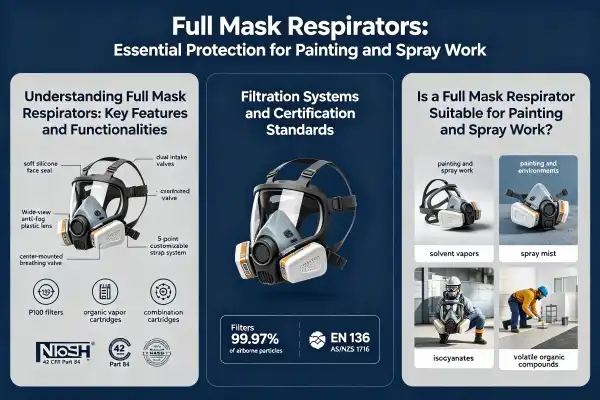
Full Mask Respirators represent a big step forward in the technology used to protect people's lungs. They protect the whole face from harmful contact through an integrated design. At PPE MAX, our models use precision-engineered parts that were created by production experts with more than 60 years of experience.
Components That Define Superior Protection
Our lung protection systems are made up of a number of important parts that all work together. The soft silicone face seal molds to different facial shapes, making an airtight shield that keeps germs out of sensitive areas like the lips, forehead, and chin. Our wide-view anti-fog plastic lens keeps the lenses clear even when you're working hard, which solves the common problem of blocked vision that slows you down. Dual intake valves lower breathing resistance, so you can breathe naturally even when you're doing hard physical work. The center-mounted breathing valve effectively lets out CO2 and wet air, stopping the uncomfortable buildup that causes people to take off their masks too soon. A 5-point customizable strap system spreads pressure evenly across the head, so there are no painful pressure points when wearing it for long periods of time.
Filtration Systems and Certification Standards
Our respirators' bayonet connection method makes it easy to change the cartridges quickly, meeting the filter needs of a wide range of painting tasks. At least 99.97% of flying particles are caught by P100 screens. This includes dangerous dust and fine paint mist. Organic vapor cartridges use activated carbon to soak up dangerous solvent fumes like xylene, ketones, and aromatic hydrocarbons that are common in industrial coatings. Combination cartridges are used in places with more than one danger, like places with both particles and chemical fumes.
At our factory, we make sure that every unit meets strict foreign standards. NIOSH approval under 42 CFR Part 84 proves that safety standards for the workplace in the United States are being met. The EN 136 approval proves that the mask meets European standards for full face masks. Certification to AS/NZS 1716 shows that it is suitable for the markets in Australia and New Zealand. These approvals give people who buy things official proof that our equipment provides measurable safety benefits in real-life workplace settings.
Compatibility and Ergonomic Considerations
We understand that breathing protection needs to work well with other PPE systems. Our speech diaphragm makes it easier to communicate clearly in busy industrial settings without affecting the integrity of the seal. The alternative drinking tube fixes a major comfort problem that frequently leads to workers not following safety rules: it lets them stay hydrated during long shifts without breaking the protective seal. People who work in construction don't have to choose between different types of safety gear because the practical design works with hard hats, face shields, and hearing protection.
Is a Full Mask Respirator Suitable for Painting and Spray Work?
There are special breathing problems in the painting and spray coating business that need special safety gear. Workers are exposed to many different types of airborne dangers, such as solvent vapors, spray mist, and chemicals that release when coats cure.
Why Complete Facial Coverage Matters in Coating Operations
Working as an industrial painter creates risks that affect both the lungs and the eyes. Isocyanates are powerful respiratory sensitizers that are released by two-component polyurethane systems. They can cause workplace asthma and long-term lung problems. Coatings made with solvents give off volatile organic chemicals that get into mucous membranes and cause short-term symptoms like sickness and dizziness while also being neurotoxic in the long term. Spray application makes fine aerosol droplets that stay in the air for a long time, especially in small areas or rooms that don't have enough airflow.
Full Mask Respirators have benefits that half-mask designs can't match. The built-in lens protects the eyes from chemical splashes and irritating vapors. It also fills in the space between different safety glasses and breathing protection, where germs can get in. Total Inward Leakage is much lower with this device than with ones that only cover the nose and mouth because it has a better seal around the whole face. When working with high-toxicity paints that contain lead, chromates, or other heavy metal colors, this all-around barrier is a must.
Addressing Practical Considerations
Concerns about comfort during long shifts are a real thing to think about when looking at full face makeup systems. We deal with this by adding careful design features that were based on feedback from real users. The soft rubber seal stops painful pressure spots that can happen with hard materials. Strategically placing valves reduces breathing resistance, making it easier on the body during physically hard spray operations. The wide-view lens keeps peripheral vision, which lets workers move around safely in busy spray rooms or around complicated workpieces.
Some safety managers aren't sure if powered air-purifying respirators are the best way to protect painters. Even though PAPRs completely remove breathing resistance and provide cooling wind, they are very expensive and hard to maintain. Because of their higher starting cost, battery management, and unreliability, PAPRs are only really good for the worst chemical exposure situations or for workers who can't get a good fit with rubber face seals because they have facial hair or other unique facial features.
Comparing Respirator Types for Painting and Spray Work
When making decisions about what to buy, it helps to know how well different types of breathing protection work in coating uses. If you need to meet certain operational needs, risk levels, or price limits, each choice has its own pros and cons.
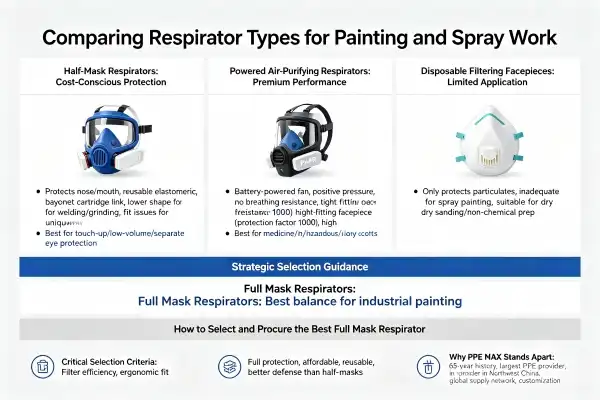
Half-Mask Respirators: Cost-Conscious Protection
Half-face masks only protect the nose and mouth, but they're reasonably priced and do a good job of protecting the lungs. The bayonet cartridge link on these reusable elastomeric devices is the same as on types that cover the whole face, so they can be used for a variety of chemical dangers. The lower shape makes it easier for welding covers and grinding face protection to work.
But people who don't wear eye protection are more likely to be hurt by liquid mist and chemical splashes in spray settings. The smaller seal area makes it more likely that there will be fit issues, especially for workers with unique face shapes. Because OSHA guidelines give them a safety factor of 10, they aren't very good for high-concentration exposure situations that happen a lot in industrial spray booths. Half-masks are good for touch-up work, low-volume applications, or cases where separate eye protection is enough to protect the eyes from dangers.
Powered Air-Purifying Respirators: Premium Performance
A battery-powered fan in a PAPR draws air through filters and sends clean air at positive pressure to the facepiece. This completely removes the resistance to breathing, lowers heat stress, and makes room for workers with facial hair who can't get tight seals. With tight-fitting facepieces, the given protection factor goes up to 1000, which gives great protection against serious chemical exposure.
The big starting cost, ongoing costs for battery replacement, and difficulty of upkeep need careful financial consideration. These systems work great for making medicines, cleaning up harmful waste, and other jobs that involve very dangerous materials or long shifts where breathing resistance fatigue is a real issue. When making a budget, you should include costs for charger infrastructure, extra batteries, and possible motor fixes that aren't covered by the filter replacements.
Disposable Filtering Facepieces: Limited Application
Standard N95 or P100 throwaway respirators only protect against particulate dangers. They don't protect against the chemical gases and organic vapors that are most common in painting environments. These devices are fine for dry sanding or surface preparation that doesn't involve chemicals, but they are dangerously inadequate for real spray painting work. Specifications for buying things for painting jobs should clearly leave out throwaway filtering facepieces unless workers are only doing non-chemical tasks to prepare the surface.
Strategic Selection Guidance
The best balance point for most industrial painting jobs is Full Mask Respirators. In current covering systems, they offer full protection against a variety of hazards. Compared to PAPRs, they are also more affordable to buy and offer better defense than half-mask options. The design that can be used again and again and has filters that can be replaced gives a good total cost of ownership over the lifetime of the equipment. This is especially true for businesses that need consistent lung protection. For regular spray operations, safety managers should make sure that full face coverage is the usual and only use PAPRs in the worst cases of exposure.
How to Select and Procure the Best Full Mask Respirator for Industrial Painting
To make sure that Full Mask Respirators work successfully for their whole life, it's important to carefully consider technical specs, ergonomic factors, and the supplier's abilities when buying something.
Critical Selection Criteria
Effective selection is based on how well the filter works for certain chemical dangers. Organic vapor cartridges need to have enough activated carbon mass to last as long as you need them to in your real solvent concentration setting. P100 particulate filters should have very little breathing resistance while still being able to filter harmful paint mist at a 99.97% efficiency. Combination packs that meet both needs at the same time make managing inventory easier, but they may be extra expensive if your application mostly deals with gas dangers and not much particulate generation.
Ergonomic fit tells us if workers always wear their safety gear properly during their shifts. Our team tests our ideas a lot because we know that even the most high-tech equipment won't work if workers don't want to use it. After all, it hurts. Our models' 5-point belt system spreads pressure evenly, so you don't get the painful forehead marks that happen with badly designed strap arrangements. Silicone face seals can fit a wider range of face shapes than thermoplastic rubber options. This means that more people in a diverse workforce can get them to fit properly.
Why PPE MAX Stands Apart
Our history in making goes back 65 years, giving us institutional knowledge that directly improves the quality and dependability of our products. As the biggest PPE provider in Northwest China, we keep enough production capacity to handle both large orders and quick response times for urgent needs. Our global supply network covers 134 countries, showing that we have the logistical skills to produce regularly no matter where your facility is located.
We offer a wide range of customization choices to meet the specific needs of each business. Distributors can build their own brand identities with the help of custom labels. Options for bulk packaging make sending big purchases as efficient as possible. Global brands can use our engineering know-how and production ability to make their own products, while still keeping their own specs and branding.
Procurement Options and Budget Planning
Industrial buyers can choose from a number of ways to buy things, based on the wants of their businesses. When companies have established lung protection programs and know how much they will use, buying in bulk is the best way to save money per unit. Starter kits that include the facepiece and more than one type of cartridge are good for businesses that want to start painting or switch to using different finishing chemicals. Having access to replacement parts provides ongoing safety without having to throw away whole assemblies when individual parts stop working.
When making a budget, you should include the total cost of ownership, which is more than just the cost of buying something. When the cost of replacing the filter is spread out over the service life of the facepiece, reusable rubber respirators have a much lower cost-per-use than throwaway ones. To make sure there are enough safety margins, figure out how often to change the cartridges based on real exposure levels and work durations instead of claims of maximum service life. You should include the cost of quantitative fit testing in your budget because OSHA rules say that certain models must be checked every year to make sure they fit correctly on each worker's face.
Maintenance, Usage Instructions, and Best Practices
When equipment standards are put into practice correctly, they become real protection. This means that maintenance rules and teaching on how to use the equipment are just as important as decisions about what to buy.
Donning Procedures and Fit Verification
When you put on breathing protection correctly, you create the seal stability that makes it work. Before each use, workers should check the face seal for cracks, tears, or lasting damage. This is because cleaning chemicals, UV light, and mechanical stress can break down elastomeric materials over time. Place the facepiece against your face and pull all five straps over your head. Adjust each point so that the pressure is spread out evenly without making the straps too tight. Cover the cartridge's intakes and slowly breathe in. This will test the negative pressure seal. The facepiece should fall slightly against the face and stay there, with no air leaking around the seal. Cover the exhalation valve and slowly let out air. This will create a small amount of positive pressure, and air should not be leaking around the seal's edges.
OSHA rules say that Full Mask Respirators must still go through an annual numeric fit test using special tools like PortaCount devices. This objective measurement finds people whose face structures make it impossible for them to achieve a good seal with certain models. This stops false security caused by poor protection.
Cleaning Protocols and Component Inspection
Water destroys activated carbon media and jams particle filters, so take filters apart before you clean them. Using a soft brush, soak the facepiece in warm water below 50°C with neutral soap to get rid of paint dust and oils that have built up. Do not use cleaners with lanolin or strong solvents like acetone, as they break down silicone materials and make seals less reliable. Rinse well to get rid of any soap residue that might hurt the skin when you use it again.
After cleaning, carefully check the intake and exhaling valves. These thin diaphragms need to be able to bend easily without getting stuck, torn, or permanently distorted. If you see any damage to the valves, you should replace them right away because broken valves let raw air go around the cartridge system. Check the lens for cracks or scratches that could make it hard to see or that could affect the quality of the face seal. Carefully put the parts back together, making sure that all the links fit properly before putting the equipment back into work.
Filter Replacement Schedules
When breathing resistance goes up significantly, which means the filter media is full of captured paint mist, it's time to change the particulate filter. For organic vapor cartridges, you need to keep an eye on them more closely because the activated carbon media fills up with liquids before the breathing resistance changes. You should make a change plan based on your real exposure concentration and work length instead of depending on your sense of smell or taste to tell you when you've been exposed to too much of a toxic substance. Conservative replacement intervals keep workers safe from contact that happens after saturation but before they can clearly sense something is wrong.
Use a lasting pen to write the date the cartridge was installed directly on each unit so that you can keep an accurate track of its service life. Keep a stockpile of the right replacement filters on hand so that you don't have to risky extend service life past the suggested limits because of delays in the supply chain.
Conclusion
Full Mask Respirators provide the full protection needed for industrial painting and spraying, protecting workers from the complex mix of vapors, droplets, and particles that can adversely affect their eyes and lungs. We've shown that these devices are better than half-mask options because they have better seal quality and built-in eye protection, and they're still cheaper than powered air systems. To make sure equipment works regularly during busy shifts, it's important to carefully consider filtration requirements, ergonomic factors, and seller skills when doing buying. PPE MAX has been making products for 65 years and is up to the task. They have strict international standards and have made design improvements based on feedback from users on their own team.
FAQ
Can Workers Wear Prescription Glasses Under Complete Facial Coverage Respirators?
Normal glasses with temple bars break the face seal, which makes defense less effective and goes against safety rules. Our Full Mask Respirators have special eyeglass lens pieces that fit inside the facepiece and don't get in the way of the seal. Get in touch with our technical team to set up prescription lens adapter kits that will work with the glasses your employees wear.
How Often Should Organic Vapor Cartridges Be Replaced for Painting Operations?
The number of times to replace something varies depending on the concentration of the liquid and the length of time it was exposed to it. Set up a change plan by keeping an eye on the exposure or making safe guesses based on the size of the cartridge and the chemistry of the coating. Breakthrough odor detection should never be used as a replacement signal, because for many solvents, toxic contact happens before the smell of danger.
Which Certifications Are Necessary for Chemical Paint Protection?
For activities in the United States, NIOSH permission under 42 CFR Part 84 is still needed. Specifically, approval for organic vapor and P100 particulate filtration is being sought. European agreement is shown by EN 136 approval. Instead of thinking that certification for one part covers the whole system, make sure that both the facepiece and the specific cartridge mix have the right approvals.
Do Complete Facial Coverage Respirators Work with Facial Hair?
If your facial hair gets in the way of the seal border, it stops it from working properly and is against the rules. People who have beards need to wear powered air-purifying respirators with hoods that don't have to fit perfectly on their faces. Rubber respirators indeed have this problem that can't be fixed with adjustments or different types.
Upgrade Your Respiratory Protection Program with PPE MAX
PPE MAX can help you meet the safety requirements for industrial painting with Full Mask Respirators that are made to the highest international standards. Our place as a top seller lets us offer full procurement support, from helping with the initial specification to providing ongoing expert support. We have reasonable bulk prices, OEM options that can be changed to fit your needs, and full disclosure of all certifications and performance requirements. Our team uses the tools we make because we put our name on making tools that workers trust with their health every day. Contact our procurement experts at marketing@ppemax.comto talk about your unique respiratory protection needs and find out how our 65 years of experience making PPE can help protect your workers in 134 countries around the world.
References
1. National Institute for Occupational Safety and Health. "NIOSH Guide to the Selection and Use of Particulate Respirators." Department of Health and Human Services Publication, 2019.
2. Occupational Safety and Health Administration. "Respiratory Protection Standard 29 CFR 1910.134: Compliance Guidelines for Industrial Painting Operations." U.S. Department of Labor, 2021.
3. American Industrial Hygiene Association. "Chemical Hazard Assessment and Respiratory Protection in Coating Applications." AIHA Technical Publications, 2020.
4. European Committee for Standardization. "EN 136:1998 Respiratory Protective Devices - Full Face Masks - Requirements, Testing, Marking." CEN Standards, 2018.
5. National Paint and Coatings Association. "Best Practices for Respiratory Protection in Industrial Spray Finishing." NPCA Safety Guidelines, 2022.
6. International Safety Equipment Association. "Elastomeric Respirator Performance and Maintenance in Chemical Exposure Environments." ISEA Technical Report, 2023.
Learn about our latest products and discounts through SMS or email