- English
- French
- German
- Portuguese
- Spanish
- Russian
- Japanese
- Korean
- Arabic
- Greek
- German
- Turkish
- Italian
- Danish
- Romanian
- Indonesian
- Czech
- Afrikaans
- Swedish
- Polish
- Basque
- Catalan
- Esperanto
- Hindi
- Lao
- Albanian
- Amharic
- Armenian
- Azerbaijani
- Belarusian
- Bengali
- Bosnian
- Bulgarian
- Cebuano
- Chichewa
- Corsican
- Croatian
- Dutch
- Estonian
- Filipino
- Finnish
- Frisian
- Galician
- Georgian
- Gujarati
- Haitian
- Hausa
- Hawaiian
- Hebrew
- Hmong
- Hungarian
- Icelandic
- Igbo
- Javanese
- Kannada
- Kazakh
- Khmer
- Kurdish
- Kyrgyz
- Latin
- Latvian
- Lithuanian
- Luxembou..
- Macedonian
- Malagasy
- Malay
- Malayalam
- Maltese
- Maori
- Marathi
- Mongolian
- Burmese
- Nepali
- Norwegian
- Pashto
- Persian
- Punjabi
- Serbian
- Sesotho
- Sinhala
- Slovak
- Slovenian
- Somali
- Samoan
- Scots Gaelic
- Shona
- Sindhi
- Sundanese
- Swahili
- Tajik
- Tamil
- Telugu
- Thai
- Ukrainian
- Urdu
- Uzbek
- Vietnamese
- Welsh
- Xhosa
- Yiddish
- Yoruba
- Zulu
How to Properly Fit and Use a Full Mask Respirator for Maximum Safety?
The right fit and use of Full Mask Respirator tools are very important for getting the most safety from respiratory dangers. With impact-resistant glasses, a Full Mask Respirator forms a sealed shield that protects your entire face, including your eyes, nose, mouth, and chin. When properly fitted and used according to the manufacturer's instructions, these Full Mask Respirators provide a much higher Assigned Protection Factor than half-mask alternatives. This makes them essential for jobs that involve working with chemicals, making medicines, getting rid of asbestos, and responding to emergencies where breathing in concentrated vapors, gases, or particles can be very harmful to your health.
Understanding Full Mask Respirators and Their Safety Standards
Full Mask Respirator is different from other types of personal protective equipment because it covers the whole face. Half-masks only cover the nose and mouth, but Full Mask Respirators protect the eyes directly from the breathing seal. This eliminates the problem of being exposed to too many things at once that happens in high-risk settings. This combined method keeps annoying gases from getting to the membranes around the eyes while cleaning air that is breathed in through cartridge systems rated for certain contaminants.
Working Principles and Design Differences
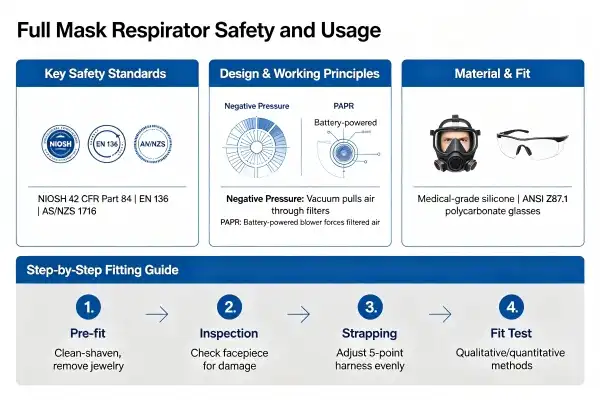
Negative pressure breathing is the basic idea behind it. When you breathe in, you create a vacuum that pulls air through filters connected to the Full Mask Respirator and into your lungs. Dual intake valves in PPE MAX Full Mask Respirators make it easier to breathe, so your employees won't get as tired after wearing them for long amounts of time. The center-mounted exhalation valve effectively lets out exhaled air while keeping CO2 from building up inside the facepiece. This is very important when doing physically hard work in small areas or hot conditions.
Powered Air Purifying Respirators are an option. They use battery-powered blowers to force filtered air into the facepiece, providing positive pressure that keeps contaminants out even if the seal is temporarily broken. Traditional negative-pressure Full Mask Respirator designs, on the other hand, are still the best choice for most industrial uses because they are easier to build, cheaper, and don't need power in case of an emergency.
Key Safety Standards and Certifications
Workplace Full Mask Respirator safety programs are based on following the rules. NIOSH approval under 42 CFR Part 84 shows that Full Mask Respirators pass strict tests in the US. These tests check for things like filter efficiency and facepiece leaking rates. Conformity with EN 136 is required for European markets. This standard divides Full Mask Respirators into three groups based on how well they fight chemicals and how long they last mechanically in harsh circumstances.
When we make things at PPE MAX, we make sure that every unit meets or beats these foreign standards. Our entire Full Mask Respirator product line has NIOSH, EN 136, and AS/NZS 1716 certifications. This gives procurement workers peace of mind that the equipment will work properly whether it's used in a refinery in Texas, a mine in Australia, or a building site in the Middle East. According to OSHA rules, there are different Assigned Protection Factors for each level of danger. Knowing these numbers helps safety managers choose the right Full Mask Respirator for known risk situations.
Material Construction and Type Selection
Medical-grade silicone is used in most current Full Mask Respirators because it is nontoxic, resistant to chemicals, and can keep its shape even when temperatures change. PPE MAX face seals are made of soft rubber that molds to different face shapes without putting pressure on sensitive areas during eight-hour shifts. The impact-resistant ANSI Z87.1 wide-view polycarbonate glasses keep your eyes safe in wet industrial settings with anti-fog coatings.
The lowest total cost of ownership is found in designs that can be used more than once and have filter tubes that can be replaced. Our 5-point changeable strap system spreads the weight evenly across the head, stopping the downward movement that weakens the seal. When workers switch between jobs, they can quickly switch between filter types using bayonet connection systems. For example, when grinding, they can use particulate capsules, and when putting on solvent-based coatings, they can use organic vapor filters on their Full Mask Respirators.
How to Properly Fit a Full Mask Respirator: Step-by-Step Guide
If a Full Mask Respirator isn't fitting properly, it gives workers false security while putting them at risk of the very things it's supposed to protect them from. According to research, even a small leak in a seal can lower the real safety factor by 90% or more, making expensive equipment pretty much useless. It doesn't matter how well the cartridge system filters air if dirty air gets around it by going through gaps between your face and the rubber seal.
Preparation for Fit Testing
In the seal area, workers must be clean-shaven before putting on any full-mask respirator protection. Even just a day's worth of stubble can break down the barrier between skin and plastic. Jewelry, glasses frames, and hair items can all get in the way of making a good bond. To find leaks through physical reaction, qualitative fit testing uses irritant smoke or bitter aerosols, while quantitative methods use special tools to compare the amount of particles inside and outside the Full Mask Respirator facepiece.
Fit testing should only be done in a controlled setting that doesn't have any other things in it that could give you fake results. The test room should be big enough to fit the whole process of putting on the Full Mask Respirator without any problems, so that the testers can see how the head strap is adjusted and the seal is checked. The exact brand, model, and size of the Full Mask Respirator used must be written down when fit tests are good; this information becomes part of each worker's safety training record.
Step-by-Step Fitting Procedure
First, look at the Full Mask Respirator facepiece for any cracks, tears, or distorted sealing areas that could make it less safe. Make sure that all of the valves can move easily and that the parts that let you breathe in and out are properly set. Inspection points for PPE MAX units are clearly marked and made right into the body of the facepiece. This makes pre-use checks easy, even for first-time users.
Hold the Full Mask Respirator up to your face so that the straps are loose. If you don't position the chin pocket properly, it can change the shape of the seal as a whole. First, put the lower head straps around your neck. Then, put the top straps over your head. Tighten slowly, switching between adjustment points so that the pressure is spread out evenly, and no one side is over-tightened. The 5-point harness system we use stops the single-point failures that happen a lot with simpler strap arrangements.
Troubleshooting Common Fit Challenges
Leak points usually happen where people's faces are very different from one another, like on the chin, the temples, or the bridge of the nose. People who have high cheekbones or temples that are set far back may need different size choices or Full Mask Respirator styles with longer seals. PPE MAX can be customized for companies with a diverse workforce, making sure that workers of all ages and races are properly protected without lowering safety standards.
Most of the time, facial hair gets in the way of sealing. As a matter of safety, organizations must maintain clean-shaven policies in seal areas. Full Mask Respirator protection programs fail right away when this basic rule is ignored. For workers who need prescription glasses, they need spectacle inserts without temples that fit inside the facepiece instead of regular glasses that break the seal plane.
Best Practices for Using and Maintaining Full Mask Respirators in Industry
Choosing what to buy is only the beginning of successful Full Mask Respirator programs to protect people's lungs. During its working life, equipment will either provide the protection that was promised based on how it is used and maintained every day. We've looked at maintenance methods at tens of thousands of industrial sites around the world, and there is a clear link between strict maintenance routines and lower rates of occupational illness.
Daily Usage Protocols for Industrial Applications
Personal Full Mask Respirators should be kept in covered cases between uses to keep them safe from dust, chemical splashes, and UV light, which breaks down elastomeric parts. Before each shift, you should look and check the seal again, even if the same unit worked well the day before. Storing it overnight can introduce contaminants or cause the straps to loosen. While wearing it, don't change the straps or break the seal to wipe your sweat or scratch your face. Doing so lets raw air into the breathing zone.
Cleaning and Storage Requirements
When multiple workers share Full Mask Respirator stocks, cross-contamination and skin problems can be avoided by following cleaning procedures. To get rid of big germs, rinse the facepiece in warm water. Then, clean it with light soap solutions that are made especially for elastomeric equipment. Cleaners made from gasoline or harsh solvents that break down silicone substances should be avoided. The inside of PPE MAX Full Mask Respirators is smooth and doesn't have any cracks where bugs can grow, which makes cleaning them easier.
Filter Selection and Replacement Schedules
To match filter tubes to known dangers in the workplace, you need to know the types of contaminants and their concentrations. Particulate filters for Full Mask Respirators have scores of 95, 99, or 100% efficiency and letters P, R, or N that show how resistant they are to oil. Gas and vapor packs say what kinds of chemicals they can take in, like ammonia, acid gases, organic vapors, or a mix of these. PPE MAX has detailed matching charts that match certain chemicals to the right cartridges, so you don't have to guess when making your purchase.
Comparing Full Mask Respirators to Make an Informed Procurement Decision
Managing full-mask respirator protection funds across various sites can be hard for procurement professionals who have to balance protection levels, user acceptance, and lifecycle costs. The decision matrix includes more than just the original buy price. It also includes the infrastructure for upkeep, the training needs, and how well it works with other parts of the safety program. Figuring out when full-face devices work better than other methods lets you choose tools based on facts and in line with real-life exposure situations.
Full Face Versus Half Mask Respirators
Half-masks that cover only the nose and mouth are lighter, better at reducing heat stress, and work with prescription glasses. In places with fewer contaminants, they're good for when eye protection isn't needed or can be provided by separate safety glasses. But their Assigned Protection Factor usually stops at 10, while it can reach 50 for Full Mask Respirators. This makes them less useful in situations with higher exposure.
Brand Comparison and Certification Overview
Established companies like 3M, Honeywell, Scott Safety, and MSA have become well-known in their fields by consistently delivering high-quality Full Mask Respirators and coming up with new ideas. Each has its own engineering philosophy. Some put an emphasis on lightweight, while others focus on lens clarity or communication systems. Certifications are different for each target market. For example, some brands focus on North American standards more than others, while others keep their compliance portfolios better in Europe or Asia-Pacific.
Procurement Considerations and Total Cost Analysis
Prices for good Full Mask Respirator protection range from modest to high at first, based on features, certifications, and extras that come with the mask. However, when figuring out the total cost of ownership, you need to take into account how much it costs to change cartridges, how often you need to test the fit, and how long the equipment will last under normal use. If you take care of your PPE MAX reusable Full Mask Respirators, they can last longer than five years. Disposable respirators, on the other hand, need to be replaced completely after getting dirty or a part breaks.
Safety Tips and Compliance Checklist for Full Mask Respirator Users
The success of a Full Mask Respirator protection program relies on careful attention to detail during the selection, use, maintenance, and tracking stages. To follow OSHA's respiratory protection guidelines under 29 CFR 1910.134, you need to have written plans that keep track of everything, from medical exams to make sure workers are fit to wear Full Mask Respirators to regular testing of fit and equipment repair schedules. The following actions turn legal requirements from meaningless tasks that need to be done into real health protection measures for workers.
Inspection Checklist and Documentation
Every day before use, the stability of the Full Mask Respirator facepiece should be checked for cuts, tears, or permanently deformed areas that would stop it from closing properly. Check the lens surfaces for cracks or crazing that would make them less resistant to impact, and make sure the anti-fog coatings are still in place. PPE MAX Full Mask Respirators are built to last and can handle normal industrial handling, but chemical splashes or accidental drops can cause damage that can't be seen and need to be fixed by taking the unit out of service.
Valve function testing makes sure that the breathing and exhalation valves can move easily and won't get stuck or permanently deformed on the Full Mask Respirator. When headbands are stretched, their flexibility should return them to their original length. If they don't, it means the material is worn out and needs to be replaced. In compliance logs, write down the results of the check, including any Full Mask Respirators that were taken out of service and the specific problems that were found. This record-keeping meets legal requirements and gives information on trends that show common failure modes that will help shape future buying requirements.
Common Usage Mistakes and Their Consequences
Donning the right gear in the wrong order is the most common mistake that makes Full Mask Respirator protection less effective. When workers are in a hurry to get into dangerous areas, they often don't check the seals or tighten the head straps equally, which can cause leaks even when they use the right-sized tools. During training, we stress that the 90 seconds needed to properly put on the gear is worth it because it saves years of work-related sickness caused by long-term low-level exposures.
When workers take off their Full Mask Respirators too soon while still in a dirty environment, they are exposed at the most vulnerable time: when they are working hard, and their breathing rates are high. These exit-phase exposures are avoided by exit processes that require workers to reach clean places before taking off their gear. When you store dirty equipment in storage or the inside of your car, the contaminants get into clean areas and are then exposed to family members.
Training Programs and Fit Test Scheduling
Compliance programs start with initial training that covers Full Mask Respirator risks, equipment limits, donning processes, and upkeep needs. But once a year, retraining classes go over these ideas again and add new information about things like new types of tools or dangers in the workplace. PPE MAX offers a wide range of training materials, such as video demos, hands-on practice guides, and competency testing tools that keep track of each person's level of skill.
How often fit tests are done relies on rules and changes in the workplace. At the very least, workers must be tested once a year, and they must be tested again whenever their weight changes significantly, they get teeth work, or they get scars on their faces that affect Full Mask Respirator seal areas. If you change the brand, model, or size of your mask, it needs to be fit tested again before it can be used in a dirty environment. Keeping fit test records that show good quantitative or qualitative results for each worker-respirator combination is a way to show that the program is following the rules during regulatory checks.
Conclusion
Using Full Mask Respirators to keep workers as safe as possible at work requires a commitment that goes beyond buying the gear and includes making sure it fits right, using it correctly, and keeping it in good shape. Because these devices have a full face seal, built-in eye protection, and high Assigned Protection Factors, they can't be replaced in chemical processing, emergency response, and other high-risk situations. Investing in high-quality Full Mask Respirators from companies that follow strict safety rules and putting in place legal respiratory protection programs are the building blocks for long-lasting improvements in workplace health. By choosing Full Mask Respirators that are properly certified, setting up a strong training system, and working with responsive providers, procurement professionals set their companies up to protect worker health and meet legal requirements.
FAQ
How often should the filter tubes in Full Mask Respirators be changed?
Replacement times vary on the type of pollutant, its quantity, and how long it has been present. In low concentration settings, organic vapor cartridges usually need to be replaced after 40 hours of use. Particulate filters, on the other hand, may last longer if breathing resistance stays acceptable. Instead of extending service life based only on worker comfort, you should always follow the manufacturer's instructions and data from watching the workplace. End-of-service-life signs tell you when to change certain types of cartridges fairly.
Full Mask Respirators: Can they be used properly during spray painting?
When painting with solvent-based finishes or goods that contain isocyanates, these Full Mask Respirators work great. The built-in eye protection keeps paint mist from getting on mucous membranes, and the right cartridge choices filter both overspray particles and organic fumes. Make sure the treatments you use to keep the lenses from fogging up work, and think about getting positive-pressure air systems if you want to use the spray booth for a long time.
What's the main difference between face covers made of rubber and silicone?
Silicone is more resistant to chemicals, doesn't cause allergies, and stays flexible over a wider range of temperatures than natural or manmade rubbers. Even though it costs a little more, silicone is now the most popular material for workplace Full Mask Respirators because it is easier to work with. Silicone seals usually last longer and are more comfortable to wear for longer amounts of time.
Partner with PPE MAX for Certified Respiratory Protection Solutions
Since 1956, PPE MAX has been protecting industrial workers by always focusing on making the best products and working with customers. All over North America and 133 other countries, our Full Mask Respirator line meets the tough needs of chemical processing, mining, emergency response, and building. As a top Full Mask Respirator provider, we can make any changes you need. We can work with OEMs to make products or create private label programs for distributors who want to build their brand.
Visitors are welcome to visit our factory in Xi'an, where they can see the strict quality control steps we use to make sure every unit meets NIOSH, EN 136, and AS/NZS 1716 standards. Email our technical team at marketing@ppemax.com to talk about your unique Full Mask Respirator protection needs, get quotes on large orders, or set up training programs for your employees. We don't just sell tools; we also give your company the knowledge, help, and dependability it needs to keep the workplace safe.
References
1. National Institute for Occupational Safety and Health. (2018). NIOSH Guide to the Selection and Use of Particulate Respirators. Department of Health and Human Services Publication No. 96-101.
2. Occupational Safety and Health Administration. (2020). Respiratory Protection Standard 29 CFR 1910.134: Compliance Guidelines for General Industry. U.S. Department of Labor.
3. European Committee for Standardization. (2019). EN 136:1998 Respiratory Protective Devices - Full Face Masks - Requirements, Testing, Marking. CEN Technical Committee 79.
4. Myers, W.R., Lenhart, S.W., & Campbell, D.L. (2017). Assigned Protection Factors: Determination Through Workplace Performance Testing. Journal of Occupational and Environmental Hygiene, 14(8), 625-637.
5. Bergman, M.S., Zhuang, Z., & Hanson, D. (2019). Fit Testing Protocols and Pass-Fail Criteria for Tight-Fitting Respirators in Industrial Applications. American Industrial Hygiene Association Journal, 80(4), 289-301.
6. Coffey, C.C., Lawrence, R.B., & Zhuang, Z. (2021). Full Facepiece Respirator Performance in Simulated Workplace Activities: Quantitative Assessment of Protection Factors. Annals of Occupational Hygiene, 65(3), 312-328.
Learn about our latest products and discounts through SMS or email