- English
- French
- German
- Portuguese
- Spanish
- Russian
- Japanese
- Korean
- Arabic
- Greek
- German
- Turkish
- Italian
- Danish
- Romanian
- Indonesian
- Czech
- Afrikaans
- Swedish
- Polish
- Basque
- Catalan
- Esperanto
- Hindi
- Lao
- Albanian
- Amharic
- Armenian
- Azerbaijani
- Belarusian
- Bengali
- Bosnian
- Bulgarian
- Cebuano
- Chichewa
- Corsican
- Croatian
- Dutch
- Estonian
- Filipino
- Finnish
- Frisian
- Galician
- Georgian
- Gujarati
- Haitian
- Hausa
- Hawaiian
- Hebrew
- Hmong
- Hungarian
- Icelandic
- Igbo
- Javanese
- Kannada
- Kazakh
- Khmer
- Kurdish
- Kyrgyz
- Latin
- Latvian
- Lithuanian
- Luxembou..
- Macedonian
- Malagasy
- Malay
- Malayalam
- Maltese
- Maori
- Marathi
- Mongolian
- Burmese
- Nepali
- Norwegian
- Pashto
- Persian
- Punjabi
- Serbian
- Sesotho
- Sinhala
- Slovak
- Slovenian
- Somali
- Samoan
- Scots Gaelic
- Shona
- Sindhi
- Sundanese
- Swahili
- Tajik
- Tamil
- Telugu
- Thai
- Ukrainian
- Urdu
- Uzbek
- Vietnamese
- Welsh
- Xhosa
- Yiddish
- Yoruba
- Zulu
Insulating Gloves: What ASTM Class Do You Really Need?
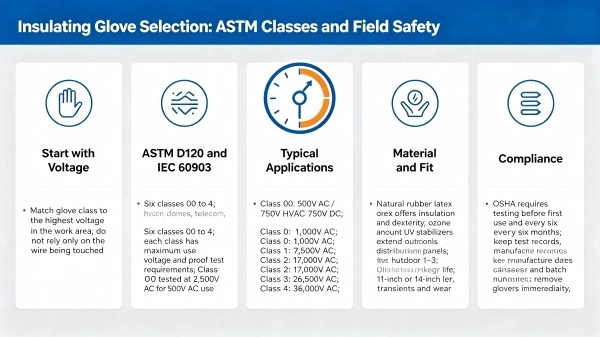
To pick the right voltage-rated electrical safety gloves of insulating gloves, you need to make sure that the ASTM class ratings match the voltage levels that you will be exposed to at work. Because it can handle voltages up to 500V AC, Class 00 is great for electrical work in homes, telecommunications, and light commercial repair. As you go up the range, Class 0 can handle 1,000V AC, Class 1 can handle 7,500V AC, Class 2 can handle 17,000V AC, Class 3 can handle 26,500V AC, and Class 4 can handle 36,000V AC. The right choice relies on three things: the highest voltage in your work area, the safety gaps needed according to OSHA 29 CFR 1910.137, and the daily tasks your team does.
Understanding Insulating Gloves and ASTM Classes
When a person comes into contact with live equipment, electrical protective insulating gloves are the main thing that stops current from flowing through their body. Unlike regular work gloves that are made to protect against bodily damage, these specialised items go through strict dielectric testing to make sure they can insulate under certain voltage conditions.
The Purpose Behind ASTM D120 and IEC 60903 Standards
IEC 60903 is the worldwide standard for rubber insulating gloves, while ASTM D120 is the standard for gloves used by electrical workers in North America. These guidelines set out six separate classes, numbered from 00 to 4. Each class has been tried and approved for a certain maximum use voltage and proof test threshold. The proof test voltage is the amount at which gloves must show that they don't leak current during lab testing. It is usually set at five times the maximum use voltage to make sure there are enough safety gaps.
We make our Class 00 products to go above and beyond both ASTM D120 and IEC 60903 standards. Each production batch goes through AC proof testing at 2,500V, even though the highest use rate is only 500V. We are committed to reliability in the real world, where voltage spikes, harmonics, and transient phenomena can be worse than standard rates. This cautious method shows that.
Material Science Behind Electrical Insulation
Because it is more flexible and has better insulating qualities, natural rubber latex is used to make most electrical gloves. When rubber is properly hardened, its chemical structure blocks the flow of electrons well while still keeping the flexibility needed for fine motor skills. Modern versions include ozone-resistant chemicals and UV stabilizers, which make gloves last longer in outdoor settings where wear and tear used to shorten their usefulness.
Our Class 00 models are made of high-quality natural rubber latex that is about 0.5 mm thick. This gives them great tactile awareness for difficult jobs like installing meters, working on control panels, and repairing telecommunications equipment. With a reference weight of only 170g per pair, the lightweight design keeps your hands from getting tired after long periods of use, which is a common issue among field workers.
Classification System Overview
Based on the level of electrical risk, the six-class scheme draws clear lines between areas. Class 00 gloves are the basic level for low-voltage tasks up to 500V AC. These tasks are common in home electrical systems, business building upkeep, and light industrial equipment. As the voltage exposure goes up, the shielding capacity of each class goes up by the same amount. For distribution panels and industrial control systems, Class 0 adds safety up to 1,000V AC. Classes 1 through 3 take care of repair for utility distribution and transmission lines. Class 4 is for the toughest high-voltage situations in substations and power plants.
If you know where your activities fall in this range, you can avoid the problems of either over-specifying protection, which raises costs and limits your ability to move, or under-specifying protection, which leaves unsafe holes.
Key Criteria for Choosing the Right ASTM Class
A starting point for choosing gloves is the voltage grade written on the equipment nameplates. However, there are a number of other factors that affect which class of insulating gloves is best for your situation.
Matching Voltage Ratings to Actual Exposure
Maximum use voltage is the largest voltage at which gloves can be used safely, as long as the right tests and inspection procedures are followed. For AC power devices that are working normally, this number is what you need to know. When you're thinking about what you need, you should find the areas with the biggest voltage, not just the wires that techs are touching. Unexpected exposure can happen because of voltages that are induced from nearby wires, energy that is saved in capacitive circuits, or backfeeding situations that happen through parallel routes.
Our Class 00 products are suitable for use where the maximum voltage is confirmed to be less than 500V AC. These include home service panels, telecommunications equipment racks, HVAC control systems, and industrial gear that runs on standard 480V three-phase power. With its 750V DC grade, it can protect battery systems, solar setups, and DC industrial drives all at the same time.
Safety Margins and Risk Assessment
Electrical safety experts always say to choose gloves that are rated for at least one class higher than the voltage you are exposed to. This range takes into account voltage changes, measurement errors, and the normal wear and tear that happens between tests. Even though Class 00 covers the voltage range, a building with 480V technology benefits from Class 0 security, which acts as a safety net in case something goes wrong.
Arc flash potential, available fault current, and closeness to higher-voltage systems should all be taken into account in site-specific risk evaluations. Wet conditions, confined areas, and touching grounded objects at the same time all raise the risk, which could mean that higher-rated gloves are needed than voltage alone suggests.
Material Considerations Beyond Voltage Rating
The voltage class is the most important factor in the selection process, but the makeup of the glove material has minor but important effects on performance. Natural rubber is great at conducting electricity, but it is not very resistant to petroleum products, some chemicals, and ozone. Some electrical efficiency is lost when synthetic rubber formulas are made to be more resistant to chemicals and last longer in harsh environments.
You can choose from 11-inch and 14-inch lengths, depending on how much of your wrist will be exposed and how much you need to tuck the gloves into your sleeves. The 14-inch model gives you more reach, so you can work near live busbars or inside equipment cages. Colour coding makes it easy to tell the difference between voltage classes at a glance. For example, our Class 00 goods are clearly marked by their red or black colour.
Compliance Documentation and Certification Requirements
Regulatory compliance includes more than just buying approved gloves. It also includes keeping the right paperwork for them while they're in use. Electrical testing is required by OSHA before the first use and every six months after that. Records must be kept to show the times and results of the tests. Gloves that fail electricity tests must be taken out of service right away.
Purchasing teams should make sure that providers give full certification paperwork, which should include proof of test results, clear manufacturing dates on each glove, and the ability to track back to specific production runs. We put a class number, size, production date, and a unique batch number on each glove. This makes keeping records and managing recalls easier in case of quality problems.
Comparing Types and Performance of Insulating Gloves
Procurement workers can make better buying choices when they can tell the difference between product categories and understand how different manufacturers' products perform.
Insulating Gloves Versus Standard Rubber Gloves
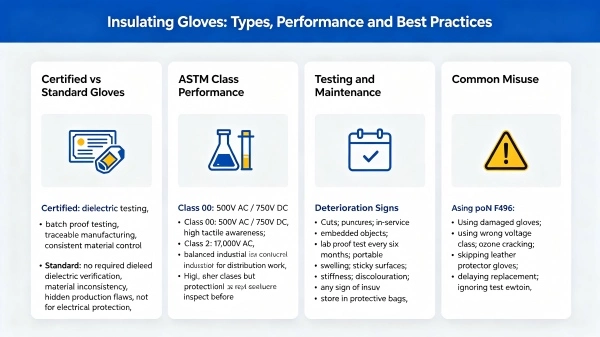
For electrical safety, general-use rubber gloves don't have the dielectric tests, material purity, or quality control that are needed. Even though they look the same on the surface, rubber goods that haven't been tested have production flaws, contamination, and material inconsistencies that let current flow when voltage is applied. If you mistake utility gloves for electrical safety gear, the results could be deadly.
During production, all of the electrical insulating gloves that are certified are tested, and each pair is proof-tested before it is sent out. This strict quality control gets rid of broken units that might look fine but don't work when put under electrical stress. The price difference is due to the fact that testing equipment and paperwork requirements make production costs much higher than for regular rubber gloves.
Performance Characteristics Across ASTM Classes
In addition to voltage levels, classes vary in how thick, heavy, and easy they are to work with. For thorough work, lower classes put comfort and tactile awareness first, while higher classes give up some movement to get thicker insulation. A utility worker working on 12kV distribution equipment needs Class 2 protection, but is okay with having less flexibility in his fingers because of the voltage. A telecommunications worker who splices fibre cables with 120V circuits can benefit from Class 00 sensitivity without having to deal with extra size.
These choices can be seen in real-life uses. Installing an electric meter requires careful handling of small terminal screws and wire connections. This makes Class 00 ideal, even though workers may come into contact with higher voltages elsewhere in the panel, as long as they keep the right lengths between themselves and those parts that are live. When industrial electricians are fixing 480V motor control centres, they usually choose Class 0 gloves because they offer a moderate level of extra protection while still letting them feel the controls and breakers properly.
Evaluating Manufacturers and Certification Status
Both well-known companies have been making electrical gloves for decades and new companies that are entering the market and offering low prices. Brands like Honeywell, Ansell, Salisbury, and 3M have built their names on testing programs that make sure their products are always of high quality. When making a purchase choice, the cost should be weighed against the history of reliability, warranty support, and the availability of expert help.
In this tough market, PPE MAX stands out because we have been making products for 68 years and have customers in 134 countries around the world. Our factories in Northwest China have both new testing tools and quality teams with a lot of experience who know how important it is to protect electricity systems. Unlike sellers who hire other companies to make their products or rebrand foreign goods, we are in charge of the whole manufacturing process, from choosing the raw materials to testing and packaging the finished products.
Best Practices for Care, Testing, and Maintenance
Protective gear is only useful if it is kept in good shape throughout its useful life. Setting up structured care routines for insulating gloves makes them last longer and protects them consistently.
Standardized Testing Procedures and Intervals
ASTM F496 spells out how to test electrical safety equipment that is already in use. When gloves are tested in the lab, they are put in conductive water tubs, a proof test voltage is applied, and any leaking current is measured. If you find the current above certain limits, it means that the insulation is failing, which means you need to take off your gloves. The most time between tests is six months, but shorter rounds are better for harsh settings or heavy use.
Field testing with portable tools is a handy way to screen between lab tests, but it can't take the place of regular lab review. The first line of defence is still visual inspection before each use. Workers are taught to spot cuts, punctures, foreign objects buried in the material, ozone cracking, and swelling that are signs of chemical pollution.
Identifying Signs of Deterioration
There are a number of visible signs that rubber is breaking down. Ozone cracking shows up as thin lines on the surface that run perpendicular to stress spots. These lines usually show up where the material folds and bends. Even though our UV-resistant formula slows down this ageing process, storing gloves outside for a long time will eventually cause noticeable cracking, which means you need to get new gloves.
Swelling from oil contact, sticky surfaces that mean they are contaminated, or stiffness that means they weren't stored properly are all things that can damage electrical integrity. If the colour changes, especially if it gets darker or has patterns of different colours, it could mean that chemicals are reacting inside the rubber structure.
Storage, Cleaning, and Handling Guidelines
Gloves stay in good shape between uses if they are stored properly. Gloves should be stored in protective bags or cases out of the sun, away from ozone sources like electric motors and welding tools, and at room temperature or below. When you fold gloves lightly instead of tightly, the stress collection points that cause cracks are lessened.
Cleaning the rubber after use gets rid of dirt and grime without hurting it. Mild soap and water are usually enough, and rinsing well gets rid of any soap residue. Gloves must be fully dry before being stored to keep them from breaking down because of wetness. Staying away from cleaners, acids, and rough scrubbing that are made from gasoline helps keep materials in good shape.
Our Class 00 gloves are safely stored from the plant to the job site because they are separately wrapped in polybags and put in protective boxes—one pair per box, 20 boxes per master carton. The 54.5cm x 35cm x 42.5cm dimensions of the carton make shipping more efficient and protect the goods while they're being moved.
Common User Errors Compromising Protection
Several trends of misuse keep coming up in reviews of incidents. Many accidents happen because people wear broken gloves instead of getting new ones, even though the problems are clear. Gloves with holes, tears, or metal pieces in them clearly don't protect as well, but workers sometimes keep using them because they're convenient or there aren't enough replacements.
When you use the wrong voltage class for the job, either because you don't know how to read voltage grades or because you don't have the right tools, you give yourself false confidence that your security isn't good enough. If you don't wear the needed leather protector gloves over the rubber insulating gloves, the rubber gloves could get punctured or worn down. The leather guards protect against mechanical damage, leaving the rubber gloves to protect against electricity.
Procurement Guide: How to Buy Insulating Gloves for Your Business
When making strategic purchases, you weigh the short-term cost against the long-term worth, dependability, and total cost of ownership of insulating gloves, which is more than just the purchase price.
Supplier Reliability and Credential Assessment
Before deciding on a provider, it's important to check their manufacturing certifications and quality system documents. Systematic quality management is shown by ISO 9001 certification, and technical ability is shown by ISO/IEC 17025 approval for electrical testing laboratories. By asking for approval papers, test results, and information about the manufacturing site, you can tell the difference between real makers and importers who are lying about their skills.
Stability in the supply chain is important for big businesses with sites in many places. Keeping enough inventory on hand, giving regular wait times, and showing that they are financially stable are all things that lower procurement risk. We keep stock in a number of different places so that we can quickly fill both sample orders and large orders. Our global shipping options allow us to serve customers on every continent.
Volume Pricing and Contract Structures
Several ways buying in bulk can save you a lot of money. Large production runs make factories more efficient, which lowers the cost per unit that sellers can pass on to buyers who buy in bulk. When you combine shipping, you save money on logistics costs, and both sides gain from lower transaction costs.
The way we set our volume price is meant to reward trust and growth. Companies that sign yearly contracts or blanket purchase orders get better prices, as well as specialised account management and first choice for production schedules. At large quantities, customisation options like private labelling, size assortment optimisation, and different packing become cost-effective. This lets wholesalers and big end users set their products apart.
OEM and Customisation Capabilities
Industrial dealers and PPE suppliers are looking for customised goods that meet technical requirements more and more. Our OEM services include adding logos, designing unique packaging, and changing specifications as long as they don't go against approval rules. With this feature, buying generic gloves can be turned into unique lines that help distributors stand out and keep customers coming back.
Customisation includes optimising the size range based on the demographics of the workforce. Customers in North America or Europe usually need different size ranges than customers in Asia. We work with buying teams to look at past usage data and come up with the best mix of sizes so that there isn't too much of the sizes that don't sell quickly and there aren't too few of the sizes that do. As a norm, our Class 00 range includes numbers 8, 9, 10, and 11, which are the most common hand sizes around the world.
Logistics and After-Sales Considerations
When you buy something from another country, you have to deal with customs rules, import taxes, and shipping processes. Experienced sellers give full export paperwork, unified tax classifications, and rules and regulations advice that are specific to the countries where the goods are going. Because we've worked with 134 countries for so long, we know a lot about export rules, sending dangerous goods when necessary, and making sure that paperwork is correct so that customs delays don't happen.
Support after the sale is what sets good sellers apart from great partners. Technical support helps customers choose the best gloves, set up testing programs, and teach workers how to use and take care of gloves properly. Through workshops, on-site visits, and complete paperwork packages, we offer full product training. You can get in touch with our technical support team through established methods of contact, such as direct email. They reply quickly to questions about specifications, testing readings, and problem resolution.
Conclusion
Picking the right voltage-rated electrical protection insulating gloves is an important choice that will affect worker safety, compliance with regulations, and the cost-effectiveness of your operations. The ASTM classification system makes it easy to match protection levels to voltage exposure. For example, Class 00 offers reliable protection for common low-voltage situations seen in telecommunications, business electricity repair, and light industrial settings. Strategic buying means paying close attention to the validity of certifications, the dependability of suppliers, and the total cost of ownership, which is more than just the purchase price. Setting up regular schedules for testing, upkeep, and replacement of gloves ensures that they provide consistent safety throughout their useful life. When companies take the time to learn about these selection factors and work with experienced manufacturers, they set themselves up for better safety results and higher business efficiency.
FAQ
1. Which ASTM class works best for low-voltage electrical maintenance?
Class 00 gloves rated for 500V AC are safe for use around home electrical systems, telecommunications setups, business lighting circuits, and factory equipment that runs on 480V or less. This class gives you the good hand-eye coordination you need for detailed work while also meeting safety standards for frequent low-voltage situations. Before making a final choice, organisations should do site-specific risk studies that take into account things like possible unexpected voltages and how close the site is to higher-voltage systems.
2. How often does electrical testing require insulating gloves?
According to OSHA rules, gloves that are being used must be electrically tested every six months at the most. Shorter testing rounds may be necessary when there are harsh environmental conditions, heavy use patterns, or demanding uses. Before the first use and after any damage that might have happened, testing must be done. Keeping accurate records of testing dates, results, and unique glove labels helps with managing supplies and making sure that regulations are followed.
3. Do voltage-rated gloves protect against mechanical and chemical hazards?
Dielectric insulation is the main way that insulating gloves guard against electrical shock. When worn over rubber insulating gloves, leather protective gloves protect against cuts, punctures, and abrasions that could damage the electrical structure. Different types of rubber have different levels of chemical resistance. For example, natural rubber doesn't protect well against oil products and solvents. When there is a lot of chemical exposure, you need to be careful about which materials you use and maybe even special safety gear like insulating gloves.
Secure Your Electrical Safety with PPE MAX
Since 1956, we've been protecting electrical workers in 134 countries. Our manufacturing know-how and unwavering dedication to quality have made PPE MAX the first choice for utilities, telecommunications companies, and industrial safety managers all over the world. Our Class 00 insulating gloves are approved to protect you and meet both ASTM D120 and IEC 60903 standards. They are made of natural rubber that has been tested to 2,500V and is reliable for 500V AC service. Procurement teams like our low bulk prices, ability to customise for OEMs, and global logistics network that allows for fast delivery anywhere your operations need safety. You can talk to our expert team at marketing@ppemax.com about your specific needs, ask for samples, or get a full quote from a top maker of insulating gloves that can meet the needs of your long-term safety program.
References
1. American Society for Testing and Materials. (2022). ASTM D120-21: Standard Specification for Rubber Insulating Gloves. ASTM International, West Conshohocken, PA.
2. International Electrotechnical Commission. (2021). IEC 60903:2021 Live Working - Electrical Insulating Gloves. Geneva, Switzerland.
3. Occupational Safety and Health Administration. (2020). 29 CFR 1910.137: Electrical Protective Equipment Standards and Guidelines. U.S. Department of Labor, Washington, DC.
4. National Fire Protection Association. (2021). NFPA 70E: Standard for Electrical Safety in the Workplace. Quincy, Massachusetts.
5. American Society for Testing and Materials. (2020). ASTM F496-20: Standard Specification for In-Service Care of Insulating Gloves and Sleeves. ASTM International, West Conshohocken, PA.
6. Institute of Electrical and Electronics Engineers. (2019). IEEE Guide for Testing and Evaluation of Personal Protective Equipment Used in High-Voltage Transmission and Distribution. IEEE Standards Association, Piscataway, NJ.
Learn about our latest products and discounts through SMS or email