- English
- French
- German
- Portuguese
- Spanish
- Russian
- Japanese
- Korean
- Arabic
- Greek
- German
- Turkish
- Italian
- Danish
- Romanian
- Indonesian
- Czech
- Afrikaans
- Swedish
- Polish
- Basque
- Catalan
- Esperanto
- Hindi
- Lao
- Albanian
- Amharic
- Armenian
- Azerbaijani
- Belarusian
- Bengali
- Bosnian
- Bulgarian
- Cebuano
- Chichewa
- Corsican
- Croatian
- Dutch
- Estonian
- Filipino
- Finnish
- Frisian
- Galician
- Georgian
- Gujarati
- Haitian
- Hausa
- Hawaiian
- Hebrew
- Hmong
- Hungarian
- Icelandic
- Igbo
- Javanese
- Kannada
- Kazakh
- Khmer
- Kurdish
- Kyrgyz
- Latin
- Latvian
- Lithuanian
- Luxembou..
- Macedonian
- Malagasy
- Malay
- Malayalam
- Maltese
- Maori
- Marathi
- Mongolian
- Burmese
- Nepali
- Norwegian
- Pashto
- Persian
- Punjabi
- Serbian
- Sesotho
- Sinhala
- Slovak
- Slovenian
- Somali
- Samoan
- Scots Gaelic
- Shona
- Sindhi
- Sundanese
- Swahili
- Tajik
- Tamil
- Telugu
- Thai
- Ukrainian
- Urdu
- Uzbek
- Vietnamese
- Welsh
- Xhosa
- Yiddish
- Yoruba
- Zulu
How to Replace the Lens on a Welding Face Shield?
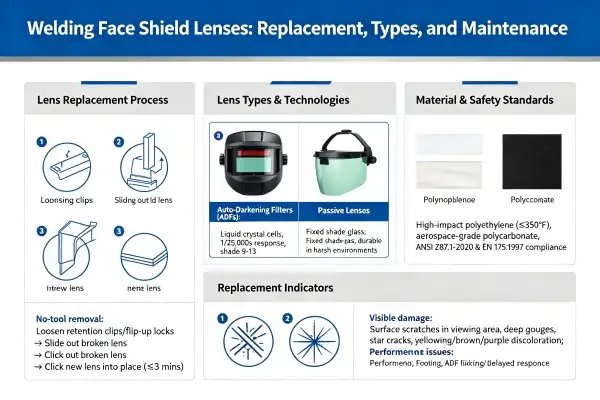
To change the lens on a Welding Face Shield, you have to take out the old filter tube or cover plate and put in a new one that fits the shield's fixing system. Most good shields have ways to take out the lens without using any tools. To do this, just loosen the retention clips or flip-up locks, slide out the broken lens assembly, and then put in the new one until it clicks safely into place. This simple maintenance job, when done right, takes less than three minutes but greatly increases the life of your equipment and keeps your workers safe from arc eye and other dangers that come with worn-out safety gear.
Understanding the Role and Types of Welding Face Shield Lenses
The lens assembly in a welding shield serves multiple protective functions simultaneously. Beyond the obvious barrier against projectile spatter, these precision-engineered components filter harmful UV and IR radiation while maintaining the visual clarity necessary for accurate weld placement. Modern lens technology represents decades of materials science advancement, balancing impact resistance with optical precision.
Auto-Darkening Versus Passive Lens Technology
Auto-darkening filters (ADFs) have liquid crystal cells that change from light to dark states right away when they sense arc radiation. These high-tech systems react in less than 1/25,000th of a second, keeping welders from getting flash burns and letting them keep their helmets down between welds. At PPE MAX, our auto-darkening shields come in shade ranges from 9 to 13, so they can be used for a wide range of welding tasks, from delicate TIG work to heavy-duty stick welding. The technology gets rid of the lost time and money that comes from constantly raising and lowering passive screens.
Passive lenses, on the other hand, use glass with a fixed shade that protects at a set amount of darkness. Even though they don't have the ease of auto-darkening technology, passive glasses are very durable in harsh settings and don't require you to worry about batteries dying or sensors not working right. Heavy production shops often choose passive lenses because they have been shown to work well in dirty, hot environments where computer parts might not.
Material Composition and Safety Standards
Lens materials have a big impact on how well they protect and how long they last. Modern shields are mostly made of high-impact polyethylene, which has great strength-to-weight ratios and can withstand temperatures up to 350°F. Both the top cover lens and the main filter unit on our shields at PPE MAX are made of aerospace-grade polycarbonate. This makes sure that they meet the standards set by ANSI Z87.1-2020 and EN 175:1997. These badges show that lenses can survive tests where they are hit at high speeds and keep their shape when heated up.
A professional-grade welding face shield usually has a multi-layer lens system with an outer cover plate that is meant to be broken, the main filter assembly, and an inner retained lens. This setup keeps the visual clarity while protecting the expensive filter element from normal damage. Teams in charge of buying things should make sure that new lenses have the right marks to show the shade number, the name of the maker, and that they meet the standards. These are important things to check for during safety audits and regulatory inspections.
Signs You Need to Replace the Lens on Your Welding Face Shield
Recognizing lens degradation before it compromises safety requires systematic inspection protocols. We recommend establishing clear replacement criteria across your operations to eliminate subjective decision-making that can delay necessary maintenance.
Visible Damage Indicators
Normal use causes surface scratches to build up over time, but once they get into the main viewing area, the screen has to be replaced. Welders have to move closer to the subject to make up for small scratches that spread light. This is dangerous because it raises the risk of getting burned. Impact damage that weakens the structure is shown by deep gouges or star-pattern cracks. Such glasses could break when hit again, putting workers at risk of missile pieces and radiation.
Discolouration means that chemicals or too much heat have gotten into the lens material and changed it. Usually, yellowing around the edges means UV damage, while brown or purple tints mean thermal damage from being exposed to an arc for a long time. These changes in colour make it harder to tell the difference between shades, which could let dangerous radiation through even when the lens looks fine.
Performance-Based Replacement Triggers
If the lenses keep fogging up even after letting them breathe, it means that the anti-fog coatings have worn off or that tiny cracks have formed on the surface of the lenses. Welders have to take off their covers while working because of this problem, which is not safe. In the same way, ADF lenses that flicker, don't darken regularly, or have slow response times need to be replaced right away because they leave workers open to arc flash injuries.
Environmental factors have a big effect on how often things need to be replaced. Heavy spatter conditions in ships and structural steel manufacturing use up outer cover plates in just a few days, which means that large quantities need to be managed. When pipeline welding is done outside, shields are exposed to high and low temperatures and UV light, which speeds up the breakdown of the material. Instead of waiting for something to break, set repair plans based on usage. This keeps you safe and lowers the total cost of ownership through regular maintenance cycles.
Step-by-Step Guide to Replacing the Lens on a Welding Face Shield
Proper lens replacement requires methodical execution to ensure protective integrity and avoid damaging expensive filter assemblies. We have trained thousands of safety personnel on these procedures through our technical support programs.
Preparation and Safety Precautions
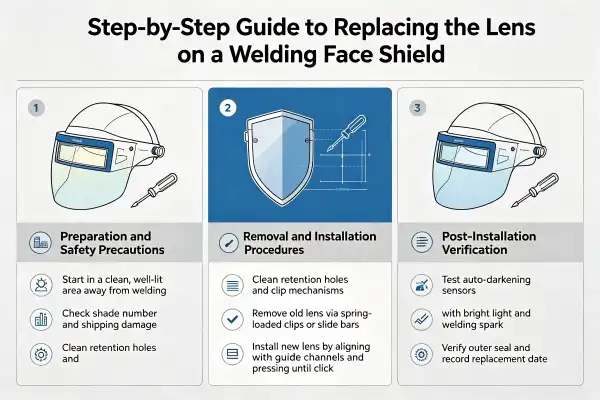
Starting your work in a clean, well-lit area away from where people are welding is a good idea. Grinding dust or metal spray can get on new lenses and damage them while they are being installed. Get the tools you'll need. For most good shields, you only need your hands, but for some types, small screwdrivers are needed for the locking screw systems. Before you open the protected box on the new lens, check to see that the shade number fits your welding needs and that there are no signs of shipping damage.
Carefully look at the shield's fixing frame and clean out the retention holes and clip mechanisms of any dirt or dust that has built up. Broken or crooked retention hardware makes lenses less secure and needs to be changed before new lenses are put in. Our PPE MAX shields have gear that doesn't rust and can handle tough industrial settings. However, they should be checked every so often to make sure they keep working well.
Removal and Installation Procedures
The way to remove it depends on the type and maker. Many new shields, like our PPE MAX types, have spring-loaded clips or slide holding bars that let go with light pressure. Find the release mechanisms, which are usually on the upper and lower sides of the lens frame, and remove them both at the same time. Hold the lens assembly in place to keep it from falling.
For shields that have auto-darkening cartridges built in, only touch the filter assembly by its sides and not the viewing surface or sensor windows. Fingerprints and grease can blur the view and make it harder to find arcs. Slide the old lens assembly straight out of the mounting slots, making sure to note how any seals or spacers need to be moved to the new lens.
Putting in the new lens changes this order. Before putting the lens piece into the fixing frame, make sure that any sealing covers are in the right place. Line up the cartridge with the guide channels and press down hard until you hear a click as the retention clips engage. Visual proof is given by our shields' sign marks that show the right way to sit, which is especially helpful when teaching new repair staff.
Post-Installation Verification
Before putting the shield back into service, testing makes sure that it was installed correctly and works properly. For auto-darkening units, shine a bright light on the sensors and hit them with a welding spark to make sure they darken. Check all of the controls that can be changed. The sensitivity settings and shade choices should work without any problems. Check the outer seal to make sure there are no gaps between the lens and frame that could let radiation or debris in.
To set up standard data for predictive maintenance plans, write down the date and purpose of each change. This method helps buying teams find the best inventory levels and find equipment that doesn't get serviced at the expected times. We've found that keeping structured records lowers the cost of emergency replacements by about 30% because it makes forecasts more accurate.
Comparing Welding Face Shield Lenses with Helmets: What Procurement Managers Should Know
Understanding the functional distinctions between shield lenses and helmet assemblies enables strategic equipment allocation across diverse welding applications. These protective systems serve complementary rather than interchangeable roles in comprehensive safety programs.
Protection Scope and Application Suitability
Welding face shields and welding hats protect the whole head, including the ears and top, from damage. This is why they are necessary for confined space and overhead welding. The sealed design of the helmet blocks out light from the sides and has built-in lung protection connections, which are important for long welding sessions in places with bad air quality. This full safety does, however, come with more weight and less knowledge of the environment, which can make it harder for users to accept in some situations.
Face shields are great for welding jobs that need to be done in short bursts or where tools need to be moved around a lot. The open form lets more air flow through, which lowers heat stress during long shifts in hot places. Most helmets weigh between 1.8 and 2.5 pounds, but our PPE MAX shields only weigh 1.2 pounds. This makes them much easier on the neck when worn for long periods of time. Shield-based security is especially useful for maintenance workers who need to do quick fixes and car techs who need to do a variety of jobs.
Cost and Maintenance Considerations
The difficulty of replacement varies a lot between systems. Helmet lens tubes usually need to be partially taken apart from the shell, which involves a lot of screws and tricky adjustment steps. On the other hand, shield lenses have change systems that don't need any tools and allow field swaps to be done in less than three minutes. This ease of access cuts down on the cost of repair labour and downtime for equipment, both of which are very important when handling big amounts of equipment across multiple sites.
The total cost of ownership is more than just the price of the car. Even though helmets cost more up front, the fact that they are contained keeps expensive ADF cartridges from getting damaged by accident. Shields let lenses be hit more often, which increases the wear on the cover plate but protects the main filter with layers that are meant to be destroyed if they get damaged. When doing a procurement study, these different cost drivers should be modelled against how they are actually used. Heavy spatter loads in pipeline operations might wear out cover plates every week, but helmet shells rarely get damaged. Precision makers, on the other hand, might find shields more cost-effective because they wear out less often.
Where and How to Source Quality Welding Face Shield Lenses for Bulk Purchase
Securing reliable lens supplies at scale requires strategic supplier relationships and rigorous quality verification protocols. Procurement decisions in this category directly impact worker safety and operational continuity.
Identifying authentic suppliers begins with certification verification. Reputable manufacturers maintain current testing documentation for ANSI, CE, and CSA standards—credentials that should be readily available for inspection. At PPE MAX, we provide complete certification packages with every bulk order, including test reports documenting optical clarity ratings, impact resistance verification, and radiation transmission specifications. This transparency eliminates procurement uncertainty and supports regulatory compliance documentation.
Beyond certification verification, evaluate supplier manufacturing capabilities and quality control processes. Lens production requires precision moulding equipment and contamination-controlled assembly environments to maintain optical specifications. Touring manufacturing facilities provides invaluable insights into quality assurance rigour. We welcome procurement professionals to our Xi'an facility, where visitors observe our testing procedures, including switching time validation using oscilloscope measurement and drop ball impact testing that exceeds minimum standard requirements.
Bulk Ordering and Customization Options
Volume procurement unlocks significant cost advantages and customization opportunities. Minimum order quantities vary by product configuration—standard passive lenses typically require lower minimums than auto-darkening assemblies with proprietary electronics. We structure our pricing to reward commitment while maintaining flexibility for emerging market demands. Custom branding options allow corporate identity integration, supporting safety culture initiatives through consistent visual messaging across equipment fleets.
OEM partnerships represent the pinnacle of strategic sourcing relationships for Welding Face Shield. Organizations with unique operational requirements benefit from tailored specifications addressing specific environmental challenges or workflow integration needs. Our engineering team collaborates with partners to develop custom lens assemblies incorporating specialized coatings, modified shade ranges, or enhanced impact resistance for extreme applications. These relationships typically involve technical exchange agreements and joint testing programs that ensure performance under actual field conditions.
Comprehensive Supplier Evaluation Criteria
After-sales support capabilities separate adequate suppliers from true partners. Technical support availability, replacement part accessibility, and warranty terms directly impact the total cost of ownership. We maintain a dedicated technical hotline staffed by safety equipment specialists who understand field conditions and can diagnose performance issues remotely. Our warranty covers manufacturing defects comprehensively, and we stock replacement components globally to ensure rapid fulfillment regardless of delivery location.
The reliability of international shipping and customs handling becomes critical when sourcing across borders. Experienced suppliers manage documentation requirements proactively, minimizing clearance delays and ensuring compliant product markings for destination markets. Having served customers across 134 countries since 1956, we have refined logistics processes that consistently deliver on committed schedules. This operational excellence matters profoundly when supply interruptions could halt production or leave workers inadequately protected.
Conclusion
Effective lens replacement protocols form the foundation of comprehensive welding safety programs. By recognizing degradation indicators early, implementing systematic replacement procedures, and sourcing quality components from verified suppliers, procurement teams protect their most valuable assets—their workforce. The technical considerations outlined here empower purchasing managers and safety directors to make informed decisions that balance regulatory compliance, operational efficiency, and worker protection. Regular lens maintenance through established protocols prevents the costly consequences of equipment failure, from minor productivity losses to catastrophic workplace injuries. We encourage procurement professionals to elevate lens replacement from reactive maintenance to proactive safety management, embedding these practices within broader occupational health initiatives that demonstrate organizational commitment to worker welfare.
FAQ
How can I verify that replacement lenses meet required safety standards?
Authentic lenses carry permanent markings indicating compliance with applicable standards such as ANSI Z87.1+, EN 379, or CSA Z94.3. These markings typically appear on the lens periphery and include manufacturer identification, shade number, and optical class ratings. Request certification documentation from suppliers showing actual test results rather than merely claimed compliance. Reputable manufacturers provide complete data packages, including UV/IR transmission testing and impact resistance verification performed by accredited laboratories.
Are replacement lenses interchangeable between different shield brands?
Lens interchangeability varies significantly by manufacturer and model generation. While some standardization exists within product families, mounting dimensions, retention mechanisms, and electrical connections differ substantially across brands. Attempting to install incompatible lenses compromises protection and typically voids equipment warranties. We recommend maintaining brand-consistent inventory to ensure proper fit and performance. When managing mixed equipment fleets, clearly label inventory by compatibility group to prevent installation errors during urgent replacements.
What compliance requirements apply to imported replacement lenses?
U.S. importers must ensure compliance with ANSI Z87.1 standards and proper product marking requirements. European markets mandate CE marking with EN 175 and EN 379 conformity. Beyond basic certification, importers should verify that suppliers maintain current production quality certifications like ISO 9001, which demonstrate consistent manufacturing controls. Import documentation should include country of origin declarations, material safety data, and testing certificates to facilitate customs clearance and support regulatory audits. Working with established manufacturers who maintain regional distribution networks simplifies compliance management substantially.
Partner with PPE MAX for Superior Welding Protection Solutions
Xi'an PPE MAX stands ready to support your organization's welding safety requirements with industry-leading face shield lenses backed by over six decades of manufacturing excellence. As a trusted welding face shield supplier serving 134 countries, we combine rigorous quality control with flexible customization capabilities that address the unique demands of large-scale industrial operations. Our technical team collaborates directly with procurement professionals to develop tailored solutions—from standard replacement lens programs to comprehensive OEM partnerships featuring custom branding and specialized performance specifications. Contact our experts at marketing@ppemax.com to discuss your specific requirements, request detailed product specifications, or arrange a consultation. Benefit from our certified manufacturing processes, competitive bulk pricing, and responsive after-sales support that keeps your workforce protected and your operations running smoothly.
References
1. American Welding Society. (2021). Safety and Health Fact Sheets: Eye and Face Protection in Welding. Miami: AWS Technical Publications.
2. National Institute for Occupational Safety and Health. (2020). NIOSH Guide to the Selection and Use of Personal Protective Equipment for Welding Operations. Cincinnati: DHHS Publication.
3. International Organization for Standardization. (2019). ISO 16321-1: Eye and Face Protection for Occupational Use — Part 1: General Requirements. Geneva: ISO Standards Authority.
4. Occupational Safety and Health Administration. (2022). OSHA Technical Manual: Personal Protective Equipment, Section VIII — Chapter 3: Eye and Face Protection. Washington: U.S. Department of Labour.
5. European Committee for Standardization. (2018). EN 379: Personal Eye-Protection — Automatic Welding Filters — Specifications and Test Methods. Brussels: CEN Technical Publications.
6. Canadian Standards Association. (2020). CSA Z94.3-20: Eye and Face Protectors — Performance and Selection Guidelines. Toronto: CSA Group Standards.
Learn about our latest products and discounts through SMS or email