- English
- French
- German
- Portuguese
- Spanish
- Russian
- Japanese
- Korean
- Arabic
- Greek
- German
- Turkish
- Italian
- Danish
- Romanian
- Indonesian
- Czech
- Afrikaans
- Swedish
- Polish
- Basque
- Catalan
- Esperanto
- Hindi
- Lao
- Albanian
- Amharic
- Armenian
- Azerbaijani
- Belarusian
- Bengali
- Bosnian
- Bulgarian
- Cebuano
- Chichewa
- Corsican
- Croatian
- Dutch
- Estonian
- Filipino
- Finnish
- Frisian
- Galician
- Georgian
- Gujarati
- Haitian
- Hausa
- Hawaiian
- Hebrew
- Hmong
- Hungarian
- Icelandic
- Igbo
- Javanese
- Kannada
- Kazakh
- Khmer
- Kurdish
- Kyrgyz
- Latin
- Latvian
- Lithuanian
- Luxembou..
- Macedonian
- Malagasy
- Malay
- Malayalam
- Maltese
- Maori
- Marathi
- Mongolian
- Burmese
- Nepali
- Norwegian
- Pashto
- Persian
- Punjabi
- Serbian
- Sesotho
- Sinhala
- Slovak
- Slovenian
- Somali
- Samoan
- Scots Gaelic
- Shona
- Sindhi
- Sundanese
- Swahili
- Tajik
- Tamil
- Telugu
- Thai
- Ukrainian
- Urdu
- Uzbek
- Vietnamese
- Welsh
- Xhosa
- Yiddish
- Yoruba
- Zulu
How to Properly Use Electrical Rubber Gloves in the Workplace?
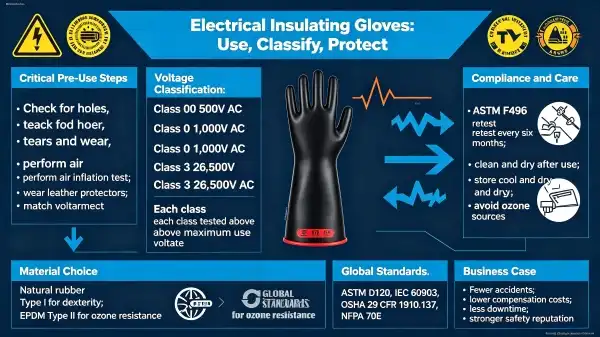
Before using electrical rubber gloves properly, they should be carefully checked for holes, tears, or other signs of wear. Workers have to do an air inflation test to find flaws that can't be seen, put on gloves with leather protection to keep their hands from getting mechanically damaged, and make sure that the right voltage type is used for the job. Gloves need to be cleaned with approved solutions, dried carefully, and stored in a cool, quiet place away from sources of ozone. Retesting according to ASTM F496 standards, which happens every six months for given gloves, makes sure that the dielectric integrity stays strong and that workers are safe from electrical dangers.
Understanding Electrical Rubber Gloves and Their Role in Workplace Safety
Electrical safety requires more than just being careful. It also needs barriers that have been shown to work. We at PPE MAX have seen a lot of industrial operations where properly fitting thermal gloves can make the difference between a normal day's work and a disaster. In places with electricity, these special hand guards are the best way to avoid getting an electrical shock, an arc flash injury, or even dying from an electric shock.
Why Voltage Classification Matters for Procurement Teams
Understanding how voltage is classified is the first step in keeping your electrical rubber gloves safe. Class 00 insulating gloves protect workers who handle up to 500 Volts AC. This makes them good for installing smart meters and doing utility work in homes, where techs need to be able to feel small connections and locking rings easily. Class 0 gloves, which can be recognized by their red sticker and meet ASTM D120 standards, can handle up to 1,000 Volts AC and are used for low-voltage tasks like maintaining EV batteries. Class 3 gloves are needed for repair on the distribution grid and operations in substations because they protect against voltages of up to 26,500 Volts AC.
Each classification goes through strict proof tests at voltages that are many times higher than the highest use rate. Face proof tests at 30,000 Volts AC for Class 3 gloves to make sure they don't fail in life-critical situations. Procurement managers need to know these differences because not specifying enough protection puts workers' safety at risk, while specifying too much protection raises costs and limits their ability to move quickly.
Material Composition and Standards Compliance
Natural rubber (Type I) or EPDM synthetic materials (Type II) are used in modern insulated gloves. Natural rubber is more flexible and sensitive to touch, which are important qualities for workers who do complicated jobs like wiring PLCs or fixing control panels. EPDM versions are better at resisting ozone degradation, which means they last longer in outdoor utility settings where ozone speeds up rubber degradation.
International rules are very strict about how gloves should work. Voltage values are set by ASTM D120 and IEC 60903, and safety rules are set by OSHA 29 CFR 1910.137 and NFPA 70E. These rules fix problems in the industry by finding a balance between dielectric strength and physical dexterity. This way, workers can do difficult mechanical jobs without putting electrical safety at risk. To support their global operations, companies that manage big workforces in the mining, manufacturing, building, and energy sectors need suppliers who keep their certifications up to date across a number of foreign frameworks.
The Business Case for Quality Dielectric Protection
In addition to meeting legal requirements, insulating gloves that are properly sized and matched provide real practical benefits. Long-lasting gloves that can be used more than once are cheaper to buy in the long run than throwaway ones. As required by ASTM F496, every six months, strict testing procedures find degradation before it fails, avoiding accidents at work that lead to workers' compensation claims, lost production, and damage to the company's image. Companies that use complete glove management systems show that they care about worker safety, which helps them hire skilled workers and get contracts with clients who care about safety.
Step-by-Step Guide: How to Properly Use Electrical Rubber Gloves in the Workplace
Effective safety starts a long time before workers even touch live equipment. Over the past 60 years, PPE MAX has worked to improve its routines, which turn academic safety standards into useful, repeatable steps that keep people safe.
Pre-Use Inspection Protocols
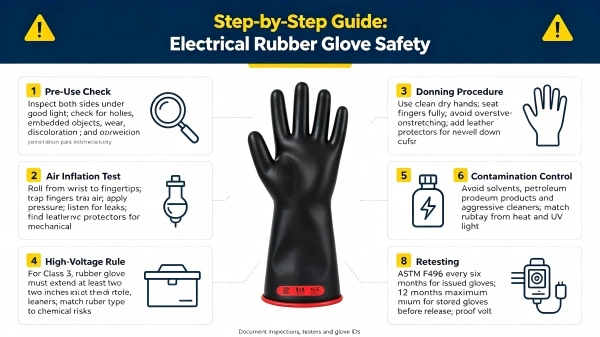
Every shift starts with an eye check of electrical rubber gloves. Workers look over gloves in well-lit areas, checking both the inside and outside for holes, cuts, strange objects stuck inside, or wear and tear on the surface. Discoloration, especially browning or breaking apart, is a sign of ozone damage or chemical contact that weakens the dielectric qualities. Sticky or slippery surfaces are a sign of pollution that needs to be taken out of service right away.
The air expansion test is still the best way to find flaws that can't be seen. As workers roll their gloves from the wrist to the tips, they trap air inside and build up pressure inside. Listening and feeling for air that is leaving can find tiny leaks that can't be seen. This easy step takes less than 30 seconds per glove and stops electrical contact that could be fatal.
Organizations that manage various work teams in different parts of the world need to keep very good records. We suggest using logbooks or digital tracking tools to keep track of inspection dates, inspector names, and glove ID numbers. Detailed inspection records show that an organization is committed to safety beyond just checking off compliance boxes when regulatory auditors look over safety programs.
Correct Donning Procedures for Maximum Protection
Clean, dry hands are the first step in the right way to put on clothes. Moisture weakens electrical protection and speeds up the wear and tear on gloves. When workers put on gloves, they should make sure that their fingers reach the tips of the gloves without stretching too much. When leather protective gloves are worn over rubber gloves, they protect against cuts, scrapes, and holes that could damage the dielectric stability.
For Class 3 uses, the rubber glove must go at least two inches past the leather cover. This keeps electricity from running along the glove's surface. This gap distance is very important when working with high voltage and arc flash potential. Workers should never roll down their gauntlets or gloves because it exposes their arms and shortens their security.
To avoid contamination during use, you need to be aware of chemical risks. Products made from petroleum, solvents, and some cleaning agents hurt rubber mixtures in a way that can't be seen until they are exposed to electricity. We tell buying teams to choose gloves that are compatible with the substances that are present in certain workplaces. For example, EPDM formulations are best when frequent contact with hydrocarbons is expected, while natural rubber is better when maximum dexterity is more important than chemical resistance.
Maintenance, Cleaning, and Storage Best Practices
Maintenance done after use greatly extends the life of gloves. Workers should rinse their gloves with clean water right away, so that dirt and germs don't get into the rubber materials. Cleaning products that have been approved, like light soap and water, can get rid of tough leftovers without hurting the insulation. Scrubbing surfaces rough with brushes breaks down their structure; washing gently with soft cloths works better.
How you dry things matters a lot. Workers should dry their gloves in the air, away from sources of heat, because high temperatures make rubber age faster. UV rays break down materials and cause surface checking when they are exposed to direct sunlight. Once the gloves are dry, they need to be kept somewhere cool, dark, and dry, away from things that make ozone, like electric motors and welding tools.
Canvas storage bags keep gloves from getting squished or folded, which can cause stress points that lead to tears. When gloves are laid down, the cuffs should be facing downward. This lets any remaining moisture drain away from the fingers, which are where electrical contact usually happens. Organizations should set aside storage areas that are away from chemicals, acids, and petroleum products that break things down quickly.
Periodic electrical testing is the most important part of programs that make electrical rubber gloves more reliable. ASTM F496 says that gloves that have been given must be tested every six months, or within 12 months if they were stored before being released. These tests use proof voltages and watch for leaking current to find insulation degradation before it causes a catastrophic failure. When buying gloves for a lot of different locations, procurement managers should work with approved testing labs or buy testing tools to use in-house.
Choosing the Right Electrical Rubber Gloves for Your Business Needs
Choices about specifications have a direct effect on the safety of workers, the speed of operations, and the total cost of ownership. For businesses that have operations all over the world and have to deal with a lot of different safety rules, they need systematic selection systems that balance technology needs with practical limitations.
Voltage Rating Alignment with Application Requirements
The main selection factor for electrical rubber gloves is matching glove classification to real exposure voltages. Utility workers who change meters at 240V/480V services need to wear Class 00 gloves, which protect well enough without losing the awareness needed to work with small terminal connections. Electric vehicle service workers who work with battery packs that are rated between 400V and 800V usually choose Class 0 gloves. These gloves protect against moderate voltages while still allowing the dexterity needed to disconnect high-voltage cables in tight engine spaces.
Maintenance crews for substations have to do very different things. When working with 12kV to 25kV distribution equipment, you need Class 3 insulating gloves that can withstand proof testing at 30,000 Volts AC. In these situations, you can give up some flexibility for strong protection against threats that could kill you. Procurement teams need to fight the urge to use one-size-fits-all solutions. For proper specification, they need to know about the real working conditions and choose the right amount of protection for each job.
Liner Configurations and Dexterity Considerations
Integral padding in gloves makes them more comfortable and makes putting them on easier. Jersey cotton liners soak up sweat, which keeps your hands from getting tired after long periods of use, which is common in industry repair work. The single-unit design gets rid of the need for a separate step for putting on the cover. This makes it easier for workers to switch between jobs when they are charged and when they are not charged during their shifts.
When worn with separate cotton or synthetic padding, linerless gloves can be adjusted to fit different environments. When working outside in cold weather, insulated sleeves keep your hands warm without sacrificing electrical safety. Companies that work in a variety of climates like being able to change the comfort layers while still keeping the same level of electrical safety. The trade-off is that it is harder to put on and there is a chance that the liner will bunch up, which makes it harder to move your fingers.
Supplier Evaluation and Procurement Logistics
Global PPE providers have different skills when it comes to the types of products they offer, the certifications they cover, and the services they can provide. Well-known companies like Honeywell, 3M, Salisbury, and Ansell make a wide range of products that are approved by many foreign standards. This is very important for businesses that have to deal with different sets of rules. Regional sellers may have lower prices, but they may only have a limited number of certifications, which makes it harder for international companies to do business with each other.
Since 1956, PPE MAX has worked with industrial safety distributors, big construction projects, and government procurement offices, learning a lot about voltage-rated safety equipment from Class 00 to Class 4 standards. In addition to making catalog items, we also work with global brands through OEM and ODM partnerships to make unique solutions that meet their business needs. Companies with a lot of workers that need PPE on a regular basis can benefit from having specialized source relationships that make sure products are always available, operations are streamlined, and technical support is quick to respond.
Common Challenges and Solutions When Using Electrical Rubber Gloves
Even safety programs that are well thought out can run into problems that make them less effective if they are not fixed. By recognizing common failure modes, you can take preventative steps that keep your program working well in a variety of operational settings.
User Compliance and Training Deficiencies
Most of the time, execution problems are caused by inadequate training. Workers who don't know the right way to check things miss problems that can be seen with the naked eye. Skipping air filling tests because of a sense of time crunch takes away the best way to find damage that can't be seen. When buying new equipment, procurement managers should demand that sellers include full training programs that cover inspection processes, donning procedures, and maintenance needs.
Ongoing support is also very important. Refresher training once a year keeps people aware as the makeup of the staff changes due to hiring and firing. Including glove inspection in pre-shift safety meetings helps employees remember how to do their jobs right without the need for separate training classes. Random spot checks should be done by supervisors, who should watch workers do inspections and give instant feedback on how to fix problems when processes don't follow established standards.
Recognizing and Addressing Glove Failures
Wear patterns that can be seen show that failure is about to happen before it does something terrible. Surface cracking, especially in areas that bend a lot, like the fingers and hands, means that the material is breaking down quickly and needs to be taken out of service right away. When gloves don't go back to their original size after being stretched, you can tell they've lost their flexibility. This is because the polymer chains have broken down, which lowers the dielectric strength.
The damage from chemical contact shows up more slowly. Swelling, softness, or stickiness on the surface are all signs of pollution with substances that don't work well together. Even if the gloves look fine, chemical contact means they have to be taken out of service, and the incident has to be recorded so that process changes can be made to stop this from happening again. We've seen workers keep using chemically-contaminated gloves even though the damage to their eyesight seemed small, only to have the insulator fail during later electrical work.
Proper disposal balances environmental responsibility with safety requirements. According to local rules, damaged gloves should be made useless by cutting off the fingers. This way, they can't be used again by accident. Organizations should keep records of glove disposals that include identification numbers and failure modes. This will help them make choices about buying and show systematic problems that need programmatic action.
Real-World Application Case Studies
A multinational mining company called PPE MAX because electrical repair teams were having problems with their electrical rubber gloves over and over again. An investigation showed that workers kept gloves in toolboxes with petroleum-based lubricants, which caused chemical breakdown that could not be seen. Putting gloves away in separate boxes from other things that could be harmful, along with better training on how to keep gloves safe around chemicals, stopped failures before they happened and increased the average service life of gloves by 40%.
An EV factory had trouble getting workers who put together battery packs to wear Class 0 gloves. Workers said that gloves made it too hard to move their fingers, which made them less reliable during processes to cut high-voltage lines. When switching from thick-walled natural rubber gloves to thin, shaped ones, the needed voltage safety was kept while tactile awareness was improved. A huge jump in worker acceptance was seen, and compliance checks showed that 95% of the time, the system was used correctly, compared to only 60% before the design change.
Conclusion
Electrical shielding gloves are the last line of defense that keeps workers safe from electrical dangers that could be fatal. To use something correctly, you must first understand the different types of voltage, choose the right specs, follow strict checking procedures, and keep up with thorough testing programs. When businesses consistently meet these needs, they create safety environments where safety is natural and not a problem.
The money spent on good gloves, proper training, and regular repair pays off in a big way: fewer accidents, lower workers' compensation costs, and more trust among workers. When procurement teams work with experienced suppliers, they get more than just goods. They get complete solutions that include technical advice, training support, and service that is flexible enough to meet changing business needs.
FAQ
What is the mandatory retesting interval for insulating gloves?
According to ASTM F496 and OSHA 1910.137, electrical testing of gloves must be done every six months after they are put to use. When gloves have been stored for more than a year, they can't be used until they've been tested within the last year. This procedure makes sure that the dielectric stability of the glove stays the same over time, finding signs of wear before workers are exposed to electricity.
Can electrical rubber gloves be reused after exposure?
Gloves can be used again and again as long as they pass an eye check, an air inflation test, and regular electrical tests. Proper care, such as using approved cleaning products, storing them in the right way, and keeping them away from chemicals that could damage them, keeps their safe qualities for many uses. When organizations follow strict repair routines, electrical rubber gloves usually last 12 to 18 months before they need to be replaced. However, the actual lifespan depends on how often it is used and the conditions of the surroundings.
Are leather protectors required for all voltage classifications?
Leather guardian gloves are very important because they protect your hands from cuts, scrapes, and holes that would damage rubber padding. Leather protectors are required for all voltage classes, even though they are technically not required for Class 00 uses in controlled settings. To keep electrical tracking from happening, the rubber glove needs to go at least two inches past the leather protector. This is especially important for Class 3 uses where arc flash potential appears.
Partner with PPE MAX: Your Trusted Electrical Rubber Gloves Supplier
PPE MAX has been protecting workers in 134 countries for 68 years and offers voltage-rated electrical rubber gloves from Class 00 to Class 4 standards. Our production skills allow us to make both regular catalog items and OEM solutions that are specifically designed to meet the needs of each business. We try every idea ourselves, and our team members are in our content because we believe in the tools we make. Contact our team at marketing@ppemax.com to talk about your volume needs, certification needs, and shipping plans for global operations. This is for procurement managers, safety directors, and distributors who want reliable electrical rubber gloves that have been used for decades and have been proven to work.
References
1. American Society for Testing and Materials. (2021). ASTM D120-20: Standard Specification for Rubber Insulating Gloves. West Conshohocken, PA: ASTM International.
2. American Society for Testing and Materials. (2020). ASTM F496-20: Standard Specification for In-Service Care of Insulating Gloves and Sleeves. West Conshohocken, PA: ASTM International.
3. International Electrotechnical Commission. (2018). IEC 60903:2018: Live Working—Gloves of Insulating Material. Geneva, Switzerland: IEC Publications.
4. Occupational Safety and Health Administration. (2019). 29 CFR 1910.137: Electrical Protective Devices. Washington, DC: U.S. Department of Labor.
5. National Fire Protection Association. (2021). NFPA 70E: Standard for Electrical Safety in the Workplace. Quincy, MA: NFPA Publications.
6. Cadick, J., Capelli-Schellpfeffer, M., & Neitzel, D. (2020). Electrical Safety Handbook, 4th Edition. New York: McGraw-Hill Professional.
Learn about our latest products and discounts through SMS or email