- English
- French
- German
- Portuguese
- Spanish
- Russian
- Japanese
- Korean
- Arabic
- Greek
- German
- Turkish
- Italian
- Danish
- Romanian
- Indonesian
- Czech
- Afrikaans
- Swedish
- Polish
- Basque
- Catalan
- Esperanto
- Hindi
- Lao
- Albanian
- Amharic
- Armenian
- Azerbaijani
- Belarusian
- Bengali
- Bosnian
- Bulgarian
- Cebuano
- Chichewa
- Corsican
- Croatian
- Dutch
- Estonian
- Filipino
- Finnish
- Frisian
- Galician
- Georgian
- Gujarati
- Haitian
- Hausa
- Hawaiian
- Hebrew
- Hmong
- Hungarian
- Icelandic
- Igbo
- Javanese
- Kannada
- Kazakh
- Khmer
- Kurdish
- Kyrgyz
- Latin
- Latvian
- Lithuanian
- Luxembou..
- Macedonian
- Malagasy
- Malay
- Malayalam
- Maltese
- Maori
- Marathi
- Mongolian
- Burmese
- Nepali
- Norwegian
- Pashto
- Persian
- Punjabi
- Serbian
- Sesotho
- Sinhala
- Slovak
- Slovenian
- Somali
- Samoan
- Scots Gaelic
- Shona
- Sindhi
- Sundanese
- Swahili
- Tajik
- Tamil
- Telugu
- Thai
- Ukrainian
- Urdu
- Uzbek
- Vietnamese
- Welsh
- Xhosa
- Yiddish
- Yoruba
- Zulu
How to Choose the Right Welding Face Shield for Your Job
To pick the right welding face shield, you need to know about the risks in the workplace, the types of welding you do, and the safety needs of your workers. The right choice strikes a mix between the best defense against UV rays, sparks, and debris, and the ease of use and compliance with regulations. This detailed guide walks purchasing managers and safety engineers through the technical details, safety standards, and performance features that make up good protection gear for industrial welding.
Understanding Welding Face Shields: Basics and Benefits
Protective walls called welding face shields are necessary to keep workers safe from the many risks that come with welding. These specialized pieces of personal protective equipment protect against all types of actinic radiation, such as UV and infrared waves, which are dangerous and can burn the skin and damage the eyes. Face shields are not the same as regular welder helmets, but they have clear benefits in certain situations. The bigger field of vision improves peripheral awareness, which is especially helpful in complex manufacturing settings where workers need to keep an eye on many processes at once. This increased sight keeps welders more aware of their surroundings, which keeps them from getting tired and improves the quality of their work generally.
Key Components and Design Features
There are three important parts to modern welding security devices that work together to make sure everyone is safe. The main safety barrier is the visor assembly, which is usually made of high-impact-resistant polycarbonate materials that can handle hits while still letting light pass through. Whether the lenses are inactive or auto-darkening, they provide the specific filtration needed to protect against strong light sources and radiation exposure. When it comes to security, the headgear piece is the practical base. Good support systems spread the weight properly across the head and neck, which makes long welding sessions less stressful. Different-sized heads can fit on adjustable parts, and they can also be used with other safety gear like hard hats and breathing protection systems.
Compliance and Safety Standards
Safety guidelines that can be trusted for Welding Face Shield are based on international safety certifications. In the US market, ANSI Z87.1-2020 sets the minimum standards for optical function and protection from impact. Face protection rules are set by European EN 175:1997 standards, while Canadian CSA Z94.3-2020 rules cover safety rules for the workplace. These approvals make sure that safety gear passes strict tests for things like optical clarity, resistance to impact, and ability to block radiation.
Core Criteria for Choosing the Right Welding Face Shield
To choose the right welding protection, you need to carefully look at a lot of different factors that have a direct effect on both safety and operating efficiency. When procurement teams know these factors, they can match the skills of tools with the needs of the workplace while keeping costs low and following the rules.
Welding Process Requirements
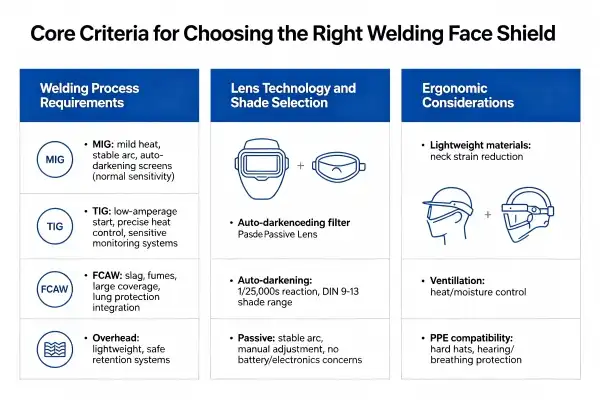
Different welding methods produce different amounts of heat, light strength, and spatter patterns, all of which affect the need for safety. Metal Inert Gas (MIG) welding usually produces mild heat levels and stable arc characteristics, which means it can be used with auto-darkening screens that have normal sensitivity settings. TIG welding has special problems because it needs a low-amperage start and precise heat control. This means that monitoring systems need to be very sensitive and react to small changes in light. Flux-Cored Arc Welding (FCAW) makes a lot of slag and fumes, so it needs to be able to cover larger areas and work with lung protection systems. For overhead welding jobs, designs need to be light and have safe retention systems so that the equipment doesn't move around during long periods of work at a high level.
Lens Technology and Shade Selection
Auto-darkening filter technology is a big step forward in welding safety because it lets you change the shade quickly and in different ways. When an arc ignites, quality systems react within 1/25,000th of a second and protect right away. The shade range is usually between DIN 9 and DIN 13, which covers a wide range of welding methods and amp outputs. Passive lens systems provide reliable safety at lower starting costs, which makes them ideal for certain uses where arc conditions are stable. Even though these systems need to be adjusted by hand, you don't have to worry about battery life or computer parts breaking down in tough environments.
Ergonomic Considerations
Comfort has a direct effect on how well workers do their jobs and follow safety rules. When you wear something for a long time, lightweight materials keep your neck from getting tired and strained, and evenly distributed weight keeps pressure points from happening that can lead to headaches and tiredness. Adjustable headgear fits people with a wide range of head shapes and lets each person find the right level of comfort. Ventilation helps keep heat and wetness from building up, which is especially important in places where welding is done at high temperatures. Compatibility with other PPE, like hard hats, hearing protection, and breathing gear, makes sure that the whole workplace is safe without sacrificing comfort or usefulness.
Comparing Welding Face Shields and Helmets: Which One Fits Your Needs?
To choose between face shields and welder helmets, you need to carefully look at the amount of protection, the needs of the job, and the cost. Each choice has its own benefits that depend on the conditions and safety rules of the workplace.
Protection Capabilities and Coverage
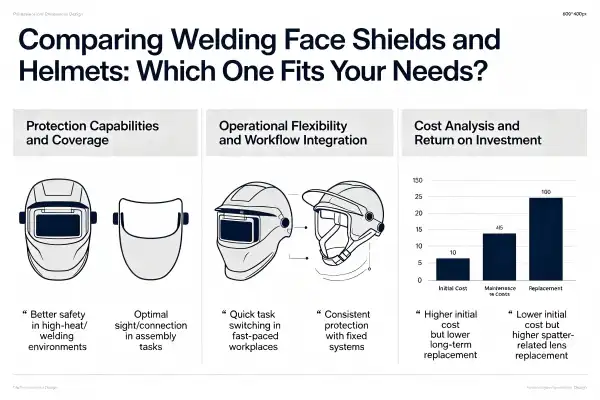
Full-coverage welding helmets and modern auto-darkening systems with various sensor settings offer better safety. These features give better performance in welding situations with a lot of heat and in places with changing lights. The sealed shape also protects better against fumes and particles in the air. Face shields work great in situations where sight and connection need to be at their best. The open shape lets heat escape better and makes it easy to connect to respiratory protection systems. This setup is especially helpful in assembly jobs where workers switch between tasks that require welding and tasks that don't require welding all the time.
Operational Flexibility and Workflow Integration
Welding face shields are very helpful in fast-paced workplaces where being flexible and able to switch between tasks quickly are important. The flip-up feature lets you switch right away to inspection or measurement tasks without taking all the tools off. This feature cuts down on interruptions to work and keeps productivity high in industrial settings that move quickly. Having a fixed or movable cover gives you different levels of comfort and upkeep needs. Although adjustable systems give you more control over how they work, they may need to be calibrated and maintained more often to make sure they always work the same way. Fixed systems protect consistently and reliably, and they don't need much upkeep.
Cost Analysis and Return on Investment
When making a budget, it's important to balance the costs of buying new tools with the costs of running them over time. When you first buy a premium auto-darkening device, it costs more, but it usually lasts longer and costs less to replace over time. Better visibility and less eye strain can boost production, which can explain higher initial investments by lowering the need for rework and improving the quality of output. The costs of maintenance are very different for each technology. Electronic parts in auto-darkening systems need to be replaced every so often, while lenses in passive systems mostly need to be replaced because of the buildup of spatter. When buying, teams know about these continued costs, and they can make smart choices about the total cost of ownership.
Top Welding Face Shield Options for 2026: Trusted Brands and Features
There are a lot of choices on the market for workplace safety from well-known brands, and each one has its own strengths that make it better for a different set of needs. When you know about these choices, you can make smart decisions about what to buy that fit your wants and your budget.
Leading Manufacturer Solutions
Xi'An PPE MAX Co., Ltd is one of the well-known companies that makes welding face shield solutions. They have been in business since 1956 and have decades of experience in the field. Our auto-darkening models have viewing areas that are 3.82" x 2.44" and lenses that are 4.5" x 3.5". This gives you the best mix between protection and sight. The 1.2-pound design keeps the user from getting tired, while the high-impact-resistant plastic construction makes it last. The auto-darkening technology has shade ranges from 9 to 13, so it can be used for a wide range of welding tasks, from light TIG work to heavy structure welding. Solar cells that use little energy and have a battery backup make sure that the device works reliably in a range of lighting situations. Because of these features, our systems are perfect for making cars, ships, metalwork, and maintaining pipelines.
Specialized Applications and Industry Requirements
Heavy-duty fabrication environments need strong structure and better heat protection. In shipyard uses, things need to work with hard hats and breathing systems while still being durable enough to withstand the tough conditions of the sea. The fact that it works with current safety gear means that you are fully protected without sacrificing working efficiency. Advanced optical clarity and true color technology help workers tell the difference between heat zones and color-coded materials in precision industrial applications. The better optical performance (1/1/1/1 sharpness scores) gets rid of distortions that can lower the quality of welds in serious situations.
Bulk Procurement Advantages
Customization options, such as company logos and custom package solutions, are helpful for large businesses. When you can order in bulk, you can get competitive pricing and make sure that the product specs are the same across all of your businesses. Full insurance coverage and help after the sale keep operations running smoothly and protect the value over time. Technical support resources, such as teaching papers and the ability to get replacement parts, make sure that the equipment keeps working well throughout its lifetime. These services are especially helpful for businesses that have to manage a lot of people with different levels of experience and skill.
Maintenance, Cleaning, and Long-Term Use Tips for Welding Face Shields
Following the right repair steps has a direct effect on both how well safety equipment works and how long it lasts. Setting up systematic care routines consistently protects and maximizes return on investment by extending the life of tools and lowering the cost of replacement.
Daily Cleaning and Inspection Procedures
The first step in the routine cleaning of the welding face shield is to gently remove any spatter or dirt using cleaning solutions that won't hurt the lens coatings or computer parts. Microfiber brushes clean well without scratching surfaces that are sensitive to light. Stay away from rough chemicals and materials that can damage anti-reflective coats or auto-darkening filters. Any cracks, scratches, or damage to the lens assembly, helmet, or shell parts should be easy to see. Damaged parts need to be replaced right away to keep the defense working properly. Electronic systems need to be tested on a regular basis to make sure they work correctly and respond to shade correctly.
Lens Replacement and Component Care
When to change the cover lens depends on how intense the welding is and the weather. In areas with a lot of spills, replacement may need to happen every day, but in smaller situations, replacement may only need to happen once a week. Using high-quality replacement parts keeps safety standards up and provides continued optical performance. When cleaning and storing auto-darkening screens, you need to be very careful. Keep sensors safe from damage and contamination while making sure they stay in the right preset settings. Battery backup systems need to be replaced on a regular basis, as directed by the manufacturer, to make sure they work properly.
Storage and Environmental Considerations
Keeping things in the right way keeps them safe from damage from the surroundings and makes them last longer. Conditions that control the climate keep out extremes of temperature and moisture that can damage electronics or fog up lenses. Individual protected cases protect against impacts while being moved and stored. Regular checks of the tuning make sure that the performance stays the same over time. Keep track of maintenance tasks and performance problems to find trends that could mean that parts are wearing out or that outdoor factors are affecting how well the equipment works.
Conclusion
To choose the right welding face shield, you have to carefully weigh the need for security, the needs of the job, and the cost, all while following strict safety rules. Knowing how to weld, the conditions of the work area, and the comfort needs of the workers all help with making smart purchasing decisions that improve safety and efficiency. Quality equipment from well-known brands works reliably, comes with full support, and holds its value over time. Maintenance and care methods that are followed in a planned way can make equipment last longer and protect it consistently throughout its working lifecycle.
FAQ
Asking common questions about welding safety helps make technical details and practical needs clearer so that buying decisions can be made.
What lens shade should I use for MIG welding?
Depending on the power and thickness of the object, MIG welding usually needs shade levels between 10 and 12. Shades 10 works well for low amperages (100 to 200 amps), while shades 11 and 12 work better for high amperages (200 amps or more). Auto-darkening systems change themselves within set ranges, making it easier to see in a variety of circumstances.
Can welding face shields be used independently without helmets?
Welding face shields can be used on their own for many tasks, especially light-duty tasks like grinding, cutting, or welding. They do, however, have to meet the safety standards needed for the job. Heavy-duty welding may need extra safety measures like helmets or breathing systems that are built in.
How do I check that safety standards are being met?
Look for certification marks that say ANSI Z87.1-2020, EN 175:1997, CSA Z94.3-2020, or AS/NZS 1338.1:2012. Make sure that the testing paperwork that comes with the equipment you buy fits the needs of the application you want to use it for. Suppliers with a good reputation send all the licensing paperwork with their goods.
Why could auto-darkening filters not work right?
Common reasons are sensor blockage from dust or spatter, wrong sensitivity settings, low battery power, or being near light sources that don't work well together. Most problems are solved by regular cleaning and the right adjustments. Extreme weather and other things in the environment can also affect how well electrical parts work.
What is the typical lifespan of welding protection equipment?
With regular care, good tools should last between 3 and 5 years. Most plastic shell parts last between 5 and 7 years, but electrical parts may need to be replaced every 3 to 5 years. The amount of use and the surroundings have a big effect on the real service life.
Partner with PPE MAX for Superior Welding Protection Solutions
With over 60 years of manufacturing quality and innovation, Xi'An PPE MAX Co., Ltd offers the best welding face shield options in the business. We are a reliable provider of welding face shields that come with auto-darkening technology, lightweight, comfortable designs, and full compliance with international safety standards like ANSI Z87.1-2020 and EN 175:1997. We are the best choice for large-scale industrial operations because we can accept big orders, offer customization options, and offer a lot of support and guarantees. Email our expert team at marketing@ppemax.com to talk about your specific needs and find out how our tried-and-true solutions can improve your workplace safety program while also giving you great value and dependability.
References
1. American National Standards Institute. "ANSI Z87.1-2020: Occupational and Educational Personal Eye and Face Protection Devices." American National Standards Institute, 2020.
2. European Committee for Standardization. "EN 175:1997 - Personal Protection Equipment - Equipment for Eye and Face Protection During Welding and Allied Processes." European Committee for Standardization, 1997.
3. Canadian Standards Association. "CSA Z94.3-2020 - Industrial Eye and Face Protectors." Canadian Standards Association, 2020.
4. National Institute for Occupational Safety and Health. "Criteria for a Recommended Standard: Occupational Exposure to Ultraviolet Radiation." U.S. Department of Health and Human Services, 2019.
5. International Organization for Standardization. "ISO 16321-1:2021 - Eye and face protection for occupational use." International Organization for Standardization, 2021.
6. Occupational Safety and Health Administration. "Personal Protective Equipment Standards for General Industry." U.S. Department of Labor, 2022.
Learn about our latest products and discounts through SMS or email