- English
- French
- German
- Portuguese
- Spanish
- Russian
- Japanese
- Korean
- Arabic
- Greek
- German
- Turkish
- Italian
- Danish
- Romanian
- Indonesian
- Czech
- Afrikaans
- Swedish
- Polish
- Basque
- Catalan
- Esperanto
- Hindi
- Lao
- Albanian
- Amharic
- Armenian
- Azerbaijani
- Belarusian
- Bengali
- Bosnian
- Bulgarian
- Cebuano
- Chichewa
- Corsican
- Croatian
- Dutch
- Estonian
- Filipino
- Finnish
- Frisian
- Galician
- Georgian
- Gujarati
- Haitian
- Hausa
- Hawaiian
- Hebrew
- Hmong
- Hungarian
- Icelandic
- Igbo
- Javanese
- Kannada
- Kazakh
- Khmer
- Kurdish
- Kyrgyz
- Latin
- Latvian
- Lithuanian
- Luxembou..
- Macedonian
- Malagasy
- Malay
- Malayalam
- Maltese
- Maori
- Marathi
- Mongolian
- Burmese
- Nepali
- Norwegian
- Pashto
- Persian
- Punjabi
- Serbian
- Sesotho
- Sinhala
- Slovak
- Slovenian
- Somali
- Samoan
- Scots Gaelic
- Shona
- Sindhi
- Sundanese
- Swahili
- Tajik
- Tamil
- Telugu
- Thai
- Ukrainian
- Urdu
- Uzbek
- Vietnamese
- Welsh
- Xhosa
- Yiddish
- Yoruba
- Zulu
How to Choose the Right Dielectric Gloves?
Founded in 1956, PPEMAX stands as a premier global manufacturer and supplier of full-range personal protective equipment. All our products comply with internationally recognized standards including IEC, ASTM, CE, UKCA, NIOSH and ISO9001. Equipped with a 2,000-square-meter modern production plant, we boast over 25 years of mature OEM & ODM capabilities to deliver one-stop customized solutions covering R&D design through worldwide logistics. Our safety gear is distributed across 134 countries globally. Upholding our core tenet “Safety First, Quality Priority”, we serve as a dependable long-term PPE partner for industrial enterprises around the world.
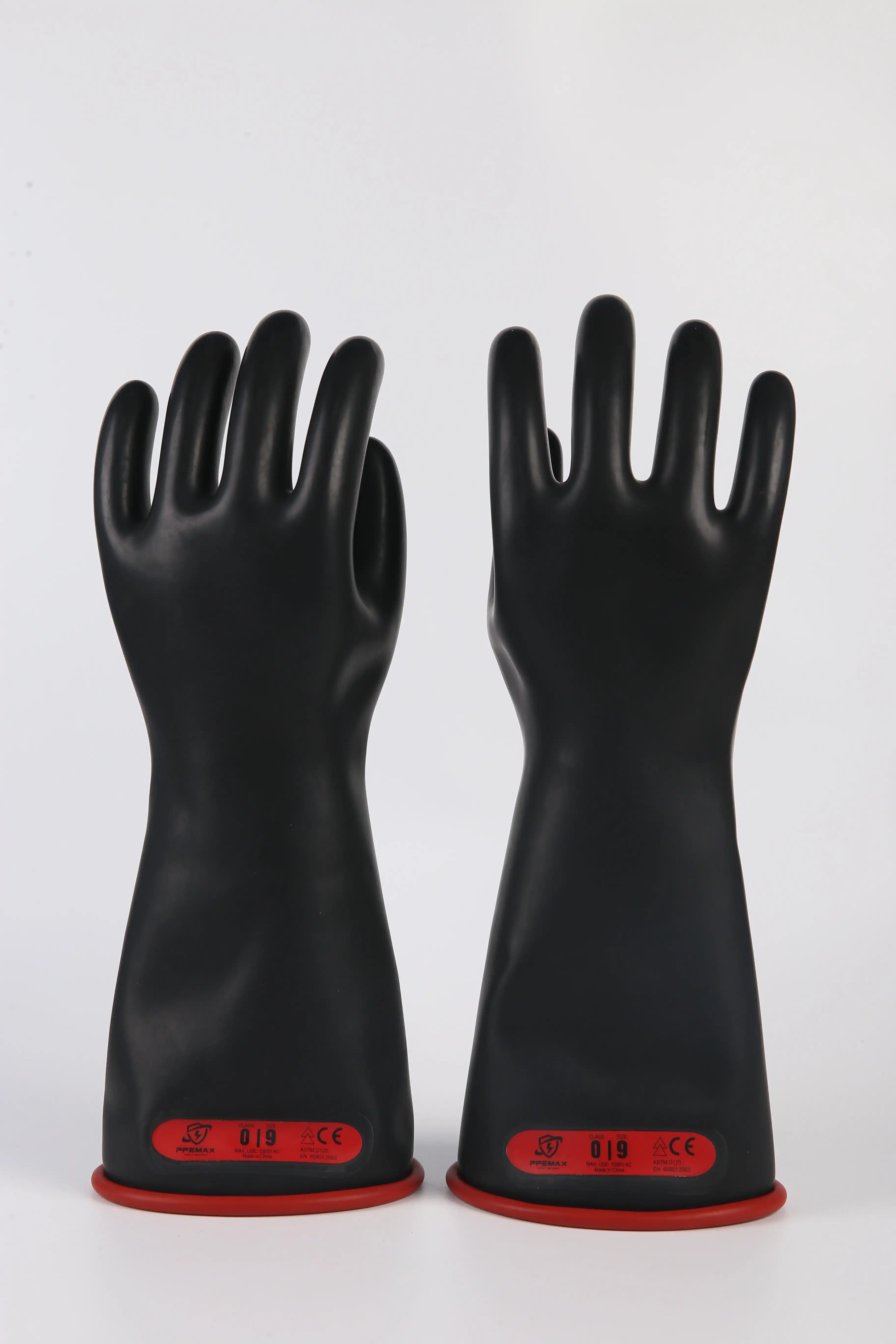
Choosing the right dielectric gloves starts with understanding the voltage hazards in your work environment. These specialized electrical insulating gloves are engineered to block current flow and protect workers from electric shock. Certified under ASTM D120 (North America) or EN 60903 (Europe), they are classified from Class 00 (500V max) to Class 4 (36,000V max). Selecting the correct class, material, and fit for your specific application is the single most important decision a procurement manager or safety engineer can make before putting any worker near energized equipment.
|
Parameter |
Specification |
|
Maximum Use Voltage |
1,000V AC / 1,500V DC |
|
Proof Test Voltage |
5,000V AC / 20,000V DC |
|
Label Color |
Red (ASTM D120/IEC 60903) |
|
Material Type |
Type I (Natural Rubber) / Type II (EPDM) |
|
Thickness |
1.02mm (0.040 inches) |
|
Length Options |
11", 14", 16" inches |
|
Cuff Styles |
Straight, Bell, Contour |
|
Standards Compliance |
ASTM D120, IEC 60903, OSHA 29 CFR 1910.137 |
Understanding Dielectric Gloves and Their Importance
Electrical accidents are still a major danger in the workplace. The U.S. Bureau of Labor Statistics says that each year in American workplaces, electrical contact kills hundreds of people and hurts thousands more. When rated correctly, dielectric gloves are a first line of defense that regular work gloves just can't match.
What Makes Them Different from Regular Gloves
Normal work gloves made of leather or rubber don't have an approved electrical insulation grade. Dielectric gloves are made from high-dielectric-strength rubber materials, are tested to withstand certain proof voltages, and are color-coded to make them easy to find. That difference isn't just for looks; at an activated panel, it means the difference between life and death.
Material Composition: Natural Rubber vs. EPDM
Natural rubber (Type I) is better for fine work because it is more flexible and sensitive to touch. EPDM (Ethylene Propylene Diene Monomer, Type II) doesn't crack when exposed to ozone or UV light, so it's the better choice for places that are biologically active or outside. Before they leave the factory floor, both materials have to pass strict tests for tensile strength, tear resistance, and puncture resistance.
Mandatory Testing Protocols
Every pair of high-voltage dielectric gloves must pass a proof test voltage that is higher than the highest voltage they can be used with. For Class 4 gloves, this is up to 40,000V AC according to ASTM D120, and OSHA 29 CFR 1910.137 also says that gloves that are being used must be retested for electrical safety every six months. These rules can't be broken because rubber breaks down over time, and a glove that passed inspection a year ago might not protect you today.
Core Criteria to Consider When Choosing Dielectric Gloves
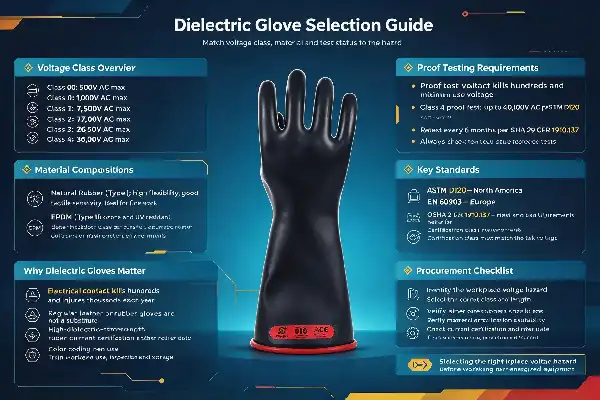
To find the right glove for the job, you need to look at a number of technical and practical factors at the same time, not separately. If the glove is too big for the job, it might make it harder to move your fingers; if it's too small, it leaves a life-threatening hole in your protection.
Voltage Class and Maximum Use Voltage
The method for classifying things is easy to understand once you know your working power. Let me give you a quick reference:
- Class 00 — Max power for use: 500V AC or 750V DC. Suitable for low-voltage work in homes or small factories.
- Class 0 — 1,000V AC or 1,500V DC is the highest voltage that can be used. Often used for managing EV batteries and doing small utility work.
- Class 2 — A maximum of 17,000V AC can be used. Normal for utility workers who work on distribution lines.
- Class 4 — No more than 36,000V AC can be used. For jobs at the transmission level and high-voltage equipment, this is needed.
Choose the class that is rated for the highest voltage in the work area, not the voltage that is normally present. The most common mistake people make when buying in bulk can be avoided by following this one rule.
Sizing, Fit, and Ergonomics
When gloves don't fit right, the fingertips bunch up, which makes it harder to grip and feel things. Most glove makers make sizes 8 to 12, and their designs are anatomically "curved-hand" to fit the way the hand naturally rests. Hands that don't get tired as quickly during long tasks are more likely to stay on task and resist the urge to take off their gloves in the middle of a task.
Glove Storage and Maintenance
Put dielectric gloves in canvas bags with the ends pointing down. Keep them out of direct sunlight, ozone sources, and heat above 120°F (49°C). When storing them, never fold or squeeze them because the lines where you fold them can become crack starting points. Use gentle soap and warm water to clean, and let them dry completely in the air before putting them away. Maintenance that is done right directly extends the life of your purchase and saves your investment.
If you're evaluating personal protective equipment suppliers and require batch-specific testing documents before placing an order, PPE MAX is able to provide official Certificates of Analysis, professional laboratory test reports, and product samples for your verification. Feel free to contact our team at marketing@ppemax.com to discuss your sourcing needs and obtain complete documentation for your quality assessment and procurement approval.
Comparing Dielectric Gloves with Other Protective Gloves
There are some insulated gloves on the market that are not approved to protect against electricity. This is a risk that B2B buyers must take into account when they are qualifying vendors.
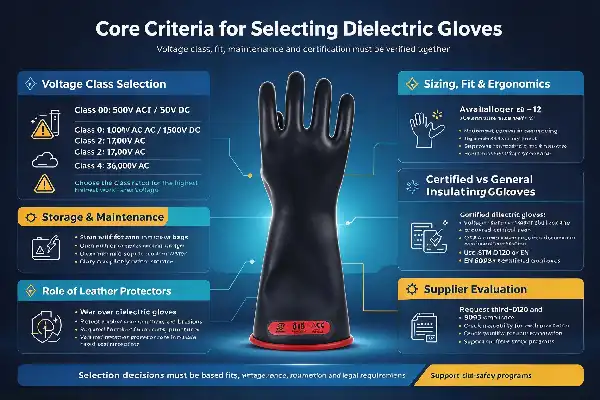
Certified Electrical Gloves vs. General Insulating Gloves
It's possible that general rubber gloves can protect you from water and weak conductors, but they don't come with a voltage rating, a proof test record, or any paperwork that shows they follow the rules. Using them on powered equipment is against OSHA rules and could leave your company open to serious liability. Safety programs for electricity should only use dielectric gloves that are certified under ASTM D120 or EN 60903.
The Role of Leather Protectors
Over-gloves made of leather are worn over dielectric gloves to protect the thin rubber layer from cuts, punctures, and abrasions that could make it less effective at keeping heat in. Both OSHA and ASTM say that most live-line jobs need to be done with leather protection on. When comparing product packages, make sure you know if your seller includes these protectors or charges extra for them separately, as they must be bought together for the system to work.
Evaluating Suppliers by Performance Data
If you sell to foreign markets, ask sellers for third-party test certificates, batch test records, and proof that they follow both ASTM D120 and EN 60903 standards. There is a quality control risk when suppliers can't provide traceable documentation for each production batch. This is especially true for companies that manage large teams of people in multiple locations.
Procurement Considerations for B2B Buyers
When buying a lot of dielectric gloves, you need to do more than just pick the right class. It needs an organized buying method that takes care of quality control, supply continuity, and paperwork for compliance.
OEM and Bulk Order Logistics
You can choose the type of material, glove class, size range, labels, and regional compliance marks for a single production run when you work with an OEM manufacturer. Having to manage multiple SKUs from different vendors becomes easier with this. Lead times for certified gloves are usually between 4 and 8 weeks, but this depends on how many are ordered and when they are tested. To avoid supply gaps, plan your buying processes properly.
Vendor Qualification Checklist
Before making large orders, make sure that any possible provider of dielectric gloves can confirm the following:
- Certification paperwork that is valid for ASTM D120 and/or EN 60903.
- Batch-level dielectric test records with leakage current data.
- Confirmed strategy for re-tests and replacements.
- References from B2B clients in the same or a similar industry.
With these four pieces of information, you can tell the difference between qualified producers and those selling fake goods at good prices. When it comes to electrical safety, a lower unit price that doesn't come with proof of compliance is not a savings; it's a risk.
Customization and Regional Compliance
When buying gloves for operations in more than one country, procurement teams should make sure that they meet both ASTM and IEC/EN standards. This is because different regional inspection groups accept different certifications. Standard practices for well-known OEM manufacturers include custom sizes, bilingual labels, and documentation that is specific to each region.
Making the Right Choice: Matching Solutions to Your Needs
When choosing the right dielectric gloves, you should think about three things: the highest voltage in the area, the physical demands of the job, and the rules and regulations that govern your operations.
Class 2 or Class 3 gloves with leather protection are the standard for maintaining utilities and power grids. When making EVs or fixing battery systems, Class 0 or Class 00 gloves with high handling profiles are the safest way to handle DC battery packs in small areas. When working on an industrial substation, Class 2 gloves with leather shields protect against arc flash risks when touching switches and circuit breakers by accident.
First, look at your risk profile. Then, match the glove class to the highest voltage present, make sure the gloves are certified, check with your safety team to make sure the maintenance procedures are followed, and pick a supplier that can meet your large-scale compliance documentation needs. This organized method gets rid of guessing and creates a safety record that can be defended.
Conclusion
Choosing the right dielectric gloves is a technical and legal choice that has a direct impact on the safety of workers and the company's responsibility. The clear structure comes from the class system in ASTM D120 and EN 60903. A protection plan that works in the real world and under OSHA review can be made by matching the framework to the working voltage, picking the right material type, making sure the supplier is certified, and requiring re-testing every six months. It is always safer for everyone on the job when procurement managers choose gloves as part of an organized process instead of just buying a random item.
FAQ
1. What is the difference between Type I and Type II dielectric gloves?
Type I gloves are made from natural rubber and are very flexible, but they can't stand up to ozone. Type II gloves are made of man-made materials like EPDM that don't crack when exposed to ozone or UV light. Type II is more durable when used outside or in places with chemicals.
2. How often should electrical insulating gloves be re-tested?
According to OSHA and ASTM guidelines, gloves that are being used must be tested again every six months. No matter when it was last certified, a glove must be taken out of service and tested before it can be used again if it has visible damage, ozone cracks, or has been exposed to chemicals.
3. Can I use dielectric gloves without leather protectors?
No, ASTM D120 and OSHA 1910.137 say that leather protectors must be worn over dielectric gloves when working with live electricity. Protectors made of leather keep the glove's insulating layer from getting punctures and cuts from machines.
4. How should I store electrical safety gloves between uses?
Keep them away from ozone sources, solvents, heat, and light in a cool, dark, and dry place with the ends pointing down. Do not fold or squeeze them, as doing so over and over again breaks the rubber.
5. What risks come with uncertified electrical gloves?
Gloves that aren't certified don't have a verified voltage rating, proof test documentation, or a guarantee of compliance. Using them on powered tools is against OSHA rules, voids liability insurance, and puts workers at direct risk of being electrocuted.
Partner with PPE MAX for Certified Dielectric Gloves Supply
Since 1956, PPE MAX has been a trusted provider of electrical safety equipment. As a top manufacturer of dielectric gloves, we have served customers in 134 countries. Full batch test records show that our gloves meet ASTM D120 and EN 60903 standards. Our team is ready to help your program, whether you need large orders, OEM production, or unique labels for compliance. To get a price right away, email us at marketing@ppemax.com.
References
1. ASTM International. ASTM D120: Standard Specification for Rubber Insulating Gloves. ASTM International, 2023.
2. International Electrotechnical Commission. IEC 60903: Live Working — Gloves of Insulating Material. IEC, 2014.
3. Occupational Safety and Health Administration. OSHA Standard 29 CFR 1910.137: Electrical Protective Equipment. U.S. Department of Labor, 2019.
4. U.S. Bureau of Labor Statistics. Census of Fatal Occupational Injuries: Electrical Exposure Data. BLS, 2022.
5. National Fire Protection Association. NFPA 70E: Standard for Electrical Safety in the Workplace. NFPA, 2024.
6. Lawrence, R., & Capelli-Schellpfeffer, M. Electrical Safety: A Practical Guide for Industry. IEEE Press, 2020.
Learn about our latest products and discounts through SMS or email