- English
- French
- German
- Portuguese
- Spanish
- Russian
- Japanese
- Korean
- Arabic
- Greek
- German
- Turkish
- Italian
- Danish
- Romanian
- Indonesian
- Czech
- Afrikaans
- Swedish
- Polish
- Basque
- Catalan
- Esperanto
- Hindi
- Lao
- Albanian
- Amharic
- Armenian
- Azerbaijani
- Belarusian
- Bengali
- Bosnian
- Bulgarian
- Cebuano
- Chichewa
- Corsican
- Croatian
- Dutch
- Estonian
- Filipino
- Finnish
- Frisian
- Galician
- Georgian
- Gujarati
- Haitian
- Hausa
- Hawaiian
- Hebrew
- Hmong
- Hungarian
- Icelandic
- Igbo
- Javanese
- Kannada
- Kazakh
- Khmer
- Kurdish
- Kyrgyz
- Latin
- Latvian
- Lithuanian
- Luxembou..
- Macedonian
- Malagasy
- Malay
- Malayalam
- Maltese
- Maori
- Marathi
- Mongolian
- Burmese
- Nepali
- Norwegian
- Pashto
- Persian
- Punjabi
- Serbian
- Sesotho
- Sinhala
- Slovak
- Slovenian
- Somali
- Samoan
- Scots Gaelic
- Shona
- Sindhi
- Sundanese
- Swahili
- Tajik
- Tamil
- Telugu
- Thai
- Ukrainian
- Urdu
- Uzbek
- Vietnamese
- Welsh
- Xhosa
- Yiddish
- Yoruba
- Zulu
What Standards Should Quality Insulating Gloves Meet?
Founded in 1956, PPEMAX stands as a premier global manufacturer and supplier of full-range personal protective equipment. All our products comply with internationally recognized standards including IEC, ASTM, CE, UKCA, NIOSH and ISO9001. Equipped with a 2,000-square-meter modern production plant, we boast over 25 years of mature OEM & ODM capabilities to deliver one-stop customized solutions covering R&D design through worldwide logistics. Our safety gear is distributed across 134 countries globally. Upholding our core tenet “Safety First, Quality Priority”, we serve as a dependable long-term PPE partner for industrial enterprises around the world.
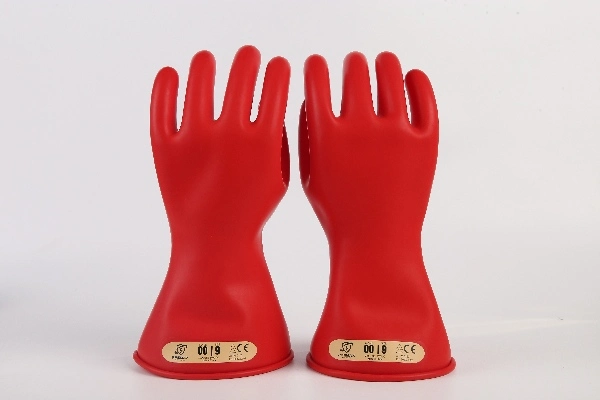
Quality insulating gloves must meet internationally recognized standards that verify their dielectric strength, material integrity, and voltage class suitability. The two primary benchmarks are ASTM D120 (North American standard) and IEC 60903 (international standard), both of which define voltage classification, proof test requirements, and physical performance criteria. For procurement managers sourcing electrical PPE at scale, understanding these standards is not optional — it is the foundation of workforce protection and regulatory compliance. At PPE MAX, every pair of insulating gloves we manufacture is built against these exact benchmarks.
|
Parameter |
Type I (Natural Rubber) |
Type II (Synthetic/EPDM) |
|
Maximum Use Voltage |
500V AC / 750V DC |
500V AC / 750V DC |
|
Proof Test Voltage |
2,500V AC / 10,000V DC |
2,500V AC / 10,000V DC |
|
Maximum Thickness |
0.75mm (30 mils) |
0.75mm (30 mils) |
|
Length Options |
11-14 inches |
11-14 inches |
|
Color Code |
Beige Label |
Beige Label |
|
Temperature Range |
Standard |
Extended (-25°C to +55°C) |
|
UV/Ozone Resistance |
Standard |
Enhanced |
Understanding the Role and Types of Insulating Gloves
How Electrical Insulating Gloves Work
Insulating gloves serve as a physical partition separating a worker's hands from live wires. They are made from high-quality natural rubber latex or man-made materials that stop the flow of electricity. When a technician touches a live circuit, the material of the gloves soaks up the difference in voltage and stops current from getting to the body. Because of this process, both ASTM D120 and IEC 60903 have strict rules about material quality and thickness limits.
The Voltage Classification System
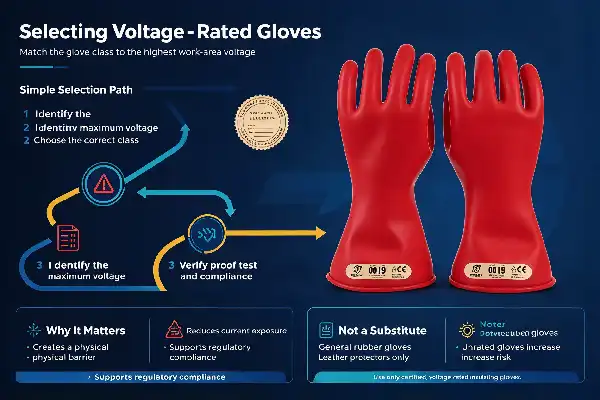
The ASTM and IEC systems divide rubber insulating gloves into groups based on their highest use voltage:
- Class 00 — 500V AC / 750V DC (beige label)
- Class 0 — 1,000V AC / 1,500V DC (red label)
- Class 1 — 7,500V AC / 11,250V DC (white label)
- Class 2 — 17,000V AC / 25,500V DC (yellow label)
- Class 3 — 26,500V AC / 39,750V DC (green label)
- Class 4 — 36,000V AC / 54,000V DC (orange label)
The Class 00 gloves from PPE MAX can handle up to 500V AC and have passed a 2,500V AC proof test. This means they are safe for low-voltage work in utilities, telecom installs, and HVAC repair.
Insulating Gloves vs. Other Protective Gloves
General-purpose rubber gloves have not been tested to provide dielectric protection. Leather gloves are only meant to protect your hands from mechanical damage when worn over approved electrical gloves. It's important to note the difference: only gloves made and tested according to ASTM D120 or IEC 60903 can really claim to have a voltage rating. Using regular work gloves instead of rated electrical gloves is not following the rules and has been linked to deaths from shocks in workplace settings.
Key Standards Governing Quality Insulating Gloves
ASTM D120: The North American Benchmark
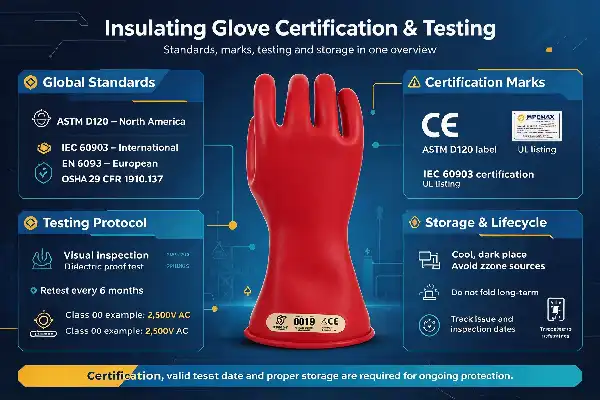
ASTM D120 says what materials rubber insulating gloves sold in North America must be made of, how big they must be, and how they must be tested for dielectric properties. It says that proof voltage tests must be done, what the accepted failure limits are, and how each glove must be marked, including the class, size, and date of the test. ASTM D120 is directly mentioned in OSHA 29 CFR 1910.137 as the standard for electrical safety equipment in U.S. workplaces.
IEC 60903 and EN 60903: International Compliance
IEC 60903 is the international standard that is similar to ASTM D120 and is the basis for the European EN 60903 standard. It adds new chemical resistance categories that weren't in the original ASTM framework. These are Category A (acid), Category H (oil), Category Z (ozone), Category R (a mix of A+H+Z), and Category C (extreme cold). If your procurement team works in more than one region, getting gloves that are approved to IEC 60903 will cover more areas.
Certification Marks to Verify
When looking at seller paperwork, procurement workers should look for these verified marks:
- CE marking — shows that it meets EU rules for personal safety equipment.
- ASTM D120 label — required for sales in the United States.
- IEC 60903 certification — backs up international testing for dielectric.
- UL listing — additional North American safety check for the product.
PPE MAX Class 00 gloves are certified by both ASTM D120 and IEC 60903, and they can also be marked with CE for sales in the European market.
If you're evaluating personal protective equipment suppliers and require batch-specific testing documents before placing an order, PPE MAX is able to provide official Certificates of Analysis, professional laboratory test reports, and product samples for your verification. Feel free to contact our team at marketing@ppemax.com to discuss your sourcing needs and obtain complete documentation for your quality assessment and procurement approval.
Testing and Maintenance Standards for Insulating Gloves
Required Testing Protocols
An electrical safety test is done on every pair of approved insulating gloves before they leave the factory. A 2,500V AC proof test is part of ASTM D120 for Class 00 gloves. The test uses electricity for a certain amount of time while keeping an eye out for current leakage that goes over the allowed limit. Before the electrical test, the surface is looked at visually for pinholes, cuts, or other surface contamination. If either check fails, the gloves are thrown away, no excuses.
Recommended In-Service Testing Frequency
Both ASTM D120 and IEC 60903 say that insulating gloves should be tested every six months again while they are in use or right away after touching voltages that are close to the rated limit. This testing cycle should be written into the PPE lifecycle paperwork by procurement managers. If you use a glove after the date it was last tested, it is no longer guaranteed and shouldn't be used on charged work.
Storage, Handling, and Lifecycle Management
Storing gloves correctly has a direct effect on how well they work. Some important practices are:
- Keep gloves away from things that make ozone, like motors and transformers, because ozone speeds up the breakdown of rubber.
- Keep gloves somewhere cool and dark, and don't fold or squeeze them for long periods of time.
- For audit readiness, keep track of each glove's service record, which should include the date it was issued, the date it was inspected, and the results of the inspection.
These actions keep the insulating qualities of rubber gloves and help with the paperwork that is needed for safety checks.
Selecting Quality Insulating Gloves for B2B Procurement
Matching Voltage Class to the Application
The first thing that needs to be decided when buying something is which voltage class to use. Putting on an under-rated glove, like a Class 00 glove on a 1,000V AC circuit, presents a deadly risk right away. The specs for the purchase should list the highest voltage that workers can come into contact with on a circuit. To be safe, the next class above that voltage should be chosen. Class 00 gloves from PPE MAX are rated at 500V AC and are perfect for working with low-voltage control screens, telecom cables, and in the lab.
Ergonomics, Size, and Environmental Fit
Compliance in practice is affected by fit and skill as well as voltage class. When workers find gloves uncomfortable, they often take them off during tasks, which takes away all of their protective value. PPE MAX Class 00 gloves come in sizes 8, 9, 10, and 11, and in lengths of 11 inches and 14 inches. Each pair weighs about 170 grams, which is a comfortable weight for long wear. For fine electrical work, the ergonomic cut keeps the fingers' ability to feel things.
Bulk Procurement Considerations
If you buy a lot of things, these factors will help you tell the difference between dependable and problematic suppliers. A trustworthy company that makes insulating gloves should give full test reports for every production batch, allow tracking from raw materials to finished products, keep wait times consistent, and help customers with technical questions after the sale. PPE MAX ships in standard cartons of 20 pairs (CTN: 54.5×35×42.5cm, 6.5 kg), which makes it easier to handle warehouses and plan supplies for operations with a lot of items.
Ensuring Safety and Longevity: Best Practices and Benefits
The Operational Case for Standard Compliance
Companies that have certified PPE programs always say that their injury rates are lower. Every year, the U.S. Bureau of Labor Statistics reports hundreds of deaths from electrical contact. Most of these deaths were caused by PPE that wasn't secured or wasn't classified correctly. Getting insulating gloves that meet ASTM D120 or IEC 60903 standards isn't just a legal requirement; it's also a measured way to stop deaths that could have been avoided at work.
Common Compliance Failures to Avoid
Most incidents involving insulating gloves in the workplace are caused by three things:
- Exceeding the maximum voltage means using a lower-class glove on a wire with a higher voltage.
- Forgetting to check gloves after their six-month retest time has passed.
- Using gloves that are mechanically damaged — cuts and abrasions make the dielectric less effective even if the glove passes a voltage test.
All three types of failure can be avoided with structured buying processes that include written seller certification, tracking of retest plans, and a required visual check before use.
Future Directions in Electrical Hand Protection
The way companies handle electrical PPE is changing because of material science and digital traceability. New types of composite rubber are better at resisting ozone and UV light without losing their flexibility. Digital tagging systems let safety managers scan each glove and get a full record of all the times it has been used right now. PPE MAX keeps a close eye on these changes so that we can add relevant improvements to our product line as soon as they are ready for production.
Conclusion
Certified insulating gloves must be worn anywhere workers come into contact with electrical equipment. The performance standards that every pair must meet before they can go to the job site are set by ASTM D120, IEC 60903, and EN 60903. To keep that safety going for a long time, it's important to choose the right class, test the dielectric regularly, and store it properly. Working with a manufacturer that has two types of certification and keeps clear records takes all the guesswork out of the sourcing process for procurement teams that are in charge of large teams spread across multiple sites or regions.
FAQ
1. How often should insulating gloves be retested?
As per ASTM D120 and IEC 60903, insulating gloves that are being used should be checked again every six months. When the glove contacts voltage gets close to its rated limit, the retest intervals start over.
2. What happens if a worker uses a glove past its voltage rating?
The glove doesn't guarantee safety above its maximum voltage. Unexpected electrical problems can happen and cause serious shocks or even death. Class 00 gloves are only supposed to be used on 500V AC circuits. Using them on higher voltage circuits is very dangerous.
3. What documentation should a supplier provide?
A good supplier of insulating gloves should give you test reports for each batch, copies of certifications (ASTM D120, IEC 60903), material safety data, and markings on each glove that show the class, size, and date of the test.
4. Can Class 00 gloves be used without leather protectors?
To avoid mechanical damage, IEC 60903 and ASTM D120 say that leather protector gloves should be used instead of rubber insulating gloves. It is possible to use Class 00 gloves without leather guards for low-voltage jobs where there are no sharp items. However, leather protectors are always safer.
Partner with PPE MAX for Certified Insulating Gloves Supply
PPE MAX has been making certified electrical PPE since 1956 and sells it to businesses in 134 countries. Our Class 00 insulating gloves are approved to both ASTM D120 and IEC 60903, come in large cartons, and come with quick expert support. As a reputable insulating gloves maker, we offer OEM production, custom sizing, and help with regional certification. To get prices and details, please email our team at marketing@ppemax.com right now.
References
1. ASTM International. ASTM D120: Standard Specification for Rubber Insulating Gloves. ASTM International, 2021.
2. International Electrotechnical Commission. IEC 60903: Live Working — Gloves of Insulating Material. IEC, 2014.
3. Occupational Safety and Health Administration. OSHA 29 CFR 1910.137: Electrical Protective Equipment. U.S. Department of Labor, 2019.
4. National Fire Protection Association. NFPA 70E: Standard for Electrical Safety in the Workplace. NFPA, 2021.
5. U.S. Bureau of Labor Statistics. National Census of Fatal Occupational Injuries. BLS, 2022.
6. European Committee for Electrotechnical Standardization. EN 60903: Live Working — Gloves of Insulating Material. CENELEC, 2003.
Learn about our latest products and discounts through SMS or email