- English
- French
- German
- Portuguese
- Spanish
- Russian
- Japanese
- Korean
- Arabic
- Greek
- German
- Turkish
- Italian
- Danish
- Romanian
- Indonesian
- Czech
- Afrikaans
- Swedish
- Polish
- Basque
- Catalan
- Esperanto
- Hindi
- Lao
- Albanian
- Amharic
- Armenian
- Azerbaijani
- Belarusian
- Bengali
- Bosnian
- Bulgarian
- Cebuano
- Chichewa
- Corsican
- Croatian
- Dutch
- Estonian
- Filipino
- Finnish
- Frisian
- Galician
- Georgian
- Gujarati
- Haitian
- Hausa
- Hawaiian
- Hebrew
- Hmong
- Hungarian
- Icelandic
- Igbo
- Javanese
- Kannada
- Kazakh
- Khmer
- Kurdish
- Kyrgyz
- Latin
- Latvian
- Lithuanian
- Luxembou..
- Macedonian
- Malagasy
- Malay
- Malayalam
- Maltese
- Maori
- Marathi
- Mongolian
- Burmese
- Nepali
- Norwegian
- Pashto
- Persian
- Punjabi
- Serbian
- Sesotho
- Sinhala
- Slovak
- Slovenian
- Somali
- Samoan
- Scots Gaelic
- Shona
- Sindhi
- Sundanese
- Swahili
- Tajik
- Tamil
- Telugu
- Thai
- Ukrainian
- Urdu
- Uzbek
- Vietnamese
- Welsh
- Xhosa
- Yiddish
- Yoruba
- Zulu
How Does a Full-Face Respirator Protect Against Workplace Hazards?
Founded in 1956, PPEMAX stands as a premier global manufacturer and supplier of full-range personal protective equipment. All our products comply with internationally recognized standards including IEC, ASTM, CE, UKCA, NIOSH and ISO9001. Equipped with a 2,000-square-meter modern production plant, we boast over 25 years of mature OEM & ODM capabilities to deliver one-stop customized solutions covering R&D design through worldwide logistics. Our safety gear is distributed across 134 countries globally. Upholding our core tenet “Safety First, Quality Priority”, we serve as a dependable long-term PPE partner for industrial enterprises around the world.
The full mask respirator protects workers by covering the complete face (eyes, nose, and mouth) at the same time. Unlike a half-mask respirator, it prevents airborne particles, chemical vapors, acid gases, and biological pollutants from entering via any facial entry site. Rated with an Assigned Protection Factor (APF) of 50 by NIOSH, it provides a far higher level of protection in high-exposure circumstances. This level of protection is used in industries such as chemical processing, mining, and pharmaceutical production to remain OSHA compliant and keep workers safe on longer shifts.
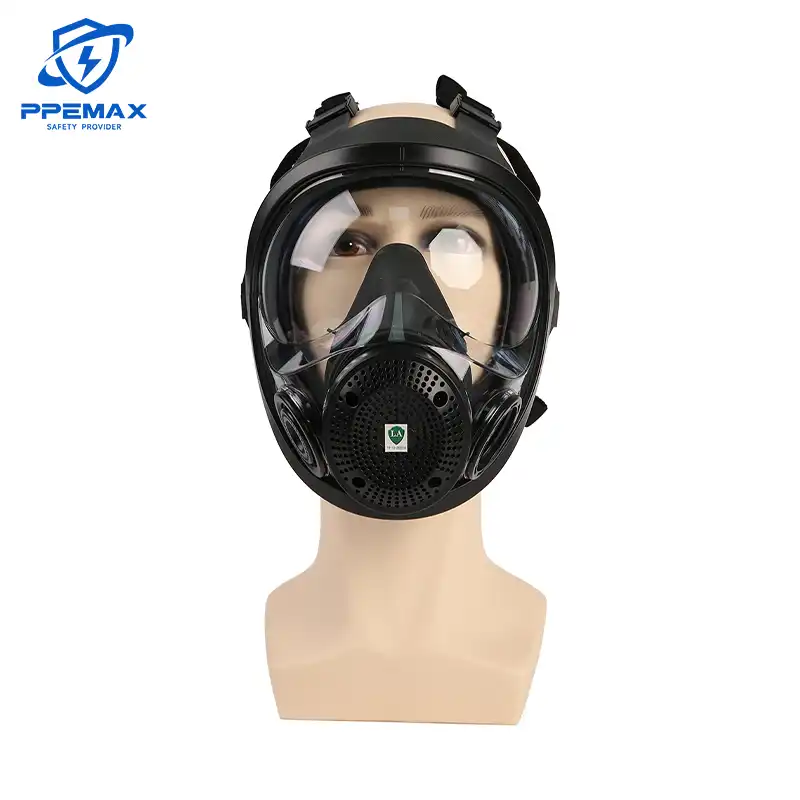
| Parameter | Specification |
|---|---|
| Product Type | Full Face Respirator Gas Mask |
| Mask Body Material | Premium Liquid Silicone (Skin-friendly & Comfort Fit) |
| Visor Material | High-transmittance Polycarbonate (Anti-impact & Anti-scratch) |
| Connection Interface | Standard 40mm NATO Thread (RD40) |
| Head Harness | 5-Point Adjustable System (Even Weight Distribution) |
| Field of Vision | Panoramic View (≥ 85%) |
| Inhalation Resistance | ≤ 30 Pa |
| Exhalation Resistance | ≤ 98 Pa |
| Total Inward Leakage | ≤ 0.05% |
| Anti-Fogging System | Integrated Independent Inner Nose Cup |
| Compatible Filters | All Standard 40mm Chemical/Particle/CBRN Filters |
| Product Weight | Approx. 450g - 500g (Without Canister) |
| Safety Compliance | EN 136 / GB2890-2009 Standards |
| Applications | Industrial Painting, Chemical Handling, Construction, Welding, Agriculture |
Understanding Full-Face Respirators: Function and Safety Standards
How the Core Components Work Together
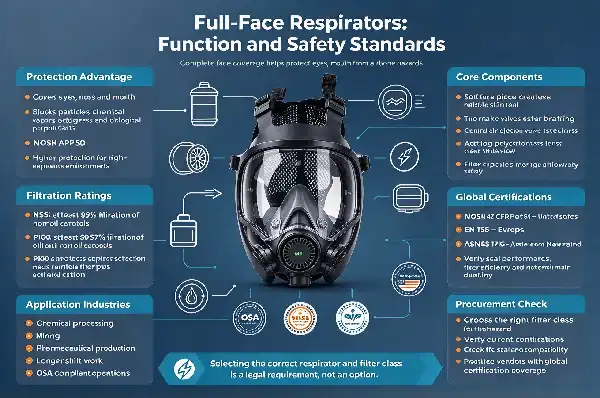
A full-face respirator is an assembly of a number of distinct technical pieces. The soft silicone face piece forms a seal against your skin and prevents air from entering. Easier to breathe with two intake valves, and the centrally located air-ejection valve dumps the air fast. Anti-fog polycarbonate wide-view glass ensures your vision remains clear even in dusty or chemical-laden environments. All of this works together to ensure that the filter capsule only receives the airflow it can handle. This guarantees the same level of safety for the whole workday.
Filtration Ratings: P100 vs. N95 and Why It Matters
The air-filtering ability of a mask is directly tied to the risks it may protect you against. N95 filters get rid of at least 95 percent of non-oil aerosols, whereas P100 filters get rid of 99.97 percent of both oil and non-oil aerosols. This implies that they may be used for removing asbestos, silica dust, and heavy metal pollutants. If you have chlorine or ammonia gas and vapor pollution, you require the combo packs with both particle filters and activated carbon. Choosing the proper filter class is not a matter of choice; it is a legal requirement, and it is mandatory for operations.
Global Certifications That Procurement Teams Must Verify
Certification is the first step to obeying the law and keeping workers safe. NIOSH 42 CFR Part 84 standards in the U.S. PPE MAX full face respirators meet or exceed They are equal to or better than EN 136 in Europe and equal to or better than AS/NZS 1716 in Australia and New Zealand. These certifications confirm that each item has been examined by a third party to ensure that the seals are working correctly, the filters are working effectively, and the materials are long-lasting. For example, if procurement managers are purchasing items for a company in more than one country, they might favor vendors who have all three certifications in one spot.
Key Benefits of Using Full-Face Respirators at the Workplace
Simultaneous Protection Across Multiple Exposure Pathways
One of the nicest things about a full mask respirator compared to a half-mask is that it protects the eyes as well as the lungs from hazardous contact. In areas where chemicals are used, unpleasant gases such as formaldehyde and VOCs may swiftly damage eye tissue. This is a full-face design, so you don’t need safety goggles. This minimizes equipment conflicts and ensures that there is no gap between eye protection and breathing protection. Such an integrated approach directly reduces the frequency of incidents in environments where many airborne hazards exist concurrently.
Ergonomic Design Built for Long Shifts
These are the main design elements that allow for longer use at work:
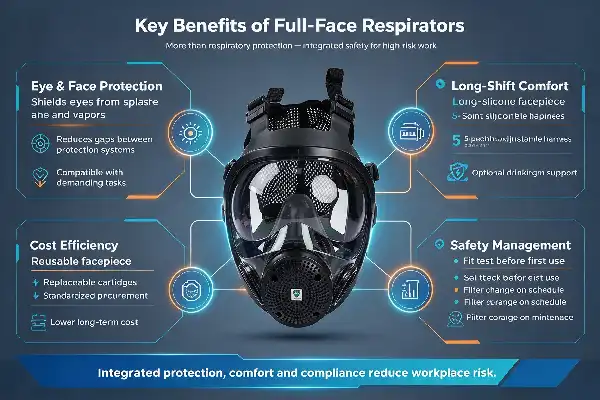
- Soft silicone facepiece: Medical-grade silicone resists chemical permeation and conforms to diverse facial geometries, reducing pressure fatigue over hours of wear.
- 5-point adjustable harness: Even pressure distribution across the head prevents slippage during physical exertion, maintaining seal integrity without requiring constant readjustment.
- Speech diaphragm: Workers can communicate clearly without removing the mask, a practical requirement in noisy industrial environments where safety instructions must be heard.
- Optional drinking tube: Hydration is possible without breaking the facial seal, an important feature for workers in hot environments or during hazmat operations.
All of these features work together to solve the main reason why workers take off their safety gear early: it's uncomfortable. Compliance rates go up when a respirator fits well and lets you do your normal job tasks.
Reusable vs. Disposable: A Cost and Performance Comparison
For jobs that expose people to the same danger every day, reusable full-face respirators with replaceable filter cartridges have a lower total cost of ownership. Over the course of a year, a single facepiece with regular cartridge replacements costs a lot less than similar disposable units. Disposable choices are good for short-term or emergency deployments. For big companies with hundreds of workers spread out across various sites, reusable models with standardized filter compatibility, like the bayonet connection system on PPE MAX units, make it easier to keep track of supplies and make buying things easier.
If you're evaluating personal protective equipment suppliers and require batch-specific testing documents before placing an order, PPE MAX is able to provide official Certificates of Analysis, professional laboratory test reports, and product samples for your verification. Feel free to contact our team at marketing@ppemax.com to discuss your sourcing needs and obtain complete documentation for your quality assessment and procurement approval.
How to Properly Fit, Use, and Maintain Full-Face Respirators
Step-by-Step Fitting for an Airtight Seal
It is necessary to properly fit a full-face mask; a unit that isn't fitted properly won't protect you. Loosen all of the harness straps to start. First, put your chin in the facepiece, and then pull the belt over your head. First wind up the bottom straps, then the side straps, and finally the top strap. Cover the breathing valve and gently let out air to do a good pressure seal check. Adjust the facepiece again and try again if air leaks out around the edge. According to OSHA 29 CFR 1910.134, each person must pass a fit test before the first use.
Common Fitting Mistakes That Compromise Safety
Donning a respirator incorrectly is consistently one of the main reasons they don't work in workplaces. When you tighten the top strap before the bottom, the pressure is spread out unevenly, which breaks the chin seal. NIOSH says that facial hair that has been growing for more than 24 hours can cut APF by more than 90%. Wearing the respirator over a beard keeps the silicone from making a tight seal with the skin. When workers don't do the seal check, they think the equipment will protect them, but it can't in that situation.
Cleaning, Filter Replacement, and Storage Protocols
Clean the facepiece with a mild disinfectant solution made for silicone materials after each use. Rinse it well and let it dry completely in the air before putting it away. Replace the filter cells when the worker notices an odor or taste breakthrough, when breathing resistance rises noticeably, or when the manufacturer says to, whichever comes first. Keep respirators in a sealed bag out of the reach of UV light, heat, and chemical vapors, which break down silicone and make the seal less effective. To help with these maintenance needs, PPE MAX offers a technical support hotline and a supply of spare parts.
Comparing Full-Face Respirators: Selecting the Best Option for Your Business
Full-Face vs. Half-Mask: When Each Is Appropriate
A half-mask respirator has an APF of 10, which means it can be used in places where the quantity of contaminants is less than 10 times the PEL. When amounts go above that level or when eye protection is also needed, a full-face mask is the only option left. Full-face protection is not only recommended for people working with chemicals, pharmaceuticals, and asbestos; it is required by OSHA and other foreign regulatory bodies.
PAPRs vs. Negative Pressure Full-Face Respirators
Powered air-purifying full mask respirators (PAPRs) include a battery-powered blower that passes filtered air through the hood or facepiece, providing an APF up to 1,000. They are particularly good for persons who have to perform a lot of vigorous labor or have problems breathing against filter resistance. PAPRs, however, are more expensive to purchase, require management, and add weight to the wearer. Negative pressure full-face respirators remain the most popular option for most industrial activities where affordability, convenience of use, and proven performance are critical.
Key Evaluation Criteria for B2B Procurement Teams
Using these factors in the right way for your business is what makes the difference between a good procurement choice and an expensive one.
- Filter compatibility: Bayonet systems offering interchangeable cartridge types reduce long-term inventory costs.
- Facepiece material: Medical-grade silicone outperforms standard TPE in chemical resistance and long-term durability.
- Certification scope: Suppliers holding NIOSH, EN 136, and AS/NZS 1716 certifications simultaneously reduce cross-border compliance risk.
- OEM and custom labeling options: Essential for distributors building a branded product line.
Matching these criteria to your specific operational environment is what separates a good procurement decision from a costly one.
Procurement Insights: Where and How to Purchase Full-Face Respirators
Pricing Factors and Total Cost of Ownership
The price of full-face respirators varies based on the kind of filter, the material of the facepiece, and the extent of certification. Combination multi-gas units cost more than basic variants that can defend against particles. Bulk purchase arrangements with recognized manufacturers may lower the cost per unit by a lot when a lot of individuals are deployed to work together. PPE MAX provides several packaging options for bulk commodities, personalized labeling for wholesalers, and protective wrapping for each unit. All of these may be acquired in different quantities that are appropriate for medium to big organizations.
Supplier Vetting and Counterfeit Risk Management
Fake respiratory protection gear poses a significant danger to the global supply chain. From 2020 through 2023, the US CDC and NIOSH issued many warnings regarding the circulation of counterfeit NIOSH-approved respirators. To prevent this, procurement departments should ask the manufacturer for confirmation of certification, check the NIOSH Certified Equipment List for approval numbers, and review the history of the supplier’s production audits. Since 1956, PPE MAX has granted manufacturing facilities and encourages consumers to visit its operations in Xi'an, China. It allows clients to see firsthand how quality control is done.
OEM and Custom Manufacturing for Specialized Needs
Standard retail products may not fulfill the demands of an organization. PPE MAX provides OEM and ODM production services to let wholesalers and large customers pick the style of facepiece, filter compatibility, color coding, and private labeling. This service is particularly valuable to government entities that purchase items and worldwide businesses that are entering new countries and want to make sure their products stand out and are compliant with the requirements in those regions. PPE MAX offers full-chain compliance from manufacturing to delivery and ships to 134 countries.
Conclusion
The greatest protection workers have against airborne chemical, particle, and biological dangers is to wear a full mask respirator. This is the finest solution for the chemical, mining, pharmaceutical, and construction sectors, as it can protect the eyes and respiratory system in one certified unit. The four elements that ensure protective equipment really protects workers and doesn’t simply appear as it does are getting the proper model, ensuring it fits well, staying on top of filter schedules, and purchasing from trusted manufacturers. Every option in this field of buying affects safety directly.
FAQ
1. What is the difference between a full-face respirator and a half-mask respirator?
A half-mask respirator covers the nose and mouth only, carrying an OSHA Assigned Protection Factor of 10. A full-face respirator covers the entire face, including the eyes, achieving an APF of 50 in negative pressure mode. The full-face design is required when contaminant concentrations exceed 10 times the permissible exposure limit or when eye protection against vapors and gases is also necessary.
2. How often should filter cartridges be replaced?
Replace cartridges when you detect odor or taste breakthrough, when breathing resistance increases, or according to the manufacturer's scheduled service life — whichever occurs first. For combination gas/particulate cartridges, OSHA recommends a change-out schedule based on contaminant identity, concentration, humidity, and work rate. There is no universal interval; the schedule must be calculated per OSHA 29 CFR 1910.134 Appendix D guidelines.
3. Are full-face respirators effective against chemical vapors?
Yes, when paired with the correct cartridge type. Chemical vapor protection requires activated carbon cartridges rated for specific gas families — acid gases, organic vapors, or ammonia, for example. A particulate-only filter does not protect against vapors. Always match the cartridge rating to the identified chemical hazard in your workplace air monitoring data.
4. Can full-face respirators be used with beards?
No. NIOSH confirms that facial hair along the sealing surface breaks the airtight contact between silicone and skin, reducing protection to an unreliable level. Workers with facial hair must either shave or use a PAPR system with a loose-fitting hood, which does not rely on a facial seal.
Get Certified Full Mask Respirator Solutions from PPE MAX
Since 1956, PPE MAX has sold approved breathing protection to businesses in 134 countries. Our manufacturing team can make what you need, whether it's a full mask respirator for a large workforce, a bulk order for distribution, or a custom OEM product line. You can email our team at marketing@ppemax.com to get a price on a bulk order and talk to a product expert about your protection needs.
References
1. NIOSH — NIOSH-Approved Particulate Filtering Facepiece Respirators, National Institute for Occupational Safety and Health, 2023.
2. OSHA — Respiratory Protection Standard: 29 CFR 1910.134, Occupational Safety and Health Administration, U.S. Department of Labor, 2022.
3. European Committee for Standardization — EN 136: Respiratory Protective Devices — Full Face Masks, CEN, 2021.
4. Bollinger, N. — NIOSH Guide to the Selection and Use of Particulate Respirators, U.S. Department of Health and Human Services, 1996.
5. Occupational Safety and Health Administration — Assigned Protection Factors for the Revised Respiratory Protection Standard, OSHA Publication 3352, 2009.
6. Standards Australia — AS/NZS 1716: Respiratory Protective Devices, Standards Australia and Standards New Zealand, 2012.
Learn about our latest products and discounts through SMS or email