- English
- French
- German
- Portuguese
- Spanish
- Russian
- Japanese
- Korean
- Arabic
- Greek
- German
- Turkish
- Italian
- Danish
- Romanian
- Indonesian
- Czech
- Afrikaans
- Swedish
- Polish
- Basque
- Catalan
- Esperanto
- Hindi
- Lao
- Albanian
- Amharic
- Armenian
- Azerbaijani
- Belarusian
- Bengali
- Bosnian
- Bulgarian
- Cebuano
- Chichewa
- Corsican
- Croatian
- Dutch
- Estonian
- Filipino
- Finnish
- Frisian
- Galician
- Georgian
- Gujarati
- Haitian
- Hausa
- Hawaiian
- Hebrew
- Hmong
- Hungarian
- Icelandic
- Igbo
- Javanese
- Kannada
- Kazakh
- Khmer
- Kurdish
- Kyrgyz
- Latin
- Latvian
- Lithuanian
- Luxembou..
- Macedonian
- Malagasy
- Malay
- Malayalam
- Maltese
- Maori
- Marathi
- Mongolian
- Burmese
- Nepali
- Norwegian
- Pashto
- Persian
- Punjabi
- Serbian
- Sesotho
- Sinhala
- Slovak
- Slovenian
- Somali
- Samoan
- Scots Gaelic
- Shona
- Sindhi
- Sundanese
- Swahili
- Tajik
- Tamil
- Telugu
- Thai
- Ukrainian
- Urdu
- Uzbek
- Vietnamese
- Welsh
- Xhosa
- Yiddish
- Yoruba
- Zulu
How Often Should Insulating Gloves Be Inspected or Replaced?
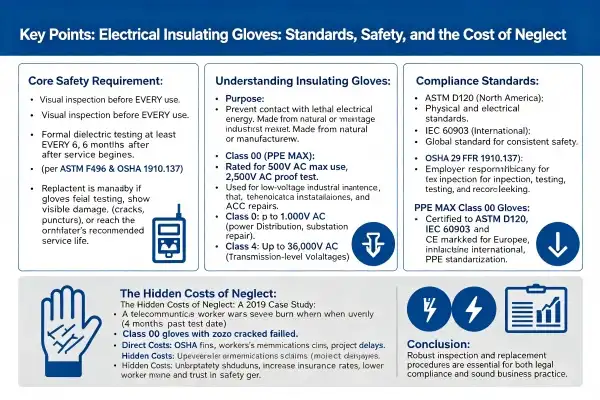
Electrical insulating gloves must be visually inspected before every single use and undergo formal dielectric testing at least every six months once placed into service, according to ASTM F496 and OSHA 1910.137 standards. Replacement becomes mandatory when gloves fail electrical testing, show visible damage such as cracks or punctures, or reach the manufacturer's recommended service life. This dual approach—frequent visual checks paired with periodic professional testing—creates the safety net that prevents electrical incidents and keeps workers protected in energized environments.
Understanding Insulating Gloves and Their Safety Importance
Electrical insulating gloves keep workers from coming into contact with energy that could kill them. Unlike regular work gloves, these are made from natural or manufactured rubber materials that stop the flow of electricity, which keeps workers from getting shocked or electrocuted during live-line work.
Types and Voltage Classifications
Insulating gloves are divided into six voltage classes by the industry: Class 00, Class 0, Class 1, Class 2, Class 3, and Class 4. Each class is rated for a higher maximum use voltage. PPE MAX makes Class 00 gloves that can handle an AC highest use voltage of 500V and a proof test value of 2,500V. These gloves are used for low-voltage industry maintenance, telecommunications installations, and HVAC repairs. These gloves provide important dielectric protection while also giving workers the touch awareness they need to do difficult jobs like installing meters or working on control panels.
Class 0 gloves can handle up to 1,000V AC, which makes them good for work in power distribution and substation repair. Class 4 gloves are approved for 36,000V AC, which means they guard against transmission-level voltages. Each classification goes through strict proof tests at voltages that are much higher than their working voltage. This creates a safety cushion that takes into account stress factors that happen in real life.
Compliance Standards and Regulatory Framework
Three main rules control how insulating gloves are made and tested all over the world. In North American markets, ASTM D120 spells out the physical and electrical standards for rubber insulating gloves. IEC 60903 is the worldwide standard that makes safety standards the same in Asia, Europe, and emerging countries. OSHA rules, especially 29 CFR 1910.137, say that employers are responsible for checking, testing, and keeping records on gloves.
At PPE MAX, our Class 00 gloves are certified by both ASTM D120 and IEC 60903, and they also have the CE mark to show that they are safe for use in Europe. This method with multiple standards makes sure that procurement teams that work with international companies can standardize their PPE inventory while still meeting the rules in each country.
The Hidden Costs of Neglecting Glove Maintenance
Real-life events show how important it is to have good glove programs. In 2019, a telecommunications worker got severely burned when their worn-out Class 00 gloves broke while they were working on a tower. A review after the event showed that the gloves had been used for four months longer than their six-month testing period and had obvious ozone cracking that had not been noticed. The company had to deal with OSHA fines, workers' compensation claims, and project delays, all of which cost a lot more than maintaining the gloves properly.
Insulating gloves that don't work right cause more problems than just direct harm costs. Unexpected safety shutdowns throw off project schedules. When accidents that could have been avoided happen, insurance rates go up. When teams lose faith in their safety gear, worker happiness goes down. These hidden costs mean that strong inspection and replacement procedures are not only needed for legal reasons, but they are also necessary for business reasons.
How Often Should Insulating Gloves Be Inspected?
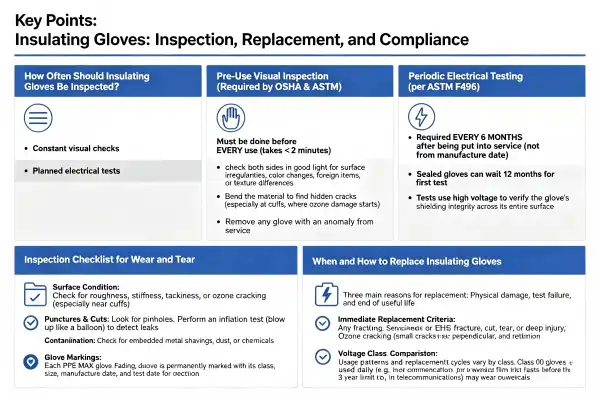
There are two parallel lines for inspection frequency: a constant visual check and planned electrical tests. Both parts work together to find different types of failures before they make security less effective. As required by OSHA and ASTM standards, workers must always carefully check rubber insulating gloves before using them. This quick check doesn't take long—less than two minutes—but it finds a lot of common problems. When PPE MAX teaches people how to use our products, we stress how important it is for this habit to become as natural as putting on gloves.
Before-Use Visual Inspection Requirements
For the visual check, both sides of each glove must be looked at in good lighting, with an eye out for surface irregularities, changes in color, foreign items buried in the leather, or differences in texture. Workers should bend the material of the gloves to find cracks that are hidden and check the cuff area, which is where ozone damage usually starts. Any finding that seems odd, even if it's just a small flaw on the surface, takes that pair out of service until it can be looked at more closely.
Periodic Electrical Testing Protocols
Damage to insulation that can't be seen with the naked eye can't be found by visual inspection. Because of this, ASTM F496 says that gloves must be professionally tested for insulating properties every six months after they are put to use. High voltage is used in this test to make sure that the rubber keeps its shielding qualities across the whole surface of the glove.
The six months begin on the date the item was put into service, not when it was manufactured. Gloves that are still sealed in the plant can wait twelve months before they are tested for the first time, but the clock starts ticking as soon as a worker puts them in their kit. A lot of safety managers get this difference wrong, which means they let used gloves stay in use after their test date.
Inspection Checklist for Wear and Tear
A methodical technique can find problems that casual observation might miss. This full list is what we suggest:
Surface condition: Slowly run your fingers over the whole glove's surface, feeling for roughness, stiffness, or tackiness that could mean the rubber is breaking down. Ozone exposure makes a breaking pattern that is easy to spot, especially near the cuff.
Punctures and cuts: Look carefully for any holes, no matter how small. Electrical safety is broken by even small holes, or pinholes. By closing the cuff and blowing up the glove like a balloon, the inflation test finds leaks that can't be seen with the naked eye.
Contamination: Look for metal pieces, concrete dust, or chemical leftovers that are buried in the ground. These toxins make paths for electricity to flow through the insulator.
Color changes: Fading, darkening, or a chalky film left behind are signs that the material is breaking down because of UV light or chemicals that don't mix well.
Flexibility loss: Areas that are stiff or brittle show that the glove is getting older, which makes it less protective.
Documentation and Compliance Records
Regulatory checks and mishap reviews need proof that inspection rules were followed. We set up tracking systems with procurement teams that keep track of dates for eye inspections, results of electrical tests, and choices about when gloves should be retired. Digital tools, ranging from basic spreadsheets to specialized EHS software, help businesses keep track of their glove stocks at multiple locations.
Permanent marks should be put on each glove that show its class, size, date of manufacture, and date of testing. This information is clearly marked on PPE MAX's Class 00 gloves, which makes them easy to find in the field and lowers the risk of using the wrong voltage-rated equipment.
When and How to Replace Insulating Gloves
Knowing when to throw away electrical insulating gloves strikes a balance between safety and waste. There are three main reasons to replace something: physical damage, test failure, and the end of its useful life.
Immediate Replacement Criteria
Some flaws mean that the service must be taken away right away, with no chance of going back to use. Any fracture, cut, tear, or deep injury means you have to quit right away. The damaged insulation can't be trusted, even if the damage looks small. Also, gloves that have ozone cracking—those small cracks that run perpendicular to stress lines—must be thrown away, no matter what their test status is.
Electrical Test Failure
When electrical testing shows that the insulation is breaking down, it has to be replaced. High voltage is applied between the inside and outside of the glove during the test, and current loss is watched. Any current flow that can be measured means that the insulator is broken.
Manufacturer Service Life Recommendations
Gloves that pass both visible and electrical tests can only be used for a certain amount of time. Over time, rubber materials lose their protective qualities due to oxidation and exposure to the environment. Accelerated aging studies and field performance data are used by manufacturers to set maximum service life periods.
Voltage Class Comparison: Replacement Cycle Differences
Different voltage classes have very different patterns of use and repair times. Class 00 gloves that are used every day in telecommunications work might wear out and become dirty before they hit the three-year limit. A worker who installs fifty low-voltage meters every month puts gloves through a lot more mechanical stress and contamination than someone who only uses them once in a while.
Maintenance Tips to Prolong the Life of Insulating Gloves
Strategic repair methods make insulating gloves last longer without putting safety at risk. These steps keep your property safe and make sure that protection is always there.
Proper Storage Conditions
The environment speeds up the aging of rubber more than actual use. Ozone is made by electrical equipment, welding, and even sunlight. It breaks down the chemical bonds in rubber, which causes surface breaking that destroys insulation. Storage places should be away from sources of ozone, keep temperatures between 50°F and 70°F, and stay out of direct sunshine.
When you buy our Class 00 gloves, we include cloth storage bags to keep them from getting damaged during storage. When you fold or crush rubber, you create stress points that become places where cracks start. Gloves should never be squished into toolboxes or smashed under heavy machinery. Instead, they should hang loosely or lie flat in protective bags.
Leather Protector Usage
When worn over rubber insulating gloves, leather guard gloves do more than just protect against punctures. They are also an important part of routine maintenance. They protect the leather from wear and tear that would otherwise damage it, which makes the insulating gloves last a lot longer.
Good leather protectors have reinforced hands and fingers that can handle the roughest surfaces that workers come across, like metal edges, concrete, and rough wire jackets. We suggest changing leather guards more often than insulating gloves because their ability to protect depends on them staying in good shape. Leather protection that is worn through doesn't do its job.
Cleaning and Decontamination
Cleaning rubber the right way gets rid of contaminants while keeping its shape. We suggest that you wash your gloves with light soap and water every time you use them, especially if they come in touch with dirt, oils, or chemicals. Rubber surfaces should never be cleaned with harsh solvents, cleaners made from gasoline, or rough washing.
Gloves need to be completely dry before being stored because water that gets trapped between the rubber and leather protection speeds up wear and tear. For best results, let the hair dry naturally at room temperature. Never use direct heat sources, like hair dryers or heaters, as they can damage the hair.
Partnering with Knowledgeable Suppliers
The success of maintenance rests in part on how well the provider helps. At PPE MAX, our technical team is always happy to talk to you about the best ways to store your gear, clean it, and use it in your unique working setting. Over the past 67 years, we've learned a lot about how different work situations affect the performance of gloves.
This kind of knowledge is especially useful for businesses that are moving into new areas or power classes. When moving from Class 00 to Class 0 equipment, a procurement manager needs to think about different upkeep issues. Suppliers with a lot of knowledge can help with these issues before they become a problem.
Procuring Insulating Gloves: What B2B Buyers Should Know
To strategically buy electrical insulating gloves, you need to know more than just how much they cost. The right way to buy things strikes a mix between saving money and making sure safety standards are always met.
Matching Gloves to Application Requirements
The voltage rating is only one of the standard dimensions. Depending on the application, you need to think about things like glove length, dexterity needs, and weather defense categories.
For different types of contact, our Class 00 gloves come in lengths of 11 inches and 14 inches. The 11-inch version is good for tasks where your arm won't be exposed much, while the 14-inch length gives you more safety when you need to reach into closets or work near live bus bars. Accurately measuring gloves is very important. Gloves that are too small make it hard to move and wear out your hands, while gloves that are too big make it harder to move and raise the risk of sticking.
Certification Verification and Quality Assurance
Unfortunately, the market has low-quality goods with fake approval marks. The offices that buy things have to make sure that the suppliers they work with provide valid test results and keep up with their factory certifications. Suppliers with a good reputation are happy to answer questions about their quality systems and make approval papers easy to find.
PPE MAX keeps its production processes ISO-certified and lets qualified customers check out the site. Our test reports have more than just a "pass" stamp. They also have detailed dielectric test voltages, leakage current measures, and physical property checks. This openness helps procurement workers show that they did their research when choosing a seller.
Evaluating Supplier Capabilities Beyond Product
The relationship with the provider goes beyond the purchase. Some things that should be looked at when judging a product are its professional help, training materials, ability to be customized, and responsiveness after the sale. Our image at PPE MAX is based on this all-around help method. This level of accessibility sets true production partners apart from transactional wholesalers.
Bulk Purchasing Strategy and Supply Chain Stability
Consolidated purchasing, which uses numbers to save money and keep the supply chain consistent, helps large companies that manage various places. Using the same types of gloves everywhere makes training easier, keeps inventory simpler, and makes sure that replacements are always available.
Our packing specifications—20 pairs per carton, 54.5 x 35 x 42.5 cm, and 6.5 kg per carton—make it easier to load containers for foreign shipping, which lowers the cost of freight for large orders. We work with buying teams to set up blanket purchase orders with set release dates. This way, we can make sure that there is a steady supply without having to pay too much for on-site inventory.
Conclusion
Electrical insulating gloves are only safe if they are regularly checked and replaced as directed. Before each use, a visual check finds any damage that is easy to see. After six months, a dielectric test finds any secret insulation degradation. When deciding what to replace, worker safety must come before cost, and gloves must be thrown away as soon as they get damaged, fail a test, or reach the end of their useful life. When gloves are stored properly, away from ozone and UV light, and leather protectors are used regularly, they last a lot longer. Strategic buying puts a lot of weight on approved sellers who offer high-quality goods and full technical support. Companies that use these methods make safety plans that keep workers safe, make sure they follow the rules, and lower their long-term equipment costs.
FAQ
How can I tell if electrical insulating gloves have deteriorated?
How can I tell if my electrical insulating gloves are worn out? Surface cracks (especially those that run perpendicular to stress lines), changes in color, stiffness or tackiness, alien material buried in the material, and any holes or cuts can all be seen. When you seal the cuff and blow up the glove for the expansion test, you can see tiny leaks that you couldn't see before. Any gloves that show any of these signs must be taken out of service right away.
What distinguishes electrical insulating gloves from standard rubber gloves?
To make sure they meet ASTM D120 or IEC 60903 standards for protection qualities at certain voltages, insulating gloves go through specific dielectric tests. They are made from special rubber materials that are designed to prevent electricity. Normal rubber gloves don't protect against electricity, so they should never be used instead of certified insulating gloves in places where electricity is present.
Which manufacturers produce reliable, compliant electrical gloves?
Along with PPE MAX, which has been serving industrial markets around the world since 1956, Honeywell, Ansell, and Salisbury are well-known brands that are known for consistently high quality. Instead of depending only on name recognition, people in charge of buying things should check the latest certifications. This is because manufacturing standards and ownership change over time. For the specific batch of products being bought, ask for proof that they meet ASTM or IEC standards.
Partner with PPE MAX for Certified Electrical Safety Solutions
For electrical safety to work, you need more than just goods that follow the rules. You also need a business partner who knows what's at stake. PPE MAX has been making safety gear for 67 years and brings that experience to every relationship, from our factories in Xi'An to your workplace. Our Class 00 insulating gloves offer the same level of safety that utilities, telecommunications companies, and industry clients in 134 countries trust every day. They are fully certified by ASTM D120 and IEC 60903.
As one of the biggest companies that makes insulating gloves, we offer discounts for buying in bulk, unique packing options, and helpful technical support that lasts after the sale. Our team helps you find the best options, whether you're trying to standardize PPE across international operations or find specific voltage classes for specific uses. You can email our purchasing agents at bettybing@ppemax.com to talk about your electrical safety needs, get product samples, or get bulk prices. Your workers deserve safety measures that are based on years of experience and strict quality standards.
References
1. American Society for Testing and Materials. (2020). "ASTM D120-19: Standard Specification for Rubber Insulating Gloves." ASTM International Standards Worldwide.
2. Occupational Safety and Health Administration. (2021). "1910.137 - Electrical Protective Equipment." OSHA Safety and Health Regulations for General Industry.
3. International Electrotechnical Commission. (2018). "IEC 60903:2002+AMD1:2018: Live Working - Gloves of Insulating Material." IEC International Standards.
4. National Fire Protection Association. (2021). "NFPA 70E: Standard for Electrical Safety in the Workplace, 2021 Edition." NFPA Safety Standards.
5. American Society for Testing and Materials. (2019). "ASTM F496-19: Standard Specification for In-Service Care of Insulating Gloves and Sleeves." ASTM International Standards Worldwide.
6. International Labour Organization. (2019). "Safety and Health in the Use of Personal Protective Equipment at Work: Practical Guidelines for Employers and Workers." ILO Occupational Safety Publications.
Learn about our latest products and discounts through SMS or email