- English
- French
- German
- Portuguese
- Spanish
- Russian
- Japanese
- Korean
- Arabic
- Greek
- German
- Turkish
- Italian
- Danish
- Romanian
- Indonesian
- Czech
- Afrikaans
- Swedish
- Polish
- Basque
- Catalan
- Esperanto
- Hindi
- Lao
- Albanian
- Amharic
- Armenian
- Azerbaijani
- Belarusian
- Bengali
- Bosnian
- Bulgarian
- Cebuano
- Chichewa
- Corsican
- Croatian
- Dutch
- Estonian
- Filipino
- Finnish
- Frisian
- Galician
- Georgian
- Gujarati
- Haitian
- Hausa
- Hawaiian
- Hebrew
- Hmong
- Hungarian
- Icelandic
- Igbo
- Javanese
- Kannada
- Kazakh
- Khmer
- Kurdish
- Kyrgyz
- Latin
- Latvian
- Lithuanian
- Luxembou..
- Macedonian
- Malagasy
- Malay
- Malayalam
- Maltese
- Maori
- Marathi
- Mongolian
- Burmese
- Nepali
- Norwegian
- Pashto
- Persian
- Punjabi
- Serbian
- Sesotho
- Sinhala
- Slovak
- Slovenian
- Somali
- Samoan
- Scots Gaelic
- Shona
- Sindhi
- Sundanese
- Swahili
- Tajik
- Tamil
- Telugu
- Thai
- Ukrainian
- Urdu
- Uzbek
- Vietnamese
- Welsh
- Xhosa
- Yiddish
- Yoruba
- Zulu
How to Test Insulating Gloves Before Every Use
Founded in 1956, PPEMAX stands as a premier global manufacturer and supplier of full-range personal protective equipment. All our products comply with internationally recognized standards including IEC, ASTM, CE, UKCA, NIOSH and ISO9001. Equipped with a 2,000-square-meter modern production plant, we boast over 25 years of mature OEM & ODM capabilities to deliver one-stop customized solutions covering R&D design through worldwide logistics. Our safety gear is distributed across 134 countries globally. Upholding our core tenet “Safety First, Quality Priority”, we serve as a dependable long-term PPE partner for industrial enterprises around the world.
Before touching any energized equipment, you need to know that your electrical gloves are sound. Insulating gloves are the primary barrier between a worker and a fatal shock, and even a pinhole defect can allow current to pass through. According to OSHA 29 CFR 1910.137, rubber insulating equipment must be tested before first use, after any incident that may have caused damage, and at intervals not exceeding six months. This guide walks procurement professionals and safety managers through every test step to keep workers protected and operations compliant.
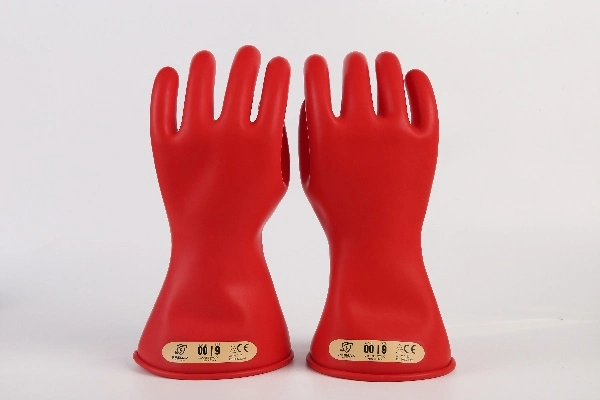
|
Parameter |
Type I (Natural Rubber) |
Type II (Synthetic/EPDM) |
|
Maximum Use Voltage |
500V AC / 750V DC |
500V AC / 750V DC |
|
Proof Test Voltage |
2,500V AC / 10,000V DC |
2,500V AC / 10,000V DC |
|
Maximum Thickness |
0.75mm (30 mils) |
0.75mm (30 mils) |
|
Length Options |
11-14 inches |
11-14 inches |
|
Color Code |
Beige Label |
Beige Label |
|
Temperature Range |
Standard |
Extended (-25°C to +55°C) |
|
UV/Ozone Resistance |
Standard |
Enhanced |
Understanding the Importance of Testing Insulating Gloves
Electrical accidents don't happen by chance; they always happen because of broken equipment, missed checks, and problems that could have been avoided. The U.S. Bureau of Labor Statistics said that 126 workers died because they were too close to electricity in 2022 alone. In most of those cases, the PPE wasn't there, wasn't working right, or wasn't checked before it was used.
Why Untested Gloves Are a Hidden Liability
Maybe insulating gloves that passed their last lab test six months ago have a small cut, an ozone crack, or a chemical stain on them now. At first glance, you can't see any of those flaws. Not only is sending a worker into a panel room with a damaged glove a safety breach, but it is also a compliance breach that can lead to OSHA citations and civil liability.
Standards That Require Pre-Use Testing
OSHA 29 CFR 1910.137, ASTM D120, and IEC 60903 all set required testing intervals and performance standards. It takes 2,500V AC to prove that Class 00 insulating gloves that are rated at 500V AC are okay. There is no choice when it comes to these standards; testing is required in order to operate legally.
The Real Cost of Skipping Inspections
Faulty insulation not only hurts people, but it also damages technology, causes unexpected downtime, and leads to fines from the government. A single arc flash can cost a building hundreds of thousands of dollars in lost work time, equipment repair, and investigations. A two-minute glove check before each shift is a small price to pay for that risk.
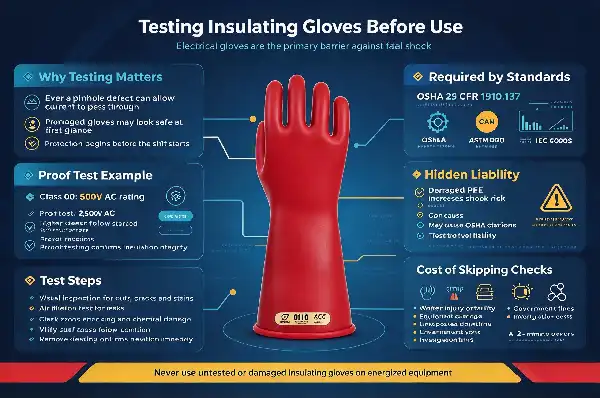
Step-by-Step Guide: How to Test Insulating Gloves Before Every Use
There are three separate steps that make up a good pre-use practice for insulating gloves. Each part finds a different kind of defect, and when put together, they cover all of the failure types that are recognized by ASTM and IEC standards.
Step 1 — Visual Inspection
Lay the glove flat in bright light and look at the whole outside, inside, collar, and finger seams. Check for cuts, scrapes, bits trapped in the material, color changes from chemicals, and ozone cracking, which shows up on natural rubber as fine surface crazing. Any flaw that can be seen should be taken out of service right away.
Step 2 — Air Inflation Test
Roll the cuff toward the fingers to trap air inside the glove. Then, hold it closed and gently squeeze. This step takes less than a minute and stops most of the mechanical damage. The glove should stay in place and not deflate. You can also slowly move the swollen glove over your cheek or the back of your hand to feel for air escaping through tiny holes that you can't see. NFPA 70E approves of this field test as a valid pre-use check. It adds about 60 seconds to the inspection process.
Step 3 — Electrical Proof Testing and Certification Verification
A proof voltage is used during regular dielectric testing, which can be done in accredited labs or by trained testers in the field. This tests the breakdown resistance. According to ASTM D120 and IEC 60903, the proof test voltage for Class 00 gloves is 2,500V AC. Check the test date stamp on the glove tag all the time. If the test date on the label is more than six months ago, the gloves should not be used again until they have been re-certified.
If you're evaluating personal protective equipment suppliers and require batch-specific testing documents before placing an order, PPE MAX is able to provide official Certificates of Analysis, professional laboratory test reports, and product samples for your verification. Feel free to contact our team at marketing@ppemax.com to discuss your sourcing needs and obtain complete documentation for your quality assessment and procurement approval.
Types and Ratings of Insulating Gloves Relevant to Testing
Knowing the names of voltage classes has a direct effect on the test settings that apply to your tools. It's just as dangerous to use insulating gloves that haven't been tested as it is to match the wrong class to the wrong job.
Voltage Class Overview
There are six levels of classification for rubber insulating gloves. Up to 500V AC and 750V DC are safe with Class 00. The range for Class 0 is up to 1,000V AC. Up to 36,000V AC is protected by Classes 1 through 4. When proof testing, the test voltage goes up or down depending on the class. For example, a worker wearing Class 00 gloves on a 480V panel is within the allowed limits, but wearing the same gloves on a 600V circuit would go over the maximum use voltage.
PPE MAX Class 00 Insulating Gloves — Product Specifications
Since 1956, PPE MAX has been making approved electrical safety items. High-quality natural rubber latex is used to make our Class 00 gloves, which meet both ASTM D120 and IEC 60903 standards. The comfortable shape makes them easy to hold on to when they're wet or dry, and the stickers that clearly show the class, size, and test date make it easy to check for compliance on the job site.
- Maximum Use Voltage: 500V AC or 750V DC is the highest voltage that can be used.
- AC Proof Test Voltage: 2,500V AC is the AC proof test voltage.
- Available Lengths: It comes in two lengths: 11 inches (280 mm) and 14 inches (360 mm).
- Sizes: 8, 9, 10, 11
- Colors: They come in red and black.
- Reference Weight: Weight as a guide: 170g per pair.
- Packing: Each pair comes in a box, and there are 20 pairs in a carton, which is 54.5 cm long, 35 cm wide, and 42.5 cm high.
The Role of Leather Protector Gloves
When using insulating gloves, they should always be worn with leather protection. The rubber insulation layer would be damaged by scratches, cuts, and other mechanical damage, but the leather shell protects against these. It is against ASTM D120 and OSHA rules to wear rubber gloves without leather protectors. This means that the voltage safety number is not valid.
Best Practices for Maintaining and Extending the Lifespan of Insulating Gloves
Being careful after each use of insulating gloves is just as important as the test itself. A glove that passed its last proof test without any obvious signs of damage can be ruined by bad storage conditions.
Storage Requirements
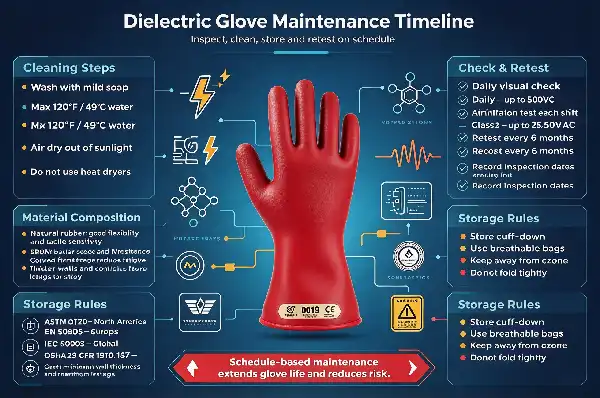
Rubber insulating gloves should be kept in a cool, dark place that is out of direct sunlight and away from chemicals that come from gasoline, bright lights, and electric motors. Keep them in a special glove bag so they don't come into contact with anything sharp. To keep the fingers from getting stress cracks at the fold places, don't fold them. Instead, roll or lay them flat.
Cleaning and Drying Procedures
Use mild soap and warm water to clean your gloves. Fully rinse and let them dry at room temperature, away from heat sources. Solvents, bleach, and cleaning products made from gasoline should never be used on rubber because they speed up the breakdown process. Once the surface is dry, look it over again for any flaws that may have shown up after cleaning and drying.
Recognizing End-of-Service Indicators
Even gloves that pass the sight and inflation tests need to be thrown away after a certain amount of time and use. Manufacturers and standards groups say to throw away gloves that have hardened on the outside, become less flexible, or have any discoloration that shows they've been exposed to chemicals, even if they still hold air. By following the manufacturer's service life guidelines, workers can avoid hidden damage that testing alone may not always pick up.
Procurement Considerations for B2B Buyers: Choosing and Buying Insulating Gloves
It takes more than comparing unit costs to find a large supply of insulating gloves. When buying something, putting price over the quality of the license causes long-term compliance and liability risks.
Verification of Certification Documentation
Before you place a large order, make sure you have all the certification paperwork you need. This includes ASTM D120 test records, IEC 60903 certificates, and CE marking for sale in Europe. With every order, PPE MAX sends you a full certification package that meets all of your audit and compliance documentation needs.
Matching Glove Class to Workforce Application
Connect each job role to the power levels that workers will be exposed to. Class 00 gloves are the right choice for telecom workers and HVAC teams working below 500V AC. A higher class is needed for people who work on distribution panels or substations above that level. When gloves don't match, there is a safety risk and a legal danger.
Bulk Ordering and Supply Chain Continuity
Blanket purchase agreements help big businesses because they lock in prices and make sure deliveries happen on time. PPE MAX ships to 134 countries and offers bulk packaging with 20 pairs per carton. Labeling and OEM requirements can be changed as needed. When there is a steady supply, there is no chance of delays on the job site due to lack of stock.
Conclusion
It's not just a routine to test rubber insulating gloves before every use; it's what keeps electrical workers alive. Visual inspection, air inflation testing, and regular dielectric proof testing are all different ways to find failure modes that the others can't find on their own. A full safety program includes strict pre-use routines as well as the right way to store, clean, and remove items. For procurement teams, the compliance loop from production to the job site is closed when they buy approved gloves from a maker with test records that can be tracked.
FAQ
1. How often must insulating gloves be electrically tested?
OSHA 29 CFR 1910.137 and ASTM D120 say that electrical proof testing for insulating gloves must be done every six months at most. No matter when the last test was, if a glove is damaged in any way or is involved in an accident, it must be taken out of service and tested again before it can be used again.
2. Which tests can be done on-site versus in a laboratory?
Both visual check and air inflation tests can be done on-site before each use, and both are acceptable. Electrical proof testing at the rated voltage—2,500V AC for Class 00—needs calibrated dielectric test equipment in the lab or the field, and it should only be done by a qualified testing facility.
3. What are the most common causes of glove failure?
Punctures from sharp objects, ozone cracking from bad storage near motors or UV sources, chemical breakdown from liquid or oil contact, and the normal aging of the rubber substance are the main reasons. Most of these are found during regular pre-use inspections, which happen before they put a person at risk.
4. Can Class 00 gloves be used on 480V panels?
Yes, PPE MAX Class 00 gloves can handle up to 500V AC, which is enough for most 480V industrial panels. But make sure you know the exact circuit voltage before choosing a glove class, and always wear leather protection over the rubber gloves.
Get Certified Insulating Gloves from PPE MAX
PPE MAX has been a trusted maker of insulating gloves since 1956, supplying certified electrical PPE to industrial buyers across 134 countries. Our Class 00 gloves meet ASTM D120 and IEC 60903 standards and are available in sizes 8 through 11 with bulk carton packaging for large procurement orders. Contact our team today for a personalized quote, OEM options, or technical documentation. Reach us at marketing@ppemax.com to begin your inquiry.
References
1. American Society for Testing and Materials. ASTM D120: Standard Specification for Rubber Insulating Gloves. ASTM International, 2020.
2. International Electrotechnical Commission. IEC 60903: Live Working — Gloves of Insulating Material. IEC, 2014.
3. Occupational Safety and Health Administration. 29 CFR 1910.137: Electrical Protective Equipment. U.S. Department of Labor, 2019.
4. National Fire Protection Association. NFPA 70E: Standard for Electrical Safety in the Workplace. NFPA, 2021.
5. U.S. Bureau of Labor Statistics. Census of Fatal Occupational Injuries Summary, 2022. BLS, 2023.
6. Neal, T. E., & Bingham, E. Electrical Safety Handbook, 4th ed. McGraw-Hill, 2010.
Learn about our latest products and discounts through SMS or email