- English
- French
- German
- Portuguese
- Spanish
- Russian
- Japanese
- Korean
- Arabic
- Greek
- German
- Turkish
- Italian
- Danish
- Romanian
- Indonesian
- Czech
- Afrikaans
- Swedish
- Polish
- Basque
- Catalan
- Esperanto
- Hindi
- Lao
- Albanian
- Amharic
- Armenian
- Azerbaijani
- Belarusian
- Bengali
- Bosnian
- Bulgarian
- Cebuano
- Chichewa
- Corsican
- Croatian
- Dutch
- Estonian
- Filipino
- Finnish
- Frisian
- Galician
- Georgian
- Gujarati
- Haitian
- Hausa
- Hawaiian
- Hebrew
- Hmong
- Hungarian
- Icelandic
- Igbo
- Javanese
- Kannada
- Kazakh
- Khmer
- Kurdish
- Kyrgyz
- Latin
- Latvian
- Lithuanian
- Luxembou..
- Macedonian
- Malagasy
- Malay
- Malayalam
- Maltese
- Maori
- Marathi
- Mongolian
- Burmese
- Nepali
- Norwegian
- Pashto
- Persian
- Punjabi
- Serbian
- Sesotho
- Sinhala
- Slovak
- Slovenian
- Somali
- Samoan
- Scots Gaelic
- Shona
- Sindhi
- Sundanese
- Swahili
- Tajik
- Tamil
- Telugu
- Thai
- Ukrainian
- Urdu
- Uzbek
- Vietnamese
- Welsh
- Xhosa
- Yiddish
- Yoruba
- Zulu
Full Mask Respirator Supplier Guide: Quality and Compliance
Founded in 1956, PPEMAX stands as a premier global manufacturer and supplier of full-range personal protective equipment. All our products comply with internationally recognized standards including IEC, ASTM, CE, UKCA, NIOSH and ISO9001. Equipped with a 2,000-square-meter modern production plant, we boast over 25 years of mature OEM & ODM capabilities to deliver one-stop customized solutions covering R&D design through worldwide logistics. Our safety gear is distributed across 134 countries globally. Upholding our core tenet “Safety First, Quality Priority”, we serve as a dependable long-term PPE partner for industrial enterprises around the world.
Understanding the need of sourcing high quality respiratory protection for your personnel is key to knowing what makes a dependable full-face respirator more than just any respirator. These modern Full -Mask Respirator protection devices cover the complete face, safeguarding the eyes, nose, and mouth, and provide a tight seal against airborne threats that half-face versions cannot achieve. When you are responsible for buying industrial safety equipment for construction sites, chemical plants, or mining operations, compliance is not simply a box to tick; it is the bedrock of worker safety and business continuity. In this article, we’ll help you understand the key differences between excellent suppliers and others so you can make educated choices and safeguard your people and your bottom line.
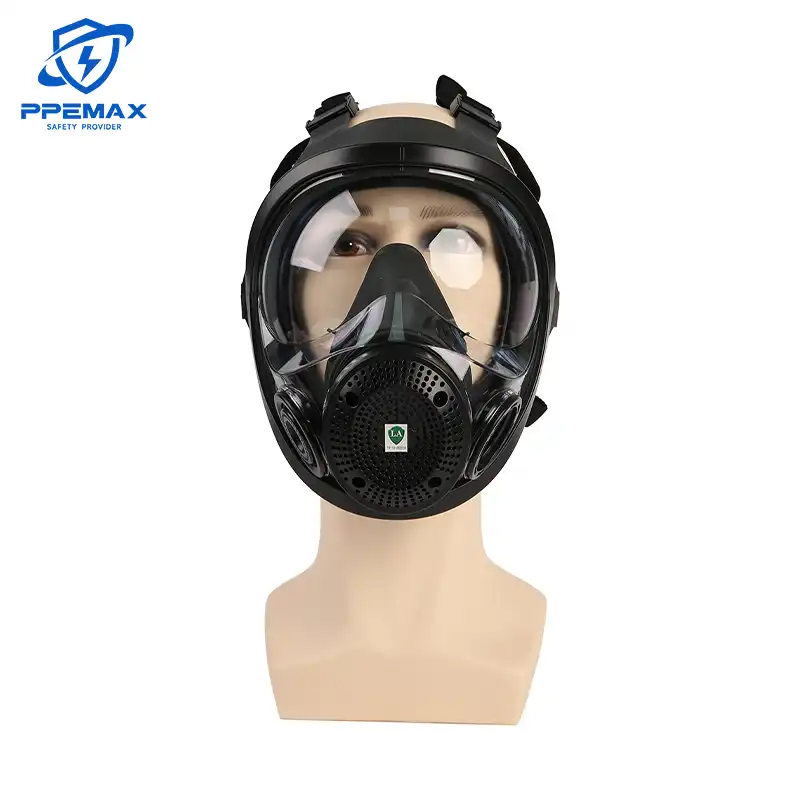
| Parameter | Specification |
|---|---|
| Product Type | Full Face Respirator Gas Mask |
| Mask Body Material | Premium Liquid Silicone (Skin-friendly & Comfort Fit) |
| Visor Material | High-transmittance Polycarbonate (Anti-impact & Anti-scratch) |
| Connection Interface | Standard 40mm NATO Thread (RD40) |
| Head Harness | 5-Point Adjustable System (Even Weight Distribution) |
| Field of Vision | Panoramic View (≥ 85%) |
| Inhalation Resistance | ≤ 30 Pa |
| Exhalation Resistance | ≤ 98 Pa |
| Total Inward Leakage | ≤ 0.05% |
| Anti-Fogging System | Integrated Independent Inner Nose Cup |
| Compatible Filters | All Standard 40mm Chemical/Particle/CBRN Filters |
| Product Weight | Approx. 450g - 500g (Without Canister) |
| Safety Compliance | EN 136 / GB2890-2009 Standards |
| Applications | Industrial Painting, Chemical Handling, Construction, Welding, Agriculture |
Understanding Full Mask Respirators: Features and Safety Standards
What Makes Full Face Respiratory Protection Different
Full-face respirators provide the best respiratory protection. They shield the eyes as well as filter the air with great efficiency. These devices establish a barrier around the forehead, cheeks, and chin that is uninterrupted and, unlike half-mask choices, does not fail to protect your eyes, so contaminants cannot enter at any exposed place. The design meets a real-world operational necessity. Workers in situations where volatile organic compounds or high-velocity particles are present need simultaneous respiratory tract and mucous membrane protection. The polycarbonate lens allows you to see clearly and provides impact resistance requirements such as ANSI Z87.1 and chemical splash protection for high-stakes work.
PPE MAX full face versions include soft medical-grade silicone face seals that conform to a variety of face shapes with no pressure points during prolonged use. This material selection is a product of 65+ years of field input. We understand that pain leads to incorrect usage, which negates the purpose of premium protection. The twin inhalation valves greatly decrease the breathing resistance compared to single-valve designs, reducing worker fatigue during physically hard shifts. A center-mounted exhalation valve easily expels humid exhaled air, along with anti-fog lens coatings for clear sightlines throughout the workday.
Critical Safety Standards You Cannot Ignore
If safety equipment meets accepted safety criteria, it is genuine. If it does not meet accepted safety standards, it is likely to be harmful. NIOSH certification (42 CFR Part 84) is the gold standard in North America, which means respirators fulfil strict filtration efficiency and breathing resistance levels. European markets need EN 136 conformity, which classifies masks into three classes based on optical quality, mechanical strength, and flame resistance. As a procurement manager for a worldwide organization, knowing these differences can save expensive delays at customs and guarantee consistent protection for your global staff.
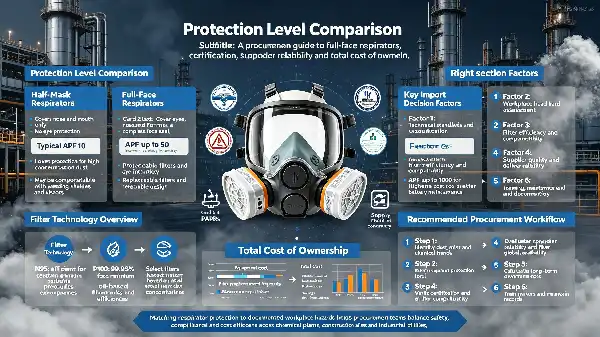
The Assigned Protection Factor (APF) tells you how much cleaner the air within the mask is compared to the outside. Quality full-face respirators are rated to an APF of 50 in negative pressure modes -- indicating that the concentration of pollutants within the mask is 50 times lower than outside. In combination with powered air-purifying respirators, this number may increase to 1000, which is appropriate for settings that approach Immediately Dangerous to Life or Health (IDLH) levels. Since OSHA rules set minimum APFs for various danger categories, this statistic becomes a critical part of your supplier evaluation process.
Filter Technology That Actually Protects
But today's filter cartridges contain tailored media that strike a compromise between high capture efficiency and breathability. P100 filters can capture 99.97% of oil and non-oil-based particles down to 0.3 microns. They do it all from welding fumes to asbestos fibres. Gas and vapour cartridges use activated carbon loaded with chemical catalysts suited for the contaminant; for example, organic vapours need different media than acid gases or ammonia. Knowing your workplace exposure profile helps you select the right mix of protection for your team without over-specifying equipment that drives up unneeded expenditures.
Professional-grade respirators include a bayonet attachment method that will change cartridges in less than ten seconds without any tools. This minimises your exposure time while changing filters. This standardised interface, often according to RD40 or EN 148-1 threading criteria, ensures compatibility with a range of filter types from recognised manufacturers. Our masks are compatible with single- and dual-cartridge setups, so you can adapt when your operational dangers change, or as your personnel travel between various job settings throughout their shifts.
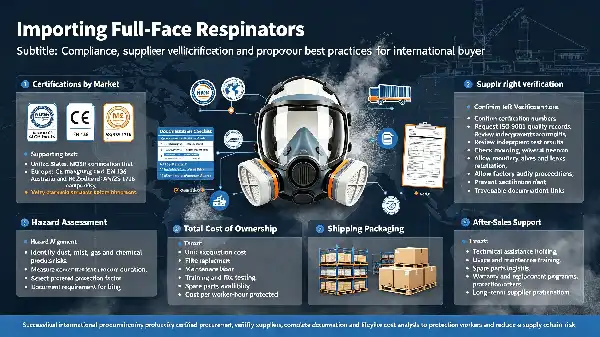
How to Choose the Right Full Mask Respirator for Your Business
Matching Protection Level to Workplace Hazards
Selecting an effective full-face respirator starts with a thorough danger evaluation. Basic dust masks do not offer the particle and organic vapour protection needed for chemical production processes using isocyanates in spray polyurethane applications. Protection factors for pharmaceutical compounding facilities that process powerful active chemicals must be measured and validated by fit testing. Mining activities are exposed to silica dust, needing P100 filtering efficiency across numerous shifts. Your procurement approach should align recognised threats with individual Full Mask Respirator protection needs, instead of relying on one-size-fits-all solutions that create gaps in coverage.
Many purchasers don't realise how important compatibility with current safety equipment is. Workers who use prescription eyeglasses require respirators with enough internal capacity and appropriately placed lenses to avoid interference. The low-profile designs avoid unpleasant touch areas and are appreciated if you need a hard hat. In noisy circumstances, integrated speech diaphragms may be required to improve voice intelligibility while preserving the face seal. Practical issues such as these impact compliance rates – equipment that workers see as incompatible with their job needs ends up placed in lockers rather than protecting anybody.
Evaluating Comfort for Real-World Compliance
We have learnt from decades of production that technical specs are meaningless if workers won't wear the equipment. “Respirator comfort is a safety performance metric, not a luxury feature, and it directly impacts compliance. The five-point adjustable harness system distributes strain uniformly over the skull and eliminates concentrated pressure areas that cause headaches during long use. Silicone elastomers are flexible across a broad temperature range, so seals are effective whether your team is working in chilled warehouses or desert construction sites.
During extended shifts, weight distribution impacts fatigue buildup. Well-designed full-face respirators place heavier elements such as filter cartridges near the center of gravity of the face to reduce the load on the neck. There are also drinking tubes that may be used to hydrate without breaking the seal. This is very important for workers in hot situations where dehydration is a secondary safety issue. We believe that respiratory protection is a function of a complex system of human factors and that optimising one aspect while disregarding the others weakens the overall safety program.
Comparing Traditional Negative Pressure vs Powered Options
Traditional negative-pressure respirators depend on the user’s own lung capacity to suck air through filtration media, generating a small vacuum within the mask with each breath. This simple, dependable method does not need batteries or outside power, so it's good for distant sites and for jobs with intermittent danger exposure. The tradeoff is breathing difficulty, which rises when filters get loaded with particles, or when numerous cartridge types are being used at the same time. For workers with respiratory issues or doing intense physical labour, increased effort to breathe may be an issue.
Powered Air-Purifying Respirators (PAPR) use a battery-powered blower to force the filtered air into the facepiece, generating a positive pressure within the mask, making breathing easy and affording greater protection factors. This technology is ideal for all-day wear or intense levels of activity. The increased complexity translates to greater upfront expenses, regular battery maintenance, and more weight from the blower unit, which is usually worn on a belt. In determining if PAPR is worth the premium, the overall cost of ownership should be considered, including increased productivity from less weariness and the ability to prolong wear duration without having to take a break because of pain.
If you're evaluating personal protective equipment suppliers and require batch-specific testing documents before placing an order, PPE MAX is able to provide official Certificates of Analysis, professional laboratory test reports, and product samples for your verification. Feel free to contact our team at marketing@ppemax.com to discuss your sourcing needs and obtain complete documentation for your quality assessment and procurement approval.
Quality Assurance and Compliance in Full Mask Respirators
Material Integrity as Your First Defense
The material of the facepiece influences the dependability of the seal and the service life in adverse environments. The use of medical-grade liquid silicone rubber (LSR) results in improved resistance to chemical penetration and suppleness throughout a temperature range of -40°C to +60°C without hardening or breaking. This is crucial in outdoor winter construction or petrochemical plants with temperature fluctuations. Lower-quality thermoplastic elastomers deteriorate more quickly and form micro-cracks that destroy the seal long before any visible damage is apparent. Certifications like EN 136 Class 1 for material testing standards prove resistance to specified chemical exposures and provide objective benchmarks independent of manufacturer claims.
The lens quality has a role in the safety and the functioning of the light. Polycarbonate lenses, designed to be impact-resistant, are capable of enduring high-velocity particle impacts without breaking, so safeguarding eyes from both chemical splashes and mechanical threats. Anti-fog coatings utilise hydrophilic surface treatments that disperse condensation into an even clear sheet instead of vision-obscuring droplets. Hard coats that resist scratching provide optical clarity for the life of the product. Rather than blanket claims of conformance, which may hide poor parts, obtain particular material requirements and third-party testing results from vendors.
Documentation That Proves Compliance
Certified paperwork for legitimate producers may be traced back to particular manufacturing batches. This includes NIOSH approval numbers, which you may cross-check immediately using the NIOSH Certified Equipment List database to remove any doubt regarding product legitimacy. The European Declaration of Conformity documentation must identify the notified body that did the testing, with the test report numbers you may check independently. We keep a detailed record of every unit that leaves our plant so customers may show due care during regulatory audits or incident investigations.
The issue of counterfeit respiratory protection in worldwide supply chains poses a real threat to unwitting customers. Fake Full - Mask Respirator items tend to imitate brands'packaging and insignia but use lower-quality materials that don't stand up to real dangerous conditions. When you source from authorised manufacturers or verified distributors with transparent supply chains, your company is shielded from the legal liabilities and human effects of non-compliant equipment. We are directly connected to the procurement departments in 134 countries, eliminating middlemen and ambiguity, and providing authorised items with complete certification documents and lot tracking from source to delivery.
Audit Rights and Supplier Transparency
Progressive procurement agreements include facility audits and quality system verification. For suppliers devoted to real quality, these inspections are a chance to show their production rigour. When customers visit our Xi’an production site, they get to see our quality control checkpoints, from inspecting incoming raw materials to pressure-decay leak testing on each finished mask. This openness gives you assurance that your supplier has consistent standards and isn't only reaching specification during certification testing and then letting production quality slide.
Traceability systems must be able to identify every part of a unit – which batch of silicone compound, which run of lenses, which batch of filter cartridges. This kind of monitoring is critical in the event of a fault or if a certain lot of manufacturing has to be recalled. We provide serialisation and batch coding, linking production records to specific goods. We provide the documentation infrastructure for real quality monitoring, not just the paperwork theatre for the casual inspection.
Leading Full Mask Respirator Brands and Supplier Profiles
Established Industry Leaders and Their Strengths
Decades of invention and field validation have earned major brands of respiratory protection, such as 3M, Honeywell, and MSA, their place in the market. Their products find use in many industrial applications across the globe and are supported by extensive technical assistance and a plentiful supply of spare parts. Manufacturers spend a lot of money on research and are always improving the materials and designs as new dangers present themselves, and they get feedback from their users. The high price is not just for the medicine but also for the worldwide distribution network, technical knowledge, and government connections that help get the drug approved in other countries.
But the known brands may not always meet the need for each purchase. Long lead times may be associated with big volume orders or specialised setups. Minimum order numbers may surpass the realistic demands of mid-sized enterprises. The price includes marketing cost and brand premium, which, while acceptable in certain situations, may not be appropriate for tight safety budgets. It takes knowing your risk profile and support requirements to differentiate between a true operational necessity for brand name awareness and when it's just adding expense.
How PPE MAX Delivers Manufacturer-Direct Value
As the manufacturer and direct supplier since 1956, we remove the markup layers wholesalers bring to your procurement prices. As the biggest manufacturer of PPE in Northwest China, we are able to benefit from economies of scale and provide very low prices without sacrificing quality. Our approved equipment is manufactured on the same manufacturing lines that fulfill OEM orders for global companies, so you have access to the same technological capabilities at transparent prices. That dual competency means we understand the production needs that provide quality and the procurement issues you confront when balancing protection, compliance, and budget restrictions.
Our engineering team is right in your procurement process to provide you with the technical knowledge. You get to talk with the folks that create and test the technology, instead of sales reps reading off spec sheets. Such a level of knowledge may be helpful in trying to match respirator features to more subtle needs in the workplace that are not described by typical catalogue descriptions. Custom configurations – whether they are specialised filter combinations, branded packaging for distributor customers, or customised harness systems for particular applications – exploit our manufacturing flexibility without the exorbitant minimum numbers that large companies usually need.
Building Reliable Long-Term Supplier Relationships
The most cost-efficient respiratory protection program is much more than the original purchase price and includes total ownership expenses, preventing downtime and ensuring continuity of supply. Reliability of suppliers and availability of products to avoid operational interruption of back orders of safety equipment that might cause work stoppages. We manage our inventory to let you buy just in time and yet have strategic reserves to shield you from supply chain interruptions. This balance has been honed over six decades of servicing customers in 134 countries with a diversity of logistical issues.
After-sales assistance converts a transactional purchase into a strategic relationship. We provide training programs to teach your safety managers the correct fitting methods, maintenance needs, and regulatory compliance duties. When difficulties emerge, competent personnel on technical support hotlines handle field problems swiftly, reducing downtime. Replacement parts, including lenses, valve assemblies, and harness components, are available and prolong equipment life and reduce total cost of ownership. These service elements often matter more than initial price when evaluating long-term supplier value.
Maintaining and Optimizing Full Mask Respirator Performance
Cleaning Protocols That Preserve Equipment Integrity
Proper cleaning extends respirator service life while preventing cross-contamination between users or shifts. The cleaning agent selection matters—harsh solvents can degrade silicone and elastomeric components, creating surface damage that compromises the facial seal. We recommend mild detergents or specialized respirator cleaning solutions that remove organic residues without attacking material integrity. Warm water between 40-50°C provides effective cleaning without thermal stress that accelerates material aging. The cleaning process should include complete disassembly of removable components, allowing thorough cleaning of valve seats and breathing channels where contaminant residues accumulate.
Disinfection protocols become critical in shared-equipment environments where multiple workers use the same masks across different shifts. EPA-registered disinfectants appropriate for medical equipment kill pathogens without material damage, though contact time and concentration require strict adherence to product instructions. After chemical cleaning, thorough rinsing removes all disinfectant residues that might cause skin irritation or respiratory sensitization during subsequent use. Air drying in clean environments prevents recontamination, with storage occurring only after complete moisture evaporation to prevent microbial growth in valve assemblies.
Filter Management Best Practices
There are no set calendar replacement schedules for filter cartridges; the time period for replacement depends on the kind and concentration of contamination and the length of time the filter is used. The particulate filters have noticeable loading via increased breathing difficulty and obvious discolouration, giving unambiguous signs for maintenance. Gas and vapour cartridges are more difficult. Activated carbon saturates with no visual cues, and the breakthrough point at which impurities flow through the used media might occur without notice. Change schedules based on data from worksite monitoring, working out service life from known contaminant concentrations and cartridge capacity specs, not guessing based on looks.
The shelf life of unused filters is substantially affected by storage circumstances. Sealed cartridges in their original packaging will last for years under regulated circumstances. If exposed to humidity and severe temperatures, cartridges will lose capacity before use. Once respirators are used, even empty cartridges start absorbing ambient pollutants and moisture, reducing service life compared to spares that are kept. We urge that cartridge history be traced via equipment logs, and installation dates should be documented, thereby building accountability measures that prevent prolonged usage beyond acceptable service limitations.
Fit Testing as Ongoing Quality Control
Quantitative fit testing provides objective information on the adequacy of protection by measuring actual seal performance rather than the user's impression. During specified workout routines that mimic real-world movement and breathing patterns, specialised devices compare the particle concentrations inside and outside the mask throughout the testing procedure. The minimum fit factor of at least 500 for complete facepieces (and other respirator types) under OSHA regulations indicates the seal integrity needed for the equipment's assigned protection factor. Testing each year detects seal difficulties caused by the face changing from weight fluctuations, dental procedures, or scars that might affect a previously good fit.
User training promotes correct donning techniques and seal checks that workers complete prior to each use. Negative and positive pressure tests – inhalation with filters occluded to confirm the facepiece compresses somewhat, exhalation with the exhalation valve occluded to confirm no leakage — take just seconds but detect an improperly seated or damaged component before exposure to a threat. We give training materials and methods that your safety team may use internally to improve respiratory protection competence instead of create dependent on outside consultants for everyday compliance operations.
Conclusion
When you're choosing a provider of Full Mask Respirator protection, it's not about the lowest price; it's about the value the supplier brings to the table. That includes the realness of the certifications, the openness of the production process, the level of technical assistance, and the commitment to a long-term collaboration. Full-face respirators are high-quality safety gear that safeguard your employees and help you meet regulations in a wide range of industrial settings. Properly designed and maintained respiratory protection is an investment that reduces both the immediate dangers of hazardous exposure and the long-term expenses of occupational sickness. Procurement managers establish robust safety plans by selecting suppliers with demonstrable manufacturing expertise, full certification documents, and real after-sales service, protecting the workers and the company's interests.
FAQ
1. How do I verify NIOSH certification authenticity?
Access the NIOSH Certified Equipment List database directly at the CDC website, where you can search by approval number, manufacturer name, or product model. Legitimate certifications include a TC-approval number formatted as "TC-84A-XXXX" printed on both the product and packaging. Cross-reference this number with database entries to confirm authenticity. Counterfeit products often display fabricated approval numbers that don't appear in official records or use expired certifications from discontinued models.
2. What's the difference between reusable and disposable full-face respirators?
Reusable models feature replaceable filter cartridges and durable facepiece construction designed for hundreds of uses with proper maintenance. The higher initial cost is distributed across the extended service life, making them economical for regular use. Disposable units integrate non-replaceable filters with the facepiece, intended for single use or limited duration. These suit emergency response applications or short-term projects where maintenance infrastructure isn't practical. Calculate total cost based on expected usage frequency and duration.
3. Can workers wear prescription glasses with full-face respirators?
Standard eyeglasses usually interfere with the facial seal, creating dangerous leakage paths. Approved solutions include spectacle kits that mount prescription lenses inside the respirator without breaking the seal, or contact lenses worn under the mask. Some workers adapt successfully to contacts specifically for respirator use even if they typically prefer glasses. Never compromise seal integrity to accommodate eyewear—the resulting leakage negates the respirator's protective function.
Partner with PPE MAX for Certified Full Mask Respirator Solutions
PPE MAX delivers comprehensive respiratory protection backed by 65 years of manufacturing excellence and global compliance expertise. Our NIOSH and EN 136 certified full-face respirators provide the quality and reliability your workforce deserves, manufactured in our state-of-the-art Xi'an facility and shipped to 134 countries worldwide. As a trusted Full Mask Respirator manufacturer, we offer competitive pricing, extensive customization options, and technical support that transforms procurement from a transactional exercise into a strategic safety partnership. Contact our team at marketing@ppemax.com to discuss your specific requirements, request product samples, or schedule a facility tour that demonstrates our commitment to quality and transparency.
References
1. National Institute for Occupational Safety and Health. (2019). "Respiratory Protection Program Guidelines and Best Practices." NIOSH Publication No. 2019-145.
2. Occupational Safety and Health Administration. (2020). "Respiratory Protection Standards: 29 CFR 1910.134 Compliance Guide for Industrial Applications."
3. European Committee for Standardization. (2018). "EN 136:1998 Respiratory Protective Devices - Full Face Masks - Requirements, Testing, Marking."
4. American National Standards Institute. (2021). "ANSI Z88.2 Respiratory Protection - Minimum Performance and Use Requirements."
5. International Safety Equipment Association. (2022). "Global Respiratory Protection Market Analysis: Quality Benchmarks and Procurement Best Practices."
6. Industrial Hygiene Association. (2023). "Fit Testing Protocols and Filter Selection Criteria for Full Facepiece Respirators in Hazardous Environments."
Learn about our latest products and discounts through SMS or email