- English
- French
- German
- Portuguese
- Spanish
- Russian
- Japanese
- Korean
- Arabic
- Greek
- German
- Turkish
- Italian
- Danish
- Romanian
- Indonesian
- Czech
- Afrikaans
- Swedish
- Polish
- Basque
- Catalan
- Esperanto
- Hindi
- Lao
- Albanian
- Amharic
- Armenian
- Azerbaijani
- Belarusian
- Bengali
- Bosnian
- Bulgarian
- Cebuano
- Chichewa
- Corsican
- Croatian
- Dutch
- Estonian
- Filipino
- Finnish
- Frisian
- Galician
- Georgian
- Gujarati
- Haitian
- Hausa
- Hawaiian
- Hebrew
- Hmong
- Hungarian
- Icelandic
- Igbo
- Javanese
- Kannada
- Kazakh
- Khmer
- Kurdish
- Kyrgyz
- Latin
- Latvian
- Lithuanian
- Luxembou..
- Macedonian
- Malagasy
- Malay
- Malayalam
- Maltese
- Maori
- Marathi
- Mongolian
- Burmese
- Nepali
- Norwegian
- Pashto
- Persian
- Punjabi
- Serbian
- Sesotho
- Sinhala
- Slovak
- Slovenian
- Somali
- Samoan
- Scots Gaelic
- Shona
- Sindhi
- Sundanese
- Swahili
- Tajik
- Tamil
- Telugu
- Thai
- Ukrainian
- Urdu
- Uzbek
- Vietnamese
- Welsh
- Xhosa
- Yiddish
- Yoruba
- Zulu
Why Use a Full Mask Respirator in Dusty Workplaces?
Founded in 1956, PPEMAX stands as a premier global manufacturer and supplier of full-range personal protective equipment. All our products comply with internationally recognized standards including IEC, ASTM, CE, UKCA, NIOSH and ISO9001. Equipped with a 2,000-square-meter modern production plant, we boast over 25 years of mature OEM & ODM capabilities to deliver one-stop customized solutions covering R&D design through worldwide logistics. Our safety gear is distributed across 134 countries globally. Upholding our core tenet “Safety First, Quality Priority”, we serve as a dependable long-term PPE partner for industrial enterprises around the world.
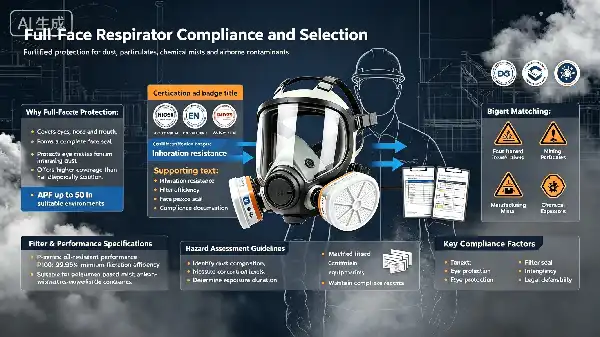
Dust in the workplace is a significant respiratory threat and requires robust protective solutions. The best option is a full-face respirator, which fits over your full face, eyes, nose, and mouth, and forms a complete seal against airborne toxins. These devices provide excellent filtration with high-efficiency particulate filters and protection of the eye tissues from irritating dust particles, which is not the case with half-mask solutions or disposable alternatives. With wide coverage and Assigned Protection Factors (APF) of up to 50, these Full Mask Respirator systems are a must in environments such as construction sites, mining, and manufacturing plants with dust levels above acceptable exposure limits.

| Material | Silicone、PC |
| Features | Never fog technology, impact resistant, anti scratch |
| Head Belt | 4 points soft silicone |
| Weight | 0.485KG(Face mask) |
| Connector | Dual bayonet |
| Size | M,L |
| Certified | CE EN: 136: 1998 |
Regulatory Compliance and Safety Standards
Procurement decisions for respiratory protection must align with jurisdictional regulations and internationally recognized standards for full-face respirators. These frameworks establish minimum performance criteria that protect workers while providing legal defensibility for employers.
NIOSH Certification Requirements
The National Institute for Occupational Safety and Health establishes rigorous testing protocols under 42 CFR Part 84. Certified devices undergo evaluation for inhalation resistance, exhalation resistance, filter efficiency, and facepiece seal integrity. Our full-coverage respirators meet these demanding requirements, carrying official NIOSH approval that validates their protective capabilities.
Procurement managers benefit from selecting NIOSH-approved equipment because it simplifies compliance documentation and reduces liability exposure. Regulatory inspections consistently verify that employers provide appropriate protection levels; using certified equipment demonstrates due diligence in workforce safety management.
European and International Standards
Beyond North American markets, different regulatory frameworks govern respiratory protection. The EN 136 standard classifies full-face masks into three classes based on construction materials and operational capabilities. Our products meet Class 1 specifications, indicating suitability for demanding industrial applications, including chemical exposure scenarios.
We maintain certifications across multiple jurisdictions—including AS/NZS 1716 for Australia and New Zealand—enabling seamless deployment across international operations. This multi-standard compliance proves particularly valuable for multinational corporations managing safety programs across diverse regulatory environments. Supply chain managers appreciate working with manufacturers who understand these varied requirements and maintain consistent quality standards regardless of destination market.
Filter Classification and Hazard Matching
Effective respiratory protection requires matching filter capabilities to workplace contaminants. P-series filters provide oil-resistant performance suitable for environments containing petroleum-based mists alongside particulates. The P100 designation indicates 99.97% minimum filtration efficiency against all particulate sizes.
Our technical support team assists buyers in conducting thorough hazard assessments. We evaluate workplace conditions—including dust composition, concentration levels, and exposure duration—to recommend appropriate filter configurations. This consultative approach ensures that purchased equipment delivers actual protection rather than merely meeting minimum compliance thresholds.
Comparing Respiratory Protection Options
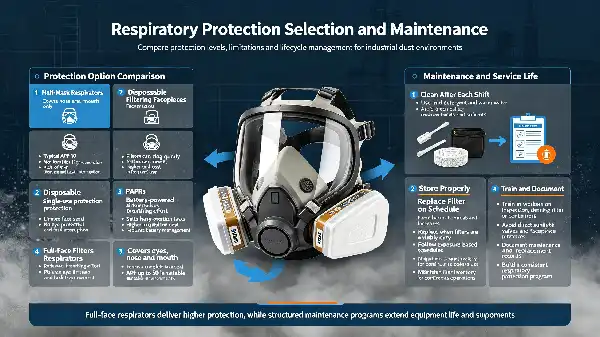
Industrial safety managers face multiple equipment choices when addressing dust hazards. Understanding the trade-offs between different protection levels guides optimal selection decisions.
Half-Mask Respirators: Limitations in Dusty Conditions
Half-mask designs cover the nose and mouth while leaving eyes unprotected. These devices achieve lower Assigned Protection Factors—typically APF 10—making them unsuitable for high-concentration dust environments. Workers in grinding operations, sandblasting, or demolition activities require the enhanced protection that only full-face coverage provides.
The absence of eye protection represents a significant operational gap. Dust particles contacting the eyes cause immediate discomfort, forcing workers to interrupt tasks for eye rinsing. This productivity loss compounds with the health risks associated with corneal abrasion and potential chemical conjunctivitis when dust contains reactive substances.
Disposable Filtering Facepieces: Cost Versus Performance
Disposable N95 or P100 filtering facepieces offer convenient single-use protection. However, these devices present challenges in truly dusty workplaces. The lack of a robust seal, combined with the absence of eye protection, limits their effectiveness. Heavy dust loading quickly clogs disposable media, increasing breathing resistance and reducing filter efficiency before the end of a work shift.
While per-unit costs appear attractive, the total cost of ownership favors reusable full-face respirators. Our devices accept replaceable filters, extending service life significantly while maintaining consistent protection levels. Procurement managers overseeing large workforces realize substantial savings through reusable equipment programs, particularly when operating in high-dust environments requiring frequent filter changes.
Powered Air-Purifying Respirators: Specialized Applications
PAPRs utilize battery-powered blowers to force air through filters, creating positive pressure inside the facepiece. This design reduces breathing effort—beneficial for workers with respiratory limitations or those performing high-exertion tasks. However, PAPRs introduce complexity through battery management, increased weight, and significantly higher acquisition costs.
The operational profile determines whether PAPR investment proves worthwhile. Continuous heavy-exertion activities in extreme dust conditions may justify the added expense. Standard industrial applications typically achieve excellent results with properly fitted negative-pressure full-face respirators, delivering protection at more favorable economics.
If you're evaluating personal protective equipment suppliers and require batch-specific testing documents before placing an order, PPE MAX is able to provide official Certificates of Analysis, professional laboratory test reports, and product samples for your verification. Feel free to contact our team at marketing@ppemax.com to discuss your sourcing needs and obtain complete documentation for your quality assessment and procurement approval.
Maintenance Protocols and Service Life Management
Full -Mask Respirator protection equipment needs a regular maintenance program to maintain its protective efficiency. Procurement choices should reflect not just purchase expenses, but also total cost of ownership, such as consumables, maintenance labour, and service support.
Cleaning and Sanitization Procedures
Our respirators have smooth surfaces that are simple to clean from use to use. We propose thorough cleaning after each shift with mild detergent solutions and warm water. Avoid aggressive chemicals or solvents that will deteriorate silicone parts or harm polycarbonate lenses.
Centralised cleaning facilities may be suitable for big worksites. Designated areas with suitable cleaning products, soft brushes, and sanitising tools for consistent hygiene standards. This method allows avoiding the hazards of cross-contamination and increasing the life of the equipment with the right maintenance.
Filter Replacement Scheduling
The cartridge filter requires replacement when the breathing resistance increases, when the cartridge is visibly dirty, as part of a predetermined schedule, or on the basis of a particular exposure event. We provide you with explicit recommendations for replacement, based on a variety of operating conditions and degrees of dust exposure.
Procurement managers need to have inventory systems that ensure filter availability in accordance with consumption rates. Our worldwide supply chain (134 countries) ensures availability of replacement filters and no interruptions in operations due to supply shortages. We have adjustable ordering amounts to fit small-sized companies and big organisations with hundreds of workers needing respiratory protection.
Storage and Inspection Requirements
Storing a respirator properly while it is not in use helps prevent contamination, damage, or deterioration of the respirator. Cleaned respirators should be kept in tight bags or containers, out of direct sunlight and away from extremes of temperature. Regular checks should ensure strap integrity, valve performance, and facepiece condition.
Training programs are vital for good maintenance. We give full details, including how to check, clean, and replace the filters. These teaching tools provide safety coordinators with the information they need to develop strong respiratory protection programs that ensure equipment performs for the whole length of its service life.
Selecting the Right Full-Face Respiratory Protection
Good procurement starts with an awareness of the dangers in the workplace and matching the equipment’s capabilities to the needs of the operation. Selection options for industrial respiratory protection programs are influenced by many aspects.
Workplace Hazard Assessment
Hazard assessment includes identification of kinds of contaminants, levels of concentration, and exposure. Characterisation of dust should include: Particle size distribution, chemical content, and potential synergistic risks. Protection against silica dust should be stricter than protection against nuisance dusts. Metal particles may cause toxicity issues beyond simple irritation of the respiratory tract.
“Our technical team says: ‘We work with buyers to assess the conditions of the workplace and advise on the level of protection needed.’ We look at Material Safety Data Sheets, assess exposure statistics, and look at operational issues such as how long the activity is and how physically demanding the task is. This consulting strategy guarantees that the equipment chosen will perform under real working conditions, not theoretical criteria.
Fit and Compatibility Considerations
The individual face measurements of workers vary widely among populations. Adjustable parts and different sizes in quality respirators allow for this variety. The 5-point strap system offers accurate fitting adjustments, providing efficient sealing across varied face shapes.
Compatibility with other personal protection equipment should be carefully evaluated. Workers using prescription glasses require particular accommodation, and we provide versions with inside spectacle frames that protect seal integrity while delivering vision correction. In complicated industrial situations, equipment selection must account for hard hat compatibility, hearing protection integration, and welding shield synchronisation.
Supplier Reliability and Support Infrastructure
Respiratory protection is an essential safety system, and product quality and supply continuity affect worker welfare. Established manufacturers with a track record give more confidence than unknown vendors with tempting prices.
PPE MAX is supported by over 65 years of manufacturing expertise in what we provide. Our plant in Xi’an, China, works under strict quality control methods to ensure consistent product performance. We have contacts with industrial safety distributors, PPE wholesalers, and direct buyers in 134 countries and a proven track record of supporting worldwide companies with dependable product availability and technical competence.
Our wide product range offers the possibility of customisation to unique operating needs. We provide OEM and ODM manufacturing partnerships for companies that require branded solutions or custom setups. That flexibility is essential to major organisations standardising equipment across many locations or to distributors establishing complete safety product portfolios.
Conclusion
Full-mask respirator protection is the best protection against dust risks in industrial environments. The full coverage, higher filtration efficiency, and integrated eye protection satisfy essential safety criteria that partial-face versions can’t. The purchase price is more than for simpler alternatives, but the whole value offer, including better protection, longer service life, compliance with regulations, and decreased health risks, strongly favours quality full-coverage respirators.
PPE MAX is ready to meet your respiratory protection needs with reliable products from decades of manufacturing expertise. Our relentless standards of quality and innovation are driven by our dedication to worker safety – the most precious asset you have – your workers.
FAQ
1. How long do full-face respirator filters last in dusty conditions?
Filter service life depends on dust concentration, particle characteristics, and usage patterns. Light dust exposure may allow filters to remain effective for weeks, while heavy concentrations require replacement within days or even shifts. Monitor breathing resistance and follow time-based replacement schedules appropriate to your specific environment.
2. Can workers wear prescription glasses with full-face respirators?
Standard prescription eyeglasses typically prevent proper seal formation. Our respirators accommodate vision correction through internal spectacle frame systems designed specifically to maintain seal integrity. These specialized inserts hold corrective lenses without compromising facial seal effectiveness, ensuring both clear vision and reliable protection.
3. What training do workers need before using these respirators?
Comprehensive training should cover proper donning and doffing procedures, seal-checking techniques, filter replacement protocols, cleaning requirements, and limitation awareness. Workers must understand when respiratory protection is required and recognize conditions indicating equipment failure. We provide detailed training resources supporting effective respiratory protection program implementation.
Partner with PPE MAX for Your Full Mask Respirator Needs
Your workforce deserves protection backed by proven expertise and unwavering quality standards. PPE MAX has manufactured respiratory protection equipment since 1956, earning trust across mining, construction, manufacturing, and energy sectors worldwide. Our full-face respirators deliver the comprehensive protection your dusty workplace demands, supported by NIOSH, EN 136, and AS/NZS 1716 certifications.
As a leading full-face respirator manufacturer, we offer customization capabilities, flexible order volumes, and reliable global shipping to 134 countries. Our technical support team provides expert guidance on Full Mask Respirator product selection, fit testing protocols, and maintenance programs. We welcome inquiries from industrial safety distributors, PPE wholesalers, and direct purchasers seeking dependable respiratory protection solutions.
Contact our team today at marketing@ppemax.com to discuss your specific requirements. We'll help you implement respiratory protection programs that safeguard your workers while meeting regulatory obligations and operational demands.
References
1. National Institute for Occupational Safety and Health. (2018). NIOSH Guide to the Selection and Use of Particulate Respirators. DHHS Publication No. 96-101.
2. Occupational Safety and Health Administration. (2020). Respiratory Protection Standard 29 CFR 1910.134: Compliance Guidelines for Industrial Applications.
3. European Committee for Standardization. (2019). EN 136:1998 Respiratory Protective Devices - Full Face Masks - Requirements, Testing, Marking.
4. American National Standards Institute. (2015). ANSI Z88.2 Respiratory Protection Standard: Practices and Procedures for Industrial Environments.
5. International Labour Organization. (2017). Guidelines on Occupational Safety and Health Management Systems: Respiratory Hazard Control in Dusty Workplaces.
6. Colton, C.E., & Brosseau, L.M. (2016). Assigned Protection Factors and Respirator Performance in Industrial Settings. Journal of Occupational and Environmental Hygiene, 13(8), 567-581.
Learn about our latest products and discounts through SMS or email