- English
- French
- German
- Portuguese
- Spanish
- Russian
- Japanese
- Korean
- Arabic
- Greek
- German
- Turkish
- Italian
- Danish
- Romanian
- Indonesian
- Czech
- Afrikaans
- Swedish
- Polish
- Basque
- Catalan
- Esperanto
- Hindi
- Lao
- Albanian
- Amharic
- Armenian
- Azerbaijani
- Belarusian
- Bengali
- Bosnian
- Bulgarian
- Cebuano
- Chichewa
- Corsican
- Croatian
- Dutch
- Estonian
- Filipino
- Finnish
- Frisian
- Galician
- Georgian
- Gujarati
- Haitian
- Hausa
- Hawaiian
- Hebrew
- Hmong
- Hungarian
- Icelandic
- Igbo
- Javanese
- Kannada
- Kazakh
- Khmer
- Kurdish
- Kyrgyz
- Latin
- Latvian
- Lithuanian
- Luxembou..
- Macedonian
- Malagasy
- Malay
- Malayalam
- Maltese
- Maori
- Marathi
- Mongolian
- Burmese
- Nepali
- Norwegian
- Pashto
- Persian
- Punjabi
- Serbian
- Sesotho
- Sinhala
- Slovak
- Slovenian
- Somali
- Samoan
- Scots Gaelic
- Shona
- Sindhi
- Sundanese
- Swahili
- Tajik
- Tamil
- Telugu
- Thai
- Ukrainian
- Urdu
- Uzbek
- Vietnamese
- Welsh
- Xhosa
- Yiddish
- Yoruba
- Zulu
Full Mask Respirator Standards: What Buyers Must Check
Founded in 1956, PPEMAX stands as a premier global manufacturer and supplier of full-range personal protective equipment. All our products comply with internationally recognized standards including IEC, ASTM, CE, UKCA, NIOSH and ISO9001. Equipped with a 2,000-square-meter modern production plant, we boast over 25 years of mature OEM & ODM capabilities to deliver one-stop customized solutions covering R&D design through worldwide logistics. Our safety gear is distributed across 134 countries globally. Upholding our core tenet “Safety First, Quality Priority”, we serve as a dependable long-term PPE partner for industrial enterprises around the world.
When procuring respiratory protective equipment, understanding compliance benchmarks is non-negotiable. Full Mask Respirator standards establish the technical, performance, and safety criteria that separate effective protection from potential workplace hazards. Governed by organizations like NIOSH, EN regulatory bodies, and OSHA, these standards ensure equipment meets minimum thresholds for filter efficiency, seal integrity, and material durability. For procurement professionals managing large workforces across construction, chemical manufacturing, or mining operations, selecting certified respiratory protection directly impacts both legal compliance and worker safety outcomes. Grasping these regulatory frameworks empowers buyers to evaluate suppliers confidently and secure equipment that delivers reliable, long-term protection in demanding industrial environments.
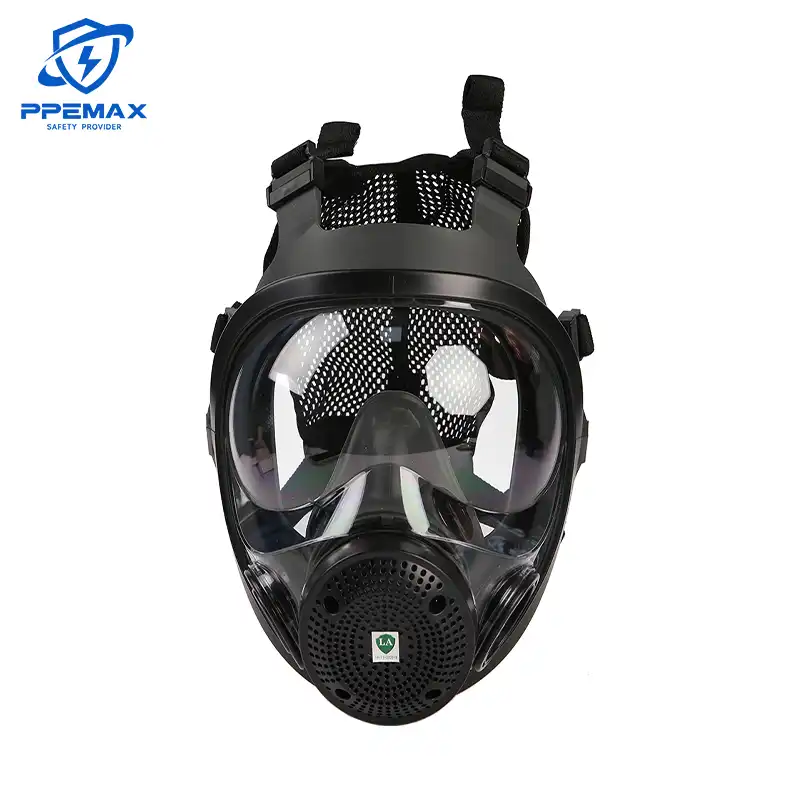
| Parameter | Specification |
|---|---|
| Product Type | Full Face Respirator Gas Mask |
| Mask Body Material | Premium Liquid Silicone (Skin-friendly & Comfort Fit) |
| Visor Material | High-transmittance Polycarbonate (Anti-impact & Anti-scratch) |
| Connection Interface | Standard 40mm NATO Thread (RD40) |
| Head Harness | 5-Point Adjustable System (Even Weight Distribution) |
| Field of Vision | Panoramic View (≥ 85%) |
| Inhalation Resistance | ≤ 30 Pa |
| Exhalation Resistance | ≤ 98 Pa |
| Total Inward Leakage | ≤ 0.05% |
| Anti-Fogging System | Integrated Independent Inner Nose Cup |
| Compatible Filters | All Standard 40mm Chemical/Particle/CBRN Filters |
| Product Weight | Approx. 450g - 500g (Without Canister) |
| Safety Compliance | EN 136 / GB2890-2009 Standards |
| Applications | Industrial Painting, Chemical Handling, Construction, Welding, Agriculture |
Understanding Full Mask Respirator Standards: A Comprehensive Overview
There are rules about breathing protection in place to keep workers from getting sick on the job and to make sure that all businesses follow the same safety standards. These standards tell makers how to test, approve, and keep track of their equipment's safety features.
Why Standards Matter for B2B Procurement
Industrial buyers have to protect workers and keep an eye on legal risk at the same time. Standards are the minimum requirements that say if a mask can officially be used in certain dangerous places. If organizations don't get verified compliance, they risk fines from regulators, more liability, and worsened worker health. If procurement teams know about these measures, they can tell the difference between fake certifications and real, tested performance.
Major Regulatory Bodies and Their Jurisdictions
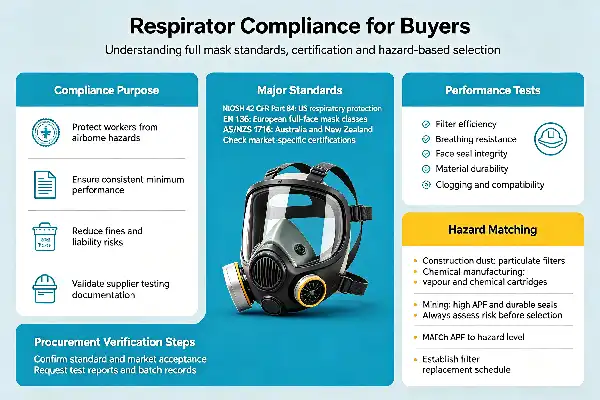
In different areas, certification standards are different. In the US, NIOSH 42 CFR Part 84 sets the rules for respiratory protection and includes testing procedures for particulate filtration and breathing resistance. European markets follow EN 136, which divides face masks into three performance classes based on how well they block light and how well they seal against entry. Australia and New Zealand use the AS/NZS 1716 standard, but many developing markets use "hybrid" models that are based on more than one international standard. When a buyer does business in more than one jurisdiction, they need to make sure that their suppliers have the right certifications for each market.
The Relationship Between Standards and Workplace Hazard Assessment
Finding the right breathing protection starts with figuring out what the danger is. Protection factors, which are numbers that show how much the equipment reduces contaminants, are given by standards. A full-face respirator with an APF of 50 lowers the amount of airborne contaminants that a person breathes in by a factor of 50. This means that the person is breathing in only 1/50th of the atmospheric quantity. Different dangers in the workplace need different APF rates, and standards set the testing methods that prove these claims. Chemical exposure, particulate contamination, and vapor hazards all need different types of filters and performance levels that are set by certification frameworks.
Key Technical Standards and Certification Requirements to Check
Professionals in charge of buying things need to check certain technical factors that tell them if respiratory equipment meets safety standards for the workplace. These parameters include more than just approval stamps; they also include specific measures of success.
NIOSH 42 CFR Part 84 Compliance
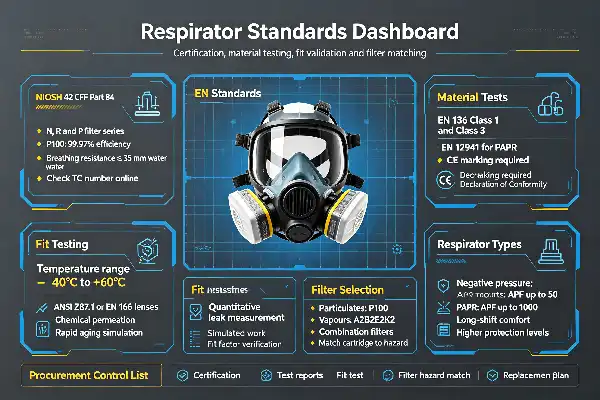
This US standard sets up nine groups of particulate filters (N95, N99, N100, R95, R99, R100, P95, P99, and P100) based on how well they screen and how quickly they break down. P100 filters get rid of 99.97% of airborne particles, which is the highest level of particulate filtration. Buyers should ask for test results that show the product meets the requirements for breathing resistance—inhalation resistance cannot be higher than 35 mm of water column pressure. The NIOSH Certified Equipment List database can be used to check the TC number (Testing and Certification) that is printed on NIOSH-approved equipment.
EN 136 and EN 12941 Standards
There are different levels of performance for respiratory protection in Europe. EN 136 Class 1 is the highest level of protection, and it has strict rules about how lenses must be able to resist impact, fire, and breathing. Class 3 has less security and is better for uses that don't need as much. EN 12941 sets specific requirements for powered air-purifying respirators, including how much air they can move and how well their batteries must work. Teams in charge of buying things should make sure that sellers give them Declaration of Conformity papers and CE markings that list specific standard numbers.
Material Properties and Durability Testing
Standards require testing for more than just filter effectiveness. They also require testing for material decay, temperature resistance, and chemical permeation. As the temperature goes from -40°C to +60°C, medical-grade rubber face seals must stay flexible. Impact resistance for polycarbonate glasses must meet ANSI Z87.1 or EN 166 standards. Face masks made by PPE MAX go through rapid aging tests that are meant to mimic years of use in the field. This makes sure that the soft silicone seals and wide-view anti-fog lenses keep their protective qualities over a longer period of time.
Fit Testing and Seal Validation
Even approved equipment doesn't work if it's not put together right. According to the standards, the fit must be tested quantitatively to see how much leakage there is around the face seal while work movements are simulated. The fit factor, which is the ratio of atmospheric contaminant to in-mask contaminant, needs to be below certain levels. Buyers should make sure that providers offer fit testing methods and that the mask design can fit people with different-sized faces by using 5- or 6-point harness systems that can be adjusted.
If you're evaluating personal protective equipment suppliers and require batch-specific testing documents before placing an order, PPE MAX is able to provide official Certificates of Analysis, professional laboratory test reports, and product samples for your verification. Feel free to contact our team at marketing@ppemax.com to discuss your sourcing needs and obtain complete documentation for your quality assessment and procurement approval.
Full Mask Respirator Types and Their Certified Use Cases
For different business uses, different types of breathing protection are needed. Knowing these differences helps buyers match equipment to specific hazards in the workplace and make sure that certifications are aligned.
Negative Pressure vs. Powered Air-Purifying Systems
Standard negative pressure respirators work by drawing air through filters when the user breathes in. They usually have an APF rating of 50. These methods are good for jobs where workers' endurance isn't affected by breathing resistance. Powerful air-purifying full-face respirators (PAPR) have battery-powered blowers that force clean air into the face mask. This can achieve APF ratings of up to 1000 while making breathing easier. PAPR systems are very important in places where people have to wear them for long periods of time or who have trouble breathing.
Filter Classification and Hazard Matching
Filters are put into groups based on the type of protection they offer. Solid and liquid droplets, dust, and biological agents can't get through P-rated screens. Activated carbon is used in gas and vapor cartridges to remove chemical contaminants. Numbers like A2B2E2K2 show how well the cartridges work against ammonia, organic compounds, inorganic gases, and acidic vapors. Combination screens protect against both particles and chemicals in a wide range of contact situations. Buyers must make sure that the filter licenses fit the known dangers in the workplace. Using the wrong filter type will not protect you, no matter how good the face mask is.
Industry-Specific Applications
When making chemicals, factories that use volatile organic compounds need to use high-capacity cartridges that are certified for multi-gas exposure. To keep products from getting contaminated, pharmaceutical cleanrooms need particulate filters without chemical absorption. Spray painting exposes workers to isocyanates and epoxy mists, so they need protection from both particles and organic vapors. Since 1956, PPE MAX has provided certified respiratory protection in these difficult areas. Our ergonomic designs include speech diaphragms and drinking tube options that keep workers comfortable and allow them to communicate during long chemical handling tasks.
How to Evaluate and Select Certified Full-Face Respirators for Procurement
When choosing respiratory protection, it's important to carefully look at the licensing paperwork, the reliability of the provider, and their ability to provide long-term support. Decisions about procurement affect not only immediate compliance but also the reliability of operations in the long term.
Verifying Supplier Documentation
Reliable manufacturers offer full certification packages that include test results, conformity declarations, and paperwork for tracking. Instead of depending on approvals from the design phase, ask for batch-specific test certificates that show the units you bought went through real certification testing. Make sure that the certification marks are on the product itself, not just the packaging. At PPE MAX, we give buyers full certification records for all of our products, such as NIOSH approval numbers, EN 136 class names, and AS/NZS 1716 compliance records that they can check on their own.
Comparing Protection Factors Across Equipment Types
Full-face safety is much better than half-mask options in many ways. Half masks usually offer 10 SPF, but full face masks offer 50 SPF thanks to their better seal integrity and full facial coverage. When exposure levels get close to or go over ten times the allowed exposure limit, this difference becomes very important. When you wear safety goggles with half masks, there are compatibility problems. The built-in eye protection makes sure that there are no gaps that could damage the protective shield.
Addressing International Procurement Challenges
When buyers look for goods in more than one country, they have to deal with different certification and paperwork standards. Equipment that has been approved under one system might not immediately meet the rules in another area. Compliance management is easier when you work with manufacturers who hold multiple standard certifications. Our ability to ship to 134 countries around the world shows that we understand how regulations vary from one region to the next. Our team also gives advice on the paperwork needed for each market to make customs clearance and workplace implementation go more smoothly.
Evaluating Total Cost of Ownership
The initial purchase price is only one part of the total cost. To figure out the total cost of ownership, you should look at how often the filters need to be replaced, how easy it is to get new parts, and how much upkeep is needed. Even though they cost more up front, reusable systems with replaceable filters and modular parts are worth it in the long run. Our bayonet filter connection system makes it easy to change cartridges quickly, and our full after-sales support makes sure that extra parts are always available, so that operations don't have to be interrupted.
Maintenance, Cleaning, and Ongoing Compliance for Full Mask Respirators
Certified performance depends on keeping the equipment in good shape over its entire life. Standards set cleaning schedules and check rates that keep the defensive qualities.
Standard-Aligned Maintenance Protocols
Manufacturers give upkeep directions that are in line with the settings used for certification testing. If you don't follow these rules, you could lose your certifications and your security. To keep silicone and thermoplastic rubber materials from breaking down, cleaning products must be able to work with them. The way something is stored affects its qualities; for example, high temperatures and UV light speed up the aging process. Set up written repair plans that include checking the functionality of the valves, the seals, and the clarity of the lenses.
User Training and Fit Testing Requirements
OSHA rules say that tight-fitting respirators must be tested for fit once a year, and more often if the person's weight or face changes. Donning procedures, seal checks, choosing a filter cartridge, and recognizing limitations should all be part of training programs. Workers need to know that facial hair makes it hard to seal properly and that some medical conditions make it unsafe to wear a mask. We provide thorough training programs that cover the right way to use and take care of our products so that your employees can get the most out of their safety.
Documentation for Audit Readiness
Compliance audits need proof that equipment is regularly maintained, that fit tests were conducted, and that training was completed. Keep logs of the times of inspections, part replacements, and filter changes. Keep track of the certification status of all equipment that is in use and make sure that new parts have the same certifications. This kind of record-keeping shows that you did your job properly during regulatory inspections and helps with investigations into workplace injuries.
Conclusion
When choosing an approved full-face respirator, it's important to pay attention to regulations, technical requirements, and the reliability of the provider. Standards like NIOSH 42 CFR Part 84 and EN 136 create the performance standards that separate acceptable safety from poor equipment. Buyers need to check the certification paperwork, make sure that the safety factors match the risks in the workplace, and make sure that suppliers offer ongoing support for upkeep and compliance. In high-exposure areas, the difference between half-mask and full-face protection becomes very important. Integrated eye protection and better seal integrity make the investment worthwhile. Since our company's founding in 1956, PPE MAX has been dedicated to making breathing protection that meets international standards and provides the comfort and sturdiness needed for tough industrial settings. Our team doesn't just make equipment; we try it and trust it ourselves, and we stand behind every product with decades of reliable proof.
FAQ
1. How can I verify a respirator's certification is legitimate?
Make sure that the license numbers are written on the product itself, not just the package. You can check the TC approval number that comes with NIOSH licenses in the NIOSH Certified Equipment List online database. European CE marks should use specific standard numbers, such as EN 136. Ask suppliers for test reports and Declarations of Conformity, and get in touch with certification bodies directly if any of the paperwork doesn't look right. Manufacturers who are doing business legally always provide clear, verifiable paperwork.
2. What are the main differences between full-face and half-mask respiratory protection?
Full-face respirators protect the whole face, including the eyes, and have an assigned protection factor (APF) of 50, while half masks only have an APF of 10. The bigger sealing area and rigid structure make the seal more reliable, especially when moving around. Full-face designs keep your eyes from being exposed to unpleasant gases and fast-moving particles, so you don't need to wear separate eye protection. Half masks are good for low-risk areas where cost and difficulty breathing are more important than full protection.
3. Can one certified respirator work across multiple industries?
Certification, not industry-specific approval, proves achievement of skills. A respirator that is certified under EN 136 Class 1 has the right mechanical and optical properties for a number of different uses. The choice of filter is what makes the difference. The same face mask platform is used for making medicines, processing chemicals, and painting, but each job uses a different filter capsule that is designed to remove a certain type of contamination. Make sure that the system you've chosen can handle the filter types that are needed for the dangers you face.
Partner with PPE MAX as Your Trusted Full Mask Respirator Supplier
Purchasing choices have effects that go beyond just placing an order. The safety of your workers depends on tools that always work when situations are dangerous. Every Full Mask Respirator system that PPE MAX makes is made with medical-grade silicone seals, impact-resistant polycarbonate lenses, and modular filter compatibility that can be changed to meet the needs of the workplace as they change. We have certifications that cover NIOSH, EN 136, and AS/NZS 1716 standards. This gives your compliance team the proof they need for operations around the world. Our team provides full support throughout the entire buying process, whether you need bulk orders with custom labels or expert help choosing the best protection setup. Email us at marketing@ppemax.com to get certified data sheets, talk about bulk prices, or set up a visit to our manufacturing plant in Xi'an. Let us protect your team with gear that we would use ourselves.
References
1. National Institute for Occupational Safety and Health. (2019). NIOSH Guide to the Selection and Use of Particulate Respirators. Department of Health and Human Services Publication No. 96-101.
2. European Committee for Standardization. (2018). EN 136:1998 Respiratory Protective Devices - Full Face Masks - Requirements, Testing, Marking. Brussels: CEN.
3. Occupational Safety and Health Administration. (2020). Respiratory Protection Standard 29 CFR 1910.134. United States Department of Labor.
4. Myers, W.R., Peach, M.J., Cutright, K., & Iskander, W. (2021). Workplace Protection Factors for Full Facepiece Air-Purifying Respirators. Journal of Occupational and Environmental Hygiene, 18(4), 145-158.
5. International Safety Equipment Association. (2022). Respiratory Protection Equipment: Standards, Selection and Use. Arlington: ISEA Publications.
6. Standards Australia/Standards New Zealand. (2019). AS/NZS 1716:2012 Respiratory Protective Devices. Sydney/Wellington: Joint Technical Committee.
Learn about our latest products and discounts through SMS or email