- English
- French
- German
- Portuguese
- Spanish
- Russian
- Japanese
- Korean
- Arabic
- Greek
- German
- Turkish
- Italian
- Danish
- Romanian
- Indonesian
- Czech
- Afrikaans
- Swedish
- Polish
- Basque
- Catalan
- Esperanto
- Hindi
- Lao
- Albanian
- Amharic
- Armenian
- Azerbaijani
- Belarusian
- Bengali
- Bosnian
- Bulgarian
- Cebuano
- Chichewa
- Corsican
- Croatian
- Dutch
- Estonian
- Filipino
- Finnish
- Frisian
- Galician
- Georgian
- Gujarati
- Haitian
- Hausa
- Hawaiian
- Hebrew
- Hmong
- Hungarian
- Icelandic
- Igbo
- Javanese
- Kannada
- Kazakh
- Khmer
- Kurdish
- Kyrgyz
- Latin
- Latvian
- Lithuanian
- Luxembou..
- Macedonian
- Malagasy
- Malay
- Malayalam
- Maltese
- Maori
- Marathi
- Mongolian
- Burmese
- Nepali
- Norwegian
- Pashto
- Persian
- Punjabi
- Serbian
- Sesotho
- Sinhala
- Slovak
- Slovenian
- Somali
- Samoan
- Scots Gaelic
- Shona
- Sindhi
- Sundanese
- Swahili
- Tajik
- Tamil
- Telugu
- Thai
- Ukrainian
- Urdu
- Uzbek
- Vietnamese
- Welsh
- Xhosa
- Yiddish
- Yoruba
- Zulu
Electrical Rubber Gloves: What Safety Standards Should You Know?
Founded in 1956, PPEMAX stands as a premier global manufacturer and supplier of full-range personal protective equipment. All our products comply with internationally recognized standards including IEC, ASTM, CE, UKCA, NIOSH and ISO9001. Equipped with a 2,000-square-meter modern production plant, we boast over 25 years of mature OEM & ODM capabilities to deliver one-stop customized solutions covering R&D design through worldwide logistics. Our safety gear is distributed across 134 countries globally. Upholding our core tenet “Safety First, Quality Priority”, we serve as a dependable long-term PPE partner for industrial enterprises around the world.
If you work near live electrical systems, having the right insulating gloves can make the difference between a safe shift and one that ends in death. To stop electric current and shield workers from shock or electrocution, electrical rubber gloves are a type of personal protective equipment. These gloves are rated by voltage class, from Class 00 (500V AC) to Class 4 (36,000V AC). They have to meet high international standards before they can be used on the job. Any procurement or safety professional who has to deal with electrical hazards needs to know the rules, how to test gloves, and when to replace them.
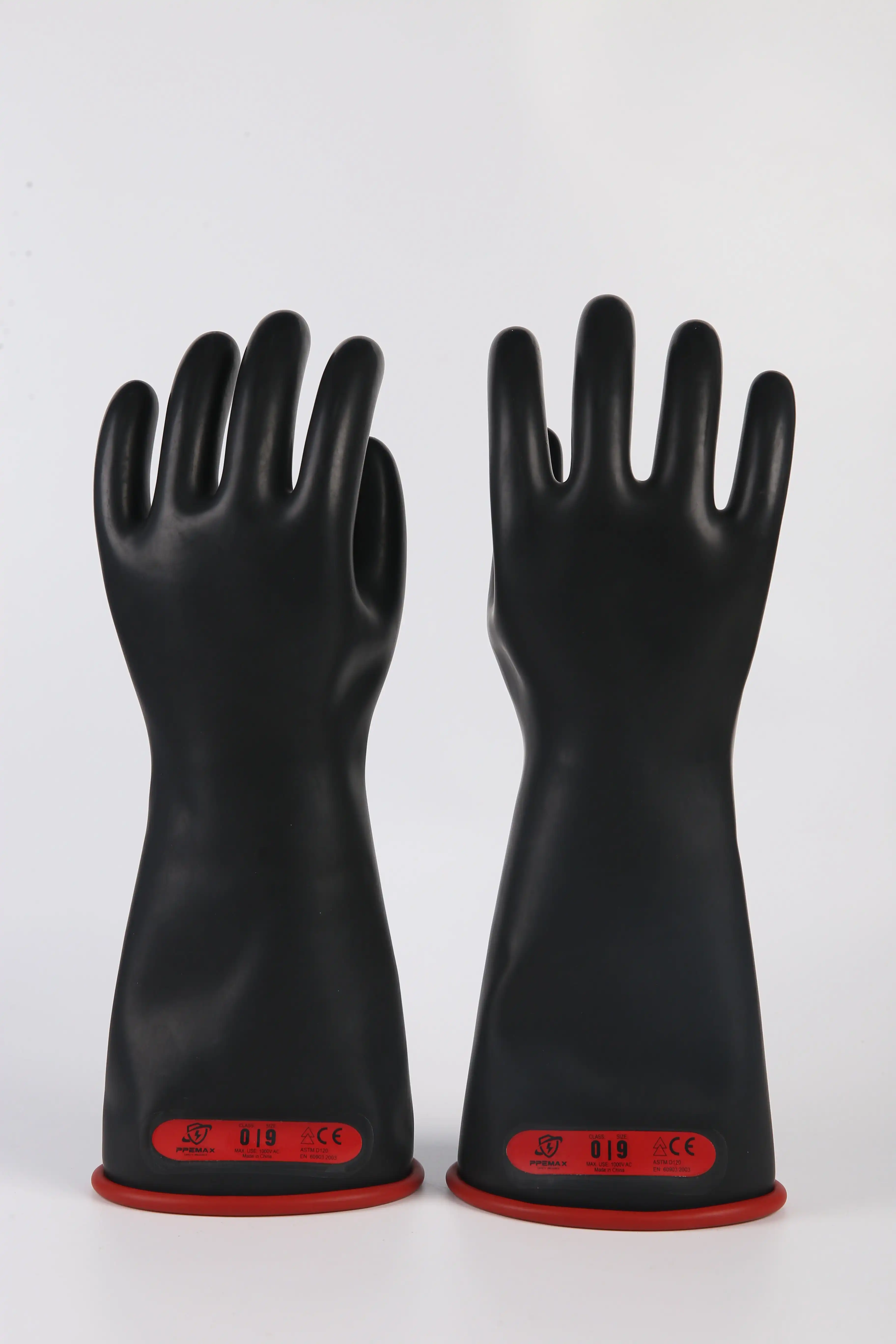
|
Parameter |
Specification |
|
Maximum Use Voltage |
1,000V AC / 1,500V DC |
|
Proof Test Voltage |
5,000V AC / 20,000V DC |
|
Label Color |
Red (ASTM D120/IEC 60903) |
|
Material Type |
Type I (Natural Rubber) / Type II (EPDM) |
|
Thickness |
1.02mm (0.040 inches) |
|
Length Options |
11", 14", 16" inches |
|
Cuff Styles |
Straight, Bell, Contour |
|
Standards Compliance |
ASTM D120, IEC 60903, OSHA 29 CFR 1910.137 |
Understanding Electrical Rubber Gloves and Their Functionality
What Are Electrical Rubber Gloves?
Insulating rubber gloves are made from natural rubber or EPDM (Ethylene Propylene Diene Monomer), and they are designed to stop electricity from getting to the hands that are wearing them. EPDM is better at resisting ozone and UV light, which makes it perfect for electrical work that needs to be done outside. Natural rubber is more flexible and dexterous. The anatomical "curved-hand" design of good gloves keeps hands from getting tired after long periods of use. This directly helps workers concentrate and lowers the risk of damage to powered systems.
Voltage Classes Explained
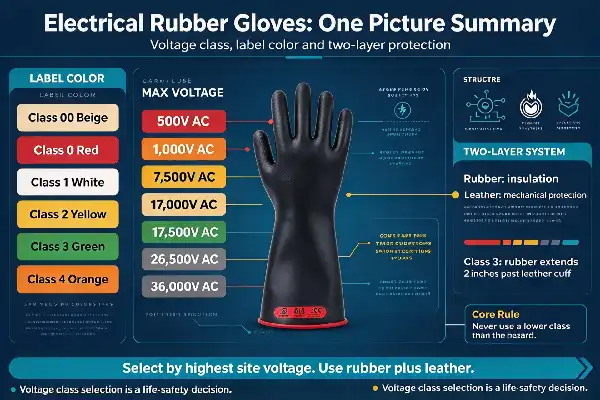
Classification goes from Class 00 to Class 4, and each class is linked to a different maximum use voltage:
- Class 00—500V AC/750V DC (Beige label): This is often used for servicing electric vehicles, working on smart meters, and maintaining control panels.
- Class 0—1,000V AC/2,500V DC (Red label): Used for low-voltage utility and industry tasks like installing meters.
- Class 1—7,500V AC/11,250V DC (White label): Maintenance on main power lines.
- Class 2—17,000V AC/25,500V DC (Yellow label): Substation and switching operations.
- Class 3—26,500V AC/39,750V DC (Green label): Work with high voltage.
- Class 4—36,000V AC/54,400V DC (Orange label): Places where extra-high power is transmitted.
Picking the wrong class is not only a violation of the law, but it is also dangerous to people's lives. Always make sure that the glove class matches the highest power at the job site.
Rubber + Leather: A Two-Layer System
Insulating electrical rubber gloves are always worn under leather protector gloves. The leather layer shields the rubber from cuts, punctures, and abrasions that could damage the insulation. The rubber layer acts as an insulating barrier. To keep electricity from moving along the surface of Class 3 gloves, the rubber must go at least two inches past the leather cuff.
Essential Safety Standards for Electrical Rubber Gloves
Key International Standards
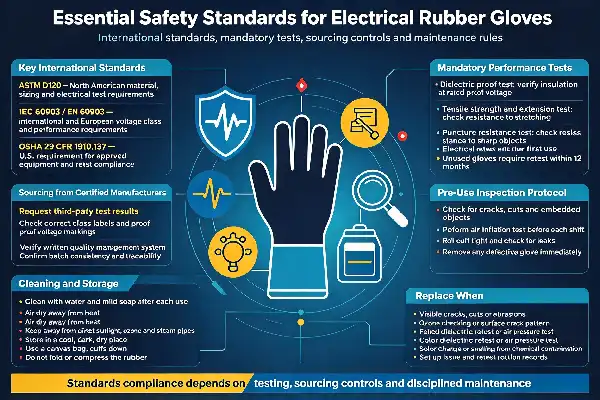
In most markets around the world, insulated electrical rubber gloves must meet three standards:
- ASTM D120 is the North American standard for rubber insulation gloves that lists their material qualities, sizes, and electrical test requirements.
- IEC 60903 / EN 60903 is the international and European standard that lists voltage classes, proof test voltages, and mechanical performance requirements.
- OSHA 29 CFR 1910.137 is the U.S. law that says all electrical safety gear, like gloves, must meet ASTM F496 retest intervals.
The classification structures of ASTM D120 and EN 60903 are very similar, which makes buying from one market to another easier for people around the world.
Mandatory Performance Tests
Standards say that gloves must pass both mechanical and electrical tests before they can be used. These are the main types of tests:
- Dielectric (proof) testing: An AC or DC voltage is used to make sure the glove's insulation stays intact at its rated proof test voltage.
- Tensile strength and extension tests show that the rubber can stretch without breaking when put under mechanical stress.
- Puncture resistance: Makes sure the material won't break when it comes into contact with something sharp.
These tests happen more than once. Under ASTM F496 and OSHA 1910.137, gloves must be retested for electricity every six months after they are first used. Gloves that haven't been used in more than 12 months can't be given out until they pass a new dielectric test.
Sourcing from Certified Manufacturers
Third-party approval and quality checks of factories greatly lower the risk of buying things. Buyers should ask for test results from approved labs, make sure that gloves have correct class labels with proof test voltage markings, and make sure that the company has a written quality management system in place.
If you're evaluating personal protective equipment suppliers and require batch-specific testing documents before placing an order, PPE MAX is able to provide official Certificates of Analysis, professional laboratory test reports, and product samples for your verification. Feel free to contact our team at marketing@ppemax.com to discuss your sourcing needs and obtain complete documentation for your quality assessment and procurement approval.
Testing and Maintenance: Ensuring Long-Term Glove Safety
Pre-Use Inspection Protocol
Before each shift, workers should look at their electrical rubber gloves to see if they have any cracks, cuts, or embedded objects. They should also do an air inflation test, which involves rolling the cuff up tight and catching air inside to see if there are any leaks. No matter when the last dielectric test was, any glove that fails this test must be taken out of service right away.
Cleaning and Storage Best Practices
Clean your gloves with water and gentle soap after each use, then let them dry in the air away from heat sources. Cleaning isn't the only thing that counts. Keep gloves away from direct sunlight, ozone sources like electric motors, and steam pipes. Keep them somewhere cool, dark, and dry. Put them inside a canvas bag with the cuffs down. Do not fold or compress the rubber. Material breaks down faster and has a much shorter useful life when stored incorrectly.
Recognizing When to Replace
Gloves have a limited useful life, even if they are well taken care of. Put away a pair right away if you see any of these signs:
- Cracks, cuts, or abrasions in the rubber that can be seen.
- Ozone checking, which is a pattern of cracks on the surface caused by ozone exposure.
- Failed the dielectric redo or the air pressure test.
- Changes in color or swelling caused by chemical contamination.
To make sure that everyone on the job always has the right tools, procurement managers should set up a rotation schedule that keeps track of when items are issued and when they need to be retested.
Comparing Electrical Rubber Gloves: Choosing the Right Option
Matching Glove Class to the Job
Voltage is where glove choice begins. Thicker gloves protect against dielectrics better, but they make it harder to move your fingers, which is a real problem for techs working in small areas with small terminals or wiring. Class 00 electrical rubber gloves are great for working on control panels and taking care of EV batteries because they are thin and can handle small motor tasks. Class 3 and Class 4 gloves are made for transmission settings where safety is more important than dexterity.
Type I vs. Type II Material
Gloves are put into two groups by ASTM D120: Type I (natural rubber) and Type II (EPDM). When movement and response from the touch are important, Type I gloves are best. Type II gloves are better for long periods of time spent outside, places with a lot of ozone, or places where UV light is present every day.
Supplier Evaluation Criteria
When looking for a long-term supply partner, pay attention to these things:
- Proof of certification: Current test certificates from approved labs that are in line with ASTM D120 or EN 60903.
- Inventory depth: The ability to regularly offer a wide range of classes and sizes for large orders.
- Support for retesting: Some makers and wholesalers offer retesting services for dielectrics either in-house or through partnerships.
- Lead time reliability: Important for companies with a lot of workers where supply gaps can put them at risk of not following the rules.
Procurement Guidance for Electrical Rubber Gloves
Buying Channels and Volume Considerations
Different types of safety equipment wholesalers, OEM manufacturers, and industrial safety distributors all have their own benefits. When you buy in bulk from a certified manufacturer, you can usually get better unit prices, shorter lead times, and the option of custom labeling or OEM branding. For procurement teams that are in charge of more than 500 workers in various locations, getting electrical rubber gloves through a single certified partner cuts down on paperwork and makes sure that the standard of the products is the same everywhere.
B2B Procurement Checklist
Make sure of the following before placing a large order:
- Gloves have true class marks and proof test voltage labels.
- There are certificates of approval for every shipment lot.
- The supplier can help with the details of retesting every six months or provide paperwork to make it easier.
- Both wait times and levels of volume discounts are written down in the supply deal.
- Technical help is offered after the sale for training employees or safety checks.
These traits set a real safety partner apart from a transactional vendor, and it's important to know the difference when your employees work on live systems every day.
Conclusion
The standards, testing, and sourcing decisions that go into making electrical rubber gloves are what make them work. A full safety system includes class ratings, ASTM D120 compliance, regular dielectric tests, and the right way to store things. People who work in procurement in manufacturing, energy, construction, or mining don't see these details as small print; they are what keep workers safe. The easiest way to build a PPE program that your employees can rely on is to find a company that has been vetted, has a lot of experience, and has clear approval procedures.
FAQ
1. How often do electrical insulating gloves need to be checked again?
ASTM F496 and OSHA 1910.137 say that gloves must be electrically tested every six months after they are first issued. If gloves have been stored for a year and haven't been tested in that time, they can't be used until they pass a new dielectric test.
2. What's the difference between safety gloves Type I and Type II?
Natural rubber is used to make Type I gloves, which are more flexible and easy to use. Type II gloves are made from EPDM, a material that is better at resisting damage from ozone and UV light. This makes them the best choice for places with a lot of ozone.
3. Do leather guard gloves change how well rubber insulation gloves conduct electricity?
Leather covers don't add to the dielectric value, so no. They protect the electrical rubber gloves from being hurt by things that move. To keep the full barrier of insulation, the rubber glove must always go past the leather cuff—usually by at least two inches for Class 3—and stay there.
4. Can Class 00 gloves be used to work on EV batteries?
Yes. Class 00 insulating gloves rated at 500V AC / 750V DC are the standard PPE for high-voltage EV system work, as long as the real system voltage doesn't go over the glove's highest use voltage. This is because EV battery packs usually work between 400V and 800V.
Partner With PPE MAX for Certified Electrical Rubber Gloves
Since 1956, PPE MAX has sold approved insulated gloves to businesses in 134 countries. As a reputable company that makes electrical rubber gloves, we offer stock that meets ASTM D120 and EN 60903 standards, OEM production, and dedicated account support for buying in bulk. Get in touch with our team at marketing@ppemax.com if your company needs a reliable partner in the supply chain for insulating PPE.
References
1. ASTM International. ASTM D120: Standard Specification for Rubber Insulating Gloves. ASTM International, 2023.
2. International Electrotechnical Commission. IEC 60903: Live Working — Gloves of Insulating Material. IEC, 2014.
3. Occupational Safety and Health Administration. OSHA 29 CFR 1910.137: Electrical Protective Equipment. U.S. Department of Labor, 2021.
4. ASTM International. ASTM F496: Standard Specification for In-Service Care of Insulating Gloves and Sleeves. ASTM International, 2022.
5. National Fire Protection Association. NFPA 70E: Standard for Electrical Safety in the Workplace. NFPA, 2024.
6. European Committee for Electrotechnical Standardization. EN 60903: Live Working — Gloves of Insulating Material. CENELEC, 2014.
Learn about our latest products and discounts through SMS or email