- English
- French
- German
- Portuguese
- Spanish
- Russian
- Japanese
- Korean
- Arabic
- Greek
- German
- Turkish
- Italian
- Danish
- Romanian
- Indonesian
- Czech
- Afrikaans
- Swedish
- Polish
- Basque
- Catalan
- Esperanto
- Hindi
- Lao
- Albanian
- Amharic
- Armenian
- Azerbaijani
- Belarusian
- Bengali
- Bosnian
- Bulgarian
- Cebuano
- Chichewa
- Corsican
- Croatian
- Dutch
- Estonian
- Filipino
- Finnish
- Frisian
- Galician
- Georgian
- Gujarati
- Haitian
- Hausa
- Hawaiian
- Hebrew
- Hmong
- Hungarian
- Icelandic
- Igbo
- Javanese
- Kannada
- Kazakh
- Khmer
- Kurdish
- Kyrgyz
- Latin
- Latvian
- Lithuanian
- Luxembou..
- Macedonian
- Malagasy
- Malay
- Malayalam
- Maltese
- Maori
- Marathi
- Mongolian
- Burmese
- Nepali
- Norwegian
- Pashto
- Persian
- Punjabi
- Serbian
- Sesotho
- Sinhala
- Slovak
- Slovenian
- Somali
- Samoan
- Scots Gaelic
- Shona
- Sindhi
- Sundanese
- Swahili
- Tajik
- Tamil
- Telugu
- Thai
- Ukrainian
- Urdu
- Uzbek
- Vietnamese
- Welsh
- Xhosa
- Yiddish
- Yoruba
- Zulu
How Do Dielectric Gloves Protect Electrical Workers?
Founded in 1956, PPEMAX stands as a premier global manufacturer and supplier of full-range personal protective equipment. All our products comply with internationally recognized standards including IEC, ASTM, CE, UKCA, NIOSH and ISO9001. Equipped with a 2,000-square-meter modern production plant, we boast over 25 years of mature OEM & ODM capabilities to deliver one-stop customized solutions covering R&D design through worldwide logistics. Our safety gear is distributed across 134 countries globally. Upholding our core tenet “Safety First, Quality Priority”, we serve as a dependable long-term PPE partner for industrial enterprises around the world.
Dielectric gloves provide electrical workers with protection by providing a physical barrier between the human body and active electrical sources. These insulating gloves are constructed of natural rubber or synthetic materials such as EPDM to prevent electric current from flowing through the hands and arms. When a worker encounters an electrified conductor, the glove’s high-resistance material stops the current from completing a course through the body. Rated from Class 00 (500V) to Class 4 (36,000V), each class is proof-tested far over its operating limit, providing reliable protection in real-world voltage settings in utilities, construction, and industry.
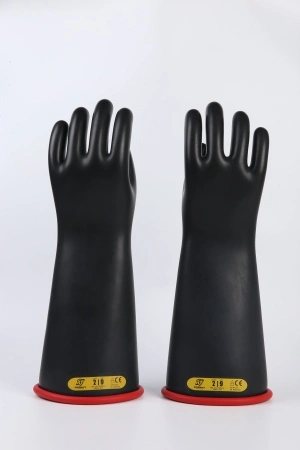

|
Parameter |
Specification |
|
Maximum Use Voltage |
17,000V AC / 25,500V DC |
|
Proof Test Voltage |
20,000V AC / 50,000V DC |
|
Typical Thickness |
2.3mm (ASTM D120 compliant) |
|
Material Type I |
Natural Rubber (high elasticity) |
|
Material Type II |
Synthetic/EPDM (ozone resistant) |
|
Standards Compliance |
ASTM D120, IEC/EN 60903 |
|
Temperature Range |
-40°F to +140°F (-40°C to +60°C) |
|
Color Options |
Orange, Red, Black |
Understanding Dielectric Gloves and Their Protection Mechanism
Electrical insulating gloves work on basic physics. Materials such as rubber and EPDM have extremely high electrical resistance ( measured in megaohms ) . This implies that electricity can't travel through the material. The difference between dielectric gloves and ordinary work gloves is that dielectric gloves were designed for this function, and every decision made in their design was centered on electrical safety.
Voltage Classes Explained
The sequence of items in the system is Class 00 to Class 4. Class 00 can be used for up to 500V AC, and Class 4 may be used for up to 36,000V AC. A proof test voltage in accordance with ASTM D120 should be passed by each class. For Class 4, it implies withstanding 40,000V AC in a laboratory water-submersion test. It is not a small thing to choose the incorrect class; it may be deadly.
Material Composition and Design
Natural rubber is best for delicate hardware work, since it gives your hands greater flexibility and sensitivity to touch. EPDM ( ethylene propylene diene monomer) is more resistant to ozone and UV degradation, so it lasts longer outdoors. Many gloves also include a “curved-hand” shape that fits your body better and helps protect your hands from tiring during lengthy periods. This is particularly handy for linemen who spend hours overhead conducting repairs.
Governing Standards You Must Know
In North America, ASTM D120 is the standard for rubber insulated gloves. EN 60903 is the one used in Europe. OSHA 29 CFR 1910.137 establishes rules for electrical safety tools for general business, and IEC 60903 provides for markets across the globe. The standards include everything from minimum wall thickness to maximum leakage current. Never include gloves that do not meet these specifications in your supply chain.

Inspecting and Maintaining Dielectric Gloves for Long-Term Protection
If you don't check and take care of your electrical safety gloves properly, even the best ones will break. Every six months, OSHA requires that electrical testing be done again on gloves that are still being used, but daily inspections are just as important for keeping workers safe in between official test rounds.
The Pre-Use Air Inflation Test
Before each shift, workers should roll the cuff of their gloves toward their fingers to trap air inside. They should then squeeze the gloves tightly to look for cracks, holes, or slow leaks. In less than 60 seconds, this easy test can find mechanical damage that an eye check might miss. If a glove fails the inflation test, it must be taken out of service right away.
Visual Inspection for Degradation
Workers should look over the whole surface of the glove for ozone checking (a pattern of tiny surface cracks), chemical stains, swelling, or buried debris. Checking for ozone is a sign that the rubber compound is breaking down. Because Type I gloves made from natural rubber are more likely to get damaged by ozone, Type II EPDM gloves are better for electrical work that needs to be done outside.
Proper Cleaning and Storage Protocols
Gloves should be washed in warm water with mild soap that doesn't go over 120°F (49°C). They should then be dried in the air, out of direct sunlight, and away from heat sources. Keep them cuff-down in canvas bags that let air flow and away from things that make ozone, like electric motors or fluorescent ballasts. If you fold or squeeze gloves while they are stored, the folds will turn into stress cracks over time. The usual way to store things is in a cool, dark, and dry place, which directly increases their useful life.

If you're evaluating personal protective equipment suppliers and require batch-specific testing documents before placing an order, PPE MAX is able to provide official Certificates of Analysis, professional laboratory test reports, and product samples for your verification. Feel free to contact our team at marketing@ppemax.com to discuss your sourcing needs and obtain complete documentation for your quality assessment and procurement approval.
Comparing Dielectric Gloves: Selecting the Best Protection for Your Team
Not all insulating gloves are made to do all jobs. When purchasing managers know the important and noticeable differences between options, they can make better buying choices that lower the chance of mistakes in the field.
Before you buy, you should think about these main differences:
- Natural Rubber Gloves: Offer excellent dielectric strength and tactile feedback. Best suited for controlled indoor environments such as substations and switchgear rooms. They are susceptible to ozone cracking without protective storage measures.
- EPDM Gloves: Resist ozone, UV radiation, and many industrial chemicals. They are preferred for utility linemen working outdoors on overhead transmission lines using dielectric gloves. Their slightly stiffer feel is offset by long-term durability. Neoprene Gloves: Provide moderate electrical insulation alongside resistance to petroleum-based fluids. They are used in hybrid applications where chemical splash and low-voltage electrical exposure occur together.
Because of these differences in materials, your team needs to choose a different class rating, glove length, and liner combination. A transformer repair worker wears a Class 2 glove. To protect the outside from wear and tear, a leather protector is put on top of it; the rubber layer alone is not strong enough. EV battery techs, on the other hand, use Class 0 or Class 00 gloves that put close grip and safety over bulk.
Procurement Strategies for Dielectric Gloves: Ensuring Quality and Compliance
It takes more than comparing unit prices to buy a lot of rubber protective gloves. When there is a problem in the supply chain, like getting gloves that don't meet standards, missing certifications, or test dates that have passed, it leads to worker injuries and fines from the government, not just higher costs for buying things.
Verifying Supplier Certifications
Every order should have proof that it meets ASTM D120 or EN 60903, along with the date of the test and the exact class grade. Reputable companies that make dielectric gloves keep third-party lab certifications and can show where the gloves came from. PPE MAX has been in business since 1956 and ships products to 134 countries. For each product line, they keep strict quality paperwork.
Bulk Ordering and Custom Options
Businesses that have hundreds or thousands of electrical workers benefit from bulk purchasing agreements that lock in prices and delivery times. Well-known OEM makers offer custom choices, such as specific glove lengths, color-coded inner layers to make checking easier, and private-label packaging. This is especially important for businesses in emerging markets that are making their own branded PPE programs.
Evaluating After-Sales Support
Procurement managers in charge of complex safety programs must make sure that gloves that fail incoming inspection are covered by warranty, that they are replaced, and that they get quick technical support. An operational risk is greatly reduced when the supplier of dielectric gloves provides clear instructions for re-testing, shelf-life documentation, and in-country distribution support.
Key Benefits and Business Value of Using Dielectric Gloves
But buying authorized electrical shielding gloves is excellent business, and not simply because of the requirements. Companies who take pride in proven PPE equipment notice a significant reduction in time- and money-consuming incidents, workers' compensation claims, and project delays.
“Trust in one’s safety equipment is a key factor in getting the best from workers in dangerous situations. That confidence lets you focus more easily, and there are fewer near calls. Also, having a documented safety policy and certified tools helps your firm seem better in the eyes of your potential customers, whether you are bidding on contracts, going through regulatory audits, or completing due diligence assessments. Safety performance is becoming more crucial in competitive industrial areas, such as construction, energy, mining, and infrastructure.
Conclusion
Dielectric gloves are designed to protect against the flow of electric current to a worker’s hands and arms while working on powered equipment. How safe they are relies on their materials, their class number, and their compliance with standards such as ASTM D120 and EN 60903. This protection lasts a long time, since it is constantly examined, carefully maintained, and then retested at regular intervals. To avoid falling prey to risk, the difference between a safety program that plays by the rules and one that leaves the firm exposed to danger is choosing a verified source that has all the approved documentation and provides helpful after-sales assistance.
FAQ
1. What is the difference between Type I and Type II dielectric gloves?
Since Type I gloves are made of natural rubber, they can't stand up to ozone damage. Type II gloves are made of man-made materials like EPDM that don't crack when exposed to ozone or UV light. Type II is usually the better choice for electrical work that needs to be done outside.
2. How often should electrical insulating gloves be re-tested?
ASTM D120 and OSHA 29 CFR 1910.137 say that gloves that are being used must be electrically checked again every six months. Also, gloves should be tested again right away if it seems like their integrity has been weakened.
3. Why do workers wear leather protectors over rubber insulating gloves?
During normal job activities, leather guards keep the rubber layer safe from cuts, punctures, and wear and tear. The electrical insulation is made of a thin rubber material that isn't very tough on its own, so the leather layer protects against damage.
4. How should dielectric gloves be stored?
Keep gloves away from direct sunlight, ozone sources, and heat in cool, dark, dry places. Place canvas bags so that the ends are faced down. To keep stress cracks from appearing at fold points, don't fold or compress stored gloves.
5. Can dielectric gloves be cleaned?
Yes. Before putting them away, wash them with mild soap and warm water (not more than 120°F/49°C), rinse them well, and let them dry in the air, away from heat sources and direct sunlight.
Source Your Next Dielectric Gloves Order Through PPE MAX
PPE MAX has been making and selling approved insulated PPE since 1956, and they have helped businesses in 134 countries. As a reliable company that makes dielectric gloves and works with original equipment manufacturers (OEMs), we offer fully documented product lines, bulk pricing programs, and custom production options to make sure that we meet the exact needs of your workforce. Our team is ready to help you with your buying process, whether you need to outfit a utility crew, a manufacturing site, or a private-label PPE program. To get a price right away, email us at marketing@ppemax.com.
References
1. ASTM International. ASTM D120: Standard Specification for Rubber Insulating Gloves. ASTM International, 2021.
2. International Electrotechnical Commission. IEC 60903: Live Working – Gloves of Insulating Material. IEC, 2014.
3. Occupational Safety and Health Administration. OSHA 29 CFR 1910.137: Electrical Protective Equipment. U.S. Department of Labor, 2019.
4. National Fire Protection Association. NFPA 70E: Standard for Electrical Safety in the Workplace. NFPA, 2021.
5. European Committee for Electrotechnical Standardization. EN 60903: Specification for Gloves and Mittens of Insulating Material for Electrical Purposes. CENELEC, 2003.
6. Occupational Safety and Health Administration. Personal Protective Equipment: Eye and Face Protection, Hand Protection. OSHA Publication 3151, U.S. Department of Labor, 2003.
Learn about our latest products and discounts through SMS or email