- English
- French
- German
- Portuguese
- Spanish
- Russian
- Japanese
- Korean
- Arabic
- Greek
- German
- Turkish
- Italian
- Danish
- Romanian
- Indonesian
- Czech
- Afrikaans
- Swedish
- Polish
- Basque
- Catalan
- Esperanto
- Hindi
- Lao
- Albanian
- Amharic
- Armenian
- Azerbaijani
- Belarusian
- Bengali
- Bosnian
- Bulgarian
- Cebuano
- Chichewa
- Corsican
- Croatian
- Dutch
- Estonian
- Filipino
- Finnish
- Frisian
- Galician
- Georgian
- Gujarati
- Haitian
- Hausa
- Hawaiian
- Hebrew
- Hmong
- Hungarian
- Icelandic
- Igbo
- Javanese
- Kannada
- Kazakh
- Khmer
- Kurdish
- Kyrgyz
- Latin
- Latvian
- Lithuanian
- Luxembou..
- Macedonian
- Malagasy
- Malay
- Malayalam
- Maltese
- Maori
- Marathi
- Mongolian
- Burmese
- Nepali
- Norwegian
- Pashto
- Persian
- Punjabi
- Serbian
- Sesotho
- Sinhala
- Slovak
- Slovenian
- Somali
- Samoan
- Scots Gaelic
- Shona
- Sindhi
- Sundanese
- Swahili
- Tajik
- Tamil
- Telugu
- Thai
- Ukrainian
- Urdu
- Uzbek
- Vietnamese
- Welsh
- Xhosa
- Yiddish
- Yoruba
- Zulu
Can a full mask respirator Support Safer Emergency Response?
Founded in 1956, PPEMAX stands as a premier global manufacturer and supplier of full-range personal protective equipment. All our products comply with internationally recognized standards including IEC, ASTM, CE, UKCA, NIOSH and ISO9001. Equipped with a 2,000-square-meter modern production plant, we boast over 25 years of mature OEM & ODM capabilities to deliver one-stop customized solutions covering R&D design through worldwide logistics. Our safety gear is distributed across 134 countries globally. Upholding our core tenet “Safety First, Quality Priority”, we serve as a dependable long-term PPE partner for industrial enterprises around the world.
By covering the entire face—including the eyes, nose, and mouth—this type of respirator creates a sealed barrier against airborne hazards that partial respirators simply cannot match. During chemical spills, rescue operations, or industrial incidents, first responders face concentrated gas exposures and particulate threats simultaneously. A certified Full mask respirator with an Assigned Protection Factor (APF) of 50 addresses both respiratory and ocular risks in a single device, making it a practical and proven choice for emergency teams managing high-risk environments.
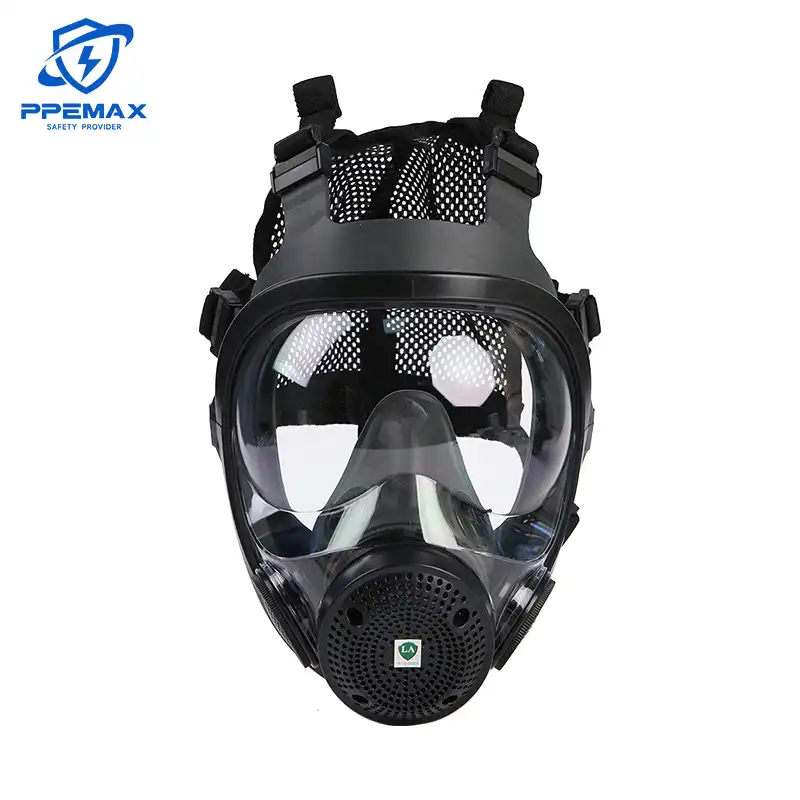
| Parameter | Specification |
|---|---|
| Material | High-grade lightweight silicone |
| Lens | Impact-resistant scratch-proof PC lens |
| Field of View | 88% panoramic vision |
| Mask Style | Full-face gas mask |
| Connector | Dual 40mm NATO RD bayonet port |
| Protection Class | Class 2 standard |
| Inward Leakage | ≤0.03% |
| Head Harness | 6-point high-tenacity nylon mesh, adjustable |
| Exhalation Valve | Low-resistance design |
| Compatible Filters | A2B2E2K2P3 RD NATO canister filters & all 40mm NATO series |
Understanding Full Mask Respirators in Emergency Response
When first responders go to a dangerous scene, the stakes are very high. The first thing you need to know about how a full-face mask works is how it's made.
Core Components That Define Protection
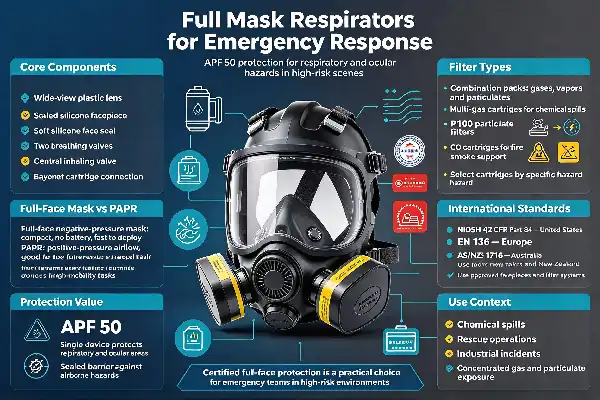
There are two breathing valves and an inhaling valve in the middle of a full-face respirator. The facepiece is made of sealed silicone and has a wide-view plastic lens. It's easy to change cartridges in the field thanks to the bayonet clip link. As you work, the soft silicone face seal molds to the shape of your face, reducing the number of leaky spots that void your security.
Filter Types for Different Threat Categories
Filters are chosen based on how dangerous they are. Ammonia, acid gases, and organic vapors (P100) are just some of the gas and mist threats that combination packs can handle. When there is a chemical spill, it is very important to have multi-gas cartridges that can handle certain chemicals. Particulate filters and CO cartridges work well together to get rid of smoke and other things that come from fires in support roles for firefighters.
Full-Face Masks vs. PAPRs: Choosing for Context
Powered air-purifying respirators (PAPRs) let positive-pressure air flow through the body, which is good for people who have to work long jobs or have hair. On the other hand, full-face negative-pressure respirators are smaller, don't need batteries, and can be used faster. All of these things are very important in emergencies where time is quickly running out. Most of the time, the normal full-face mask is better for first aid and jobs that need a lot of movement.
International Standards and Certification
In the United States, NIOSH 42 CFR Part 84 must be followed. In Europe, EN 136 must be followed. In Australia and New Zealand, AS/NZS 1716 must be followed. These approvals show that the filter system and facepiece are safe enough to use. You could be sued if you buy equipment that hasn't been approved, and workers could be exposed to amounts of danger that haven't been tested.
Advantages of Using Full Mask Respirators During Emergencies
Because of how it's made, a Full mask respirator is better than a half-mask or an N95 mask in an emergency.
Full-face respirators are safer than other choices because of the following:
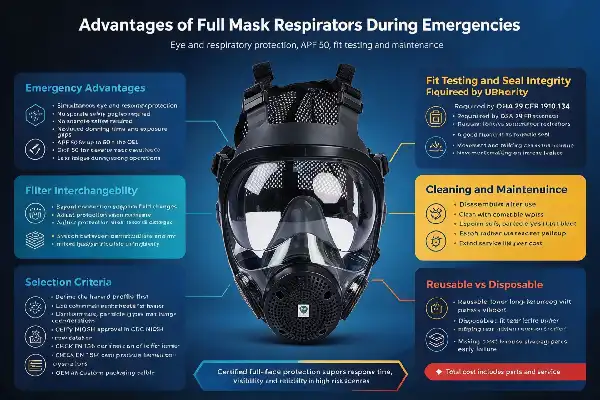
- Simultaneous eye and respiratory protection: Unlike half-mask respirators, the full-face design eliminates the need for separate safety goggles, reducing gear-donning time and the risk of exposure gaps between PPE components during urgent deployment.
- Higher APF rating: OSHA assigns an APF of 50 to full-face air-purifying respirators, compared to an APF of 10 for half-masks. This means personnel can safely work in environments with contaminant concentrations up to 50 times the occupational exposure limit.
- Reduced breathing resistance through dual inhalation valves: The dual-valve design distributes inhalation effort across two pathways, reducing fatigue during extended wear—an important factor during multi-hour emergency operations.
These benefits help emergency workers right away, since their bodies are already under a lot of stress from not being able to have their tools break down during active incidents. A full-face mask that fits properly and is approved lowers the risk of exposure while still letting workers see, talk, and keep things going.
Fit Testing and Seal Integrity
According to OSHA 29 CFR 1910.134, all tight-fitting respirators, even full-face types, must go through quantitative fit testing. Making sure that the facepiece fits well makes sure that it seals well enough for everyone. You might be able to get germs into your mask while you move or talk if you don't do this step.
Filter Interchangeability and Field Maintenance
When filter cartridges are joined by a bayonet, responders can change how much security they have without taking off the facepiece. This helps a lot when the level of danger changes during an event, like when you switch from particulate to mixed gas/particulate cartridges in the middle of an activity.
Cleaning and Maintenance Protocols
Every time you use the facepiece, you should take it apart, clean it with the wipes that came with it, and look for broken rubber seals or scratched lenses. The sides of PPE MAX respirators are flat and easy to clean, so dirt doesn't stick to them between uses. This makes them last longer and cost less to own overall.
If you're evaluating personal protective equipment suppliers and require batch-specific testing documents before placing an order, PPE MAX is able to provide official Certificates of Analysis, professional laboratory test reports, and product samples for your verification. Feel free to contact our team at marketing@ppemax.com to discuss your sourcing needs and obtain complete documentation for your quality assessment and procurement approval.
How to Choose the Right Full Mask Respirator for Emergency Response
Brand loyalty is not enough to help you choose the right respirator for an emergency. You should also evaluate things in a planned way.
Define the Hazard Profile First
Figure out all the risks before you start looking for things. Make a list of the chemicals, particle types, and numbers that your team might come across. In order to follow OSHA's respiratory protection standard, this has to be done before any mask can be picked. The level of danger determines what filter tubes are needed and whether an APF of 50 is enough.
Evaluate Key Procurement Criteria
A lot of people work for buying teams, and when they compare sellers and models, these things should be at the top of their list:
- Certification validity: Verify current NIOSH approval numbers directly on the CDC NIOSH database. EN 136 certificates should reference a notified body accreditation number.
- Spare parts availability: Confirm that filter cartridges, exhalation valves, and head harnesses are stocked by the supplier for at least five years post-purchase.
- OEM and custom labeling options: For distributors and government procurement agencies, suppliers offering OEM manufacturing and custom packaging reduce downstream branding complexity.
If you buy something, make sure that the seller will have filter cartridges, exhalation valves, and head harnesses for at least five years after the sale.- OEM and custom marking options: Making it easier for distributors and government agencies to brand their goods is when suppliers offer OEM making and custom packaging.
Reusable vs. Disposable: A Cost Efficiency Analysis
When people don't think about after-sales help when they buy something, equipment often breaks down because new parts aren't available during the contract.
Case Studies: Full Mask Respirators in Action During Emergencies
There is a lot of evidence from the field that Full mask respirators keep first responders safe in many different situations.
Chemical Spill Response: Industrial Facility
When a water treatment plant let out chlorine gas, response teams wearing full-face respirators and acid gas/particulate cartridges went into the danger zone, but they didn't exceed the safe exposure limits. An investigation after the event confirmed that none of the team members had said they had any breathing problems. Staff said that the lenses were clear and the seals were tight during the two-hour process.
Firefighting Support Operations
People have used full-face respirators with CO/organic vapor packs to help put out building fires where there is smoke and combustion fumes. Municipal chemical teams often tell PPE MAX that the performance of the speech diaphragm and lens anti-fog are strategically important features. These parts are already built into the product.
Procurement Lessons from the Field
Companies that pre-certify their respirator stock and test the fit of their employees once a year say that accidents involving their gear happen less often. Managers who buy things say that costs are more reliable when they include information in contracts about how long filter tubes last.
Streamlining Procurement: Where and How to Buy Full Mask Respirators
To find a lot of certified respiratory protection, you need a structured plan.
Wholesale and Bulk Purchasing Options
When small to large businesses work directly with producers, they can get a steady supply of goods at a lower cost per unit. Xi'An PPE MAX Co., Ltd sells full-face respirators in large quantities to businesses and wholesalers in 134 countries. OEM partners can pick from different types of protective packaging and unique labels.
Price Range Guidance
Each certified reusable full-face mask costs around $30 to $120, but this varies based on the materials used, the lens requirements, and the level of certification. Buying teams should look at the total lifetime cost, not just the unit price, to figure out how much filter cartridges will cost over two years of use.
Verifying Supplier Credibility
Check that your certifications are up-to-date and get references from clients who have worked with you before in the same field. PPE MAX takes part in safety shows around the world, such as the A+A Safety Exhibition in Germany. Buyers can also go to the Xi'an workplace of the company to see for themselves that it meets production standards.
Conclusion
When you're reacting to situations, you need breathing gear that works reliably even when things get tough. Full mask respirators that are certified protect first responders and industrial emergency teams from chemical, gas, and particle threats in the air. They have an APF of 50, a sealed facepiece, and a replaceable filter system. People who are in charge of buying things for large groups should get full-face respirators that are NIOSH or EN 136 certified from a reputable company. This is an easy choice that is supported by OSHA rules, facts from the field, and lower total costs. When the right tools are bought at the right time, the risk of accidents goes down, and worker safety goes up.
FAQ
1. How often should filter cartridges be replaced during active emergency operations?
Depending on which comes first, filter tubes should be changed after the manufacturer's recommended service life, OSHA's change-out plan, or right away if the person smells something or is having trouble breathing. Sometimes, cartridges last a lot less than people think they do in places with a lot of dust.
2. What is the main difference between a full-face respirator and a PAPR?
People who wear full-face negative-pressure respirators can put them on faster and don't need a power source since they breathe through the filter. A powered fan in a PAPR brings in filtered air under positive pressure. It protects you better and fits better for people with hair, but it's heavy and needs batteries.
3. Are full-face respirators suitable for extended shifts?
Yes, full-face respirators can be worn for a long time as long as they fit right and have dual inhalation valves with low resistance. Long-term use is less tiring when there are comfort features like rubber seals that fit your body and 5-point strap systems that can be changed.
4. Can one respirator work across multiple chemical threats?
If the facepiece has the right combination cartridge, like an OV/P100 or ABEK multigas filter, it can handle more than one type of threat at the same time. Before you use the cartridge, you should always make sure that it can handle the threat.
Source Your Full-Face Respirator Supplier from PPE MAX
Since 1956, people in 134 countries have bought approved breathing protection from PPE MAX. We make Full mask respirators and are a well-known business that does so. The facepieces we sell are NIOSH- and EN 136-certified. You can buy a lot of them, have your own design made, and get help after the sale. Call our team right away to talk about what you want to buy and to get free samples of our goods. We can be reached at marketing@ppemax.com.
References
1. National Institute for Occupational Safety and Health (NIOSH). NIOSH Respirator Selection Logic. Centers for Disease Control and Prevention, 2004.
2. Occupational Safety and Health Administration (OSHA). Respiratory Protection Standard 29 CFR 1910.134. U.S. Department of Labor, 2011.
3. European Committee for Standardization (CEN). EN 136: Respiratory Protective Devices — Full Face Masks — Requirements, Testing, Marking. CEN, 1998.
4. Lawrence, R. B., et al. "Evaluation of Loose-Fitting Powered Air-Purifying Respirators." Journal of Occupational and Environmental Hygiene, 2006.
5. Bollinger, N. NIOSH Guide to the Selection and Use of Particulate Respirators. National Institute for Occupational Safety and Health, 1996.
6. Zhuang, Z., et al. "Facial Anthropometric Differences Among Gender, Ethnicity, and Age Groups." Annals of Occupational Hygiene, 2010.
Learn about our latest products and discounts through SMS or email