- English
- French
- German
- Portuguese
- Spanish
- Russian
- Japanese
- Korean
- Arabic
- Greek
- German
- Turkish
- Italian
- Danish
- Romanian
- Indonesian
- Czech
- Afrikaans
- Swedish
- Polish
- Basque
- Catalan
- Esperanto
- Hindi
- Lao
- Albanian
- Amharic
- Armenian
- Azerbaijani
- Belarusian
- Bengali
- Bosnian
- Bulgarian
- Cebuano
- Chichewa
- Corsican
- Croatian
- Dutch
- Estonian
- Filipino
- Finnish
- Frisian
- Galician
- Georgian
- Gujarati
- Haitian
- Hausa
- Hawaiian
- Hebrew
- Hmong
- Hungarian
- Icelandic
- Igbo
- Javanese
- Kannada
- Kazakh
- Khmer
- Kurdish
- Kyrgyz
- Latin
- Latvian
- Lithuanian
- Luxembou..
- Macedonian
- Malagasy
- Malay
- Malayalam
- Maltese
- Maori
- Marathi
- Mongolian
- Burmese
- Nepali
- Norwegian
- Pashto
- Persian
- Punjabi
- Serbian
- Sesotho
- Sinhala
- Slovak
- Slovenian
- Somali
- Samoan
- Scots Gaelic
- Shona
- Sindhi
- Sundanese
- Swahili
- Tajik
- Tamil
- Telugu
- Thai
- Ukrainian
- Urdu
- Uzbek
- Vietnamese
- Welsh
- Xhosa
- Yiddish
- Yoruba
- Zulu
Electrical Rubber Gloves Uses in Utilities, Mining, and Industry
Founded in 1956, PPEMAX stands as a premier global manufacturer and supplier of full-range personal protective equipment. All our products comply with internationally recognized standards including IEC, ASTM, CE, UKCA, NIOSH and ISO9001. Equipped with a 2,000-square-meter modern production plant, we boast over 25 years of mature OEM & ODM capabilities to deliver one-stop customized solutions covering R&D design through worldwide logistics. Our safety gear is distributed across 134 countries globally. Upholding our core tenet “Safety First, Quality Priority”, we serve as a dependable long-term PPE partner for industrial enterprises around the world.
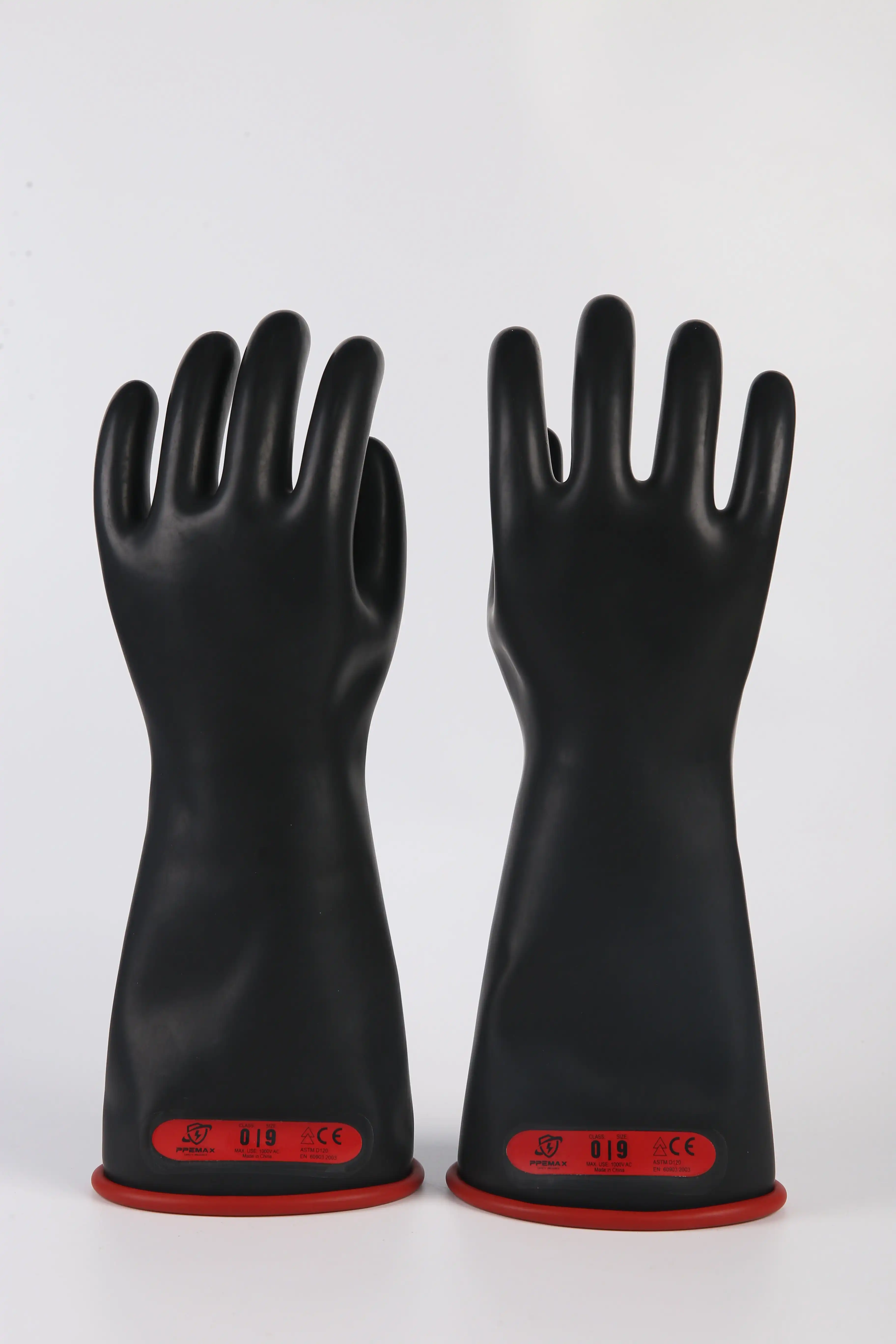
Electrical rubber gloves are the first line of defence for utilities, mining, and industry against shock and electrocution threats. These are specialised insulating gloves designed to safeguard people who operate with energised circuits, high-voltage equipment, and live electrical systems on a regular basis. They are designed to operate at high voltages while remaining dexterous, plugging important safety gaps in low-voltage control tasks and maintenance of distribution grids. Whether you’re repairing substations or working in an underground mine, these gloves are an essential part of a well-rounded worker safety strategy that helps avoid electrical mishaps and keeps you in compliance with regulations.
|
Parameter |
Specification |
|
Maximum Use Voltage |
1,000V AC / 1,500V DC |
|
Proof Test Voltage |
5,000V AC / 20,000V DC |
|
Label Color |
Red (ASTM D120/IEC 60903) |
|
Material Type |
Type I (Natural Rubber) / Type II (EPDM) |
|
Thickness |
1.02mm (0.040 inches) |
|
Length Options |
11", 14", 16" inches |
|
Cuff Styles |
Straight, Bell, Contour |
|
Standards Compliance |
ASTM D120, IEC 60903, OSHA 29 CFR 1910.137 |
How to Evaluate and Test Electrical Rubber Gloves for Maximum Safety and Performance
Visual Inspection Protocols
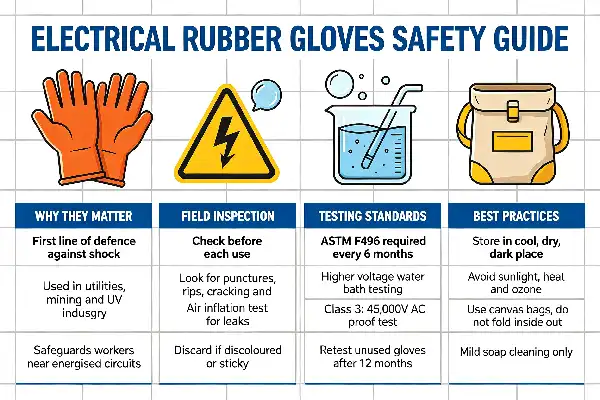
Workers should inspect gloves carefully before each use for punctures, rips, embedded foreign objects, ozone cracking, and UV damage. The air inflation test is still the best approach for field use. The worker inflates the glove with air, twists the cuff shut, and applies pressure, listening for leaks of air. Discolouration, altered texture, or stickiness of the surface are signs of chemical contamination or deterioration, and the glove should be immediately removed from use. Small imperfections may provide an electrical route when the defect comes in touch with energised components, therefore violating the integrity of the dielectric.
Laboratory Dielectric Testing Requirements
Electrical rubber glove testing is required by ASTM F496 at intervals not to exceed six months after being put into operation. Specialised equipment dips the gloves in water baths and administers proof test voltages far higher than the allowed operating voltages. Class 3 gloves are tested at 45,000V AC, whereas their maximum usage rating is 26,500V AC. Leakage current is measured by testing facilities to find small faults unseen to the naked eye. If gloves have not been used, they should be retested after a period of longer than twelve months from the date of the previous test. In safety audits, we often find major industrial customers with compliance gaps because expired electrical rubber gloves are making their way to field personnel. Systematic testing schedules prevent this from occurring.
Storage and Maintenance Best Practices
Good storage extends the life of the gloves very well without losing their protective characteristics. Gloves should be stored in cool, dry, dark places away from ozone-producing equipment, bright sunlight, and heat sources such as steam pipes. Canvas storage bags help avoid compression damage and folding that generate stress areas that can fracture. Never keep gloves inside out or wet. Moisture speeds up the process of rubber breakdown. Mild soap solutions clean without changing the makeup of the material, and petroleum-based chemicals degrade rubber. Keeping the glove from ageing too soon and retaining the glove’s structural integrity between test cycles is done by following the manufacturer’s storage requirements (which we provide with every PPE MAX shipment).
Comparing Electrical Rubber Gloves: Making the Right Procurement Decisions
Insulating Gloves Versus Leather Protectors
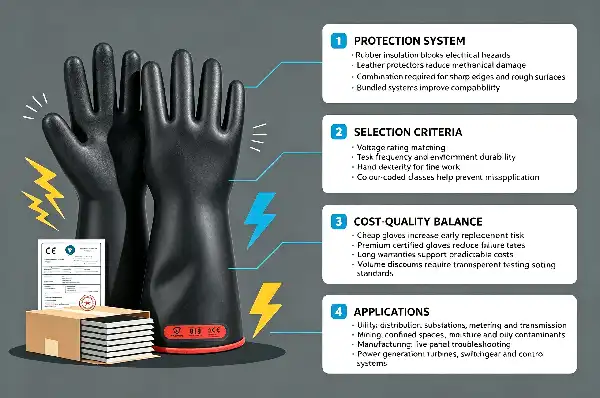
Leather protector gloves have a specific mechanical protection role. They protect rubber insulating gloves from cuts, abrasions, and punctures that would damage the dielectric qualities. The regulations also require that the leather protectors extend a minimum of two inches below the rubber glove cuff to avoid electricity tracking. The combo solution is designed to eliminate electrical and mechanical risks at the same time – the rubber offers insulation, and leather protects against physical harm from the sharp metal edges and rough surfaces typical in utility pole work and maintenance of mining equipment.
Procurement plans need to include both of these components, since rubber gloves alone will not protect against the mechanical risks often seen in industrial settings. You may also save money and make sure the rubber and leather layers are compatible by buying packaged systems in bulk. We provide bespoke bundles for companies that have big workforces. We bundle certain classes of gloves with the right leather protectors so that they can manage their inventory better.
Evaluating Technical Specifications for Operational Needs
When choosing the right gloves, there are three primary things to consider: sufficient insulating capability for the maximum voltage exposure, durability sufficient for the frequency of tasks and environmental conditions, and ergonomic design allowing for the required hand dexterity. In the mining industry, where abrasive surfaces are often encountered, Thicker rubber compositions are advantageous, although there is a compromise on flexibility for improved puncture resistance. However, utility meter techs prefer thinner Class 00 gloves for their tactile sensitivity while handling tiny locking rings and terminal screws, even if they must change them out more often.
Customisation options make safety programs more effective. Voltage class colour labelling (red, yellow, green) avoids harmful glove misapplication (Class 0, 1, and 2, respectively). The size range is intended to provide for a very broad range of workforces, hence boosting compliance via greater comfort for longer durations of usage through the use of well-fitted gloves. Better grip textures prevent slippage of tools while working finely. The details of these choices significantly affect the adoption rate of workers and the regularity of correct use.
Cost-Quality Balance for Bulk Procurement
Safety managers face the difficulty of budget limits, weighing the cost of initial purchase against long-term benefit. Cheap gloves with poor quality control fail testing more often and need to be replaced early, negating any seeming savings. Premium manufacturers provide long warranties and replacement assurances, providing predictable lifespan costs. Years of experience with industrial customers have shown that purchasing certified gloves from reputable vendors lowers the total cost of ownership due to longer service intervals and reduced failure rates. To negotiate volume-based discounts, suppliers need to be transparent about their production methods and the rigour of their test procedures in order to maintain quality standards. These principles have been the foundation of our client engagements since we started.
If you're evaluating personal protective equipment suppliers and require batch-specific testing documents before placing an order, PPE MAX is able to provide official Certificates of Analysis, professional laboratory test reports, and product samples for your verification. Feel free to contact our team at marketing@ppemax.com to discuss your sourcing needs and obtain complete documentation for your quality assessment and procurement approval.
Electrical Rubber Gloves Applications in Utilities, Mining, and Industry
Utility Sector Applications
Electrical rubber gloves: utility workers face diverse voltage exposures, requiring precise glove selection. Distribution line technicians performing live-line maintenance on overhead power lines use Class 2 or 3 gloves depending on system voltages, while substation electricians switching circuit breakers and disconnects in enclosed spaces rely on similar ratings. Meter installation crews working with 240V to 480V residential and commercial services employ Class 00 or Class 0 gloves that allow finger dexterity for terminal manipulation.
Smart grid modernization has expanded glove applications to include sensor installations and communication equipment integration on energized infrastructure. Transmission maintenance on high-voltage lines above 72kV demands Class 4 gloves, though such work typically involves additional protective measures including hot sticks and insulated aerial platforms. The utility sector's emphasis on zero-accident safety cultures drives demand for premium gloves with verified performance records.
Mining Industry Protection Requirements
Underground mining presents unique electrical hazards complicated by moisture, dust, and confined spaces. Battery-powered equipment, conveyor systems, and ventilation fans create multiple energized contact points throughout mine shafts where escape routes are limited. Surface mining operations utilize massive electric shovels and draglines operating at medium voltages, exposing maintenance crews during repairs. Electricians servicing these systems require gloves rated for equipment voltages plus safety margins, typically Class 0 through Class 2, depending on mine electrical infrastructure.
Wet conditions common in mining environments necessitate gloves with superior moisture resistance or specialized coatings. Oily contaminants from hydraulic systems degrade natural rubber, making synthetic alternatives preferable for maintenance personnel. Integration with other PPE—hard hats, flame-resistant clothing, respiratory protection—creates comprehensive safety systems addressing mining's multi-hazard landscape. A coal mining operation we supply in the Appalachian region reduced electrical incidents by 47% after implementing our recommended glove selection protocol matched to specific equipment voltage surveys.
Industrial Manufacturing and Power Generation Uses
Power generation facilities, whether fossil fuel, nuclear, or renewable, require extensive electrical maintenance on turbines, generators, switchgear, and control systems. Plant electricians troubleshooting energized control panels use Class 00 gloves for 480V circuits, while generator maintenance may require Class 1 or higher depending on voltage levels. The inability to shut down critical systems during production demands safe live-work practices where insulating gloves prove indispensable.
Manufacturing plants with automated production lines depend on continuous equipment operation. Maintenance engineers use appropriate voltage-rated gloves when addressing electrical faults without halting entire assembly lines, preventing costly downtime. Industrial environments emphasizing predictive maintenance strategies value gloves enabling safe diagnostic work on energized machinery. Chemical plants add requirements for gloves resistant to specific substances, necessitating material compatibility verification beyond standard electrical ratings.
How to Source Certified Electrical Rubber Gloves: A Comprehensive Buying Guide
Identifying Reliable Suppliers and Manufacturers
The right supplier is key to product quality, regulatory compliance, and long-term relationship value. New entrants to the market do not have the level of consistency and experience of existing producers, who have specialised in electrical safety equipment for decades. Verification processes include seeking certification papers, checking the credentials of the production plant, and verifying the testing laboratory accreditations. Suppliers must give clear information on their material sourcing, quality control systems, and compliance with ASTM, IEC, and EN standards.
The shipping and technical assistance depend on the location of the company. International suppliers may be competitive on price, but working with manufacturers that have local inventory helps to shorten wait times for urgent replenishment. We built distribution networks in 134 countries to reduce supply chain delays that undermine safety initiatives. Procurement budgets are protected from unexpected replacement expenses by warranty terms and return procedures for faulty items. Checking a supplier's financial soundness avoids delays from company collapses mid-contract.
Bulk Purchasing Strategies and Negotiation
Buying in bulk lets you buy items at a discount and guarantees you have enough on hand to meet the demands of your workers. The amount calculation requires knowing how many people you have, how often they use gloves, how often you test and replace them, and what your safety stock buffers are. Purchasing managers find that purchasing in volume across various plants provides more bargaining power. Soliciting bids from numerous qualified suppliers puts pressure on them to provide a good cost without compromising quality.
Scheduled deliveries in long-term supply agreements provide for budget certainty and product availability. The flexibility to adjust for seasonal labour shifts or project-based demand surges adds value beyond unit cost. Some manufacturers even provide consignment inventory systems where the gloves stay the property of the supplier until supplied, thereby optimising cash flow management. Bundled kits including glove storage containers, testing equipment, and training materials make vendor management easier, and complete solutions are available.
OEM and Customization Opportunities
OEM relationships let organisations customise their products to individual needs. Private labelling and bespoke sizing address particular labour demographics and strengthen company safety branding. “Color coding beyond the traditional classifications allows facilities to set their own internal safety procedures. The improved grip patterns accommodate industry-specific tool handling demands. Using our 68 years of manufacturing knowledge, we partner with major organisations to produce custom glove specifications for proprietary equipment to address particular electrical protection needs.
Typically, the minimum order quantities for customised items are higher than for regular products, making this strategy a good fit for major firms or distributors with a regional market presence. Lead times increase throughout product development stages, then plateau after requirements are finalised. The investment offers specialised safety solutions, tailored to operational circumstances and not one-size-fits-all market options.
Conclusion
Rubber electrical rubber gloves are a vital piece of safety equipment that protects workers from electrocution in the utility, mining, and industrial sectors. Knowing the categorisation systems, material qualities, and regulatory standards will help you make educated purchasing choices to ensure the right balance between protection and operational demands. Proper maintenance and strict testing techniques prolong glove life, assuring ongoing dielectric integrity. “Partner with certified manufacturers who have proven records to ensure reliability of the product and compliance with regulations.” The breadth of applications, from high-voltage gearbox to complex control system maintenance, demonstrates the adaptability and crucial necessity of these gloves in current electrical safety programs.
FAQ
1. How often should electrical insulating gloves be tested?
ASTM F496 and OSHA 1910.137 require electrical testing every six months after issuing gloves to service personnel. Gloves remaining in storage without use must be tested if twelve months have elapsed since the last examination before they can be issued. Harsh working environments with extreme temperatures, chemical exposures, or frequent mechanical stress may warrant more frequent testing intervals to maintain adequate protection margins and prevent undetected degradation.
2. What certification marks should procurement teams verify?
Authentic electrical gloves display ASTM D120, IEC 60903, or EN 60903 certification marks indicating compliance with recognized safety standards. These markings confirm the manufacturer conducted required dielectric strength testing and physical property evaluations. Procurement professionals should request test reports and certificates of conformance documenting that specific glove batches meet regulatory requirements, protecting organizations from liability associated with substandard protective equipment.
3. Can insulating gloves be used in wet or oily mining conditions?
Standard rubber gloves perform adequately in damp environments, though water on glove surfaces reduces grip security. Mining operations with significant oil contamination require gloves made from synthetic materials like EPDM that resist petroleum degradation better than natural rubber. Specialized coatings and textured surfaces enhance grip under slippery conditions. Pairing insulating gloves with appropriate leather protectors adds mechanical protection while improving handling in challenging mining environments where both electrical and physical hazards coexist.
Partner With PPE MAX for Certified Electrical Safety Solutions
Protecting your workforce requires electrical rubber gloves from trusted manufacturers who understand the stakes involved in high-risk environments. PPE MAX has manufactured reliable insulation and respiratory protection since 1956, serving utilities, mining operations, and industrial facilities across 134 countries. Our comprehensive product line spans all voltage classes with ASTM, IEC, and EN certifications you can verify. We offer bulk purchasing advantages, customization capabilities for OEM clients, and responsive technical support from safety professionals who use the same equipment we manufacture. Whether you need Class 00 gloves for meter installations or Class 3 protection for substation work, our team provides tailored solutions meeting your specific operational requirements. Contact our procurement specialists at marketing@ppemax.com to discuss volume pricing, testing equipment bundles, and delivery schedules that keep your safety programs running without interruption. As a leading electrical rubber gloves supplier, we deliver quality backed by decades of field-proven performance.
References
1. American Society for Testing and Materials. (2022). ASTM D120: Standard Specification for Rubber Insulating Gloves. West Conshohocken, PA: ASTM International.
2. Occupational Safety and Health Administration. (2021). 29 CFR 1910.137: Electrical Protective Devices. Washington, DC: U.S. Department of Labor.
3. International Electrotechnical Commission. (2020). IEC 60903: Live Working - Gloves of Insulating Material. Geneva, Switzerland: IEC Publications.
4. National Fire Protection Association. (2021). NFPA 70E: Standard for Electrical Safety in the Workplace. Quincy, MA: NFPA.
5. Cadick, J., Capelli-Schellpfeffer, M., & Neitzel, D. (2019). Electrical Safety Handbook (4th ed.). New York: McGraw-Hill Education.
6. Zarhoun, H., & Reeves, T. (2018). Practical Guide to Electrical Safety in Mining and Heavy Industry. Melbourne: Standards Australia Publishing.
Learn about our latest products and discounts through SMS or email