- English
- French
- German
- Portuguese
- Spanish
- Russian
- Japanese
- Korean
- Arabic
- Greek
- German
- Turkish
- Italian
- Danish
- Romanian
- Indonesian
- Czech
- Afrikaans
- Swedish
- Polish
- Basque
- Catalan
- Esperanto
- Hindi
- Lao
- Albanian
- Amharic
- Armenian
- Azerbaijani
- Belarusian
- Bengali
- Bosnian
- Bulgarian
- Cebuano
- Chichewa
- Corsican
- Croatian
- Dutch
- Estonian
- Filipino
- Finnish
- Frisian
- Galician
- Georgian
- Gujarati
- Haitian
- Hausa
- Hawaiian
- Hebrew
- Hmong
- Hungarian
- Icelandic
- Igbo
- Javanese
- Kannada
- Kazakh
- Khmer
- Kurdish
- Kyrgyz
- Latin
- Latvian
- Lithuanian
- Luxembou..
- Macedonian
- Malagasy
- Malay
- Malayalam
- Maltese
- Maori
- Marathi
- Mongolian
- Burmese
- Nepali
- Norwegian
- Pashto
- Persian
- Punjabi
- Serbian
- Sesotho
- Sinhala
- Slovak
- Slovenian
- Somali
- Samoan
- Scots Gaelic
- Shona
- Sindhi
- Sundanese
- Swahili
- Tajik
- Tamil
- Telugu
- Thai
- Ukrainian
- Urdu
- Uzbek
- Vietnamese
- Welsh
- Xhosa
- Yiddish
- Yoruba
- Zulu
Class 1 Insulating Gloves Inspection and Care Guide
Founded in 1956, PPEMAX stands as a premier global manufacturer and supplier of full-range personal protective equipment. All our products comply with internationally recognized standards including IEC, ASTM, CE, UKCA, NIOSH and ISO9001. Equipped with a 2,000-square-meter modern production plant, we boast over 25 years of mature OEM & ODM capabilities to deliver one-stop customized solutions covering R&D design through worldwide logistics. Our safety gear is distributed across 134 countries globally. Upholding our core tenet “Safety First, Quality Priority”, we serve as a dependable long-term PPE partner for industrial enterprises around the world.
Proper inspection and upkeep of Class 1 Insulating Gloves certified for 7,500 volts AC might make the difference between a safe day on the job site and a life-threatening electrical mishap. This detailed tutorial takes you through the necessary measures to keep your electrical safety gloves to make sure they provide dependable protection throughout their service life. If you supervise electrical contractors, utility operations, or industrial maintenance teams, knowing these practices can help you keep your workers safe, get the most out of your PPE investment, and stay compliant with regulations in tough work situations.

|
Parameter |
Specification |
|
Voltage Rating |
7,500V AC / 11,250V DC (Maximum Use) |
|
Proof Test Voltage |
10,000V AC / 40,000V DC |
|
Material Type |
Type I (Natural Rubber) / Type II (EPDM Synthetic) |
|
Thickness Range |
1.02mm - 1.52mm |
|
Tensile Strength |
>17.2 MPa |
|
Standards Compliance |
ASTM D120, IEC 60903 |
|
Temperature Resistance |
Category A, H, Z rated |
|
Label Color |
White (Class 1 Standard) |
Understanding Class 1 Insulating Gloves: Specifications and Safety Standards
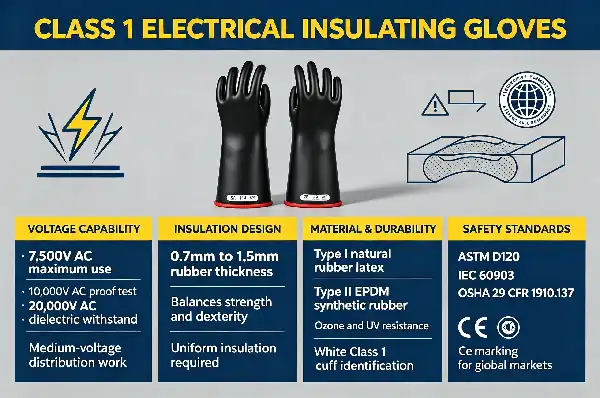
Class 1 Electrical Safety Gloves are a kind of personal protective equipment (PPE) that protects workers against electrical dangers up to 7,500 volts AC and 11,250 volts DC. In the maintenance of utilities, telecommunications infrastructure, and industrial electrical work, gloves are the essential link between live conductors and human touch.
Voltage Ratings and Insulation Properties
The most important attribute of these protective gloves is that they have a maximum usage voltage of 7,500V AC, a proof test voltage of 10,000V AC, and a dielectric withstand voltage of 20,000V AC. This voltage rating puts them between Class 0 gloves (certified for 1,000V AC) and Class 2 gloves (qualified for 17,000V AC), making them perfect for distribution line work and medium-voltage equipment maintenance.
Insulation qualities are achieved by careful regulation of rubber thickness in the range of 0.7mm to 1.5mm to take into account the trade-off between dielectric strength and hand dexterity requirements. The thickness must be consistent over the whole surface of the glove so that there are no weak areas that might impair protection upon electrical contact.
Material Composition and Durability
PPE MAX uses high-grade natural rubber latex for the fabrication of Type I gloves and EPDM synthetic compounds for the manufacturing of Type II versions. Natural rubber has excellent flexibility and touch sensitivity, so technicians may move tools and components with accuracy. EPDM compounds provide better resistance to ozone degradation and UV exposure, therefore increasing service life in outdoor utility applications where environmental conditions drive material breakdown.
Ergonomically moulded to the shape of your fingers and palm to help prevent strain during long use. White colour-coded cuffs are commonly used for Class 1 rating; for example, they provide fast visual identification on job sites, preventing workers from unintentionally picking gloves that do not provide sufficient voltage protection for the specified application.
Compliance with International Safety Standards
Electrical insulating gloves meet ASTM D120 and IEC 60903 standards and are a fundamental need for North American and worldwide markets. These criteria require rigorous testing for dielectric strength, mechanical characteristics, and chemical resistance. OSHA standards 29 CFR 1910.137 require employers to guarantee that protective equipment is maintained in an insulating condition via periodic inspection and testing.
In our factories in Xian, we have complete quality control systems that check every batch of production against these requirements. We have CE marking for European markets and extra certifications to show our dedication to worldwide compliance. This is helpful for procurement managers who are procuring PPE for multinational operations in different regulatory contexts.
Comprehensive Inspection Process for Class 1 Insulating Gloves
Systematic inspection protocols prevent electrical accidents by identifying compromised gloves before they reach energized work environments. Regulatory bodies mandate these checks, and failure to implement proper inspection procedures exposes organizations to both safety incidents and compliance violations.
Why Regular Inspection Matters
Rubber insulating materials deteriorate by regular usage, exposure to the environment, and storage conditions. Electrical stress may transform microscopic fissures, unseen by the casual observer, into catastrophic breakdowns. Obvious faults are checked with daily visual inspections, and the dielectric function is confirmed with periodic electrical tests during the glove's rated service life.
The failure to examine Class 1 Insulating Gloves does not just affect the safety of the particular worker. Electrical mishaps result in OSHA inspections, workers’ compensation claims, shutdown of production, and harm to reputation that impacts client relationships and contract renewals. Procurement managers defend their organisations from these cascading risks by setting up solid inspection processes.
Visual Defect Identification
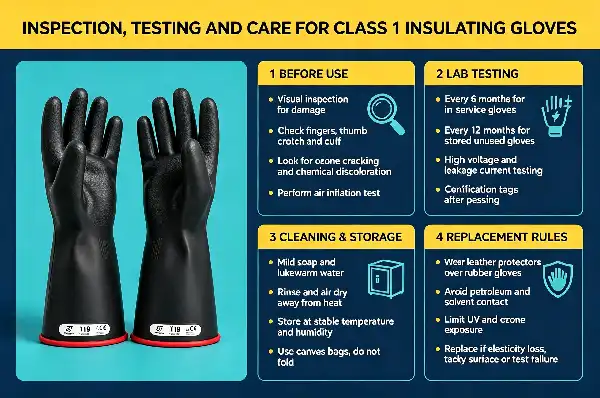
Gloves should be inspected before each use for punctures, wounds, rips, and embedded foreign objects under suitable illumination. Look for cracking patterns around the cuff or between fingers. This is ozone damage, and gloves must be removed from service immediately. Discolourations may indicate chemical pollution affecting the characteristics of the insulation.
When the material of the glove is pulled out, faults may be seen that the casual observer does not know about. Problem locations under high stress, such as fingers, thumb crotch, and cuff transitions, are taken care of before they become issues. Gloves that show any obvious damage must be marked out and submitted for electrical testing or disposal and never reintroduced to active inventory until verified.
Air Inflation Testing Procedure
The air inflation test is the most practical field approach for the detection of leaks and tiny punctures. The workers rotate the cuff to trap air within the glove and then apply slight pressure, listening and feeling for escaping air. The inflated glove must be rotated to examine all surfaces, including seams and prior repairs.
This test must be done every day before use and recorded in the inspection logs. Training programs should stress appropriate technique – over-inflation damages gloves, under-inflation does not show faults. We provide extensive training resources for large purchases to make sure your staff does this crucial safety step properly.
Electrical Testing Requirements
In addition to field inspections, electrical testing of gloves in current use should be performed every six months, and inventories stored in appropriate storage every twelve months at authorised labs. This test applies high voltage and measures leakage current to conclusively determine the glove’s protective capacity.
These assessments should only be performed by certified testing facilities using calibrated equipment. Gloves are provided with fresh certification tags with the test date and next due date after passing testing. These schedules must be closely followed by organisations, and expired gloves must be removed from service until re-certification. Our technical support team works with customers to develop test plans that provide continuous coverage without compromising on downtime.
If you're evaluating personal protective equipment suppliers and require batch-specific testing documents before placing an order, PPE MAX is able to provide official Certificates of Analysis, professional laboratory test reports, and product samples for your verification. Feel free to contact our team at marketing@ppemax.com to discuss your sourcing needs and obtain complete documentation for your quality assessment and procurement approval.
Proper Care and Maintenance to Extend Glove Life
Extending the life of electrical safety gloves results in significant cost savings while still protecting the personnel. These methods tackle the main degradation factors that restrict the life of gloves, turning PPE investment into real value.
Daily Cleaning Procedures
“Rubber deterioration is promoted by contaminants that can be removed by cleaning the gloves after each use. Mild soap solutions or specific rubber cleaning agents may be used to remove dirt, oils, and residues without compromising insulating qualities. Avoid harsh chemicals, petroleum-based solvents, and abrasive cleansers that destroy the molecular framework of rubber.
Washing it by hand in lukewarm water, rinsing well to remove detergent residue, and air-drying away from direct heat. Thermal stress leads to accelerated ageing via hot water and forced-air dryers. Dry the gloves inside-out first, and then flip them over to dry all the wetness from both sides.
Optimal Storage Conditions
The storage environment has a considerable influence on the lifetime of gloves. Temperature-controlled environments between 10°C and 21°C minimise thermal cycling that may wear rubber compounds. Humidity between 40% and 65% helps to retain the suppleness of material and prevents mould formation and over-drying.
Never fold or wrinkle gloves during storage since stress concentrations can trigger fracture development. They are kept in canvas bags in special containers that protect them from mechanical harm, ultraviolet light, and ozone from electrical equipment. When storing rubber insulating gloves, removing the leather covers minimises pressure points that will distort the rubber.
Keep the storage space for Class 1 Insulating Gloves clean of oils, greases, chemicals, and sharp items. Dedicated PPE storage rooms or cabinets keep gloves away from contamination sources in normal workspaces. Inventory rotation is done on a first-in, first-out basis to guarantee that older gloves are used before their shelf-life restrictions are reached.
Handling Best Practices
The first step in proper handling is leather protective gloves over the rubber insulating layer. The combination of the dielectric barrier and the mechanical protection forms a protective system that solves the twin problems of electrical insulation and cut resistance. The leather takes the abrasions, punctures, and rips that would otherwise ruin the integrity of the rubber layer.
Workers should avoid contact with petroleum products due to swelling and deterioration of gloves. Fuels, lubricants, and many industrial solvents destroy the molecular bonds in rubber and reduce its dielectric strength even when there is no visible damage. Job planning must recognise these exposure concerns and incorporate barriers such as extra overgloves when unavoidable contact occurs.
Sunlight UV radiation increases the ageing of natural rubber compositions. Our Type II EPDM gloves have the best UV protection; however, if you reduce exposure to the sun, all glove types will last longer. Do not leave gloves out in the sun for lengthy periods during work shifts, and store gloves in opaque containers to retain material qualities.
Wear Indicators and Replacement Protocols
Clear replacement criteria help prevent workers from continuing to utilise minimally protective equipment. In addition to visible physical degradation, gloves nearing their 12-month maximum service life should be carefully inspected. Manufacturing dates imprinted on gloves may be tracked via this timeline.
Loss of elasticity, continued darkening after washing, tacky surface, or repeated failures of the air test indicate replacement. Gloves that fail electrical testing should be destroyed and not restored to inventory for inadvertent reintroduction into service. Disposal documentation ensures that records of compliance are available for regulatory audits.
Procurement managers need to have buffer inventory available for fast replacement when the need arises to take gloves out of service. It stops the workers from delaying replacement choices because of supply shortages, a frequent occurrence that undermines safety measures.
Class 1 Insulating Gloves in Action: Application Areas and User Benefits
Understanding where these gloves deliver maximum value helps procurement professionals match protective equipment to operational requirements. The applications span multiple industries, each presenting unique electrical hazards demanding reliable insulation.
Typical Industrial Applications
Utility companies deploy these gloves during distribution system maintenance, where line workers encounter energized conductors between 2.4kV and 7.2kV during hot-line operations. Telecommunications technicians require this protection when working near power lines that contact communication cables. Manufacturing facilities use them for electrical maintenance on machinery fed by 480V to 4,160V systems.
Construction sites employ these gloves during electrical installation and troubleshooting phases. Industrial maintenance teams protecting workers servicing motor control centers, switchgear, and transformer equipment rely on this voltage rating. The versatility across these applications makes them among the most commonly specified insulating gloves in B2B procurement.
Workplace Safety Enhancement
The primary benefit centers on preventing electrical shock fatalities and severe burns. Each year, electrical contact injuries result in hundreds of deaths and thousands of lost-time incidents across industries. Proper insulating glove use, combined with comprehensive safety programs, virtually eliminates direct-contact electrical injuries within their voltage rating.
Beyond immediate injury prevention, these gloves enable safer work practices that reduce arc flash incidents. Workers equipped with proper insulation can safely perform tasks that would otherwise require complete de-energization, maintaining productivity while meeting safety standards. This balance between protection and operational continuity represents significant value for organizations managing critical infrastructure.
Regulatory Compliance and Cost Efficiency
Meeting OSHA requirements and industry-specific regulations depends on documented PPE programs, including insulating gloves. Compliance protects organizations from citations, fines, and potential criminal liability following serious incidents. Insurance carriers often mandate proper electrical PPE as a condition of coverage, making compliant procurement essential for risk management.
The cost efficiency extends beyond purchase price to total cost of ownership. Gloves properly inspected and maintained deliver reliable protection throughout their certified service life, avoiding premature replacement costs. Preventing even a single electrical injury generates returns far exceeding PPE investment through avoided medical expenses, workers' compensation claims, and business interruption.
Comparison with Class 2 Voltage Ratings
Class 2 gloves rated for 17,000V AC serve transmission and high-voltage distribution applications beyond Class 1 capabilities. The higher rating comes with increased bulk and reduced dexterity from thicker insulation. For work within the 7,500V maximum use range, Class 1 gloves provide optimal protection without unnecessary compromise to dexterity.
This voltage rating distinction guides procurement decisions based on actual workplace exposure. Over-specifying glove class increases costs and reduces worker acceptance due to decreased comfort and manipulative ability. Accurate exposure assessment ensures appropriate protection level selection, balancing safety requirements against practical usability.
Selecting and Procuring Class 1 Insulating Gloves: What Buyers Need to Know
Choosing what to get is an important consideration in worker safety and operating efficiency. Understanding assessment standards and supplier selection considerations helps make sound buying decisions that are consistent with company requirements.
Critical Evaluation Criteria
Durability evaluation tests tensile strength, rip resistance, and puncture performance, exceeding minimal requirements. Gloves that are above baseline criteria will resist the rigors of field circumstances, lengthening replacement intervals. Flexibility measures help establish whether gloves allow difficult activities to be performed without undue hand fatigue during lengthy usage.
Grip qualities influence tool control and worker confidence. Utility work requires textured surfaces that provide more friction when wet. To safeguard procurement experts against sub-standard items being sold on the basis of false specifications, compliance claims are verified by official certifications from recognised testing labs.
At PPE MAX, our 65-year manufacturing background means we have expertise in reconciling these opposing criteria. Our rigorous quality control system examines every manufacturing batch, assuring the stability procurement managers rely on to safeguard vast workforces.
Trusted Brand Considerations
3M, Ansell, and Honeywell are leading industry suppliers with a recognised track record for electrical safety equipment. Their goods are continuously improved according to the input from the field and the changing standards. But new players with robust quality systems like PPE MAX provide similar performance with price benefits that are especially beneficial for bulk purchasing.
Select a brand that has accreditation credentials, transparent production processes, and offers technical assistance. Customization-capable suppliers allow organisations to choose characteristics that meet particular operating requirements—cuff lengths, size alternatives, and material formulas optimised for certain environmental exposures.
Purchasing Pathways and Logistics
Wholesale channels provide the bulk reductions required to outfit big workforces. Custom orders enable you to specify alterations to meet certain demands not accessible in normal catalogue options. Warranty services are for manufacturing faults, and it is the responsibility of the user to examine and properly care for the product.
Costs should be considered across the complete life cycle, not just the unit purchase price. The better value is the more costly gloves with a longer service life due to better materials than the less expensive gloves that need to be replaced more often. The terms used for buying in bulk, such as volume discounts, payment schedules, and delivery logistics, have an impact on budget planning and inventory management.
We serve clients in 134 countries with a worldwide supply chain that reliably delivers to even distant operating sites. A reasonable price on large quantities will allow procurement managers to get the most out of safety expenditures without sacrificing the quality of protection.
Supplier Validation and Support
Checking that your suppliers are legit helps stop fake gear from getting into your PPE stock. Do not only accept certifications from suppliers, but also ask testing labs for the certification documents. Customer comments and references from organisations with comparable operational characteristics might give some insight into how suppliers function in the real world.
Exceptional suppliers are defined by their after-sales assistance, not by being transactional providers. Technical support hotlines are available to address field queries related to inspection processes and usage guidelines. Responsive customer assistance for shipping difficulties, warranty claims, and product queries. We provide flexible return and replacement procedures to preserve your investment and keep your staff protected at all times.
We are always seeking to develop, and as a sign of our dedication to the business, we attend key industry events such as the A+A Safety Exhibition in Germany. Customer visits to our manufacturing sites in Xi’an are welcome and serve to demonstrate our production methods and quality systems.
Conclusion
The best protection for your personnel and to get the most out of your PPE investment is strict inspection and maintenance procedures for Class 1 Insulating Gloves. By inflating the tyre and looking at it every day, faults might escalate into catastrophic failures. Proper cleaning, storage, and handling procedures can increase service life, lowering replacement frequency and overall ownership costs. Understanding application requirements and procurement criteria can assist you in specifying the correct levels of protection to match real electrical exposures. As workplace electrical risks still challenge safety professionals, disciplined PPE management remains critical to injury prevention and compliance with regulations.
FAQ
1. How often should electrical testing occur?
Gloves in active service require electrical testing every six months by certified laboratories. Inventory stored properly but not placed in service extends to 12-month intervals before testing becomes mandatory. Organizations must track these schedules rigorously, removing any glove that exceeds its testing due date from active inventory until re-certification occurs.
2. Can these gloves provide protection in wet conditions?
Rubber insulating materials maintain dielectric properties when wet, though water exposure introduces complications. Moisture trapped between the rubber glove and leather protector can cause discomfort and skin issues during extended wear. Gloves should be thoroughly dried after wet exposure before returning to storage, preventing mold growth and material degradation.
3. What should happen when a glove fails inspection?
Any glove displaying physical damage or failing air inflation tests must be immediately removed from service and tagged to prevent accidental reuse. Failed gloves should be sent for electrical testing if damage appears minor, or destroyed if obviously compromised. Never attempt field repairs—insulating glove integrity cannot be reliably restored outside factory conditions.
Partner with PPE MAX for Reliable Electrical Protection
PPE MAX stands ready to support your organization's electrical safety requirements with certified insulating gloves manufactured to exacting international standards. Our engineering team brings over six decades of PPE expertise to every product, ensuring the protection your workers depend on. Contact our specialists at marketing@ppemax.com to discuss your specific needs, access competitive wholesale pricing, and explore customization options that address your unique operational challenges. As a trusted Class 1 Insulating Gloves supplier, we provide complete technical support, comprehensive documentation, and global logistics capabilities that simplify procurement while maintaining uncompromising quality.
References
1. American Society for Testing and Materials. (2019). ASTM D120-19 Standard Specification for Rubber Insulating Gloves. West Conshohocken, PA: ASTM International.
2. International Electrotechnical Commission. (2021). IEC 60903:2021 Live Working – Electrical Insulating Gloves. Geneva, Switzerland: IEC Publications.
3. Occupational Safety and Health Administration. (2020). OSHA Standard 29 CFR 1910.137 – Electrical Protective Equipment. Washington, DC: U.S. Department of Labor.
4. National Fire Protection Association. (2021). NFPA 70E Standard for Electrical Safety in the Workplace. Quincy, MA: NFPA Publications.
5. Cadick, J., Capelli-Schellpfeffer, M., & Neitzel, D. (2020). Electrical Safety Handbook, Fourth Edition. New York, NY: McGraw-Hill Education.
6. IEEE Standards Association. (2018). IEEE Guide for Testing and Evaluating Electrical Insulating Gloves. Piscataway, NJ: Institute of Electrical and Electronics Engineers.
Learn about our latest products and discounts through SMS or email