- English
- French
- German
- Portuguese
- Spanish
- Russian
- Japanese
- Korean
- Arabic
- Greek
- German
- Turkish
- Italian
- Danish
- Romanian
- Indonesian
- Czech
- Afrikaans
- Swedish
- Polish
- Basque
- Catalan
- Esperanto
- Hindi
- Lao
- Albanian
- Amharic
- Armenian
- Azerbaijani
- Belarusian
- Bengali
- Bosnian
- Bulgarian
- Cebuano
- Chichewa
- Corsican
- Croatian
- Dutch
- Estonian
- Filipino
- Finnish
- Frisian
- Galician
- Georgian
- Gujarati
- Haitian
- Hausa
- Hawaiian
- Hebrew
- Hmong
- Hungarian
- Icelandic
- Igbo
- Javanese
- Kannada
- Kazakh
- Khmer
- Kurdish
- Kyrgyz
- Latin
- Latvian
- Lithuanian
- Luxembou..
- Macedonian
- Malagasy
- Malay
- Malayalam
- Maltese
- Maori
- Marathi
- Mongolian
- Burmese
- Nepali
- Norwegian
- Pashto
- Persian
- Punjabi
- Serbian
- Sesotho
- Sinhala
- Slovak
- Slovenian
- Somali
- Samoan
- Scots Gaelic
- Shona
- Sindhi
- Sundanese
- Swahili
- Tajik
- Tamil
- Telugu
- Thai
- Ukrainian
- Urdu
- Uzbek
- Vietnamese
- Welsh
- Xhosa
- Yiddish
- Yoruba
- Zulu
Are Insulating Gloves Tested Differently by Voltage Class?
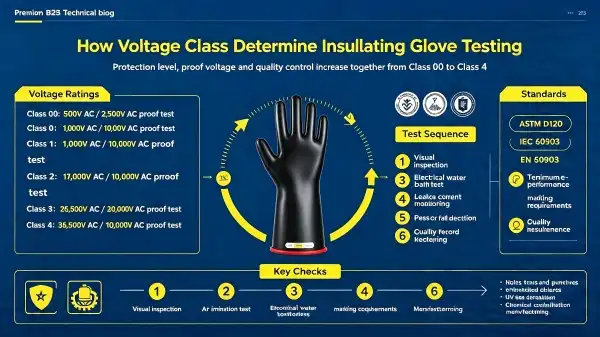
Different tests are done on insulating gloves based on their voltage class grade. It takes higher proof test voltages and stricter quality control methods to prove the dielectric strength of each voltage classification, from Class 00 to Class 4. Class 00 gloves, which can handle up to 500V AC, go through a 2,500V AC proof test. Gloves with better ratings, like Class 3, are tested at voltages higher than 30,000V. These differences have a direct effect on purchasing choices because testing procedures show how reliable gloves are, how well they meet ASTM D120 and IEC 60903 standards, and how well they work with certain electrical hazards in the workplace.
Understanding Insulating Gloves and Voltage Classes
Electrical safety rests on using the right safety gear, and insulating gloves are the main thing that keeps workers from coming into contact with electricity, which could be fatal. These aren't like regular work gloves; they're made from high-quality natural rubber latex or advanced synthetic materials that are designed to provide reliable dielectric insulation. Because of the way the material is made, electrical current can't get to the wearer's hands. This keeps them from getting shocked, burnt, or electrocuted.
The Voltage Class System Explained
International safety organisations have set up a clear rating system to match the amount of protection gloves offer with the voltage levels present at work. The system goes from Class 00, which is the least protective level, to Class 4, which is made for voltages at the gearbox level. Each class number is linked to a certain range of maximum use voltages and proof test standards. Class 00 gloves are great for telecommunications, home electrical service, HVAC repair, and low-voltage industrial tasks because they protect workers who handle circuits up to 500V AC. Class 0 protects up to 1,000V AC and is good for utility metering and light commercial distribution work.
Regulatory Standards Governing Glove Classification
In North America, the requirements for voltage gloves are set by ASTM D120, and around the world, they are set by IEC 60903. Minimum performance standards, testing methods, marking requirements, and quality assurance processes are set by these systems. On European markets, EN 60903 is also used, which is the same as the IEC standards. Compliance with these standards gives procurement professionals faith that sellers meet basic safety standards that are recognised across multiple countries. This makes international buying easier and protects workers no matter where they are located.
How Are Insulating Gloves Tested According to Voltage Class?
Testing procedures are the most important part of making sure that electrical insulating gloves are safe. Before they can be sold to end users, every pair of voltage-rated gloves has to go through a very strict inspection. The level of scrutiny goes up straight with the voltage classification.
Electrical Proof Testing Procedures
The most important part of validating gloves is the dielectric proof test, in which each glove is put into an electrical water bath and high voltage is applied to it. As a safety measure, test voltages are much higher than the highest use rates. Class 00 gloves are tested for one minute at 2,500V AC, which is five times safer than their working voltage of 500V. Class 0 gloves are tested with 5,000V AC, Class 1 gloves with 10,000V AC, and so on. The testing voltage keeps going up as you move up the classification system.
During this process, high-tech equipment checks for current leaks that could mean the insulation is breaking down or there are problems with the material. If there is any visible current movement, that glove is immediately thrown away. Depending on what the glove is meant to do, it may need to be tested with both alternating current and direct current. This is because DC voltages put different amounts of stress on insulation materials.
Visual and Physical Integrity Inspections
Electrical tests can't find all the possible ways that something could go wrong. Trained testers look at each glove for damage that could make it less protective, like holes, tears, punctures, foreign items stuck inside, UV degradation, ozone cracking, chemical contamination, or problems with the way it was made. Before the electrical tests, these visual checks are done because gloves that are physically broken could fail horribly under high-voltage stress.
Advanced Testing Technologies
Modern testing labs use automatic tools that make the work more accurate and faster. By pressurising gloves and keeping an eye out for pressure loss, air inflation methods find tiny pinhole flaws that can't be seen with the naked eye. Computerised high-voltage test sets let you precisely control the voltage, keep track of the time, and keep full records of every test run. These technological improvements cut down on mistakes made by people while keeping detailed records of quality that are useful for tracking and following rules.
Key Factors Influencing Testing and Selection of Insulating Gloves
There are many things that can change how well insulating gloves work in tests and in real-life electrical settings. Knowing about these things helps buying teams choose the right items and keep them in good shape.
Material Composition and Dielectric Properties
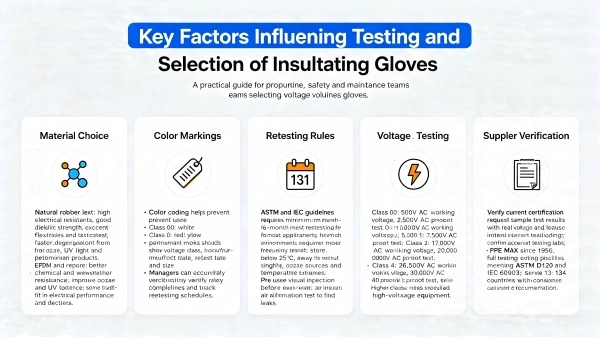
Due to its high electrical resistance and flexibility, natural rubber latex is still the most common material used for voltage-rated gloves. On the other hand, synthetic options like EPDM and neoprene materials are better in some situations. Natural rubber has better dielectric strength and physical awareness, but it breaks down more quickly when it comes in contact with ozone, UV light, and petroleum products. Synthetic materials give up some electrical performance and dexterity, but they are better at resisting chemicals and weather stresses.
The choice of material has a direct effect on how well tests go and how long the service lasts. Gloves made from high-quality materials keep their shielding qualities longer between tests and don't break down physically as quickly, which is what causes them to fail early. In our Class 00 line at PPE MAX, we use high-quality natural rubber latex to give workers the best safety and the freedom they need for detailed electrical work.
Color Coding and Certification Markings
Quick visual recognition of voltage grades keeps gloves from being used incorrectly, which could be risky. Certain colour schemes are required by industry standards. For example, white is for Class 00, red is for Class 0, yellow is for Class 1, and so on. Our Class 00 gloves are a bright red or black colour and are clearly marked with the voltage class, the date they were made, the date the test is due, and the size information. With these permanent marks, managers can quickly check for compliance and keep track of when tests need to be done again.
Maintenance and Periodic Retesting Requirements
Even gloves that pass the original testing at the plant need to be checked and approved again and again as they are used. According to ASTM and IEC guidelines, products must be retested every six months at the very least for most uses. In harsh settings, they must be tested more often. When gloves are stored properly, out of the sun, away from sources of ozone, and away from temperature extremes, they last longer between tests. Before each wear, users should do pre-use checks to look for damage that can be seen and an air filling test to find leaks. This method, which includes testing in the plant, retesting in the lab on a regular basis, and daily user checks, makes it more difficult for equipment to break down.
Comparing Insulating Gloves Testing Across Voltage Classes and Market Solutions
The difference in testing rigour between voltage classes is directly related to both the cost of the product and how important it is for the application. Understanding these differences helps make spending decisions and source choices more logical. For lower-voltage uses, testing procedures for insulating gloves can be made a little easier.
Testing Intensity Versus Voltage Rating
Proof tests are done on Class 00 and Class 0 gloves at voltages that can be handled by standard high-voltage tools found in most testing labs. For higher classes, you need special high-voltage testing equipment that can safely make and handle tens of thousands of volts. This investment in equipment, along with longer test times and stricter quality control methods, helps explain why Class 2 through Class 4 goods cost more. The difference in testing costs is due to real technical problems, not to random price systems.
When purchasing, professionals look at quotes; they should be aware that prices that seem too low for higher power classifications could mean that the materials weren't tested properly or aren't up to par. Legitimate makers can't significantly lower their prices below what the market will bear without putting safety gaps built into testing methods at risk.
Market Overview and Supplier Credentials
In the global market for electrical safety tools, both well-known companies have been making products for decades and new companies that are trying to get a piece of the market. Leading brands have built their names on consistent quality, clear evidence of testing, and quick expert help. When buying from providers, teams should check that they have the latest certifications, ask for sample test results with real voltage and leakage current readings, and make sure that the testing labs are accredited.
PPE MAX has been making things since 1956, which shows that we have always cared about worker safety. We have full testing facilities that meet the standards of both ASTM D120 and IEC 60903. This lets us serve customers in 134 countries with the faith that our products will always be the same. Our Class 00 gloves go through the same strict proof testing at 2,500V AC that confirms their 500V working rate. We provide full paperwork to support your compliance needs.
Addressing Bulk Procurement Challenges
Large buyers have to think about things that individuals don't have to. Total cost of ownership is affected by things like minimum order amounts, customisation choices, lead times, and coordinating logistics. Reliable providers offer a range of adjustable packing options. For example, our Class 00 goods ship with 20 pairs per carton and one pair per box, which saves storage space and keeps gloves safe during transport. Bulk price should be based on real economies of scale, not quality compromises, and custom size choices should be able to suit a wide range of workforce groups without needing too much inventory variety.
Ensuring Compliance and Safety: Best Practices for B2B Buyers
Effective buying goes beyond the original purchase and includes ongoing program management that keeps safety up throughout the lifecycle of insulating gloves.
Verifying Testing Documentation and Certifications
Not just certificates of compliance, but also test records with real voltage testing results should be sent with every shipment. For each production batch, detailed reports show the voltages used for the proof test, the length of the test, the leakage current readings, and a pass/fail decision. This paperwork helps find out what went wrong if something goes wrong in the field, and it shows that you did your job properly during regulatory checks or incident investigations. Check to see if testing labs have the right credentials from reputable organisations that prove they are technically competent and can take accurate measurements.
Implementing Onsite Glove Management Programs
Leading safety programs have clear rules about how to store gloves, check them, test them again, and remove them. Gloves stay in good shape when they are stored in places that are away from heat, sunshine, and machines that make ozone. Visual check training makes sure that workers can find common flaws before each use. Tracking systems keep an eye on each glove test's due date and make sure it's sent to the right testing labs on time. At PPE MAX, we support these efforts by giving our clients thorough technical training and quick response advice services that help them build long-lasting systems for managing their safety equipment.
Building Long-Term Supplier Relationships
For electrical safety, there needs to be stability, which can only come from long-term relationships rather than one-time purchases. Suppliers who understand your unique applications, worker trends, and organisational challenges will be able to give you better solutions than those who are only interested in individual deals. We encourage people who work in buying to involve suppliers early on in the process of developing specifications. This way, they can use the suppliers' experience with previous projects to help improve worker safety over time.
Conclusion
The testing methods for insulating gloves are directly based on their voltage class. Each classification level needs higher proof test voltages and stricter quality checks. By following this method, you can be sure that the gloves you wear will protect you from specific electrical dangers. Professionals in procurement need to know about these differences in testing in order to choose the right goods, assess the skills of suppliers, and keep safety programs running smoothly. Buying properly tested and approved gloves from well-known companies is a basic form of risk management that saves both workers and the company from potential liability.
FAQ
1. Can insulating gloves be reused after passing voltage testing?
Of course. When gloves pass regular testing, they can still be used until the next test date or until they get damaged. When you store and handle things properly between tests, you can get the most use out of them, which lowers your total cost of ownership compared to disposable options.
2. What testing interval does OSHA require for electrical gloves?
Under 29 CFR 1910.137, OSHA requires electricity testing before the first problem and every six months after that. If gloves show signs of damage or are thought to be exposed to electrical stress while being used, they need to be tested more often.
3. Can Class 00 gloves substitute for higher voltage classes in emergencies?
Never. Putting on gloves rated lower than the real voltage exposure creates instant dangers that could kill you. There is no safety buffer for higher exposures because each voltage class only protects up to its maximum use voltage.
Partner with PPE MAX as Your Trusted Insulating Gloves Manufacturer
At PPE MAX, we make insulating gloves that meet the strictest safety standards by combining 67 years of experience making high-quality products with full testing facilities. This is shown by our Class 00 product line, which is set for a maximum use voltage of 500V AC, proof tested at 2,500V AC, and approved to both ASTM D120 and IEC 60903 standards. These gloves come in lengths of 11 and 14 inches, sizes 8 through 11, and flexible red or black designs that weigh about 170 grams. They give your workers the protection they need while still letting them move their fingers freely. We help people buy in bulk by offering low prices, good packaging, and shipping to 134 countries around the world. Email us at marketing@ppemax.com to talk about your unique needs and find out how our knowledge can help your electricity safety program.
References
1. American Society for Testing and Materials. "ASTM D120-21: Standard Specification for Rubber Insulating Gloves." ASTM International, West Conshohocken, PA, 2021.
2. International Electrotechnical Commission. "IEC 60903:2002+AMD1:2014: Live Working - Electrical Insulating Gloves." Geneva, Switzerland.
3. Occupational Safety and Health Administration. "29 CFR 1910.137: Electrical Protective Equipment." U.S. Department of Labor, Washington, DC.
4. National Fire Protection Association. "NFPA 70E: Standard for Electrical Safety in the Workplace, 2021 Edition." Quincy, Massachusetts.
5. Marne, James P., and Richards, Thomas L. "Dielectric Testing Methods for High-Voltage Protective Equipment." Journal of Occupational Safety Engineering, vol. 48, no. 3, 2019, pp. 112-128.
6. Zhang, Wei, and Cooper, David R. "Material Science of Electrical Insulating Gloves: Natural Rubber versus Synthetic Compounds." International PPE Research Quarterly, vol. 15, no. 2, 2020, pp. 45-67.
Learn about our latest products and discounts through SMS or email